Changing with the Times

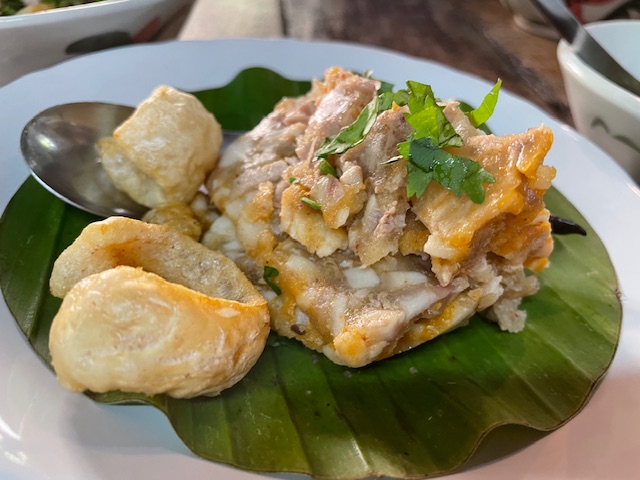
Fried chicken wings at E-san Bangkok

I have, sadly, been up to my neck in edits (some of which are in our upcoming cookbook). This is widely recognized, I believe, to be the most tedious part of the getting-a-book-you-wrote-onto-a-bookstore-shelf process. Because I have been busy pinpointing some stupid POI on a map that bears only a passing resemblance to Google Maps, or Googling “1/2 cups desiccated coconut to g” all day long, I have had little time for anything else, including this blog.

But I am a liar. I did have time to go out with friends to Charmkok for the first time, the latest in what is likely to become an ever-expanding collection of “Charm” restaurants helmed by Chefs Jai and Aew. Like real siblings, all of their restaurants are interesting in their own ways: Charmgang, the critically-acclaimed eatery featuring regional specialties; Charmkrung, the upscale wine bar where you take your guests from out of town; and Charmkok, the gastropub or “Thai izakaya”, an unheard-of concept way back in 2010 when I first started sincerely writing about food.

Back then, people barely knew what an izakaya was, much less the nuances between a yakitori joint that just happens to have other, izakaya-like dishes (like Yakitori Ise) or an actual izakaya with fewer culinary pretensions, focused on pushing as much beer and shochu as possible (like Kenshin Izakaya). When you talk about a real Thai “izakaya”, you are talking about a glub glaem (Thai drinking food) restaurant like the places littered around the edges of Klang Toey Market at night, pulsing with neon lights and menus full of sun-dried meats and sticky rice. But the gourmet “Thai izakayas”, a trend which arguably started all the way back in 2010 with restaurants like Soul Food Mahanakorn and Issaya Siamese Club, has become the go-to setting for new Thai restaurant openings, marrying decent tapas-sized bites with lots and lots of booze. Charmkok is one of those establishments, and does it very successfully, drawing lines of people on a street chock-full of cool places to eat.

The menu is full of great little surprises like old-fashioned kanom jeen sao nam (fermented rice noodles with coconut milk, pineapple and shrimp) and Southern Thai khao yum (rice salad), but what struck me most were the dishes clearly inspired by Japanese cuisine, like the “chirashi” of Thai seafood scattered over rice, or grilled chicken thigh on bamboo skewers, served with sticky rice and a healthy dollop of jaew bong (Isan chili dip).

As if to continue on this Japanese-y theme, chopsticks were available at the table right next to the fork and spoons — not because the servers were sick of fetching them for Westerners keen on showing off their chopstick skills, but because young Thais, used to years now of sashimi and ramen, have taken to eating their kanom jeen and papaya salad with chopsticks, in the same way they now don the elephant pants and shirts that once signified that you were in the presence of the most clueless of tourists. It’s ironic but not; we Thais, too, eat with chopsticks now, because eating with a fork and spoon is just too easy and convenient (but you still won’t find pad Thai — the culinary third rail of a Thai person in Thailand — on any of these menus).

To boil all of this down: Thai food is in the midst of yet another revolution. It’s always been a chameleon, adapting either through force (during the Rama V period) or through fun (when the Portuguese brought those chilies), and this period, as terrible as it seems, is no different. There were the Italian-central Thai experiments of the ’90s and the French-Thai-“Oriental” amalgams of the ’80s that made everyone scared of using the word “fusion”; today, we are, more than ever, looking northeast to Japan and Korea as their restaurants take up more and more real estate all over Bangkok. The number of Japanese restaurants alone is now around 2,700 in Bangkok from 1,400 in 2015, and judging by new openings, that trend isn’t likely to die down anytime soon. Even more interestingly, the same people who were rending their garments and beating their breasts over green curry pizza and tom yum spaghetti are strangely silent when it comes to kai yang skewers and tom yum ramen.

Some restaurants have full-on made fusing Japanese with Thai their identity. Take, for example, E-san Bangkok, mixing the flavors of Japan with those of the Thai northeast (Isan lolz get it?) Isan food is ripe for this kind of spin, especially the char-grilled meats and fried chicken, though there are also ludicrous dishes which seem more like Instagram bait than anything else:

Grilled corn kernels at E-san

Indeed, Isan cuisine is proving ripe fodder for all sorts of fusions, twisting what was once a little-known regional cuisine (globally, at least) into new and surprising shapes. I was denied a seat at Coffee Beans by Dao (in my old condo, no less) and ended up stumbling into the next closest restaurant, Jaonua, which serves a mix of Isan and Italian cuisine, because why not? Alongside charming dishes like “khao mai pla mun” (“new rice, fatty fish”, an Isan saying that ushers in the cool season) are Western-style salads that add fermented fish sauce (pla rah) and pastas that include cured Isan sausages, and, of course, Caesar salad (because every Western restaurant in Thailand must have Caesar salad).

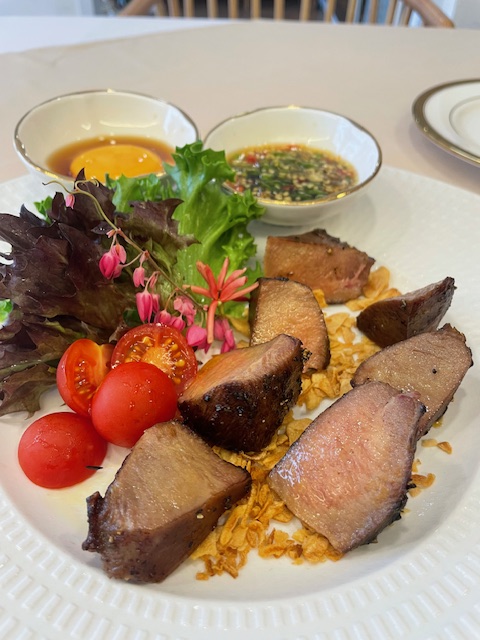
Grilled beef tongue with two sauces

But wait, I’m getting away from the Japanese thing. Perhaps the OG of seriously pairing Thai with Japanese food is Chef Black of Blackitch Artisan Kitchen, who became interested in cooking while studying in Japan to become an engineer (this also helps explain Chef Black’s preoccupation with all things fermented). When we were able to grab a table during COVID, Chef Black actually sent out an entire tasting menu of Japanese dishes (he said he missed traveling to Japan). This time, Chef Black came out with a series of dishes that included really good handmade soba, two types of sausage with grilled vegetables on skewers (what would modern Thais do without yakitori?), and beautifully treated shellfish with blanched mustard greens, a slice of tamagoyaki, a Japanese-style croquette, and the daintiest of pickled vegetables.

What does all this mean? It means that, after brushes with Great Britain, France, the Netherlands and the US, we have finally been colonized, and we are 100 percent on board with it. Maybe, if I want to brush up on my Thai cooking skills, I’ll have to start firing up the charcoal grill, boiling up some yakitori sauce, and soaking my bamboo skewers. I might even have to get better at eating with chopsticks.

2 Comments

Filed under Uncategorized

Back in Time

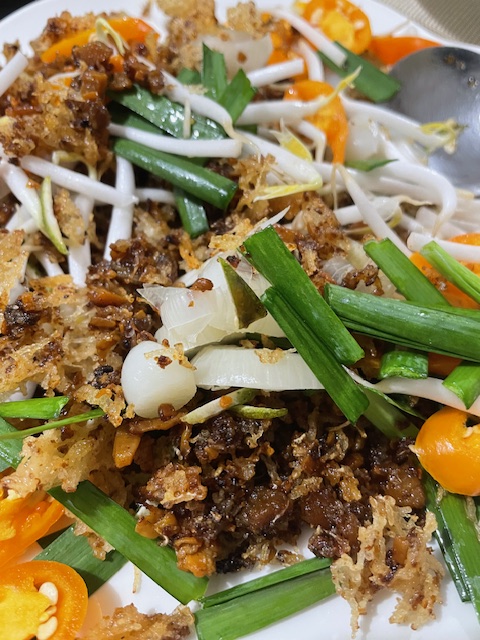
Mee krob at Somdet Cuisine by Chatcharee Bunnag

For the past few months, people who have been unlucky enough to dine with me have had to endure listening to my hot takes on “Bon Appétit, Your Majesty”, a Korean historical rom-com in which a modern woman pulls an “Outlander” but for food, not sexy times. Whereas “Outlander” is for woman who fantasize about having two husbands, but in a way that’s not their fault, “Bon Appétit” is for people who fantasize about having their food skills applauded and revered without having to actually think of anything ground-breaking themselves. Thus, our modern-day heroine finds herself back in the Joseon Dynasty, where the king is really mean but also really cute in an Edward Cullen “I might kill you someday” way.

To stay alive, she has to keep making dishes that our discerning gourmet monarch — again, this is historical fiction — will appreciate. Cue the parade of “Korean” dishes: pasta, steak, macarons, a stew made with a freaking pressure cooker, all of which dazzle everyone who is lucky enough to try them, none of which is strictly of the time (or even of the country). Obviously, she is hailed as a culinary genius (this is the fantasy part).

So stricken was I with this fantasy that I ended up watching the entirety of a Thai take on this concept, “Good Heavens! I’m a Goose not a Swan” (it must sound catchier in Thai). A woman goes back to Rama III-era Bangkok, where she catches the eye of the capital’s most eligible bachelor and comes up with an all-you-can-eat “moo kata” (pork BBQ) buffet, a nail salon, and freaking bubble tea.

As ingenious as all of these creations are, neither of these women invents a flushing toilet.

Now we find ourselves at another culinary crossroads, one not kickstarted by any time-traveling heroine (that we know of) but by the vicissitudes of modern times. I think most people who follow the current Bangkok dining scene would agree with me that the days of slavishly recreating royal Thai and even aristocratic recipes are over. What I mean by this is that royal and aristocratic Thai menus are not the only avenues for winning accolades and stars. A new type of Thai food, driven by people like Chef Prin of Samrub x2 Thai and Chef Jai of all the Charms, has been percolating for a while, inspired by the regional cuisines of Thailand’s various nooks and crannies and made by regular people for regular people. This kind of food is malleable, open to interpretation, and flexible enough to accommodate each chef’s various experiences and points of view. This is the type of food that “Bon Appétit”‘s heroine would have given rise to among later generations of chefs, if she had stayed long enough to see it (spoiler alert).

All the same, restaurants driven by aristocratic family recipes are still bubbling up all around Bangkok (this is Thailand, after all), following the precedent set by forebears like Thanying and Kalaprapruek. One of these is Somdet Cuisine by Chatcharee Bunnag, which is only open by reservation. Not surprisingly given the name, the recipes here hail from the Bunnag family, of which my husband is a member (the Bunnag family has a million different branches; you might be a member too).

My friend James who lives close by booked a table for us, and we had fun imagining what the food might be without actually looking it up. James wrote up his own imagined menu, which included dishes like “Genealogical Fish Cakes — minced sea bass hand-shaped by a third cousin twice removed from the Bunnag line who now works in finance (B1280)”, “Massaman Verification Stew — rich, tender beef in a cardamom-heavy curry ‘exactly like Grandmother made,’ according to an uncle who’s never cooked (B1620)” and “Sticky Rice Inheritance Dispute — served warm with mango, coconut cream, and the bitterness of three siblings fighting over Chanthaburi land (B1240)”.

It may surprise you to learn that none of these dishes was on the actual menu. Instead, there was a green curry with beef (there always has to be a green curry with beef) but with slivered long beans instead of pea eggplants (which is kind of sacrilegious to my husband’s branch of the family). There was a nice fish fried in fish sauce with an accompanying green mango salad, and mee krob (deep-fried noodles), another difficult dish for me to make personally. There was even chicken with cashew nuts and pad Thai (which we’re told is popular at lunchtime).

After dinner, we lingered in the courtyard, part of the compound where everyone actually lives, and listened to stories about the founding of the restaurant from the current-generation owner: so many family members came over to eat after events at the nearby temple that people thought it was a restaurant, so the owners thought, why not? Although the restaurant is over on the Thonburi side, it’s in a charming neighborhood within walking distance from the Chao Phraya Sky Park and the river, making it a great evening option right now. The best part: you won’t have to go back in time to enjoy this piece of history.

Leave a comment

Filed under Uncategorized

Glutton Abroad: Laosing It

Luang Prabang-style som tum

At the risk of flogging a dead horse, I’m going to talk about music again, if only briefly. I’m talking about Little Richard’s “Tutti Frutti”. You’ve heard it, yes? Of course you have, or if you haven’t, you should; “Tutti Frutti” a rock history classic, for people who still want to know about rock history, at least. But have you heard the Pat Boone version?, asked no one, ever. If you have, as I have, then you would know what I’m saying; it is a sad, pathetic echo of its predecessor, one of many examples of remakes that can’t hold a candle to the original. That is what Thai som tum is to the som tum in Laos.

I know people are fond of the sugary, dried shrimp- and peanut-strewn concoction that is “som tum Thai”, a dish that has made its way all over the world. But I’ve been looking for the funkier, earlier — dare I say more “authentic”? — version of this salad since I first began visiting northeastern Thailand years ago. In Isan, som tum was a revelation, graced with big, bold flavors that eschewed the bright and easy notes of lime juice and sugar in favor of something murkier and a little more primeval: fish sauce and, of course, pla rah, the fermented fish extract that makes Isan hum. Some legends say that fermented fish was so valuable that it once served as currency, but today it’s simply the backbone for almost every Isan dish there is.

So imagine my surprise to discover that, in Luang Prabang, pla rah (called “pla daek” in Laotian) is simply one in a set of possibilities when it comes to seasoning som tum (“tum mak hoong” in Laotian). The first big bite I had was on my very first day in Luang Prabang, at a tourist-friendly restaurant called Malaisone. The green papaya was shaven into big thick strips, the dressing dark and opaque like something out of a swamp, with umami from nam poo (the juice of pulverized field crabs), spice from lethal chartreuse-colored chilies, and acidity from magorg (water olive) and sour red tomatoes. The salad was accompanied by fresh young morning glory and sponge gourd, perfect for sopping up the juices.

I was smitten from first bite. Resolved to learn more, I ordered it every chance I got, even though we had eaten so much by this point that I no longer had an appetite. Our next stop was Kuang Si Falls 29 km south of the city, where the dressing (frankly even more delicious) omitted nam poo and pla rah for shrimp paste, with added crunch from purple Thai eggplant and extra brightness from tiny green tomatoes with so many seeds that we thought they were sesame.

So charmed was I that I woke up extra early for the morning market the next day in order to avoid the crowds of mostly Chinese tourists. Of course we got our share of exotica: cow placentas for boiling into a soup; dried cow lungs grilled over an open flame; a powdery, furikake-like “nam prik” festooned with deep-fried shallots made from the local Mekong seaweed.

We even had our share of Laotian spirit houses, these ones red Fanta-free. My favorite showed its own inhabitants:

Moved by the market offerings, we bought everything that caught our eye to add to our planned lunch on the Mekong that day. Because it was November, rice was newly harvested; we bought plenty of that to go with grilled tilapia, fat from the cooler water:

We got grilled local chicken too, because of course, and it was better than what you’d get at Khao Suan Kwang or Wichienburi:

But most striking of all was a dish I wasn’t able to try at the market because we had no time. “Khao soi”, they called it, but it was nothing like the khao soi we were familiar with. The name comes from the noodles (“khao”), which are hand-cut into thin strips (“soi”). Even more confusingly, it was made with meat, tomatoes and fermented beans (“tua nao”), just like the “kanom jeen nam ngiew” back home.

From then on, I was struck with a new obsession. Determined to have my own taste of “khao soi” before finally heading home, we went to “Raan Pho-Khao Soi Nang Tho” for breakfast before the airport, where some of us had “khao piek” (the udon-like noodles also known as “guay jab yuan” but which are, again confusingly, called “pho” in Laos) while the smarter ones had “khao soi”. Here, it was topped with crispy pork, rendering it criminally irresistible.

Khao soi
Khao piek

Every order came with fresh herbs, limes, those brutal chilies, and green beans to be dipped into a peanut sauce.

It was the best meal we’d had the entire trip. I told the chef so, even if she might not have understood me, and left the shop with plans to return. Now back in Bangkok, I have my own field crab juice and my own little tiny tomatoes, and harbor plans to bring a little bit of Luang Prabang into my kitchen sometime soon.

3 Comments

Filed under Uncategorized