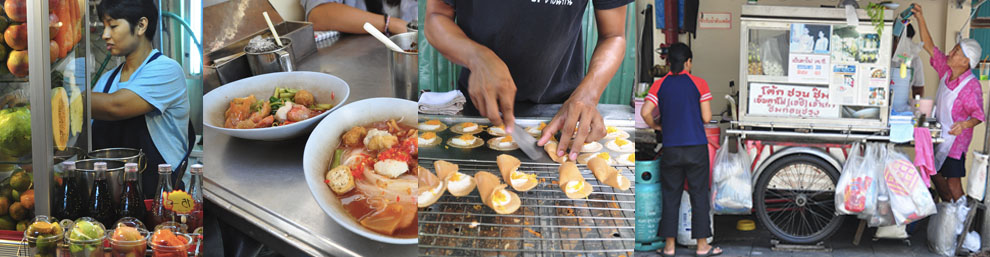
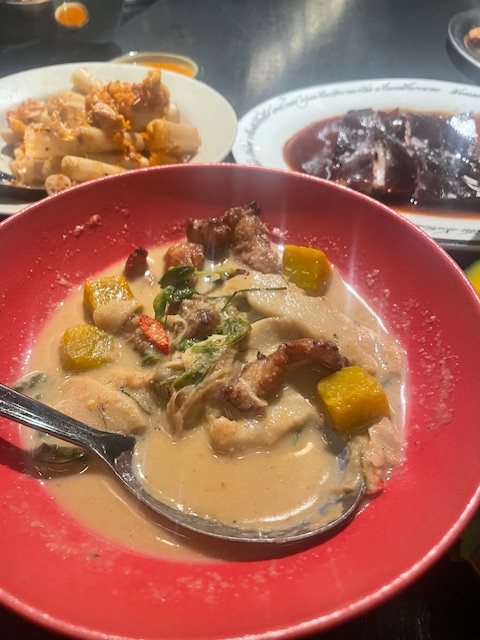
I briefly found myself in my old neighborhood and passed by a place called “Lomo” occupying the former No Idea restaurant space. It had the look of a South Pacific-style restaurant in the vein of Trader Vic’s, and relishing the idea of a pupu platter within closer Skytraining distance than the actual Trader Vic’s in Thonburi, I asked my husband if we could go to “Lomo” someday soon. And that’s how I found out what “lomo” is. It’s not a Trader Vic’s-style restaurant.
When it comes to Thai food, I come face-to-face with things I haven’t seen before all the time. That’s one of the things I love about Thai food. I was recently served “gang lork” at Khao San Sek by Chef Worakan “Grace” Krittisirikul, who hails from Phetchaburi (recently designated a UNESCO City of Gastronomy). In a nod to her roots, “gang lork” appeared as part of the samrub (Thai meal) and I was enchanted, both by the taste and by the name. No less an authority than Hua Hin Today (I am not being facetious, HHT is a treasure trove of information, seriously) says that “gang lork”‘s name came from the fact that its non-spicy nature made Phetchaburians skeptical about its curry bona fides, since, to them, curries must make your head sweat and your ears ring.
But Hua Hin Today doesn’t cover everything. And there are times when even my husband can’t explain something about Thai food to me. In those cases, there’s really nothing more valuable than a living database about everything to do with Thai Gastronomy that you can think of (and some things that you didn’t know even existed). Enter: Ros Chaad Thai, a “living archive of Thai gastronomy”, created by the Chef Cares Foundation of Thailand to collect recipes, document changes, and share knowledge about cooking techniques, ingredients and history — a living food library available to everyone for free.
A useful “Top Picks” section gives you a handy geographic rundown of regional specialties — including for Western Thailand and Phetchaburi! — with timely info on things like “Winter Dishes of Northern Thailand”, useful given the amazingly still-cool weather.
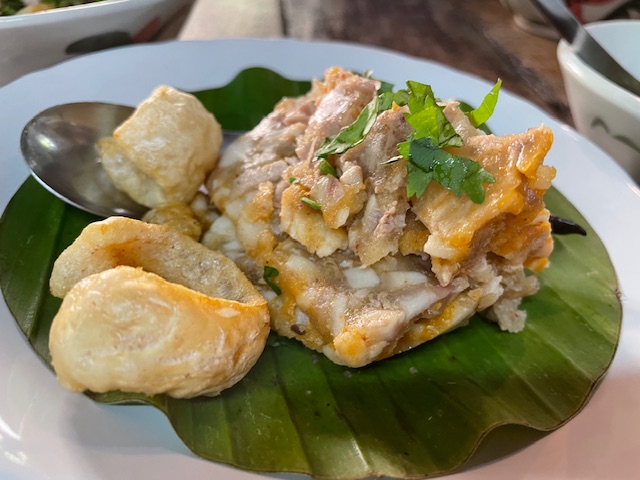
There’s a collection of recipes for meal inspiration divided Western-style into appetizers and desserts, plus things with rice (important) and even nam prik (hard to find!) Of course there’s a whole section of Royal Thai Cuisine, but there’s also a handy index on Thai food ingredients with explanations and, even more importantly, recipes for how to use them, extremely valuable when you’ve been to the fresh market and have no idea what to do with the hairy-fruited eggplant you just picked up.
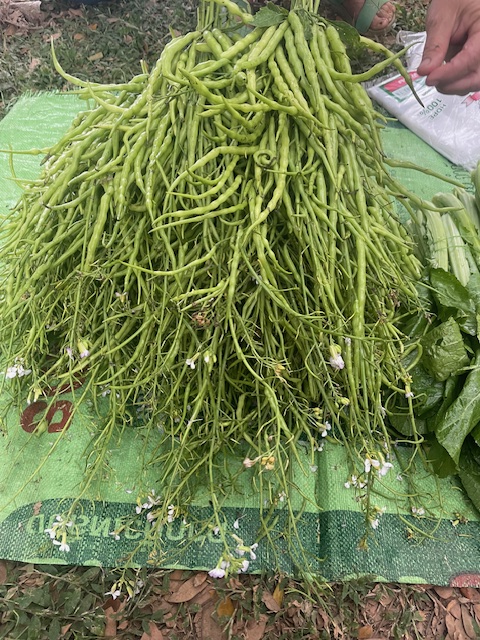
There’s even a section on “Thai Food Wisdom”, which could loosely be defined as “Thai people think it’s important you know this stuff.” This means topics like “samrub Thai”, aka “how to eat Thai food”; “the circle of rice”, aka “why you shouldn’t waste rice”; and “a real Thai kitchen”, aka “why you shouldn’t use a blender for everything”. There’s even a great tab called “Discover” where you can delve deeper into Thai wisdom stuff or find out where to eat certain dishes — really crucial to any Thai food lover and something that should be extended to every country in the world for every awesome dish. And finally, there’s a “Rare Cookbooks” section that allows you to delve into both notable Thai cookbooks and the funeral cookbooks of some of the Great and Good, which is really kind of amazing. What can’t this “living library” do? Aside from actually cook this food for me? Or do “lomo”?
 Bangkok Glutton