Monthly Archives: June 2010

Back in the Old City

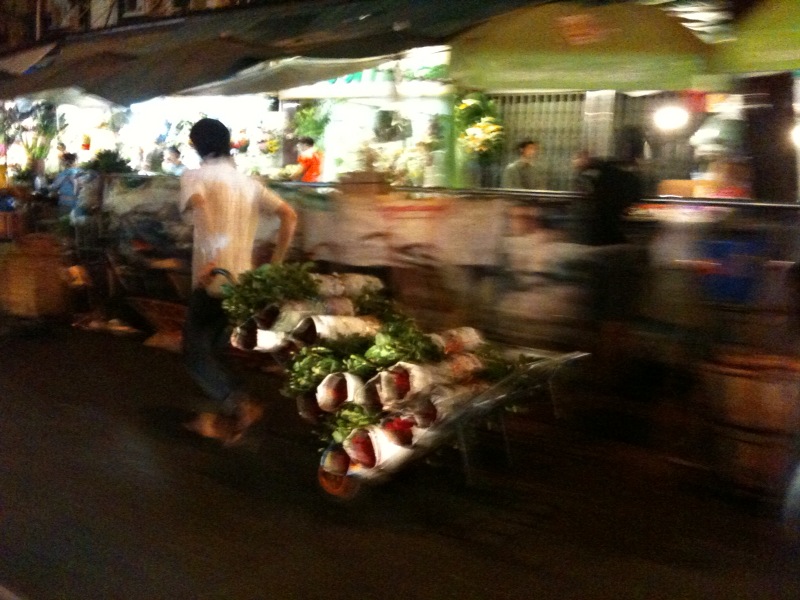
A rose vendor making a delivery at the flower market


I love the old part of town. The roughly square-shaped parcel of land along the Chao Phraya river and Phra Arthit Road on one side and the Chinese Swing, Rachadamnern Avenue and Tanao Road on the other is probably my favorite place to go in Bangkok — not least because this area has some of the city’s very best food.

Case in point: Khao Thom Bowon, a rice porridge vendor across from Bowonniwet Temple which has been serving up tasty bowls for the past six decades. This shop has mushroomed from a few tables in an alleyway to more than 50, some even grouped inside an air-conditioned room (locals gamely sweat it out; the a/c is for when you bring your parents). Its ownership has advanced into its second generation, but I like to think the old-fashioned feel and care for its food remains.
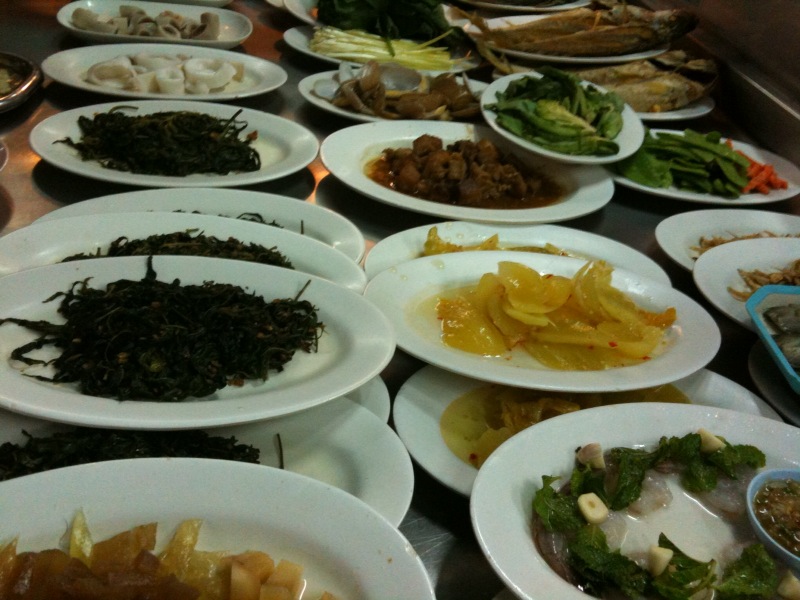
Featuring more than 30 kinds of side dishes

Khao tom is meant to be a sort of restorative concoction, which is why it is known as being particularly popular with the elderly. To facilitate digestion, the liquid in each bowl is meant to be sipped before the soggy rice is eaten with a type of side dish — be it spicy, salty, crispy or fatty, the better to go with the nursing-food blandness of the rice. That is why Thais eat rice porridge with a variety of sides, not just one: usually a crunchy pickled vegetable for its tartness; a fatty tranche of salted, dried fish; a sort of yum, or a spicy, tart salad; and a stir-fried green vegetable (indeed, Khao Tom Bowon claims to have been the first to stir-fry morning glory, or pad pak bung).
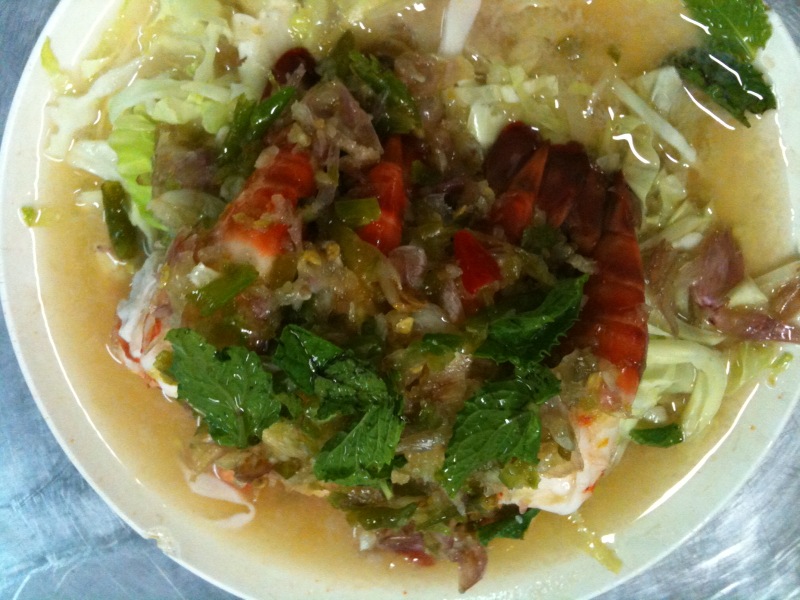
Poached prawns in a lime-chili sauce

But what sets Bowon apart are its dazzling variety of other sides — the fresh fish, the succulent crayfish, the range of gaeng jued (clear soups), the daily specials, and things like this: fresh sea prawns drizzled in a tart-spicy chili-lime sauce and dotted with mint leaves. Pillowy, sharp and green, all at once.

But the best part of Bowon, just like what sets the Old City apart from the rest of Bangkok, are the unexpected touches: solicitous, friendly service and a surprisingly beautiful canal-side view in back … a reprieve from the chaotic clamor of Banglamphu at nighttime. Stumbling across this view after dinner, we enjoyed a quiet moment in the breeze next to a dozing old man in a lawn chair listening to an iPod. The best part of Bangkok, compressed into a few seconds.
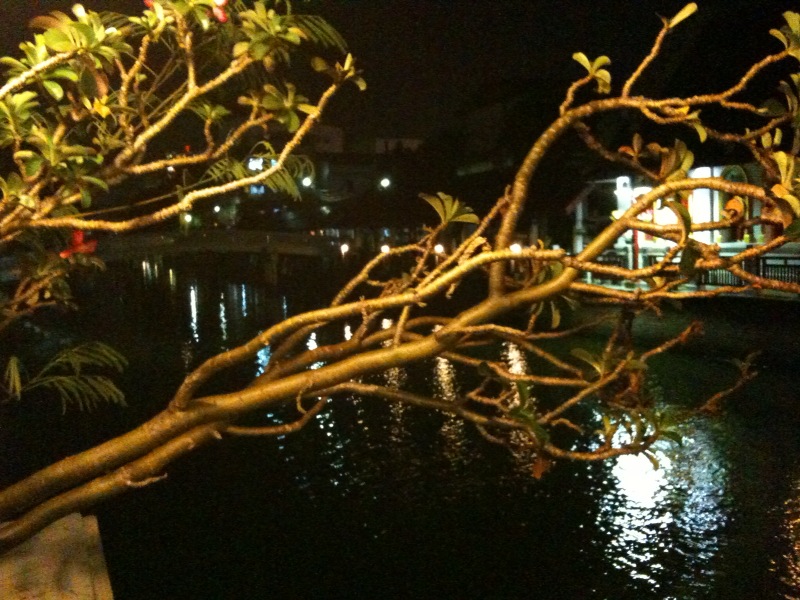
What sets Bangkok apart -- the unexpected

2 Comments

Filed under Asia, Bangkok, food, food stalls, rice porridge, Thailand

Bangkok’s best, or Where do I get some gravy noodles?

A friend of mine who likes to call himself an “omnivore” once said that the only thing he hated was lard na, the Chinese-inspired Thai pan-fried noodle in a thick gravy with meat or seafood and vegetables. I understood what he meant. As great as Cantonese food can be, a big knock commonly levelled against one of the great cuisines of the world is that it is too greasy, too goopy, too much like … baby saliva. Or the guy that is constantly coughing and clearing his throat in the corner of the coffee shop in the morning when you’re trying to mind your own business and standing in line for ages and WHY DON’T YOU HAVE DECAF?! You know what I’m talking about.

Actually, you probably don’t. But you might know what I mean about guay thiew lard na, which is seriously one of the great food stand offerings of the city. If a safari hunter is always on lookout for the “Big Five”, a galloping gourmet in Bangkok is sure to bump into a lard na stand on his or her way to the egg noodle, soup noodle, pad thai or rice porridge stall down the road. This city is littered with many a lard na stand serving faithfully exact facsimiles of that goopy, steaming mess that my friend so dreads.

But he didn’t know about sen mee krob.

Some of the very best — and by “best” I mean the places that are well-known by Thais for their lard na — vendors in the city deep-fry their noodles so that the crispy crunch of the starch offsets the thick gelatinous gravy they are slathered in. Like a Japanese cherry blossom clinging to the branch in late March, this is an ephemeral delight; the noodles go limp if you dally before tucking in. But it is something very real, something very genuine, a real added dimension to a dish that would otherwise be only okay. 

It is also the reason why I am wandering down this busy, congested street miles away from the nearest air-conditioning, where DVD vendors vie for your attention and the sidewalks are littered with remote controls and stereo components. We are in Baan Maw, a neighborhood in the old city specializing in electrical equipment — and, tucked behind what appears to be a hubcap vendor, lard na with crispy sen mee, or thin noodles, studded with pork, bristling with Chinese kale.

Crispy thin noodles in gravy at Rot Tip Yod Pak

Rot Tip Yod Pak (Baan Maw) is also known for its crispy pork on rice, but the lard na is what I’m there for: a cheery crunch nestled amid a burst of porky flavor. And at about 30-40 baht a plate, it’s reasonably priced.

Which is more than what can be said for Jay Fai (327 Mahachai Rd., Samranrach Intersection). With its various interpretations of the gravy noodle — with seafood, shrimp, pork, chicken or beef — hovering at around the “250+” range on its menu, one would wonder, Why? The answer, simply put, is this:

Crispy gravy noodle with seafood at Jay Fai

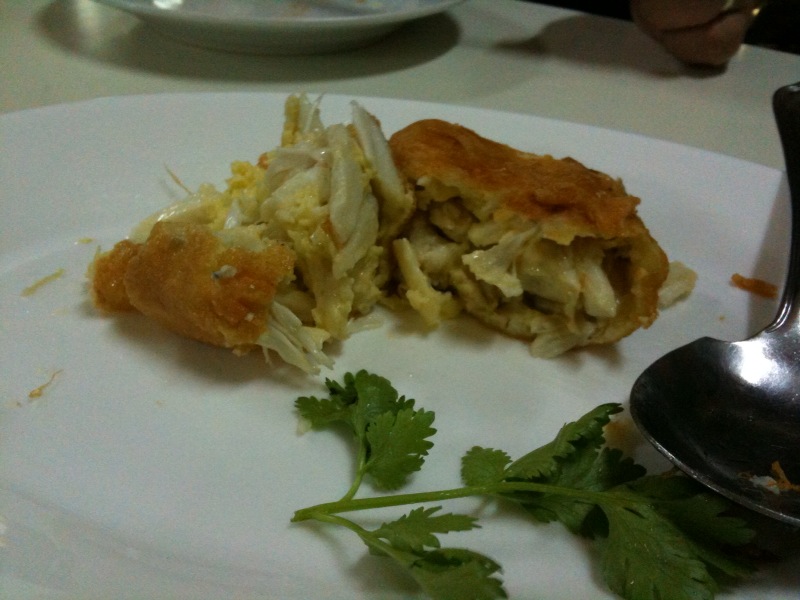
Now, I have seen people wander into this restaurant, sit down, look at the menu, calculate the prices, and then walk out again. But they were obviously not thinking clearly, and their places are almost always quickly filled. A meal at Jay Fai is an investment. That is because when people ask you, What’s the best place for Thai food in Bangkok?, you will be able to tell them, with some authority, that it’s Jay Fai. You can tell them about the tom yum hang, the ubiquitous lemongrass “soup” served without the broth, redolent in galangal and kaffir lime and chili; the stir-fried wide noodle with chicken (kua gai), thick with fresh lettuce and shrimp as big as the palm of your hand; and the most expensive crab omelette (kai jiew pu) I have ever seen at 500 baht — but so engorged with crab flesh you don’t really bat an eye.

Oops! What's left of the crab omelette

There is more (for example, this place is big on serving things “dry” — dry congee, dry sukiyaki, etc), but I would miss lunch, and that would be horrible. All I can say is, I’m saving up for my next meal. And taking my friend with me.

14 Comments

Filed under Asia, Bangkok, food, food stalls, noodles, restaurant, Thailand

Sukhothai in Bangkok

Five things you should know about Sukhothai noodles:

1. A bowl of noodles is deemed “Sukhothai” when it has pork slices and shredded green beans as a garnish alongside or instead of the usual bean sprouts.

2. The proper flavorings of a bowl of Sukhothai noodles are reminiscent of a plate of pad thai.

3. While Sukhothai noodles can involve any type of noodle, the best (in this person’s opinion) are the angel hair (sen mee) or thin noodles (sen lek), which absorb more of the seasoning while retaining some al dente crunch.

4. It’s hard to stop at just one bowl. Just try it. I dare you.

5. My favorite bowl of Sukhothai noodles can be found at Somsong Pochana (Soi Wat Sangwech, 02-282-0972), which also serves rice with different types of curry (khao gaeng), a good way to while away the time as you await your noodles, and kanom jeen saonang, a type of fermented rice noodle topped with an old-fashioned (and seriously sweet) pineapple-and-coconut-milk sauce.

Courtesy of Winner Dachaiphan and pbinbkk

2 Comments

Filed under Uncategorized