Monthly Archives: May 2013

Living to Eat

Image

The mieng pla at RBSC

It should come as a surprise to absolutely no one that I love food, or that I am drawn to other people who love food. My friend Gwen is one such person. A constant whirlwind of activity, she touches place here or there long enough to, inevitably, pick up a friend or two and eat at this or that fabulous place. She is also invariably kind, which is probably why the most damning thing she can say about someone is that he or she “eats to live”. 

Look, everybody has to eat to live. But it’s a very particular type of person who lives to eat. This is the person who plans his or her travel itinerary around restaurants; who would rather go hungry than eat something that tastes bad; who considers life a series of meals, and every sub-par meal a missed opportunity. I am this type of person, which explains why I have no friends and no one will travel with me. I have also met other people like this, and it’s like meeting other people with strange obsessions or second lives — the guy who dresses up like Boba Fett at the occasional Star Wars-themed convention, or Bruce Wayne in his off-time. 

A person who eats to live might not find much to trumpet about when it comes to the Isaan dish mieng pla: there’s fish, and vegetables, sometimes noodles, and a dipping sauce. There is no interesting technique, no volcanically hot wok, no smoke, no fire to speak of. No welcoming waft of steam when you lift the lid off the bamboo steamer, no doughy dabs wrapped like tiny birthday presents, no glistening jewel-toned slabs of flesh arranged artfully on a platter like pieces of jewelry. This is all DIY work — it’s all up to you. All you need are the fish and the seasonings. Anybody can do it.

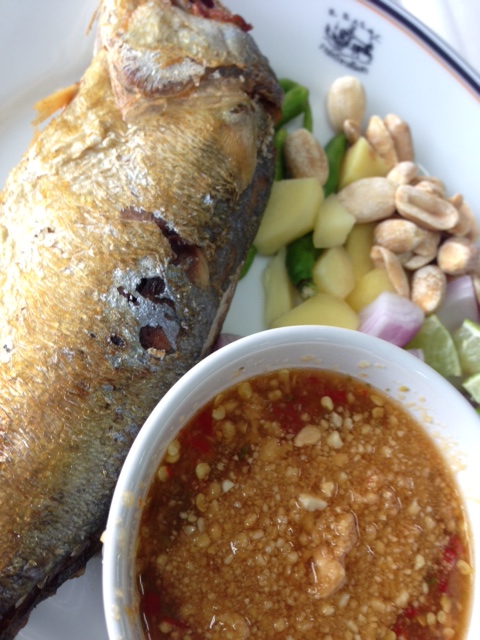
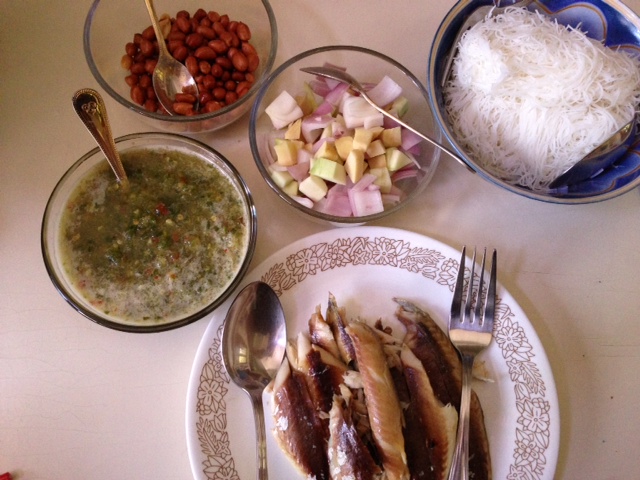
Except that not all mieng pla is made the same. It’s hard to screw up, that is true, but it’s also hard to make great. And that’s what Khun Sakol Boon-ek, the proprietor at the mieng pla tu stand at the Prajane Lumpini market, is able to do. Plump, fat (and deboned!) pieces of Thai mackerel; fat, juicy greens, and fresh, unblemished condiments (lime, shallot, peanuts, ginger, green mango, chilies, and, in her case, blanched thin rice vermicelli, or sen mee), this is everything you need for an afternoon snack, a light lunch, or, if you are a Hobbit like me, elevenses.
Image

K. Sakol’s mieng pla

Image

K. Sakol’s accompanying greens

Khun Sakol’s secret is ultimately her dipping sauce: a mixture of lime juice, fish sauce, garlic, sugar and a bountiful harvest of chilies, yes, but somehow the sum is greater than the parts. Obviously she won’t tell me her secret.

To contact her (they deliver!) call 084-944-6732. Or, if you are very lucky, she might be at the Prajane Lumpini market situated along the right-hand side of Polo Road (Soi Sanam Klee) if you are coming from Wireless, but I’m not sure how much longer she’ll be there. Sadly, some big changes appear to be planned for that road: Khao Thom Polo (they of the fire-and-brimstone jungle curry) are being asked to move, and even the mighty Polo Fried Chicken might have to follow suit. 

12 Comments

Filed under Uncategorized

What’s cooking: Khao Soy Islam

Our pork and chicken satay

Our pork and chicken satay

(Photo by Christopher Schultz)

Real friends always, somehow, prove themselves to you. My friend Dwight is able to go an entire lunch watching me try to shove morning glory into my mouth and talk at the same time. My friend Karen is able to listen to me blather for hours on end about my aching foot, or the last conversation I had with my mother. And my friend Chris is able to stomach all manner of Thai “dishes” I manage to throw at him, no matter how repugnant.

(NOTE: Real friends also tell you when your entire post is wrong. Karen has gently reminded me that Khao Soi Islam is run by a Muslim family, so they don’t serve pork! Me no remember. I will either 1. Have to rejig this recipe to do beef and chicken satays, like they REALLY do it at Khao Soi Islam, or 2. try to emulate the satay at Samerjai or Lamduan Faham. Accuracy is so tiresome.  This is what happens when I write a post in half an hour before picking up my daughter from school. The sauce recipe for the pork satay below is still pretty good though).  

It is hard to make pork satay repugnant. While pork satay is a fine street food dish all on its own, served by vendors up and down and across the land, it is also, inexplicably, the go-to accompaniment for the Northern Thai curried noodles known as khao soy — indeed, no northern Thai vendor worth his or her salt would sell without it.

While the satays at Lamduan Faham and Samerjai in Chiang Mai are rightly praised, it’s the one at Khao Soy Islam in Lampang (Prasanuk Rd., 054-227-826, open 9-14.30 daily) that sticks with me most. Run by a husband and wife team who have served up this dish for the past several decades, Khao Soy Islam also serves a particularly “curry-like” bowl of noodles where they gradually add the coconut milk to the chili paste base bit by bit, over a period of time, instead of all at once at the end like Lamduan. The result is more intense and silkier, and possibly my favorite of all the exemplary bowls available up North.

Like most vendors, Khao Soy Islam is a family affair. The son grills up both chicken and pork satays, with freshly-made peanut dipping sauce and a slightly sweet-sour ajad of cucumber, shallot and chilies. It was this satay that Chris and I tasked ourselves with trying to replicate.

A brief note: We used kebab-style cubes of pork tenderloin here, because I am really lazy and just bought stuff from the grocer’s pre-cut. It’s fine, but doesn’t absorb the marinade as well as a thinly-sliced piece of meat would. We also made this in the oven, but if you have a grill, please use it by all means. Grill 5-7 minutes, or until meat bears a slight, delicious char.

Pork and chicken Satay (makes 4 servings)

– 300 g pork shoulder, sliced thinly

– 300 g chicken thigh, sliced

– 1 Tablespoon curry powder

– 1/2 cup coconut milk

– 1 Tablespoon honey

– 2 Tablespoons fish sauce

– 2 Tablespoons soy sauce

– 3 garlic cloves, smashed

– 2 shallots, smashed

– 1-3 red chilies, crushed

– Satay sticks

To make:

1. Soak satay sticks in water.

2. Setting meat aside, combine all other ingredients to make marinade. Pour half of marinade over pork and other half over chicken and set in refrigerator for at least an hour.

3. When ready to cook, turn oven on to full whack and thread meat onto sticks. Place sticks onto oiled baking sheet (or, ideally, a cooling rack set on top of a baking sheet) and set in position closest to heat. “Grill” for 5-7 minutes, or until meat is browned and even slightly charred at edges.

For Chris’s peanut sauce:

– 1 1/2 cup dry roasted peanuts (unsalted), or 3/4 cup smooth peanut butter

– 1/2 cup coconut milk

– 3 garlic cloves, minced

– 1 tsp soy sauce

– 1 1/2 tsp sesame oil

– 1 Tablespoon brown sugar (omit if using peanut butter)

– 1 Tablespoon fish sauce (or to taste)

– 2 tsp tamarind paste (or lime juice)

– 1 tsp Sriracha sauce or Thai chili sauce

– 1/4 cup water (if needed to thin mixture)

Process until smooth. Taste and adjust seasonings until balance between tangy, spicy, sweet and salty is achieved.

For cucumber-shallot relish:

– 1 small cucumber, washed and sliced

– 3 red chilies, sliced

– 3 shallots, sliced

– 1/2 cup rice vinegar

– 1 Tablespoon white sugar

Combine all ingredients, making sure sugar dissolves in vinegar. Serve with satay, peanut sauce, and toasted white bread if you are so inclined.

6 Comments

Filed under Asia, food, food stalls, pork, Thailand

Isaan paradise

Image

Duck larb, at the Bangkok restaurant that is named for it

There are times when I think street food is a young person’s game. Constantly shifting and evolving, it seems happy to lie still for a while, lulling you into selecting “favorites” and casting yourself as a “regular”, a person who is in his or her own element.

But, like everything else, Time always tells, and things change, and before you know it, your favorite pad grapao (holy basil stir-fry) place is being replaced by a chi-chi Japanese restaurant and you are left, bewildered and alone, in desperate need of a new aharn tham sung (made-to-order) stall to frequent. Breaking up with your favorite places is hard to do. Time 1, you 0. 

I didn’t know that a sort of Times Square for the Isaan transplants to Bangkok even existed, but it does — at the intersection of Rama 9 and Petchburi Roads, called “Petch Praram Road”. Here sits everything a homesick Isaan person could possibly want: grilled fish coated in sea salt, fiery shreds of beef tossed in chilies and lime juice, steaming vats of pork in a murky broth of volcanic intensity. 

And at “Larb Ped Paw 4” (“Year 4 duck larb”) (25/15-17 Petch Praram Road, 02-719-7286, open 16.00-05.00), there is a minced salad of duck, chilies, lime juice and fish sauce that is both meaty and delicate, slightly gamy but fresh. It treads a fine line between light and dark, and heavy and light, but it does this in a way that seems completely natural and effortless. This highwire act is what duck larb is supposed to be. And that’s just one dish.

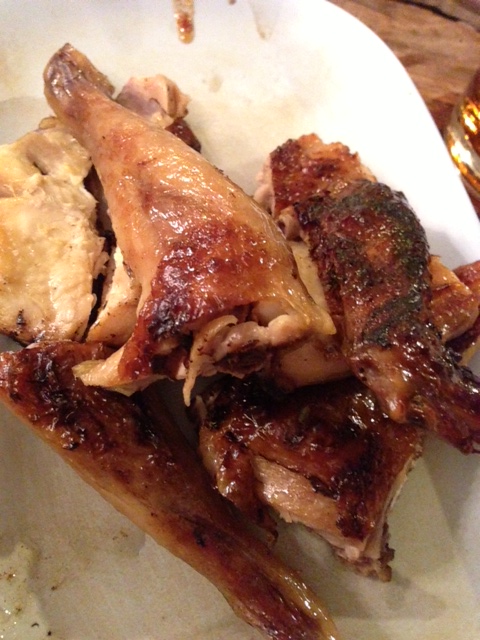
The roughest, most neglected cuts of beef become part of a nuea nam tok (spicy Isaan-style beef salad) of delicacy and restraint, spicy and salty and slightly tart. A thom saeb (spicy Isaan-style soup) with pork bones makes its point (spice) without being unbearable. The hoy klang (blanched cockles) come with a green chili dipping sauce that is dangerously addictive, threats of hepatitis be damned. And the chicken (gai yang mai madan), grilled in a halved stick made from a sour fruit tree so that the sap perfumes the chicken skin as it cooks, is almost similarly delicious (though one must ask for the jaew, or spicy/salty Isaan-style dip along with the sweet chili dip).

Image

Gai yang mai madan

Go early, because cars are frequently double- (and even triple-)parked later in the evening. Arrive hungry. Eat compulsively. It won’t be hard to do.

3 Comments

Filed under Uncategorized