Monthly Archives: June 2013

What’s Cooking: Aunt Tongsri’s house

Image

Green beef curry at Aunt Tongsri’s house

Led Zeppelin is one of the greatest bands in rock history. This pretty much cannot be disputed, although I am occasionally struck by people’s ignorance of this band’s contributions to modern music (I’m mainly thinking of you, Drunken Black Sabbath Fan in Hong Kong). Yet there are people — folks who know music, and aren’t just listening to Coldplay on repeat because they can’t be bothered — who dislike Led Zeppelin for their inherent flashiness, or because their music is “all about showing off”. Now that is just mind-boggling to me. Um, what? Do you mean they should be more mediocre? Oh, OK. Please, guys, stop being excellent. Slow your roll, William Shakespeare. Just make your point and move on. Oh, and you, Pavarotti, please pipe down. You are making the rest of us look bad.

What people seem to want today, what would appear to mark you out as One of Us, is subtlety and restraint, a testing of your willingness to throw a neutral-color-washed, Fair Trade organic cotton wet blanket over your own exuberances, your own rages — all in the name of great good taste. Flying in the face of all that Banana Republic-mandated conformity is this music: Robert Plant’s banshee wail, John Bonham’s Godzilla stomp, Jimmy Page’s ominously circling riffs, John Paul Jones’s … something.

Certainly, Thai food can be subtle and restrained — that is, after all, the point of “royal Thai cuisine”: beautifully-prepared Thai dishes with all the bones and pits taken out, made for a “harmonious” palate that refuses to skew to any extreme in flavor. I have never been a fan of this cooking philosophy, even though this balance is what most Thai cooks aspire towards: the fine point between sweet, salty, sour, spicy, and bitter. Instead, I want to be hit over the head with something (this is a metaphor).  

Yong, who has cooked for my husband’s aunt Tongsri since she was 13 (she is now 57), is basically a Bonzo with the mortar and pestle. Arduously put-together curry pastes are just a thing of the moment for this woman, something to do in her free time before she prepares real dinner for the family. One of her best-known specialties is gaeng kiew waan, or green curry, which she almost always prepares with beef. The result: unctuous, sweet and salty, but full of rattle-you-around-the-throat flavor, especially with the handful of bird’s eye chilies she flings onto the curry as garnish. The next day is even better: the meat has almost disintegrated and the chilies have mellowed and soaked up all the soup, gushing coconut milk as you bite into them. Do not omit the bird’s eye chilies!

Making this curry is hard. I will tell you up front now that I am not the cooking equivalent of Bonzo, or Keith Moon, or even the dude who played at the last wedding you attended. So I will be making do with a commercially-made green curry paste base when I try this recipe without Yong. But if you feel up to it and can source these ingredients (the addition of grachai, or wild ginger, is integral to this recipe), feel free to rock on.
Image

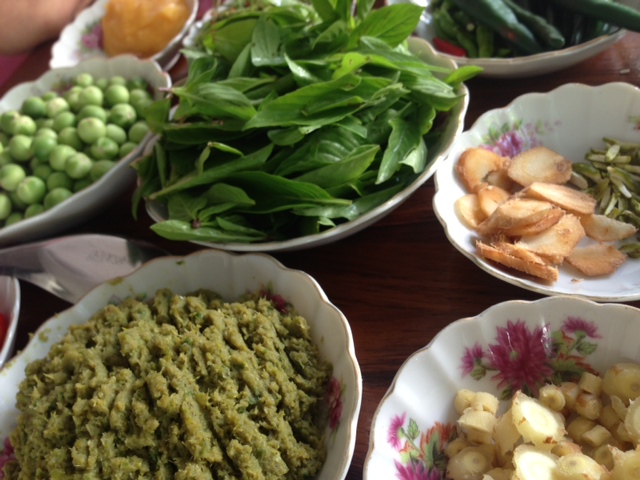
The finished paste, alongside some of the curry ingredients

Yong’s Green Beef Curry (for 4 people)

– 1 handful (1/2 cup) shallots

– 1/2 cup garlic

– 3 Tbs lemongrass, sliced

– 1 kg stewing beef with fat attached

– 2 Tbs wild ginger (grachai)

– 2 Tbs galangal

– 1 Tb kaffir lime rind, chopped

– 1 cup holy basil

– 1/4 cup prik chee fah, or green Thai chilies

– 1 Tb bird’s eye chilies (leave some for garnish)

– 1/2 cup baby eggplant (optional, as this tends to water down the curry)

– 1 Tb shrimp paste

– 2-3 Tbs palm sugar

– 4-5 kaffir lime leaves, torn (for garnish, optional)

– 3 look jan and dok jan (I DON’T KNOW WHAT THIS IS IN ENGLISH), ground alongside 1 Tb coriander seed and 1/2 Tb cumin

– 1 Tb salt

– 1 kg coconut milk, separated into “head” (thick creamy top) and “tail” (watery juice)

To make:

1. Stew beef in coconut milk “tail” for one hour.

2. For paste, pound galangal and kaffir lime rind with salt.

3. Add lemongrass to mortar.

4. Add chilies, but can omit bird’s eye chilies if you don’t want it too hot.

5. Add garlic, shallots and wild ginger.

6. Add shrimp paste.

7. Take finished paste and heat in pan with a couple of ladlefuls of coconut milk that have been used to stew the beef.

8. Add spice mix (dok jan, look jan, cumin and coriander seeds).

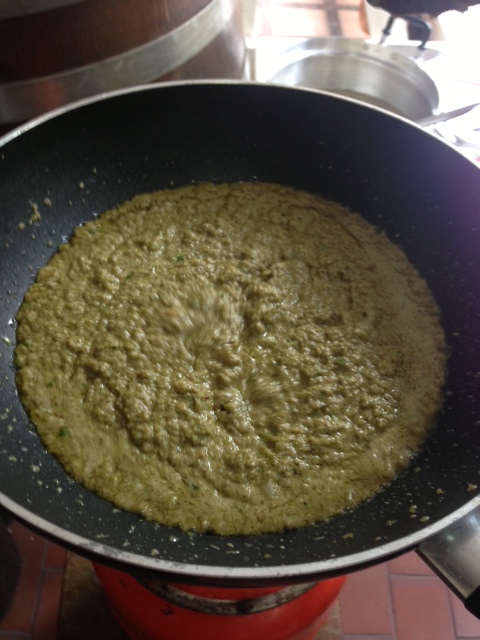
9. Wait for coconut milk to “break” and oil to reach the surface. The paste will start looking like this:
Image


10. Add a few more ladlefuls of coconut milk until you get the consistency you want.

11. Take paste off heat.

12. Add meat and coconut milk “head”.

13. Add palm sugar.

14. Add basil and baby eggplants, if using.

15. Garnish with chilies and kaffir lime leaves.

16. Eat with roti (like its Indian namesake, but flakier), kanom jeen (fermented rice noodles) and, if you like, pickled ginger.
7 Comments

Filed under Uncategorized

For simplicity’s sake

There is a lot to be said for doing as little as possible. As an officially Lazy Person, I am all for doing the absolute minimum necessary to get by, or, if that is not possible, getting someone else to do it. That philosophy is, in essence, what lies behind my house motto (THIS IS ALL YOU GET). So the concept of doing very little is something close to my own heart.

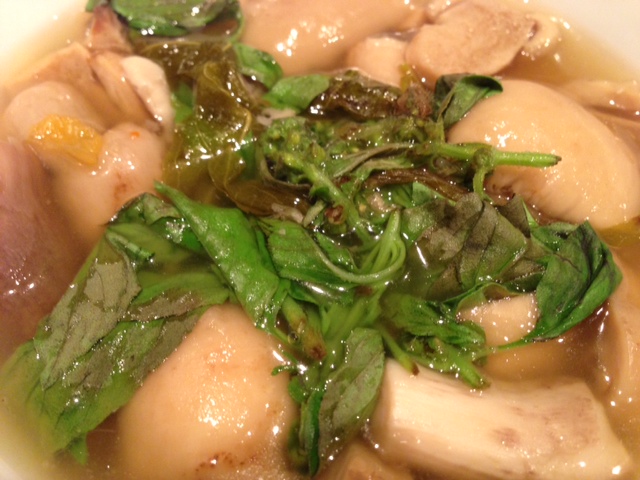
Although Isaan-ers (Thais living in the northeastern part of the country) work very hard and are known for doing so, they do very little with their food — perhaps because they are busy working. A little water, a few bits of meat, a barrage of chilies and a handful of crumpled herbs and you’ve got dinner on the table after maybe half an hour. Very easy and very simple, yet the results of this hurried labor remain delicious. Exhibit 1: an Isaan-style “mushroom soup” whipped up with water, fish sauce, lime juice, a tangle of Thai basil, and very little chili, resulting in something sharp, salty, slightly squidgy and utterly addictive:

Isaan-style mushroom soup

Isaan-style mushroom soup

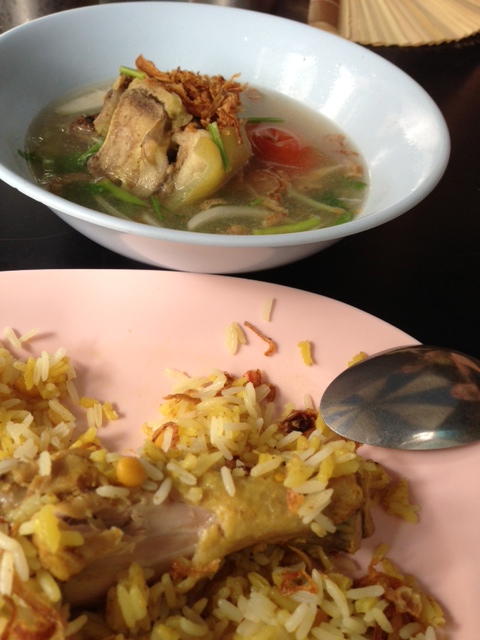
But the Isaan region is not the only part of Thailand known for its tart, spicy soups. The soup hang wua (oxtail soup) of the deep South is another gem — meaty of course, but also sour with lime and toughened by a mini-explosion of spice. It’s the perfect complement to the khao mok gai (Thai-Muslim chicken biryani)  that it almost always accompanies, sweetened as it is with raisins and deep-fried shallots. It also makes for a hearty, substantial breakfast or lunch, when a slice of toast or a smidgen of rice porridge just won’t do. A good place to get this combo is at Amat Rot Dee, about 100 meters from the entrance to Thong Lor Road on the left hand side (02-319-6576, open weekdays from 8.30 am-noon), where the biryani is reliably fluffy and the soup a fragrant melange of oxtail, onion, tomato, coriander and, of course, chilies.

Amat Rot Dee's oxtail soup

Amat Rot Dee’s oxtail soup and chicken biryani

Simple, yes, but devoid of flavor, no.

Speaking of simplicity, nothing is simpler than the humble potato. But the myriad ways different people prepare this thing can prove surprisingly fascinating. For those curious about just how many ways that could be, please check out my friend Poh Sun Goh’s new blog “The Traveling Spud” (http://www.thetravellingspud.blogspot.com), detailing potato dishes everywhere from Bangkok and Singapore to Norway and Spain.

4 Comments

Filed under Asia, Bangkok, food, food stalls, Thailand

What’s Cooking: Moo Jum

Image

Finally, a decent approximation

Isaan food is a celebration of simple things, put forth very directly and forcefully. Your finger-licking renditions of gai yang (grilled chicken) and nuea nam thok (spicy beef salad) aren’t content to sit mutely on your tabletop, requesting your appreciation; slightly smoky and full of heat, they practically shout I AM DELICIOUS as you cram morsel after succulent morsel down your throat. Paired with a hank of sticky rice and the battalion of condiments that Thais cannot resist pairing with everything, they are unstoppable, a food army that cannot be resisted, taking up all the valuable real estate in your gut that you have reserved for something useful, like beer.

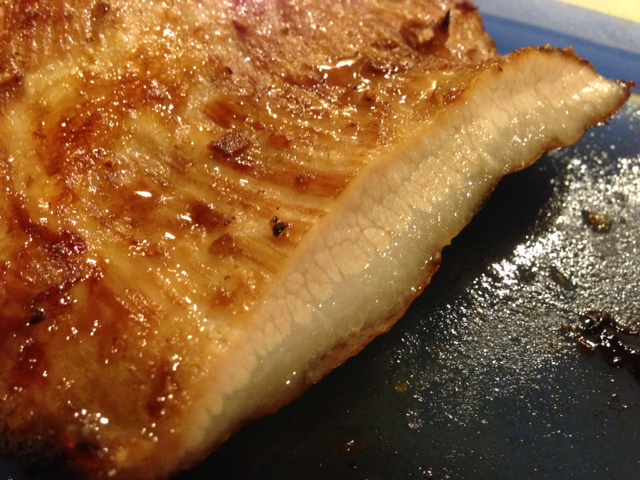
Moo Jum (located at the entrance of Suan Luang Soi 3 after 6pm) specifically traffics in these very dishes, the ones that make you sorry you stuffed yourself silly. Like most great Isaan cooks, they focus on straightforward simplicity. The namesake dish, an Isaan-style sukiyaki, is a spicy-tart broth in which unwitting vegetables, sawtooth coriander, Thai basil, pork and an egg are dunked, creating an aromatic melange good enough to eat even on sweltering hot nights. A simple spicy squid salad, rings of flesh barely blanched, dressed in sharp shards of Thai celery stalk and chili. And of course, their famed kor moo yang (grilled pork collar): sweeter than up north to be sure, charred at the edges from the grill, lacquered like a freshly-baked pie, as brown as the skin of a dedicated bodybuilder.

For all its supposed simplicity, I have struggled with this recipe. The basic recipe (as outlined in Chef McDang’s “The Principles of Thai Cookery”) uses a basic marinade of mashed garlic cloves, pounded coriander root, 1/4 cup of soy sauce, and 10 white peppercorns that is then slathered onto the meat. Very traditional, but nothing to set hearts aflutter. I tried to build on that recipe by going back to the marinade’s roots, substituting fish sauce for soy and adding some palm sugar. The result: ho-hum. I then tried to add molasses paired with fish sauce: NO DO NOT DO THIS EVER. It appears that where modern versions of kor moo yang are concerned, it is best to stick to soy sauce and build on that.

So last night, alongside an odd pairing of roasted cauliflower and soba noodles, I made some more pork collar for unsuspecting victims-slash-guests who had come over expecting dinner. The result was not awful! This is the best iteration of Moo Jum’s kor moo yang so far.

Kor Moo Yang (serves 4, just barely)

– 400 g pork collar (or shoulder)

– 4 garlic cloves

– 2-3 coriander roots, washed

– 1/2 tsp white peppercorns

– 1/4 cup soy sauce

– 1 Tb brown sugar

– 1 Tb sweet soy sauce

To make:

1. As in Chef McDang’s recipe, mash garlic, peppercorns and coriander root into a paste with mortar and pestle. Add soy sauce and sweet soy sauce and mash that all together to form marinade. Add brown sugar.

2. In a large mixing bowl, pour marinade over pork and allow to infuse meat, ideally overnight, or at least four hours.

3. When ready, grill meat until brown and charred a bit at the edges. If you, like me, don’t own a grill (why are American males so into grilling?), heat up a nice heavy pan (I use a cast-iron one) that has been oiled beforehand, and brown the pork until it’s a nice caramel-ish color. Then stick this into the oven that’s been set at 180 degrees Celsius for about 15 minutes, or until the edges gain the same charred edges and sticky-looking exterior that you would have gotten via grilling.

4. Slice and serve with a tamarind or sweet chili sauce, along with some sticky rice.

6 Comments

Filed under Asia, Bangkok, food, food stalls, pork, Thailand