Monthly Archives: July 2014

Bangkok Chili Dog

Stuffed bun, Thai-Vietnamese-style

Stuffed bun, Thai-Vietnamese-style

My friend Janet once said that the worst thing anyone could be to a Thai person is boring. People could be uncouth, or inconsiderate, or even rude, but if they are also amusing, their other sins could be overlooked with ease.

This maxim also applies to food. Once you think you’ve got a handle on all the dishes likely to appear on restaurant menus and street vendor carts, a smattering of new ones pops up. Vendors cannot bear the thought that you might be bored by something they are serving up. So they are always experimenting, adapting, making known quantities like khao gaeng (curry rice) undergo little tweaks, turning what was once mundane into something entirely new.

Foreign dishes provide ripe fodder for this kind of experimentation. Like spaghetti, slathered with green curry at a khao gaeng stall. Or Thai streetside “sushi”, stuffed with canned tuna salad and garnished with deep-fried tempura bits, slicks of wasabi mayonnaise and flying fish roe.

And kanom pang yad sai, a white flour bun that is served across Isaan and in any restaurant specializing in the Vietnamese-inspired dish kai kata (egg in a pan). It’s usually buttered thickly and stuffed with moo yaw (Vietnamese-style pork loaf) and slices of gun chieng (Chinese-style sweet sausage), and meant to accompany the kai kata — perfect for dipping into a still-runny egg yolk dotted with Sriracha and maybe a little Maggi.

At Raan Ee Noi on Fueang Nakhon Road (085-125-4333), diagonally situated from Rachabopit Temple, the kanom pang yad sai comes still warm, stuffed with moo yaw and lashings of what looks — and tastes — suspiciously like sweet chili, a type of nam prik ong for babies. They are Thai-style chili dogs! Kanom pang yad sai are available alone (13 baht apiece) or in pairs (25 baht) and, if you are willing to wait, or take a seat at one of the four tables on the sidewalk in front (there are tables inside, but the fan doesn’t work), they will be yours in roughly 10 minutes’ time.

There is no kai kata to pull focus from these babies. And although it’s the guay jab yuan (Vietnamese-Thai-style, Chinese-inspired  pork noodles — yes, that’s right) that takes pride of place on each table, filling the shophouse with the sweet smell of deep-fried shallots, it’s the kanom pang yad sai that I like most, and the least boring thing I can imagine today.


4 Comments

Filed under Uncategorized

Southern Thailand across the river

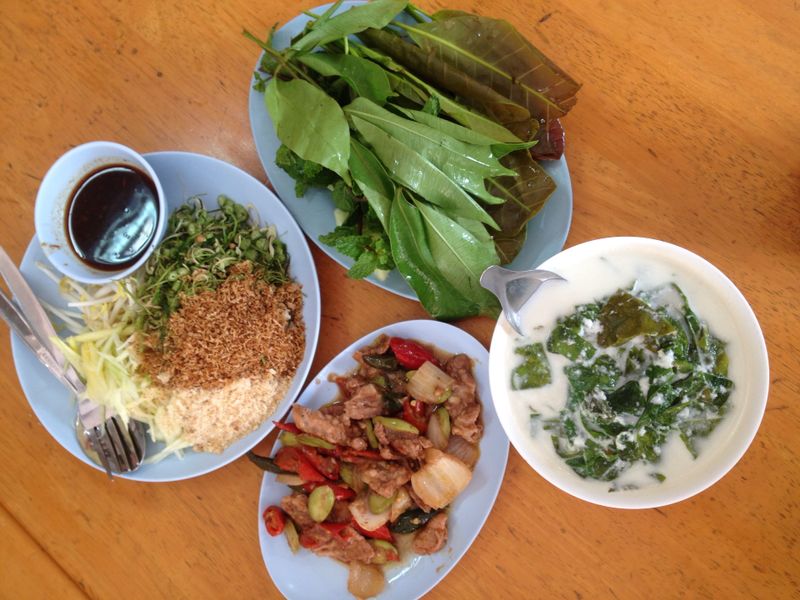
A quick lunch of khao yum, sator with shrimp and coconut milk soup at Chawang

A quick lunch of khao yum, sator with shrimp and coconut milk soup at Chawang

For years, I had heard about a magical neighborhood in Bangkok where southern Thai vendors congregated like college students on Bourbon Street during Mardi Gras. That is to say, there were a lot of them. The only problem was, it was too far away from me. How to go to this place, so far away, when I was so, so lazy?

Well, it takes another person, obviously — another person who is a friend, but not so close that she knows how much of a total and utter slob you are. That is what Chin is to me, and that is how she gets me to leave the house: a sense of shame, coupled with a underlying current of greed. I am always hungry, after all. And the promise of not one, but a handful of Southern Thai eateries, where curries and coconut milk flow thick and fast, and chilies blanket everything like a Biblical plague of deadly deliciousness, was too heady to be ignored.

Chin tells me she wants to take me to the Wang Lung neighborhood, which requires a Skytrain trip to Saphan Taksin, and then a boat trip to Wang Lung. Now, I know how much fun riding the “river bus” is for visitors to this lovely city, but I can confidently say I am totally over it. Just get me somewhere, quickly. Unfortunately, the quickest way to Chin’s favorite Southern Thai place in the Wang Lung market is on the water, which threatens to make me nauseated even before I take a single bite.

Banana stem curry at Pa Oun

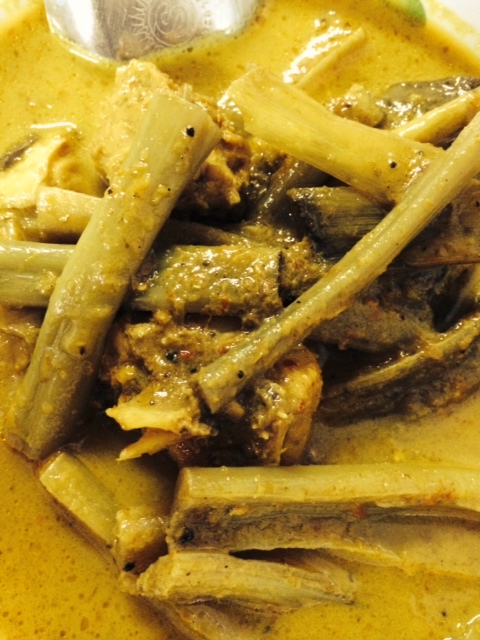
Banana stem curry at Raan Aharn Pak Tai

Located on the market’s main thoroughfare, Raan Aharn Pak Tai (a very no-nonsense name that means, literally, “Southern Thai Restaurant”, 086-664-8472) offers a sprawling selection of Southern Thai curries, soups and stir-fries that dwarf the offerings at any other vendor in the area. We get what Chin likes: pla samunprai (deep-fried fish with lemongrass), kanom jeen with nam ya gati (fermented rice noodles with a coconut milk-based fishmeat curry) and something I’ve never had before: gaeng sai gluay, or a coconut milk-based curry made of banana stems.  It’s unctuous and slightly sweet — not what I expect of Southern Thai food, which is fierce and hot and uncompromising, but it is augmented by some flaked fish flesh, which in itself feels very Southern to me. I also love that it takes an ingredient that would otherwise probably be thrown away — banana stems — and forms an entire dish around it. Best of all, our order comes with a collection of different pickles and fresh vegetables and herbs to enjoy as we see fit, my favorite thing about eating at Southern Thai places.

Pork kua gling at Dao Tai

Pork kua gling at Dao Tai

Our Southern Thai-oriented explorations don’t end at the market. Next up: Phran Nok Road, which hosts a collection of Southern Thai khao gaeng (curry rice) vendors that have been around for decades. The most famous of these is Dao Tai (508/26 Phran Nok Rd., 02-412-2385), which has a reputation for fearsomely good Southern Thai food despite its relatively “remote” location all the way over in Thonburi.

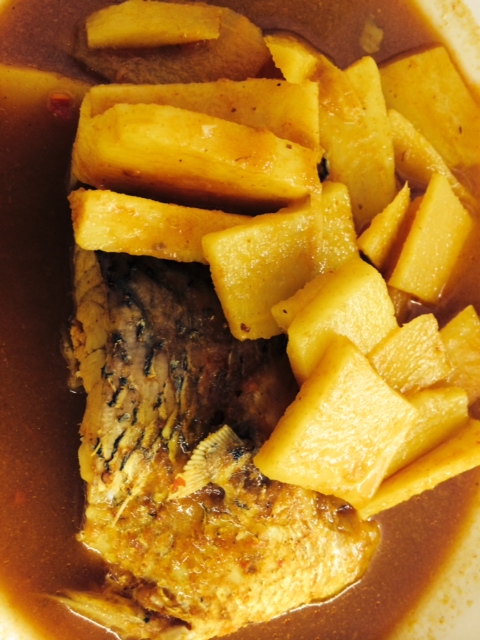
The day I get there, I am starving, having saved room all morning for this very (series of) meal(s). Chin and I try to pace ourselves, so we only order my favorite Southern Thai dish, gaeng som pla grapong (sour curry with seabass and bamboo shoots), and kua gling moo, a “dry” curry of minced pork  dry roasted in a pan over low heat with a handful of herbs and an entire pantry’s worth of chilies. I find both dishes absolutely delicious, manna from heaven, especially when coupled with the shoots, leaves and cucumber slices that automatically come to our table once we sit down, an offering to the Hot Chili Spice Gods.

Sour curry at Dao Tai

Sour curry at Dao Tai


I am so ravenous I don’t even notice the chilies, ploughing through half of my plate of rice until I see Chin across the table from me, tears in her eyes. She is not verklempt over the beauty of our meal, or from having to watch me shovel rice with so-so accuracy into my mouth hole. No, it’s too hot. And there is, she suspects, an overabundance of MSG. The curries and stir-fries are too “dark”, the “wrong color”, she says. In short, Chin is not impressed with my selection of Dao Tai. It’s time to move, ideally to that place across the street that looks a little better.

That place is called Ruam Tai and it sits kitty-corner to Dao Tai, an arrangement I suspect was set up to accommodate overflow from the more famous restaurant. However, the food here may be just as good. We have hor mok (steamed, rubbery seafood curry topped with a disappointingly icing-like dab of coconut cream) and a far better coconut milk-based curry of snails which have to be plucked from the liquid and their meat extracted via toothpick. It’s far too fiddly for me. I NO LIKE EXTRA WORK! Chin, for her part, is charmed.

Snail curry at Ruam Tai

Snail curry at Ruam Tai

Now I am absolutely stuffed, and contemplating the ride home, after which I will be rewarded by passing out on my couch for two hours while pretending to edit my book. But there is one more place to check out, and that is Chawang, right next door to Ruam Tai. It’s a shame we leave it last, because it’s friendly, airy, and  full of food that is the most restrained (chili-, flavor- and MSG-wise) of the three. Here, I manage a few bites of khao yum (a “salad” of rice with minced veggies, toasted coconut and herbs in a light, sweet-tart dressing), and then groan and make faces while Chin tastes the sator (stinkbean) stir-fried with shrimp paste and shrimp, and gaeng gati, a coconut milk “soup” bulked up generously with shrimp and pakliang leaves.

The trip back home is a doozy.


2 Comments

Filed under Asia, Bangkok, food, food stalls, Southern Thai, Thailand

Glutton Abroad: All we do in KL is eat

A bowl of assam laksa from Penang Cuisine in Publika

A bowl of assam laksa from Penang Cuisine in Publika

Frequently, when one is comparing A to B, it’s always a case of either/or, or this versus that. It is never about both things being awesome. I think it is because we are bred to think of things in terms of conflict. But A can indeed be as good as B, if different, and it would be foolish to choose one over the other. I mean, who would choose between Loki and Thor if you can have both?

So I am here to say that — while I still love Thai cuisine — Malaysian food is absolutely, indisputably delicious. Not everything makes me want to rend my garments with how wonderful it is: for instance, Chinese-style laksa seems like an exercise in flavor layering  that is unnervingly similar to how a 3-year-old puts together a sundae (let’s have that, and then this, and then a little more of the other thing, and while we’re at it, more of that again). At the same time, there are dishes that are tear-out-your-heart, stomp-on-the-ground yummy. Malaysian food is varied and many-dimensional and complicated, sure. And I’ve only just scratched the surface! The verdict, after one short trip to Kuala Lumpur, is the one that I ultimately feared: I cannot believe I waited so long to eat here.
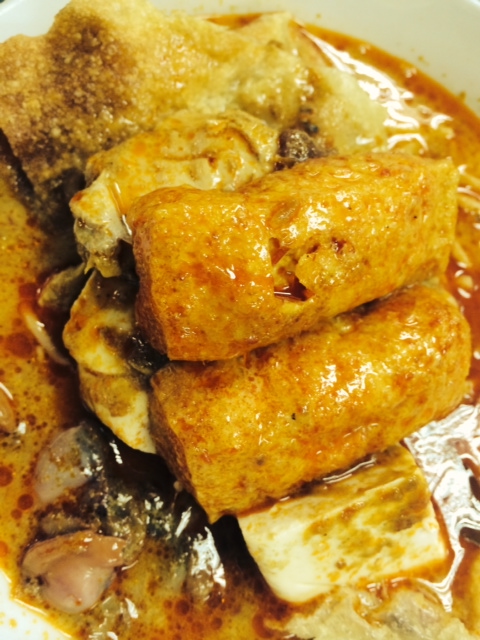
Chinese-style laksa with tofu, fried wontons, egg noodles and cockles

Chinese-style laksa with fried and fresh tofu, pork, fried wontons, egg noodles and cockles

I know our culinary “guide” May means business when she sends us a detailed food itinerary a couple of weeks in advance. She jokes about it being “gut busting”, but it really and truly is. There was once a time when I could eat like this, like when I was researching my first book only a few years ago — a handful of places, three times a day. The trick, you are supposed to tell yourself, is to remember to “graze” so that there is enough room for everything to fit.

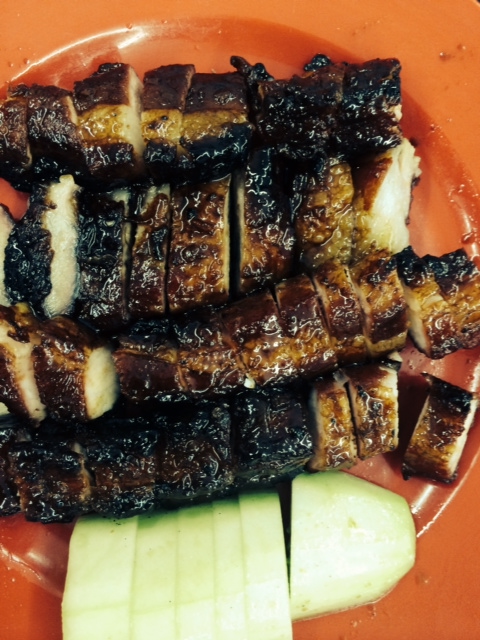
This is truly easier said than done. Especially when you are presented with the delectable char siew (Chinese-style barbecued pork) at Restoran Meng Char Siew (13 Tengkat Tong Shin, 012-252-1943). Unlike the other versions I’ve tried, this pork is neither overly sugary nor brittle with glaze; it’s a soft, melting heft of meat lacquered with sweet and bitter from the makeshift drum-like “ovens” in the kitchen.

Malaysian barbecued pork

Malaysian barbecued pork

There is less worry about offsetting greasiness with something cleansing or tangy in Malaysia, so here you have your “oiled” rice (similar to the rice you get with chicken rice) or your rice vermicelli drenched in soy sauce and your freshly sliced cucumber and maybe a stir fry of lettuce or bean sprouts (ideally from Ipoh, because those are the best, says May from Ipoh). Then you call it a day. Or, in our case, we call it an hour, because it’s already time to head off to the next destination. But before we go, May stops to watch the pork meatball vendor at work next door. Unlike the Thai pork pellets that are skewered and then grilled over an open flame, these meatballs are golf ball-sized masses of pig, served with a burning hot pork broth and bits of green onion. They are small enough to trick you into thinking you can eat them in one bite, but big enough to turn that endeavor into a total disaster.

“You should try a couple,” May urges me, but it’s too much, and I am already thinking of the next restaurant.

“Oh no, I will die if we have any more food right now,” I say.

“Two meatballs!” May answers, before I am presented with a small plastic bag of balls that I am free to carry into the car to maybe nosh on later.

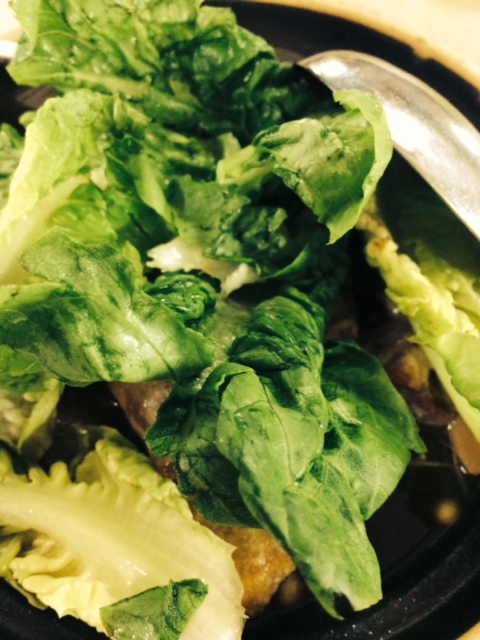
So no, I did not die, because I am sitting here writing this right now, duh. And my stomach did settle in time to sample the eye-opening bak kuh teh at Teluk Pulai (Claypot) Bak Kuh Teh (32 Jalan Batai Laut 5, 03-3344-5196). I am used to the Singporean and Thai-Chinese version of this dish, which is referred to as the “peppery” kind involving cooking greens and pork into a sort of vegetal sludge. I absolutely loathe this dish. It reminds me of Italian ribollita, which I also find revolting. Why ruin all the best parts of the vegetables? But here, they specialize in the “herbal” type of bak kuh teh, which means the greens are strewn over the top as the pot of pork is served at your table, alongside rice and cut-up deep-fried crullers (patongko) to soak up all the delicious pork broth.

bakkuhteh

There is also a “dry” kind of bak kuh teh, which was sort of a revelation for me: no broth, no greens, just a bunch of slowly braised pork bits, heavily coated with bah kuh teh spices, what appears to be the cooked-down broth, and dark soy sauce.

dry

The crullers go with the “wet” bak kuh teh. I didn’t know that when I took this photo.

As full as I was from the barbecued pork, I could not pass up this dish — a dish I had previously dreaded seeing on the dinner table. Another thing I remember dreading: Chinese food, the kind that my parents would drive two hours to Cleveland for. There, at a restaurant called “Bo Loong”, my parents would get their Asian food fix while we kids moped around like mourners at a funeral, eating plain rice and wishing ourselves at McDonald’s.

But even my parents, longtime Bo Loong boosters, would say that Restaurant Oversea (84-88 Jalan Imbi, +603-2144-9911) is a far superior restaurant. In fact, it is now my favorite Chinese restaurant in the world. There are a bunch of excellent dishes: things that are slow-cooked in pots, or freshly plucked from the fish tanks downstairs, or (this being Malaysia) coated in that black sauce that seems capable of covering just about anything edible here. But there real reason I am hoping to go back is this (order 24 hours in advance):

Roast piglet with gravy at Restaurant Oversea Imbi

Roast piglet with gravy at Restaurant Oversea Imbi

Now, I look at this and feel a twinge. This was a baby pig. I do feel bad about that. But do I respond by crossing my arms and not partaking, basically rejecting the gift that this piglet has given us? Or do I dig in and honor this pig’s sacrifice to my stomach as heartily as possible? You can guess my reaction. It is: thank you, baby pig. Your tiny squares of skin, paired with the fluffy Chinese-style steamed bread (man tou), or chunks of fatty, tender flesh drenched in pork gravy. Your sweet little trotters. And then, yes, the head, cleaved in two and presented to my neighbor at the dinner table and me, in an unspoken foodie dare.

I nibbled at the ear as my neighbor exhorted me to dig in with my bare hands, tearing the head apart at the jaw to release more of the meat buried under the cheekbone. “Try the eye,” she said, poking it out from underneath the skull to pop into her mouth. And, well, if she went to St. Andrews with Prince William and could chow down on half a piglet head like it was NBD, then I could do it too. It tasted like nothing, like a crunchy piece of gelatin. I had passed.

This is nowhere near all the food that I had. There are other highlights: fish head curry, Assam laksa (like noodles in a gaeng som broth), various stir-fried noodle dishes, yam rice with a light, slightly sour broth peppered with pig innards. But it’s not even close to the end of the road for all the dishes I want to try. I’m no fortuneteller, but I see … another trip to KL looming in my future.

Pan mee from Kin Kin: noodles with dried fish, minced pork, chili and a poached egg

Pan mee from Kin Kin: noodles with dried fish, minced pork, chilies and a poached egg


2 Comments

Filed under Asia, food, food stalls, Malaysia, restaurant