Monthly Archives: September 2022

Curry rice bonanza

Honestly, this is a shot of just half of our lunch at Mae On’s Curry Rice, before they put the rest of the dishes that we ordered on the table

I have probably written about this before, but I am now officially at the age where I repeat myself over and over, forgetting that I have already told you the thing that I am currently telling you. So you will have already probably read before that one of my recurring nightmares is going to a gorgeous buffet, being unable to decide what I really want, and then upon deciding, being unable to find the thing that I wanted in the first place. Luckily for me, the buffets of my reality are much, much simpler, and I am more than capable of making decisions in the moment (although those decisions ruin me later, when I am unable to finish all of the food that I’ve ordered).

Which is all a roundabout way of saying that the Thai street food tradition of khao gang (or curry rice, in which you are given a plate of rice on which to adorn any number of already-prepared dishes) is one of my favorite things about Thai street food. When set out on the sidewalk or in front of the shophouse, the flurry of dishes on display — stir-fries, relishes, curries, even the occasional baked item — are indescribably, heartbreakingly beautiful, and that moment of pointing at exactly all it is that you want is, for me at least, one of the happiest moments I can imagine.

So I was overjoyed to be invited along with Adam, Daria, and Jasper of the @otr.offtherails team to sample one of Adam’s favorite khao gang spots, The Originals Mae On’s Curry Over Rice at Saphan Han. In business for over 50 years total (and over 20 years in its current location on Chakkrawat Road), the plethora of dishes available in the morning are an edible treasure trove of Thai favorites and hard-to-find gems like the kai khem puu jaa, or salted egg yolk planted like a giant staring eye into a mince of deep-fried pork and crab (I’m making it sound less tasty than it really is, but it is a visually striking dish).

Don’t forget the tart-spicy sauce, which I always end up doing

While the puu jaa and gang khi lek (cassia leaf curry) are hidden gems, the sweet pork and salted pork (moo waan and moo khem) are ordered by virtually everyone, as is one of the two (!) nam prik (chili dips) pounded daily. I was once told by a customer at a now-defunct khao gaeng vendor on my street that a nam prik option was the sign of a great cook, as chili dips are ponderous and labor-intensive; the presence of two of them, by that logic, means we are dealing with a formidable Thai food cook indeed. And that cook is one woman, a native of Phichit, who makes this veritable blanket of food from 4 in the morning to when the shophouse opens at 7:30 every morning. Such is the amount of food that she makes daily that the next time I complain about making a main, a cheese tray and a couple of side dishes for guests, I will conjure up this woman’s face as inspiration and remember that some people are far, far, far busier at far, far, far earlier in the day.

People like to think that Thai breakfasts are all eggs and/or congee of some kind, but this is the real way most Thais start their day: with a curry, stir-fry and rice (maybe even with a clear soup of bitter melon stuffed with minced pork!). And if they miss their curry rice hit in the morning, they make sure to have it at lunchtime. Hell, they may even pick up a plastic baggie or two of nam prik macaam and green curry for dinner at home, where the rice is already warming in the rice cooker. Curry rice is the lifeblood coursing through the veins of Bangkok. Taking a plastic stool and hunkering down with some son-in-law eggs and a ladleful of massaman curry is the simplest way to continue on in one of the grandest of Thai street food traditions.

For an in-depth look at Bangkok’s best curry rice spots, check out Adam and the gang here.

1 Comment

Filed under Uncategorized

Glutton Abroad: The Smell of Paris

A doorway in Alsace

It was shocking to me, but in a pleasant way. Standing outside my hotel in Paris, waiting for someone to decide on where to get a coffee, a woman in an orange dress passed me on the street. In her wake trailed an aroma, something fruity yet floral (maybe Dolce & Gabbana’s “The One”?), almost as tangible as a long scarf floating in the breeze. Coming from Asia where it’s far too hot to mess around with one’s own “aroma”, I was surprised but remembered … oh yes, that’s what French people do with their perfume. They spritz it all over themselves, willy-nilly, and allow themselves to be smelled, even after they’ve passed you by.

After that, I registered every perfume I smelled. A lot of floral-fruity, which was surprising, I thought, for a sophisticated city like Paris. Lots of Eau d’hadrien by Annick Goutal. Some figgy-green Philosykos by Diptyque. A Pamplelune from Guerlain that I recognized, because I’d worn it myself throughout my 20s, as well as a Samsara or two, but only on the right bank. The temptation grew so great to add to the cacophony of perfume-y smells that I succumbed, finally taking a taxi on a rare moment off to the Palais Royal (nowadays pockmarked with empty retail spaces, echoing the complete erasure of the famous fresh market on Rue de Buci).

This is where the Serge Lutens store lurked, unremarkable, in a shaded corner. In front of a clerk who made all of the world’s stereotypes of a snooty Parisian come true, I made the wrong choices (leathery Daim Blond instead of floral De Profundis) and my daughter did the same (Femininite du Bois, but at least, as the first girly wood perfume, it is an historically important scent). It ultimately didn’t matter, since afterwards we, too, were free to add to the symphony of smells that made up Paris.

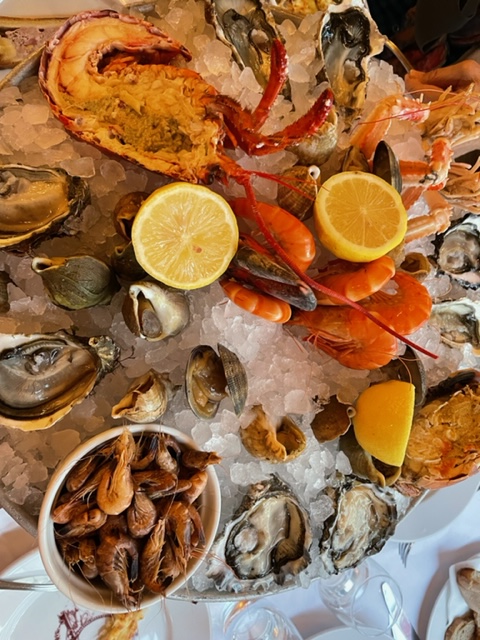
A seafood platter at Bofinger

Not to say that I would ever trail a “perfume scarf” behind me on the streets of Bangkok. After spending decades in Asia, I have become unaccustomed to strong perfumes. I keep my scents (mostly green, fresh, chosen for hot weather) close to my chest, literally. I cannot bear to fight with the other smells that assail the average person on a walk down the road: frying garlic, dust, cooking garbage, water evaporating on hot pavement, an undercurrent of sewage.

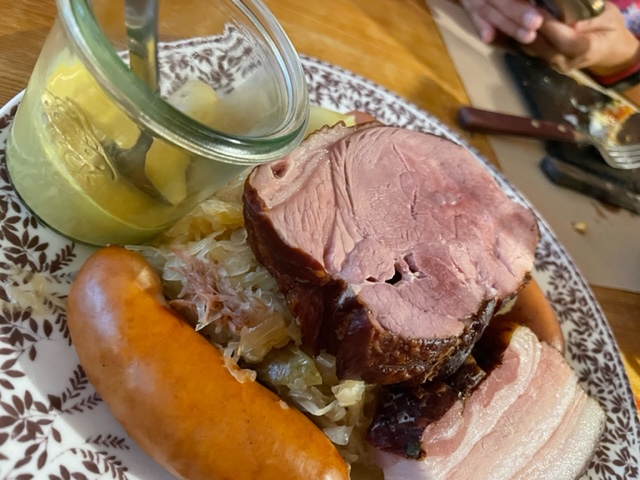
A plate of choucroute garni in Colmar

I found it strange that in France, a land where people are free to smell so flamboyantly, the smells of their food — garlic, onions — would be found to be so offensive by polite company. Yes, there is that sizzling platter of frog legs or escargot, redolent of garlic and butter, just begging to be despoiled by a torn hunk of baguette in front of you, but if you go home to your significant other, mouth aflame with the aftertaste of maitre’d butter, they are likely to not be overjoyed (although Walmart does sell a garlic-scented spray).

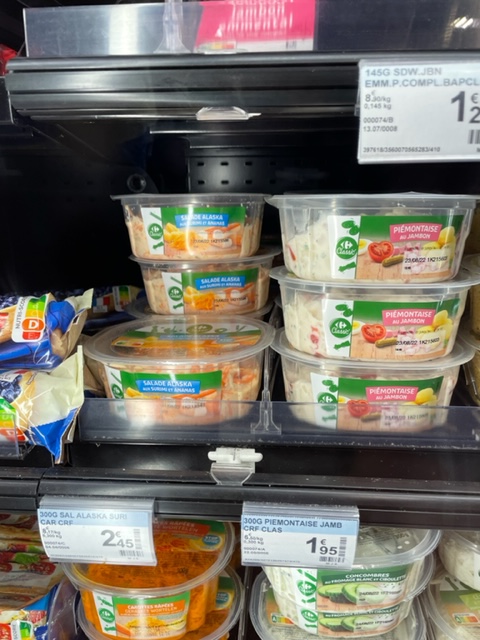
Slander on the state of Alaska at a grocery store: an “Alaskan salad” of surimi and pineapple

In Thailand, and I suspect in a lot of other parts of Asia, the opposite is true. You may not smell, but your food certainly does. Anyone who has walked past a stir-fry cook making pad kaprow knows this very well. Indeed, Thais think of the smells of food (yes, even shrimp paste) as necessary additions that enhance, rather than detract from, the dish as a whole — much like a French woman with her perfume. Torn lime leaves and bashed lemongrass bulb smells are good for you, ideal for if you have a cold. Floating galangal in a thin coconut broth are refreshing. Chopped coriander leaves and roots mean that love and care have been taken in the preparation of your food. Shrimp paste and fish sauce? Well, that’s just around to make you hungry. Smell is so important that Thais even make candles that are supposed to be lit while making dessert, infusing the final product with a smoky aroma (think Comme des Garcons’ Incense series).

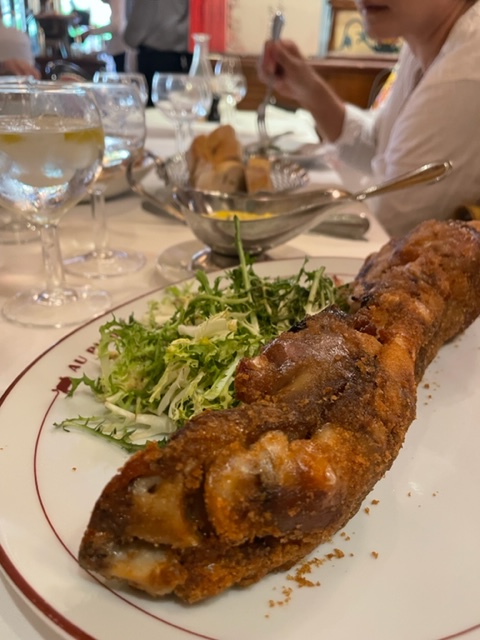
A fried pig’s trotter at Au Pied du Cochon

For all of the technique and care taken in the preparation of French food, I feel that the issue of smell has only recently been addressed, with molecular gastronomy-influenced touches like smoking, dry ice vapors, and burning. It’s one of the reasons why I (somewhat biased, yes) think Thai cuisine is often overlooked as something sophisticated. Instead, it is almost always presented as rustic and in need of “Western cooking techniques” in order to advance. I’m not saying there is no need for advancement in cooking techniques; Thai food must evolve just like everything else. I’m just saying that Thais can look to themselves for the inspiration that they need, let their freak flag fly, and trail that aromatic scarf of kapi and nam pla behind them like no one is smelling.

7 Comments

Filed under Uncategorized