Cartagena is Colombia’s fifth-biggest city, but is its biggest tourist draw. Like Thailand, it has probably seen its fair share of hardships during COVID, if our reception was anything to go by. “Welcome to Cartagena,” shouted one man in the street at our ambling, unwieldy procession as we blocked traffic on a narrow street. “We love you!” Earlier in the day, as we left our enormous tour bus (one of 4 that would leave our ship alone that morning), a police officer bowed to my daughter in what I assume was a well-intentioned gesture of welcome. Tourism is a big deal in Cartagena, home to the UNESCO World Heritage Site of Cartagena de Indias, aka the Old Town.
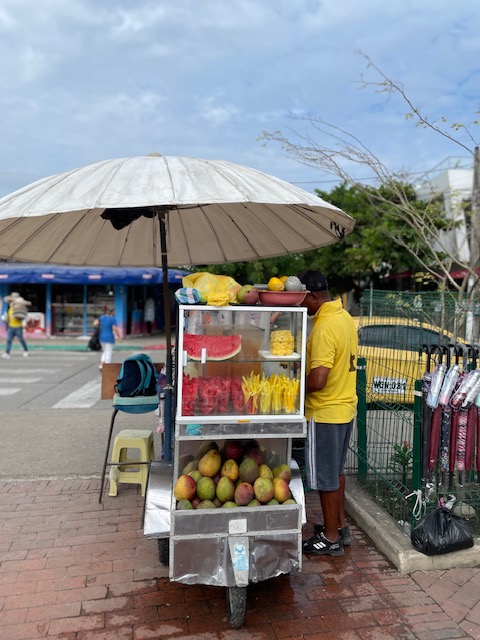
We had only 5 hours to spare in Cartagena, and 4 of it was spent on our tour, so I did not get the chance to sample what I was told was a typical Colombian meal: fried fish, rice, a salad, with a side of fried plantains. I did not even have a chance to snag an arepas rellenas (corn pancake stuffed with meat) or pandebono (cheese bread) from a vendor’s cart. And there were a lot of vendor’s carts. If sheer numbers of vendors were any indicator of how popular a particular item is, then hats would win, hands down. You will never go hatless in Cartagena, if what you are looking for is a hat.
From our port — where we were docked next to a Caribbean Princess ship and where I could imagine the geriatric inhabitants of both cruise lines could clash, West Side Story-style — we fought traffic into town and disembarked at the Naval Museum, where our guide attempted to lead us through a series of exhibits, all confusing because our group was vying with a host of other tour groups with guides attempting to do the same thing. What I gathered was that the English did a lot of bad stuff to Cartagena during the Tudor reigns in the name of Messing Up Spain’s Business. I also found out many pirates and corsairs (what I assume is a high-class pirate) trawled the waters in wait for Spanish ships laden with riches from the New World. The museum helpfully provided an image of one:

We then went for a walk through the charming Old Town, where, just like Bangkok, fueng fah grew in profusion from residential balconies, motorcycle taxis weaved through traffic, and humidity hovered like the spirits left behind as the neighborhood sprouted pricey boutiques and even a Starbucks. Among the beautiful houses boasting carved wooden balconies, however, is a cursed dwelling that housed the Palace of the Inquisition for 200 years. Here, enemies of the Catholic Church were interrogated, during which all either perished or confessed, and were then put to death in a variety of ways. Interrogators came up with several ingenious ways of torment, including a heavy collar that resembles Hellraiser’s face with a hole in it, as well as a contraption named the “Breast Ripper”, reserved for women accused of adultery or of having an abortion. Once a person ultimately confessed to something like witchcraft or being a Protestant or any other heinous crime, they were put to death, usually either by guillotine or by hanging from a scaffold, much like the one built for Mike Pence on January 6. In the 200 years of the operation of the Palace, only 5 people were burned at the stake.
It was heavy stuff, and later in the courtyard as I waited, I saw a profusion of mangos rotting on the ground. There was a tree nearby, where the sweet yellow fruit grew freely. No one ate them except for the ants, I assume because the ground is cursed. But it did get me thinking about fruit, and after leaving that place and encountering a fruit vendor outside, I immediately bought a big bag of it.
Just like in Thailand, you are supposed to haggle when you deal with a vendor. Even though I live there, I am not a good haggler. When the vendor said “10 dollars” for 3 big purple fruit, two pitaya and a yellow globe they called a “dragonfruit”, I balked. A woman munching on mangos next to the cart said that the price wasn’t really that bad. I ended up paying it, only realizing after I crossed the street that the woman also worked there. So there you go.
This was part of my haul:
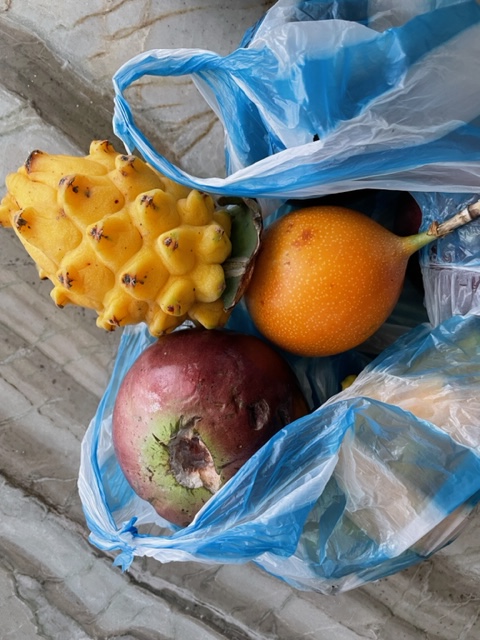
The “dragonfruit”, I learned later, was more of a passionfruit-like fruit, but with bigger seeds and much, much sweeter. Like, no tartness at all. Later, I learned that this fruit is actually called granadilla.

The pitaya ended up being the dragonfruit, but not like any dragonfruit I’d ever had. When my friend Dwight raved about the dragonfruit in Colombia, I sneered at the thought that dragonfruit could ever be that flavorful. I mean, it’s basically chunky water in Thailand. But the pitaya here is incredibly sweet and juicy, changing everything I ever thought I knew about the fruit.

The last fruit, which resembles a large mangosteen, is actually incredibly sweet inside. While Colombia does have mangosteen (referred to as “mangostino”, according to my friend Joel), I did not see any on offer today. I saw guavas, coconuts and passionfruit galore, but the fruit that seemed most predominant were these big purple globes like big tomatoes. I later learned they are “magelia Colombie”, and they are VERY sweet inside, like Thai santol or zalacca, but EVEN SWEETER.

Needless to say, these fruit are more delicate than they look and leaked juice all over my bag, but — as I eye a veritable mountain of the stuff on the desk by my bed — I’m thinking that it will probably be worth it.
Next stop: Manta, Ecuador.


 Bangkok Glutton