Monthly Archives: February 2023

Glutton Onboard: Off the bus in Bali

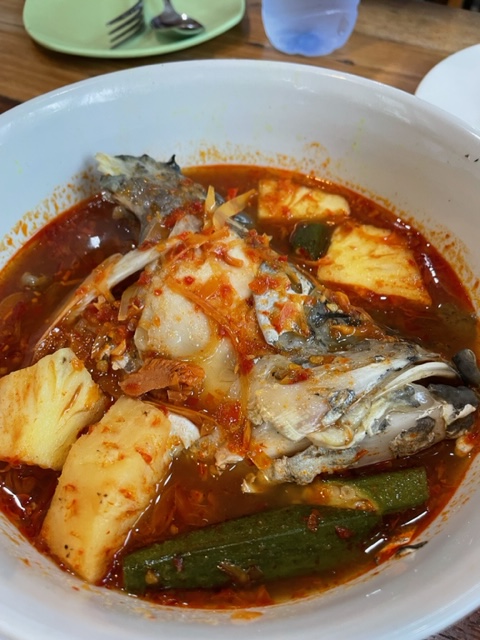
Fish head with pineapple and okra at Wr. Bambululu

I hadn’t been to Australia since my first (and only) trip to Sydney back in 2003, for the rugby World Cup. Back then, what I knew of Sydney’s dining scene came from Wildfire, Rockpool, and the basement of David Jones. Possibly as a result, my one trip to Down Under was a hazy blur, my only memorable experience being the train ride after a NZ loss to Australia, listening to an Australian explain that New Zealanders were sore losers because rugby was basically all they had going in their lives. (An aside: karma would come for this man only a few days later, when Australia lost to England in the final few minutes of the match).

So I wasn’t prepared for the sheer charm of Cairns, or the hints of immense beauty in the patch of the Great Barrier Reef that I snorkeled. In Darwin, I found alive all of the stereotypes that Americans have of Australians: guides named Wookie, towns named Humpty Doo and pubs that allowed customers who arrived on horseback to tie their horses up inside the bar. Australia is a vast, immense space, not even wholly known to most Australians themselves; in this way, it very much resembles the US. There also seems to be a big gap between the rich and the poor; in this way, it also resembles the US, and Thailand as well.

All the same, it was a feeling remarkably similar to relief that greeted me when I woke up a few mornings later to the view of Bali’s Benoa port: a concrete parking lot, what appeared to be a facsimile of a temple, and the full-on wall of humidity that could only be found in Southeast Asia. One reason was that I would find lots of good meals featuring rice (when did I turn into my parents?!); the other was this:

A bum gun

Bali is known as the “Island of the Gods”, and there’s a good reason why. It’s beautiful. Green, lush and verdant, like French Polynesia, it has also taken on the infrastructure of a (very) well-visited tourist destination. Women still wear their sarongs, and temples (and accompanying offerings to the gods) are everywhere, including underfoot.

There are places in Thailand, particularly around the capital, where anything even remotely hinting at the kingdom’s agricultural past — traditional dress, rice paddies, untamed greenery — is viewed with disdain and denigrated as “baan nok” (from the country). The Balinese have no such qualms; rice paddies coexist down the road from luxury resorts and shopping complexes, and it’s not hard to find farmers ploughing their fields with their water buffalos, hungry cranes following in their footsteps.

By this time, we have traversed most of the island, comfortable (ish) within the confines of our enormous tour buses, the kind of tourists that I myself would view with suspicion and run away from. We have seen dances and weaving and thrown money at batik factory owners, visited many temples and had more than our share of complimentary Balinese snacks with tea.
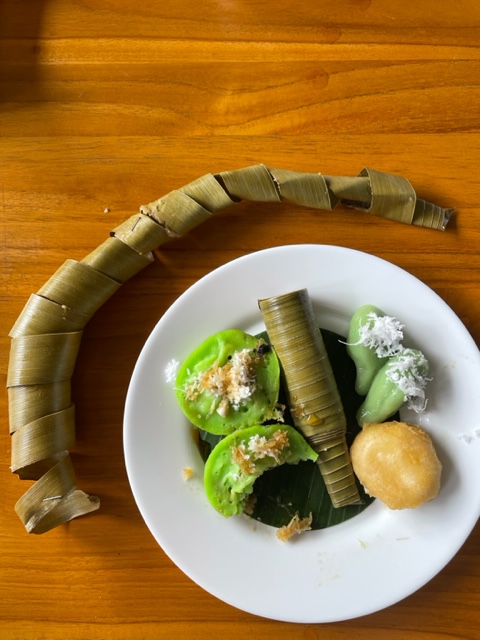
But the very nature of a trip on a cruise ship is just that — comfort within the very confines of the touristic bubble, the foreign-focused “parallel universe”, that I usually try to avoid. The point of the cruise ship tour is to isolate oneself from the burdens of researching, haggling and scrambling, but these are the only ways to get anywhere good. So at the end of our temple visit today, nearing lunchtime, we asked our tour bus to kindly drop us off at a place where we could easily find a taxi (another benefit of Southeast Asia: Grab works here too). From there, we would find our own way to lunch at a place called Warung Bambululu (otherwise known as “Lulu”, Jl Suka Merta, Sanur Kauh, Denpasar Selatan, +62 852-3731-7777), where Wikki had lunched only the day before.

I knew we were at a good place when I saw there were two containers of sambal on each table: white, for the usual red, garlicky (and very spicy) sambal that one associates with Indonesian food; red, for a fresh chili paste that resembles Thai “ajad” or Mexican “pico de gallo” but is spicy and tart, made from slivered fat chilies that look like this:

(Photo by Wikki Bhanubandh na Ayutthaya)

Hungry from an entire morning spent exploring temples and villages, we ordered as much as we thought we would be able to eat for that day: an entire steamed “Hong Kong-style” fish with soy sauce and a mountain of green onions; simply deep-fried tranches of fish; “asam padas”, a sour curry-looking stew of fish filets with okra and pineapple, as well as a separate stew of the fish head; chicken fried rice AND noodles for my seafood-hating son; a selection of fried greens including our beloved morning glory; an omelet (to soak up all the spice, of course); and best of all, stir-fried shrimp with sator, in a veritable pool of sauce.

Shrimp with petai beans
Morning glory with garlic and chilies

Either it was an excellent restaurant or we were extremely hungry (or a combination of both), but the meal was demolished in a half an hour’s time, like a field of grain ravaged by a plague of locusts. It was well worth the haggling with the taxi driver to get there and the journey back to the port (where we belatedly realized we needed Indonesiah rupiah to gain access). Being cosseted and spoiled in the confines of a cruise ship are nothing to complain about, but sometimes one just wants to feel alive, hot and grateful in a bare-bones dining room with a nose streaming from eating too many chili peppers.
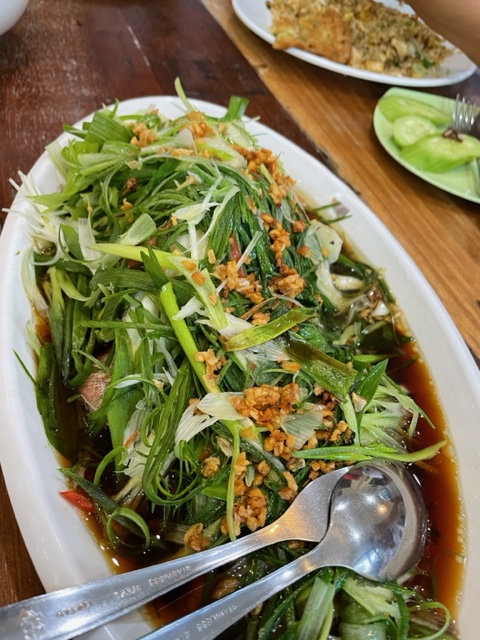
Steamed “HK-style” fish

Leave a comment

Filed under Uncategorized

Glutton Onboard: Family meal on Papua New Guinea

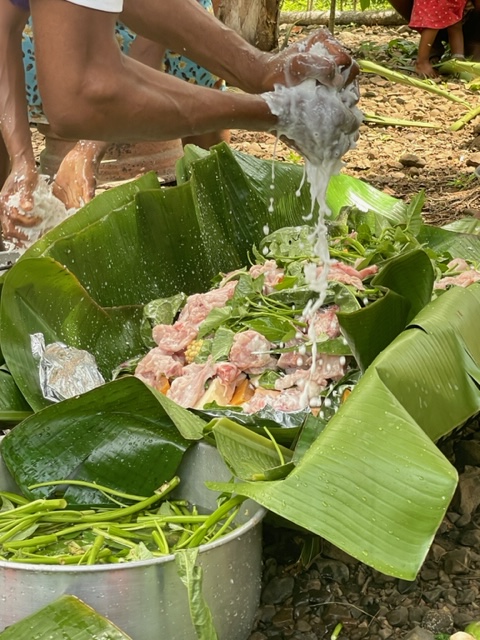
Putting coconut milk on our lunch before cooking

Papua New Guinea might not be where your mind first goes when you think about luxury. Yet it ended up being one of the most luxurious meals I’ve ever had. Riding along the potted road — built by the Americans to move their weapons and machinery during WWII — I was struck by the gorgeous, verdant scenery, the lushest I’ve seen yet, a broad, uninterrupted swathe rimmed by a restive, deep blue sea on one side, and thickly forested mountains wreathed in fog on the other. Our guide told us that the creeks and rivers, currently tamed, frequently flooded over the roads, occasionally strengthening enough to wash cars away.

Where we were headed was a village, where we would be taught how to cook “authentic” PNG food. Now, I dislike the word “authentic” and how it is used to either market or police food cooked by others, but Papua New Guinea remains free of this type of navel-gazing. In a place where electricity is shut off during the day and rainwater must be collected for day-to-day use, “authentic” is whatever you can get that day.

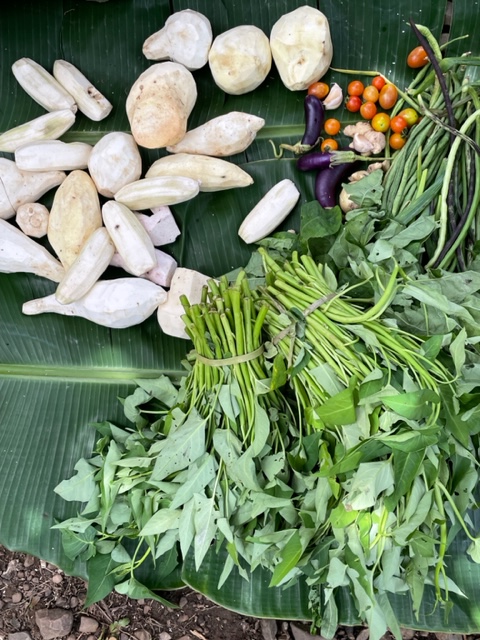
At the village, we are greeted by the chief and his sisters, with a passel of young people behind them. Families live together in each house, and everyone — older children included — appears to care for the babies and toddlers together. Banana trees flourish in profusion, and gardens abut every house, bristling with pumpkin and squash shoots, sweet potatoes, taro root, corn, cassava, and … what else is that I see? Long beans? Cherry tomatoes and eggplants? And what is that behind them? “Kam kung,” they say, and I recognize it as our own “pak bung”, or morning glory.

“Morning glory?” says Maureen from Vancouver next to me. “Usually we’re trying to get rid of it, not eat it!”

Raw ingredients, ready for the mumu

The root vegetables are quickly peeled with paring knives and chopped into bite-sized pieces by mothers and children alike, every one taking part in the meal preparations. What they are preparing is a “mu mu”, which I normally think of as something that I wear, Mrs. Roper-style, on an almost daily basis. Here, it is a big celebratory feast, the ultimate party meal: in this case, made for three busloads of strangers that they’ve only just met.

Next to the vegetables, a young man sits on what Thais would call a “grathai”, shredding the coconut which will later be squeezed into milk to season the meal.

The vegetables, once cut, are eventually bundled onto a large metal “roasting pan” lined with banana leaves. A few feet away, the men are busy cutting what appears to be a mountain of chicken: frozen from the supermarket, not the large rooster and hen looking on from behind a clutch of bushes off to the side. If there is one thing I’ve been especially struck by in my travels so far, it’s how safe and unmolested the chickens have been, from Easter Island to French Polynesia to Papua New Guinea. They run freely along roads, screeching at passersby, pooping on footpaths, making general nuisances of themselves. You and I both know where they would be in Thailand: plucked, beheaded, chopped into 8 pieces and sizzling in hot oil in a wok somewhere. Apologies for the anti-chicken sentiment, animal lovers.

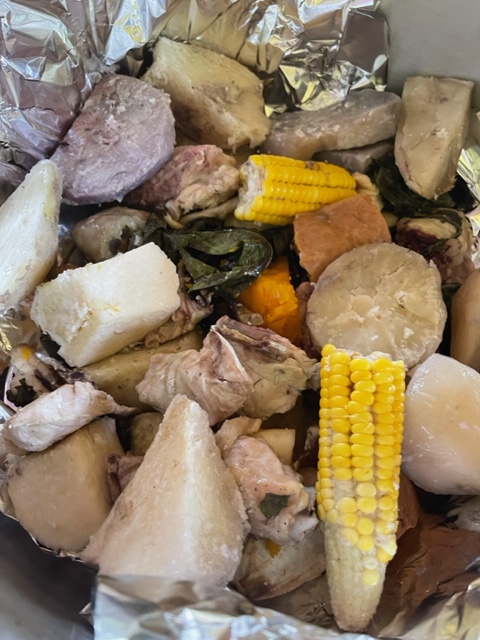
Once properly butchered, wings separated from breasts and thighs separated from drumsticks, the chicken are laid on top of the vegetables, and the coconut meat that has been painstakingly scraped from the shells is bundled into cloth and squeezed with water onto the whole shebang, to which a generous knob of ginger, cloves of garlic, curry powder and Maggi sauce have been added. Then what appears to be an entire roll of aluminum foil is laid over to cover, and then layer upon layer of banana leaf on top of that.

This whole thing is then laid into a shallow hole in the ground, prepared just for this purpose, where rocks have been heating this whole time. The rocks must be moved aside; this is another long, hot, back-breaking process involving one shovel, a pair of giant “tongs” made by a bent bamboo stalk, and the emptied halves of coconuts. The meal is then lowered and covered with those very same rocks that they have spent all that time removing. There it will stay, for 1-1.5 hours.

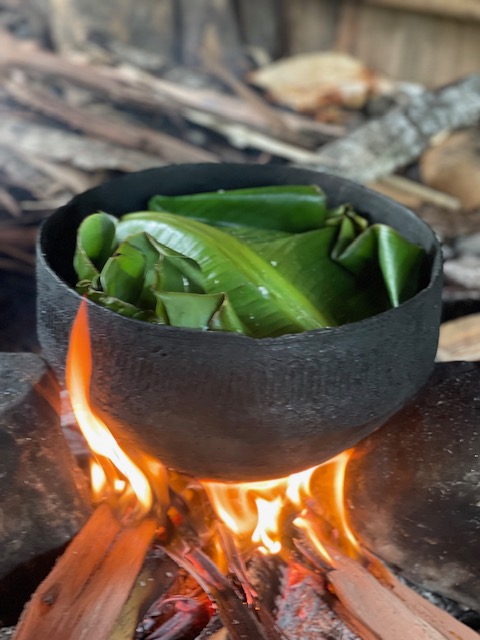
If this sounds like a very long and arduous process, that is because it is. But sometimes people are not so patient, especially if they are hungry. The villagers have attempted to assuage some hungry tummies with “snacks” steaming in banana leaves, heaped into pots set over open fires.

(Photo by Wikki Bhanubandh)

Inside those leaves, there is sweet potato, corn, and some delicious ibika leaves strongly resembling the greens that line the bottom of a Thai “hor mok”. Yellow watermelon, fresh ripe mango, and pineapple are also laid out on plates. But the heat has made some people cranky. “We’re leaving!” bellows one woman, and the first busload leaves, hardly an hour into the cooking process, in a rush for the shipdeck American barbecue buffet.

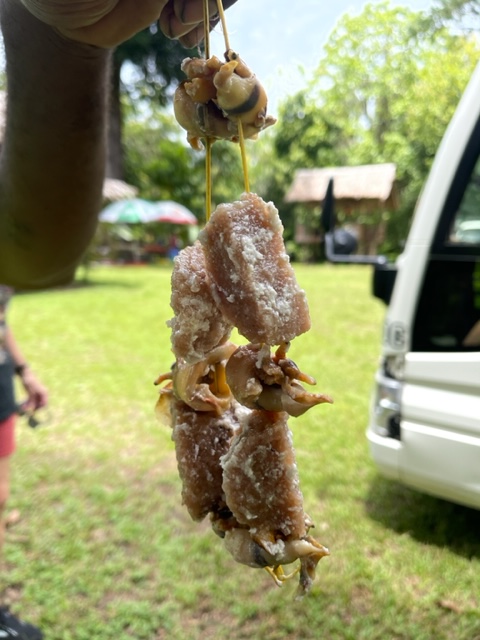
Perhaps feeling the pressure to feed these visitors who seem so hungry, we are offered some alternate snacks. My nephew Weka is offered a snack of snails on skewers, steamed with taro root.

(Photo by Wikki Bhanubandh)

Elsewhere, at the site of where the chief says was the village’s last feast featuring human flesh, Wikki and I are offered the meat of the betel nuts that grow on high trees throughout the village. A young boy, a band connecting his feet, scrambles up to the very top of a particularly towering tree, collecting a sheaf of green nuts and bringing them down just for our enjoyment. Once down, a woman cracks open a nut with her own teeth, revealing the white flesh inside. “Here,” she offers, and of course, the polite thing to do is to accept. The meat is almost aggressively bitter, and tannic like the most inaccessible pea eggplant on your chili dip platter. But like an artichoke, it sweetens the water you drink afterwards.

The woman offers us her own slaked lime, homemade from burning coral and then mashing it into a powder in a mortar and pestle. She uses the stalk of a mustard leaf to put the lime into her mouth with the betel nut, and it is the chemical reaction between all three that turns the teeth red. “You don’t need to brush your teeth because this is calcium,” she says of the slaked lime, and I believe her, because her teeth seemed extremely strong when she was breaking open that betel nut. The effect of all three on your brain, we are told, is increased energy and excitement.

But our betel nut explorations are interrupted by news that the mu mu might be ready. One of the chief’s sisters tests the meat with a small paring knife, and then the hot smoking rocks that cover the pan are removed, again painstakingly, with the same modest utensils. The pan is lifted out of its hole and brought to what the chief calls “the business arena”, the main building where the pots have been steaming snacks all day.

Alas, when the banana leaves and foil are uncovered, the meat isn’t cooked. It’s still pink. In the villagers’ eagerness to feed everyone, they have piled on too much chicken for only an hour’s cook. We will have to wait another 30 minutes. Unfortunately, the second busload decides that they, too, will say goodbye. “They tried,” one of them says as they board their bus, but really, what I am thinking is that they meant “We tried.”

There is no way the rest of us left are leaving. We will be getting fed at this village even if it means we’re staying until the next cruise ship excursion tour finds its way here. We know where all the food is, where the bathroom is, even how to chew our own betel leaf. We can pluck mangoes from the trees and pry snails from the leaves. We might even teach the villagers to collect the red ants from the bark and to throw them into a vat of heating coconut milk for a bright hit of acidity.

But the villagers are saved from our continued presence after 15 minutes, when the chief’s sister decides that the edges of the pan are ready for consumption. Those items are scooped from the pan and placed into bowls, set up into a sort of impromptu buffet in the business arena. We the guests have already broken two of their wooden benches, so we sit perched on the mezzanine made of bamboo, which thankfully still takes our weight. Some children play peek-a-boo with us from open windows, while a group of girls plays with another guest’s long blond hair, braiding it into elaborate plaits.

Sitting with my bowl made of woven banana leaves, eating my food with a bamboo skewer, and drinking from my own little coconut, I am struck by how the villagers have given me a new appreciation for what hospitality really is. In the midst of all of their challenges — weird demanding foreigners, tourists wandering into random homes to snap photos, the constant demand for food, drink and entertainment — they set out an enormous meal, sans electricity and running water, in the broiling midday heat. They put on a dance show, made chitchat with all the guests, and even hosted a walking tour, showing various points of interest like the pool of water that former chiefs used as a “mirror” to fix their hair. Really, the generosity seemed the epitome of luxury, to me: in the midst of what would appear to us to be very little, the abundance of so much sincerity.

6 Comments

Filed under Uncategorized

Glutton Onboard: Celebrating traditions on Fiji

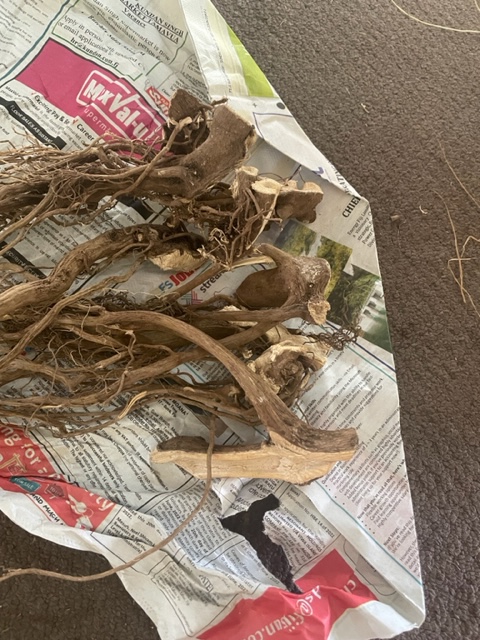
Kava roots

The kava “tea” ceremony is still a mainstay of any celebration in this region, marking weddings, birthdays, major national holidays, and, apparently, the arrival of a big group of sweaty tourists from a cruise ship. Nearby American Samoa celebrates the sacred tradition of preparing and drinking this tea, but it really seems to be ingrained in life here on Fiji: kava “saloons” selling the drink abound along the road, as do cafes where it is sold jointly alongside coffee.

I’d heard mixed things about kava, but as all Fijians seem to say to us whenever asked about it: “If you haven’t tried kava, you haven’t been to Fiji.” Prepared for centuries from the root of a tree in the pepper family, it was formerly considered a drink of the gods, consumed only by (male) village headmen. Today, anyone can drink it, even me, but it is important to observe good manners before imbibing this sacred tea: an uncovered head, a clap of the hands (only a hollow, loud, ringing clap will do), and a shout of “Bula!” are all advised. I attempted this myself, in my own lame way, so was unable to take a photo of myself drinking the tea or of the tea itself. You can simply trust me that it looks like strong, soapy dishwater.

The preparation of the tea itself takes time. Kava is made by chopping up the plant’s roots, drying them out in the sun for a week, and then grinding them painstakingly into a powder in a mortar and pestle for a few hours. The powder is then wrapped in a cheese cloth and steeped in water in a special bowl made especially for the kava. This large bowl is what everyone drinks from, with hosts scooping out the liquid for their honored guests using hollowed-out coconut shells.

Kava itself is celebrated for its healing effects, said to help with a wide variety of ailments including anxiety, insomnia, headaches, menstrual cramps and arthritis. My own experience on drinking it was … not much flavor at all. After all the cringing and grimaces from fellow travelers who had tried it before, I was expecting something much more repellent. But then the tingling of the tongue and the numbness of the mouth kick in, and after a few minutes, I see why Fijians joke about mistaking rocks for their own babies and taking the rocks home. One passenger in another tour group drank two bowlfuls and ended up unable to locate his own bus on the way back. I am amazed this drink is sold by the roadside.

At least now I can say I’ve been to Fiji.

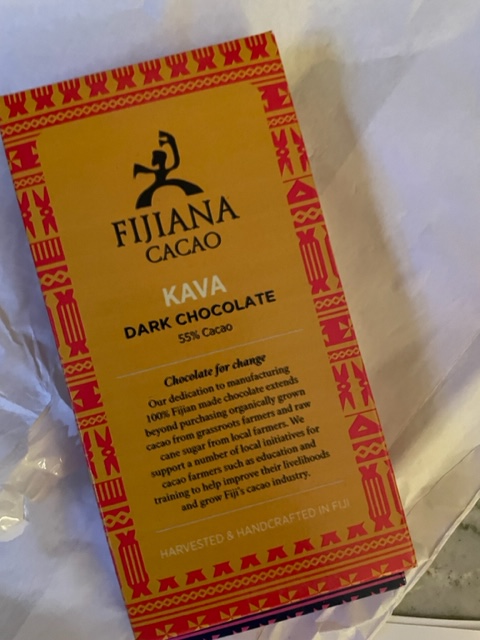
A present for my friend Chris

Leave a comment

Filed under Uncategorized