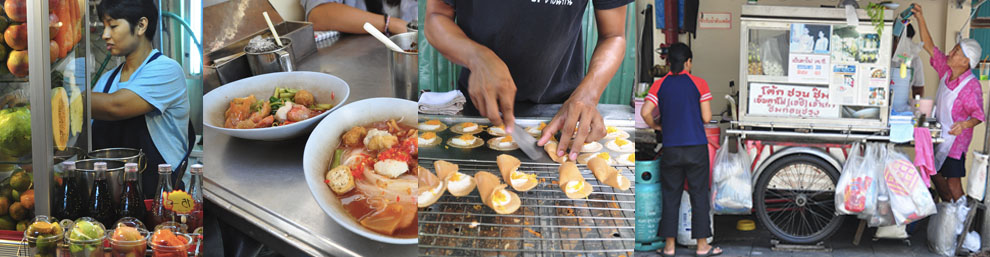
One of the things about turning 50 is seeing — or I should say experiencing — how quickly my eyesight and hearing have deteriorated. Even restaurant menus are beyond my purview; when the lettering is too small, I have to straighten my arms to read, only to discover my arms aren’t long enough. It’s unsettling, after all these years, to not know exactly what you’re going to eat, or to not have a handle on all the dishes available to you.
My hearing is another issue. People frequently say things to me either too quickly or too softly, and I’m pretty sure the problem is with me. This makes me quite angry. But my anger isn’t because I can no longer hear what other people are saying. It’s because people still feel like they have to talk to me in the first place.
All the same, I was excited when I heard from Aarya that she was going to show me her “hometown” in Loei, on the banks of the Mekong River, a place I had never been. So when Aarya invited me on a road trip of her province, I put on my fat pants — which are now just my pants — and followed her there.
We met at the airport, where she picked me up in her blue pickup. We had a big day ahead of us, so we headed off immediately to our first destination, Pa Hin Ngam National Park. Perhaps stupidly, I had not yet eaten breakfast, so I was eager to see the options when we got to the park entrance. Alas, there were none. After traveling a further 2 km and parking in front of a mountain with a rambling metal staircase built around it, we found a bunch of vendor stalls selling piggy banks made out of bamboo, a coffee stall with great iced tea served in a bamboo container that we could take home (there was a lot of bamboo), and a natural medicine vendor who let us sample his “sore throat” tea, but really had tea for every possible ailment: period pains, headaches, arthritis, even hemorrhoids.
But no food … though we did discover an elaborate shrine (including clothing rack full of dresses) set up for the spirit of the mountain, whom, the coffee vendor told us, she’d dreamed of only the night before. “She’s very pale and so so tiny,” she said, describing the spirit’s appearance, which conveniently lined up with the statue of her at the shrine.
Maybe I would get lunch at our next stop, the “Mt. Fuji of Loei” only 15 minutes away. We piled back into our car and drove to the visitor’s center, where there was an “aharn tham sung” (made to order) and noodle stall. Alas, Aarya had no confidence in them. “Let’s wait until the next village,” she said. “They just opened yesterday.”
On the way up the hill, taken by a repurposed tractor with seats added onto the back and in the front where the plow used to be, we passed by avocado, guava and dragonfruit trees, and our guide even let us pick some of the wild guava — shaped and colored like a tennis ball — to taste. They were full of seeds which were a bit bitter, but the flesh itself was fragrant and wonderfully crunchy. We picked a bagful to take home to Aarya’s mother. The trek itself up the hill, made up of three “checkpoints”, was fun if a little alarming in our tractor.
But still no food. So on our drive to our third stop, Phu Kradueng, we insisted on stopping in town — only to discover it in the throes of a rocket festival, a huge (for the village) procession blocking the road as “mor lam” music blasted from the speakers of a truck.
When we finally did make it past the procession (after busting some of our fave Thai dance moves alongside a man dressed as a nurse, a woman jabbing a faux penis on a stick into the sky, a couple of children, and a happy monk) everything was closed except for a restaurant called “Thum Loei” which served, obviously, som tum.
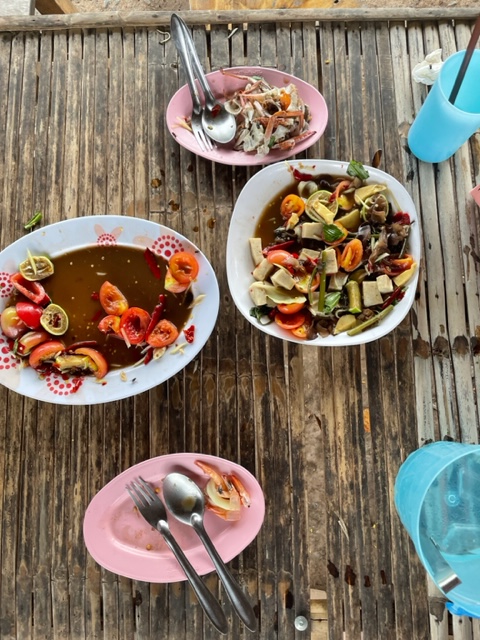
So we of course ordered som tum, a local pad mee (fried noodles) and kanom jeen sot (fresh fermented rice noodles with a dipping sauce) as the sky opened into a downpour and an enormous spider the size of my hand scuttled down the wall behind Aarya.
But we were finally getting our food. Our som tum arrived, funky and fresh if a little sweet, as did our Loei-style noodle salad (which we had to send back for more lime juice because frankly it was super-candy-like-sweet):
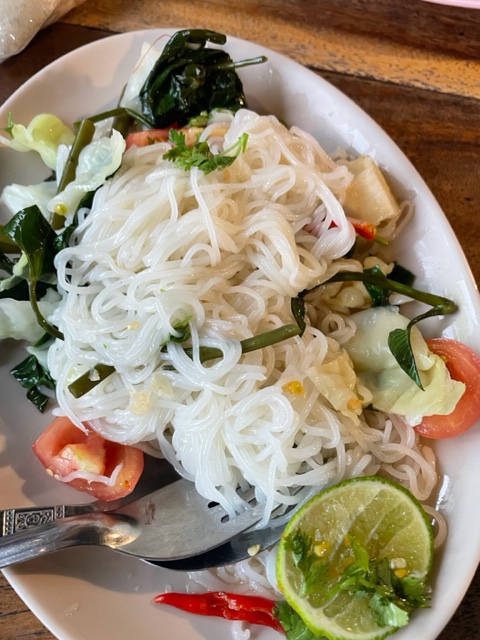
We also had a dish that Aarya says is served all over Isaan in different iterations. Here, it was comfortingly plain, a nice foil to the spice of the other two. Aarya says that her mother makes it with local deep-fried catfish at home, and I was excited to try that for myself.

Heading North towards the river the next day, we made it to the border town of Ha Haeo, where we were told the bridge — rickety, wooden, the kind you see in your nightmares — had been washed out by the rains.
Luckily for us (they said), there was a bamboo “raft” that people were using to cross the river at another juncture. Little did we know that they really did mean a “raft” (or should I say “two rafts, requiring the dexterity of a teenaged gymnast”?)
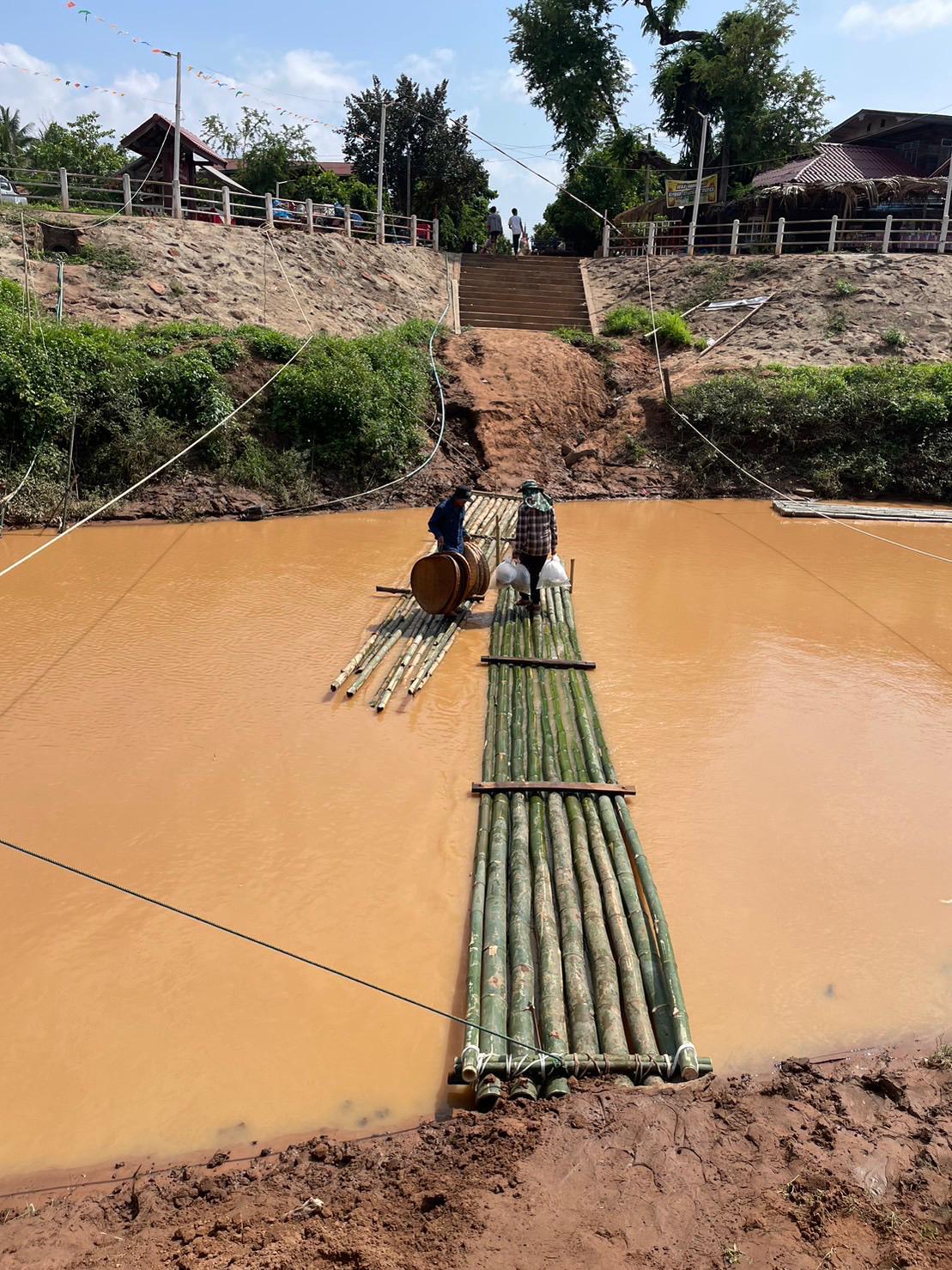
Obviously, I made such a fool of myself screeching as I teetered over the water that a Laotian woman took pity on me and ushered me to the other side. When we got there, we paid a border crossing officer 90 baht each and were left to our own devices. We were in the middle of a sleepy village where a few people were grilling meat over charcoal as a few others halfheartedly attempted to sell things. A temple, decorated with hand-drawn murals depicting village life (including soldiers and government officials) was the main draw here. Luckily our breakfast awaited just steps away: what Aarya called “pho” and what we just call “guay thiew”: a heaping bowlful of it, leavened with freshly picked morning glory and plenty of Lao Beer to fortify us for the walk back.


Aarya was understandably nervous and, as she had decided to buy a whole case of Beer Lao, two bottles of whisky and two bottles of village-made “lao khao” (white spirits), decided to pay our obliging salesperson to carry the items across the river so that we could edge our way, slug-like, along the raft on our own. It was 10:30 and they were preparing to get rid of the raft, so it was urgent work. That was when, after we had basically crawled across step by agonizing step, we discovered that the water was only knee-high; our salesperson had simply hiked up her sarong and crossed the creek on foot. So much for the raft. It was our first experience with the border crossing in Loei.
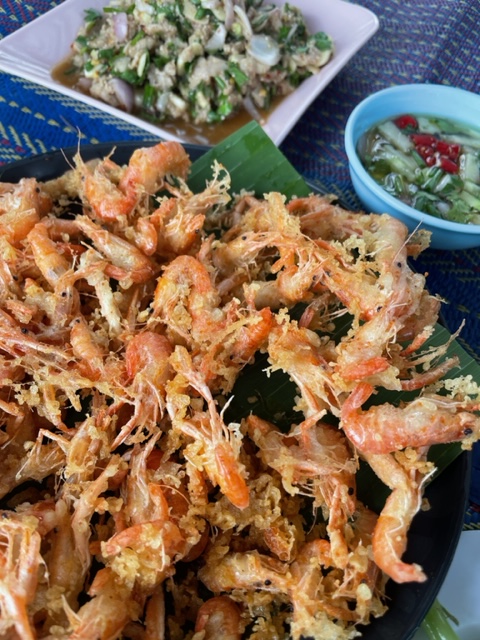
We had better luck later on along the Mekong, a mighty stretch of ochre-colored water across which Laos was clearly visible. At a collection of seafood restaurants specializing in pla nam khong (the local fish) and freshwater shrimp, we stopped at a restaurant advertising its “dancing shrimp” (a spicy salad of live baby shrimp — sorry — with lots of chilies and garlic) and enjoyed a leisurely afternoon by the water with our lunch, happily not balancing over it on a flimsy raft made of lashed-together bamboo.
 Bangkok Glutton
A photo of the raft, please?