I remember my occasional visits to Thailand in the summers of my high school years. These were meant to be earnest explorations of my roots, but ultimately ended up as half-assed hijackings of my long-suffering relatives’ lives. One summer, the relatives saddled with my presence were the family of my father’s older sister, then head librarian at Chulalongkorn University. Every weekday, I would brave the traffic with my aunt, sitting down in a desk in front of her office to write abstracts on various books. This was the extent of my foray into “Thai culture”.
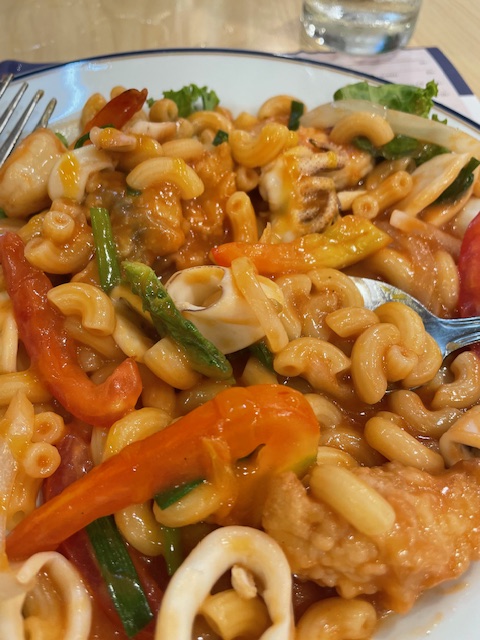
When I was not at the university with my aunt, I was in her home, eating dinners that were obviously made up of Thai food. Occasionally, my relatives would take pity on me and bring home pasta from a “farang” restaurant like 13 Coins or The Carlton. These pasta dishes were invariably based on the recipe for “pad macaroni”, even when they featured spaghetti.
Now, those were the days of restaurants like Paesano, with its famous salad of sliced tomatoes topped with Kraft cheese slices and a sprinkling of dried Italian seasoning, and the heyday of The Cup, home of the Caesar salad made with a clear, lime juice-based dressing. Pan Pan was but a twinkle in an Italian expat’s eye, and pasta was a no-brainer, made quite simply with “sauce makuea tet” — literally, “tomato sauce” but in real-life terms, “ketchup”. In fact, all pasta sauces at the time were based on ketchup mixed with margarine or butter, in which the protein of your choice — ham, seafood, minced meat, hot dogs — would be as generously coated as the chef’s chosen noodle. There was no carbonara, bolognese, alfredo; those things would arrive with the advent of Pan Pan. There was only “macaroni” or “spaghetti”.
Now, I have a lot of negative things to say about where I grew up, but none of them have to do with food. Specifically, Italian food. My hometown, New Castle, had long been known as the town with the most people of Italian descent per square mile outside of Italy. Restaurant and family tables were heaving with smelts, lasagne, cavatelli, braciole, pasta fagioli, and most deliciously, wedding soup, incomplete without an egg-and-cheese crust. So I thought I knew pasta. And these ketchup-coated monstrosities were not it.
I begged my aunt to take me to the grocery store, which in those days meant a trip to Villa, because most grocery stores did not have the ingredients that I deemed good enough for my spaghetti. I got imported pasta from Italy and expensive olive oil. I bought balsamic vinegar for no reason. I got Parmesan cheese — the shakey shakey kind that was the only kind available. I got basil (this was Thai). And I got tomatoes, onions, and garlic, because I was making this shit from scratch.
People, even now, like to complain about Thai tomatoes, charging Thais with not understanding them. It is true that real Thai-bred tomatoes are typically a different breed (literally, duh), tough and some would say rubbery on the outside, tart, watery and acidic within. When you make a sauce out of these tomatoes, they naturally pass those innate qualities on to the sauce. After forcing my cousins to a home-cooked spaghetti meal of “my pasta”, my cousin Boyd said, “This definitely does not taste like ketchup.” We finished the meal. I did not cook again that summer.
It took me almost 50 years to learn to appreciate Thai tomatoes. No, they are not the same kind that sprout up in the volcanic ash on Mt. Vesuvius, so sweet and juicy that no cooking is required to make a good sauce. They aren’t even the beefsteak tomatoes of an American summer, bursting when you bite into them like apples off the vine. They are plum tomatoes, a little oblong like San Marzanos, but that is where the resemblance ends. They are bred for yum salads, for som tum, as sour little punctuation marks in a fatty curry like gang phet ped yang, or as part of a flavor chorus in a soup like tom yum. As with all Thai ingredients that begin with the syllable “ma” (“manao”, or lime; “mamuang”, or mango; “magorg”, or water olive), their point is their acidity. They are not meant to coat pasta. Ketchup is.
Today, I appreciate the occasional ketchup pasta. Maybe this is because I’m sort of from Pittsburgh. Or maybe it’s because I’ve lived most of my life in Asia at this point, and I now understand (a little better) how people adapt their food to their surroundings. Ketchup is not the culinary equivalent of a gaudy golden toilet. It’s not even the Asian food equivalent of an American dousing his well-done steak in ketchup. It’s a piece of history, harkening back to the mid-1900s when post-war Asians began to learn about American food. It’s a tribute to a different time, when we were all younger and more innocent (or not even born). So when Chef McDang told us that he used to enjoy the occasional “pad macaroni” as a child at teatime in the palace, we got to thinking about pad macaroni again (as well as khao pad American, but that’s a different post).
I made it at home. I used leftover pasta, because that’s the point of this dish. I used whatever luncheon meat I had in my fridge at the time. I did buy a green bell pepper from the nearby Fuji though. I just can’t imagine pad macaroni without it.
Serves 2 (if a one-dish meal) to 4
Prep time: 10-20 minutes Cooking time: 5 minutes
- 4 oz (120 g) short pasta of your choice, cooked 2 minutes shy of package instructions (or leftover pasta)
- 2 Tablespoons unscented oil
- 1 Tablespoon butter
- ½ green pepper, chopped
- ½ white onion, roughly chopped
- 1 small carrot or ½ large carrot, peeled and chopped into pieces of roughly uniform size
- 1 tomato, cut into wedges
- 4 slices of luncheon meat of your choice, diced
- 1 clove garlic, minced
- 1 egg
- White pepper (optional)
For sauce:
- 3 Tablespoons ketchup
- 3 Tablespoons Sriracha (Thai, preferably. If making for children, omit this ingredient)
- 3 Tablespoons Maggi or Golden Mountain sauce
If not using leftover pasta, set a pot of salted water to boil and cook pasta according to package instructions, but stopping shy by 2 minutes of recommended cooking time (for most pasta, package instructions say 6-8 minutes, so that would be 4-6 minutes, the extent of the math that we will do for you).
In a small mixing bowl, combine ketchup, sriracha (if using) and Maggi or Golden Mountain sauce until well mixed.
When pasta is cooked, take out of the pot and drain well. In a big frying pan or wok (this is important), heat vegetable oil or other unscented oil and add your vegetables: green pepper and carrot or whatever, onion, and, to be really true to Chow’s memories of this dish, tomato wedges. The wedges are only cooked when the skin starts peeling off.
Add butter and garlic, mix well. Add luncheon meat and repeat the mixing procedure. Push everything off to one side and crack your egg; allow the whites to set a little bit, then scramble into the mixture until well incorporated.
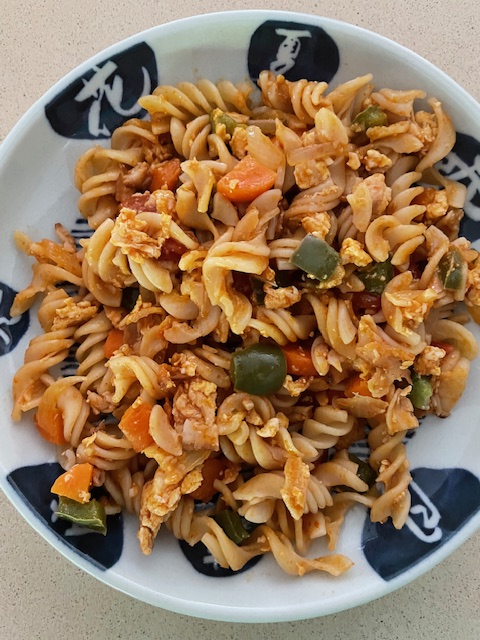
Add your pasta and the sauce. Make sure everything is coated with the sauce. Once you’ve achieved this coating, you are finished. Find a plate that reminds you of your grandma (even if your grandma wouldn’t come within 10 feet of this dish) and decant onto the plate. Serve immediately with a sprinkling of white pepper if you like.


 Bangkok Glutton