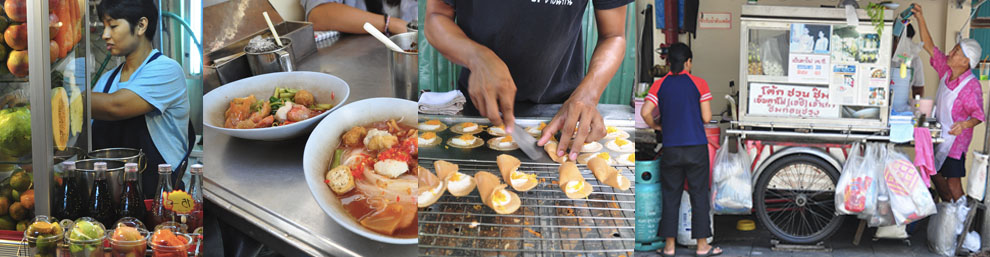

Some people have asked me about my thoughts on the news about Jay Fai’s recent troubles. To be honest, I don’t like discussing it, because it makes me really annoyed, and I’m trying to cut down on my chances of a heart attack before 60. But what it really makes me think about is how strangely things turn out sometimes. After all, Jay Fai was never meant to be the kind of chef that people waited hours in line for. That was the whole point of her prices.
I first learned about Jay Fai through food writer Bob Halliday, who used to write for the Bangkok Post under the self-deprecating nom de plume “Ung-Ang Talay” (“Sea Toad”). It was the early 2000s and Bob was a treasure trove of information about all the wonderful things waiting to be discovered in Bangkok, a city that until then I had only had surface knowledge about. I suspect he was that kind of repository of information for many people. From him, I learned about homemade streetside samosas in Phahurat alleyways, jade-colored egg noodles on Sukhumvit 38 (now gone), the long-stemmed durians prized most highly by discerning Thais. Thanks to his tireless championing of Jay Fai, my friend Noy had her farewell celebration there, in an open-air dining room lined with hospital-green tiles to eat dishes I rarely ate: “dry” congee, “dry” tom yum, stir-fried crab in curry sauce, drunken noodles, and lard na with prawns the size of my fist.
Needless to say, I was hooked. Anytime someone from out of town, close friend or stranger, wanted to take a bite of “street food”, I took them to Jay Fai first. Some people got it, and some people didn’t (I remember one Chinese news crew who ignored the food completely and decided to focus on the activated charcoal tablets you buy at 7-11). One thing you could count on: there was never a line. The prices acted as an immediate filter; after all, not everyone wanted to pay 350 baht for a plate of fried noodles or 800 baht (early 2000s prices) for a tureen of tom yum soup. If you didn’t think it was worth it, you didn’t have to go.
I remember the night that Michelin gave Jay Fai a star very clearly, because I was there that night. It was 5:30 in the afternoon and empty, and I was waiting for my friend Robert to show up. Jay Fai suggested I get the “suki hang” and I did, and of course it was good. She asked me if I also wanted the poached fish with dipping sauce (she was always asking if I wanted something else, because that’s what she did with all her customers) and I thought no, I’d get it some other night, not realizing that I’d never see that dish on her menu ever again. The next day, my friend Winner sent me a photo of an enormous line in front of her shophouse, looking like a line for sushi at Tsukiji Market. I was happy for her, but I knew that my time there was effectively over.
Some days, I think that maybe the Michelin star was more of a curse than a blessing. The moment that news was announced, the tax authorities were on her back, tallying up all of the dishes she sold and comparing them to the taxes she paid. Now they are back, because an influencer came with a regular customer who always ordered the crabmeat omelet (why) “VVIP style”. He never complained about the prices, but she didn’t know he wasn’t picking up the tab. So now the trusty Bangkok authorities are back: the tax people tallying up her sales, the Commerce Ministry fining her 2000 baht, and the government threatening jail time after the fine was seen as laughably small. What this tells me is that I need an influencer who can make a social media post about the huge pothole in front of my house.
We know why the government is up Jay Fai’s ass, but we can spell it out all the same. The fact is, her success is galling to these people. If there was a person who could stand as an ambassador for Thai food, why should it be her — a former seamstress from a working class background, no high-society connections, no blue-blood pedigree, not married to anyone’s cousin, not even a cooking show on channel 3? Specializing in a food that is eaten by everyone — fried noodles, Thai omelets, nary a curry or obscure chili dip unearthed from a cookbook from the 1800s in sight? How is it that this woman — who is elderly, mind you, and not even a fashion model — would capture the international imagination so thoroughly that the mere photo of a wok over a charcoal brazier is seen as a reference to her? Good Thai people don’t understand this. It seems unfair.
The lesson I am getting is that there are places (and people) that people line up for, and that there are places (and people, I am one) that are a more acquired taste, and that this is okay. “Crossing over” may sometimes be more trouble than it’s worth. The flip side of this coin, of course, is when a shophouse draws people from all corners of the city to a ramshackle old storefront on the fringes of Khlong Toey market — no fanfare, no hype, and definitely no Michelin star. That place is Heng Chun Seng.

My friend Andrew took me here when I was trying to map out a walking tour of Khlong Toey market. It turns out that this place has been a favorite for decades, from back when Andrew’s father was young. Today, it seems more known for its hot pot (it was on every table), but Andrew recommended the soup noodles, which are ordered with your choice of cut: shank, meatball, sliced, stewed, tendon, tongue, heart, liver, stomach, intestine, even spleen. There’s even a pork option for people who don’t eat beef.
There’s a long line. As with all long lines, there’s a hard-working and long-suffering man working it with notepad and menu in hand, taking your order so that when you do sit down, your food will come as soon as it can (there’s also a hard-working and long-suffering woman who works the kitchen, mostly alone). And yes, as with all long lines, there’s a lot of waiting, both before and after you get seated.
Is it worth it? Well, I was happy to eat at Jay Fai pre-Michelin star, so maybe you don’t want to take my word for it. Try it out for yourself. What I can say: don’t order the “fresh” sliced beef, which gets tough before your eyes, and order the hotpot only if you have native Thai levels of heat tolerance (and I’m talking about the temperature outside when I’m saying this). What you don’t have to worry about is this place being a fad and disappearing into nothingness, Bangkok-style; it’s been here for decades and is likely to be here for many more … as long as they don’t become too famous.
 Bangkok Glutton
Really enjoyed this post. The psychology behind lining up for food is fascinating—how anticipation, social proof, and the shared experience can make a meal feel more special. I’ve definitely found myself waiting in long queues just because everyone else was doing it, and honestly, sometimes the wait does make the food taste better.
It also reminds me how storytelling and culture play a huge role in food experiences, not just taste. I’ve been exploring similar food stories and simple recipe ideas here: https://pendafoodhub.com/ — it’s interesting how different cultures value food experiences in their own way.
Thanks for sharing such a thoughtful perspective on food and human behavior.