For the past few months, people who have been unlucky enough to dine with me have had to endure listening to my hot takes on “Bon Appétit, Your Majesty”, a Korean historical rom-com in which a modern woman pulls an “Outlander” but for food, not sexy times. Whereas “Outlander” is for woman who fantasize about having two husbands, but in a way that’s not their fault, “Bon Appétit” is for people who fantasize about having their food skills applauded and revered without having to actually think of anything ground-breaking themselves. Thus, our modern-day heroine finds herself back in the Joseon Dynasty, where the king is really mean but also really cute in an Edward Cullen “I might kill you someday” way.
To stay alive, she has to keep making dishes that our discerning gourmet monarch — again, this is historical fiction — will appreciate. Cue the parade of “Korean” dishes: pasta, steak, macarons, a stew made with a freaking pressure cooker, all of which dazzle everyone who is lucky enough to try them, none of which is strictly of the time (or even of the country). Obviously, she is hailed as a culinary genius (this is the fantasy part).
So stricken was I with this fantasy that I ended up watching the entirety of a Thai take on this concept, “Good Heavens! I’m a Goose not a Swan” (it must sound catchier in Thai). A woman goes back to Rama III-era Bangkok, where she catches the eye of the capital’s most eligible bachelor and comes up with an all-you-can-eat “moo kata” (pork BBQ) buffet, a nail salon, and freaking bubble tea.
As ingenious as all of these creations are, neither of these women invents a flushing toilet.
Now we find ourselves at another culinary crossroads, one not kickstarted by any time-traveling heroine (that we know of) but by the vicissitudes of modern times. I think most people who follow the current Bangkok dining scene would agree with me that the days of slavishly recreating royal Thai and even aristocratic recipes are over. What I mean by this is that royal and aristocratic Thai menus are not the only avenues for winning accolades and stars. A new type of Thai food, driven by people like Chef Prin of Samrub x2 Thai and Chef Jai of all the Charms, has been percolating for a while, inspired by the regional cuisines of Thailand’s various nooks and crannies and made by regular people for regular people. This kind of food is malleable, open to interpretation, and flexible enough to accommodate each chef’s various experiences and points of view. This is the type of food that “Bon Appétit”‘s heroine would have given rise to among later generations of chefs, if she had stayed long enough to see it (spoiler alert).
All the same, restaurants driven by aristocratic family recipes are still bubbling up all around Bangkok (this is Thailand, after all), following the precedent set by forebears like Thanying and Kalaprapruek. One of these is Somdet Cuisine by Chatcharee Bunnag, which is only open by reservation. Not surprisingly given the name, the recipes here hail from the Bunnag family, of which my husband is a member (the Bunnag family has a million different branches; you might be a member too).
My friend James who lives close by booked a table for us, and we had fun imagining what the food might be without actually looking it up. James wrote up his own imagined menu, which included dishes like “Genealogical Fish Cakes — minced sea bass hand-shaped by a third cousin twice removed from the Bunnag line who now works in finance (B1280)”, “Massaman Verification Stew — rich, tender beef in a cardamom-heavy curry ‘exactly like Grandmother made,’ according to an uncle who’s never cooked (B1620)” and “Sticky Rice Inheritance Dispute — served warm with mango, coconut cream, and the bitterness of three siblings fighting over Chanthaburi land (B1240)”.
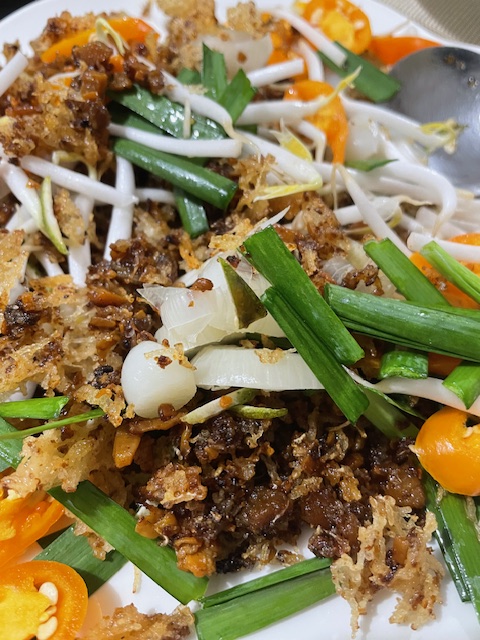
It may surprise you to learn that none of these dishes was on the actual menu. Instead, there was a green curry with beef (there always has to be a green curry with beef) but with slivered long beans instead of pea eggplants (which is kind of sacrilegious to my husband’s branch of the family). There was a nice fish fried in fish sauce with an accompanying green mango salad, and mee krob (deep-fried noodles), another difficult dish for me to make personally. There was even chicken with cashew nuts and pad Thai (which we’re told is popular at lunchtime).
After dinner, we lingered in the courtyard, part of the compound where everyone actually lives, and listened to stories about the founding of the restaurant from the current-generation owner: so many family members came over to eat after events at the nearby temple that people thought it was a restaurant, so the owners thought, why not? Although the restaurant is over on the Thonburi side, it’s in a charming neighborhood within walking distance from the Chao Phraya Sky Park and the river, making it a great evening option right now. The best part: you won’t have to go back in time to enjoy this piece of history.
 Bangkok Glutton