If you follow astrology, you will have read that there is a big shift in the world from the sun exiting Capricorn and entering Aquarius. Of course, if you follow the news, you are already well-aware that a big shift in the world is underway, and that things are unlikely to ever return to how they were before. Personally, I have experienced more than my fair share of changes over the past 12 months. I have (unwillingly) moved out of my house, am an empty nester, and find myself free from any writing projects for the first time in at least two years.
Maybe because of this, I have had a hard time shifting out of the grieving process — grief for my old house, of course, but also for my old life, which wasn’t perfect, but was perfect for me. What makes things more difficult is that I have to put on a brave face for my husband, who feels bad when I grieve, so here I am on the Internet, grieving in front of an audience of mostly strangers. I erroneously believed that Joan Didion once wrote “Growing old is saying good-bye”, but she would never write something that simple-minded. She wrote “It is easy to see the beginnings of things, and harder to see the ends” and also about being nodding acquaintances with your past selves, all of which I understand well now but wish I didn’t. Some other things that I’ll have to say good-bye to this year:
- Money (that Lonely Planet payday went quickly!)
- Prozac (Eli Lilly is no longer making it, citing the proliferation of dupes on the market. I don’t like the dupes, and my therapist says I don’t need them. This is all a good reason for me to hide away in my new abode, as I fear what will happen with an unmedicated me unleashed on the world).
- Any pretence that I’ll get to read “A Dream of Spring” by George R.R. Martin
- My hair
Since Joan Didion didn’t write about saying good-bye and getting old, I’ll say it. The longer you spend on the planet, the more used you become to saying good-bye and doing without. There will be other, much more difficult good-byes than the ones I’ve had to deal with coming up. But since this is ostensibly a food blog, I’ll have to focus on something that we never thought we’d have to say good-bye to, and that is curries.
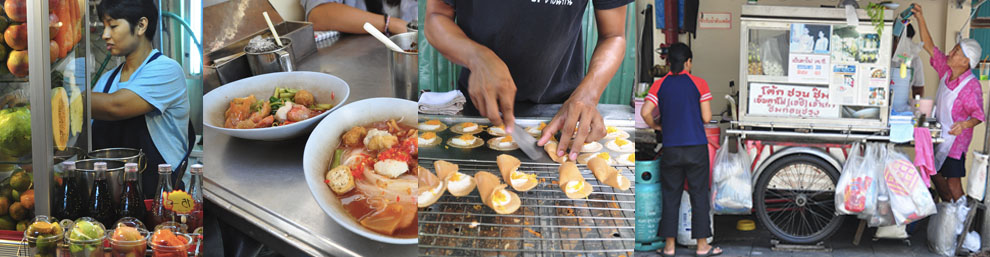
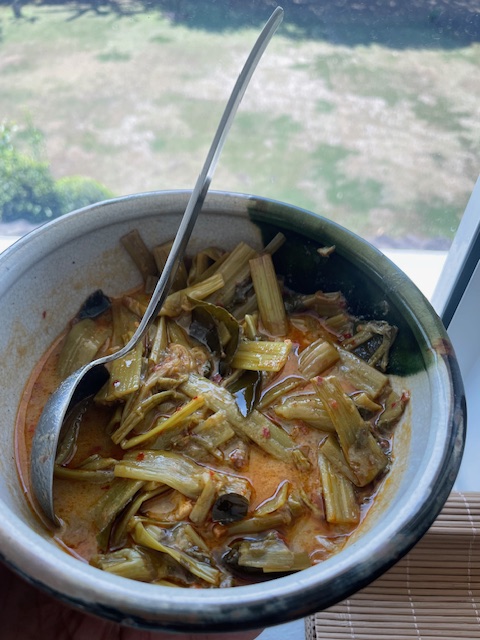
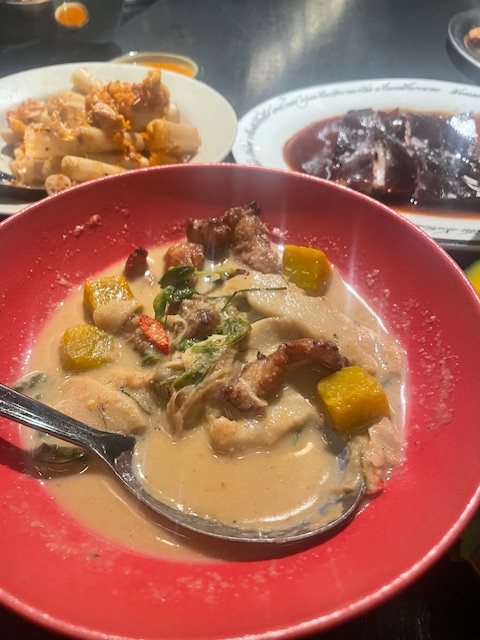
“What?” you say. “Curries are everywhere,” and that’s mostly true, though a recent stop at Nang Loeng Market shocked me when I saw that Khao Gang Rattana had shrunken to half its former size (street food Ozempic!) When I talk about disappearing curries, I’m not talking about the heavyweights like green curry and massaman curry, the Bruce Springsteens of the Thai curry world. I’m talking about curries that are harder to find: the thom kati (things simmered in coconut milk), the gang taypo (red curry with morning glory and tamarind juice), the gang ki lek (cassia leaf curry), and the super-regional stuff like white curry (from the Deep South, it has no chilies in its paste base). These are dishes I get excited about when I see them, so when I find myself at Or Tor Kor, I invariably end up at Mae Malee, where these curries rub elbows with their more famous brethren.
But even Mae Malee, and famous curry rice shops like The Originals Mae On’s Curry Over Rice in Saphan Han, have been forced to follow the times and offer more stir-fries, fried chicken and one-dish specials for diners, who are used to eating alone. One-dish meals, like pad kaprao and pad see ew are the new staples of the Thai table, supplanting curry, which 1. is wildly labor-intensive if made from scratch and 2. often requires a whole battery of other dishes to accompany it to round out the samrub (meal). Even when you do eat curry by yourself, you are all too aware of your alone-ness; after all, curry is meant to be a communal dish, as communal in spirit as hotpot and Korean barbecue. While eating these things alone is possible (and believe me, I’ve seen it), it also makes one all too aware that it wasn’t designed with the solitary diner in mind. Perhaps this is why there is a proliferation of Japanese restaurants (hand roll bars are the new Wine Connection) and pad kaprao spots. Everyone eats alone, even at home, where people are getting used to having separate meals together (thanks, Line Man, and shoutout to “Being Alone Together” by David and David, and if you know what I’m talking about, congratulations, you’ve been saying good-bye for a while now).
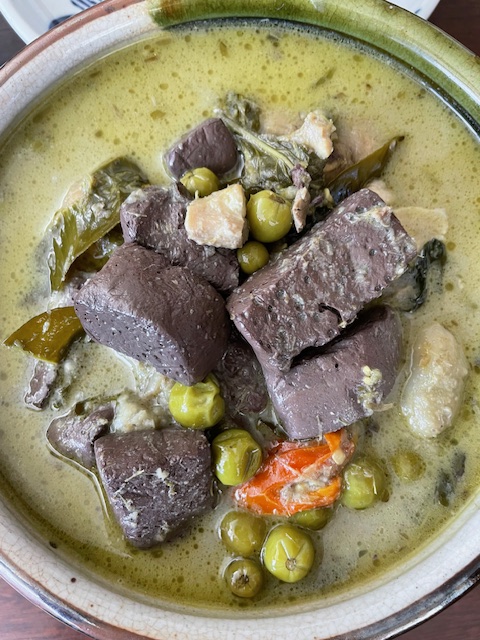
I’m not railing against the end of the institution of eating one Thai meal en famille; I’m saying good-bye to it. It’s what we inevitably do, if we stick around long enough. A few days ago, I shot something for a documentary at Klong Toei market with two young Spanish filmmakers who reminded me of my kids. One of them, Uri, said he supported national culinary boards that would protect the cuisine of each country from veering too far away from the publicly mandated path. I felt like it was a Sisyphean task. “As time goes on, you have to say good-bye to things, that’s what getting old is all about,” I proclaimed, pretending to be wise. On the way home, I bought green curry paste from the market and, because it was just for me, my favorite part of the chicken (that would be chicken blood) to make a solitary curry for myself. It felt like a good-bye, though at the time it was just a good-bye to my market.
When I have knee surgery in a few weeks (again, I’ve been around a while), I will be saying good-bye to my old knee, and seeing what delights the new one has in store for me. Until then, I have the time to say good-bye properly: to my knee, to my medication, to curry, though maybe not to my hair.
 Bangkok Glutton