A long long time ago, in a country far far away, I went to a Steely Dan concert. It was a gift (bought voluntarily, and out of the blue) from my then-boyfriend, during a visit to his family home in Vermont. It was the ’90s and Steely Dan were obviously past their prime, but big enough to do the kind of nostalgia tour that big-name acts from the past rely on as their bread and butter; as a result, the crowd was full of wealthy boomers who were no longer able to immediately recognize the smell of pot (from somewhere, I don’t know where). When we got back to the car, my then-boyfriend punched in a tape of Velvet Underground’s “Loaded” (which was mine, mind you) and, as the start of “Who Loves the Sun” began to sound, pounded on the steering wheel with the energy of a prosecutor presenting a murderer with the evidence of her crimes. “How great is this music?” he shouted, and it was his way of telling me he had had a horrible evening, full of terrible music, regretfully on his own dime.
People who care about music (or me) seem to misunderstand why I like Steely Dan. It’s not the great musicianship or production value, or occasional “smooth jazz” of it all. I like them in spite of these things. It’s because they sound like a beleaguered small-time band playing in the lobby of a down-at-heel lounge in Murray Hill, shoehorning gigs in between 9-to-5 jobs and sermons from well-meaning family members on why giving up on your dreams is the adult thing to do. There’s something about Donald Fagen’s voice that suggests that he is persevering in life in spite of it all, even though he is undoubtedly way richer than me. When he sings “Any Major Dude” (a song that pulled me through some tough times in the past), it sounds like it’s coming from an old guy sitting on someone else’s stoop in the west 40s in New York, who you’ll never see again. That thought gives me comfort for some reason.
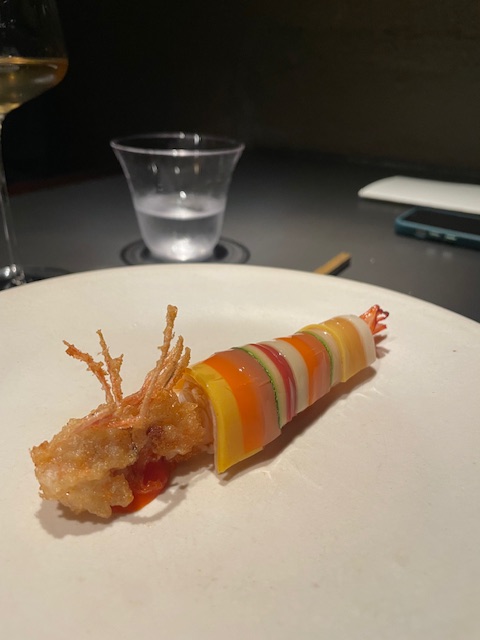
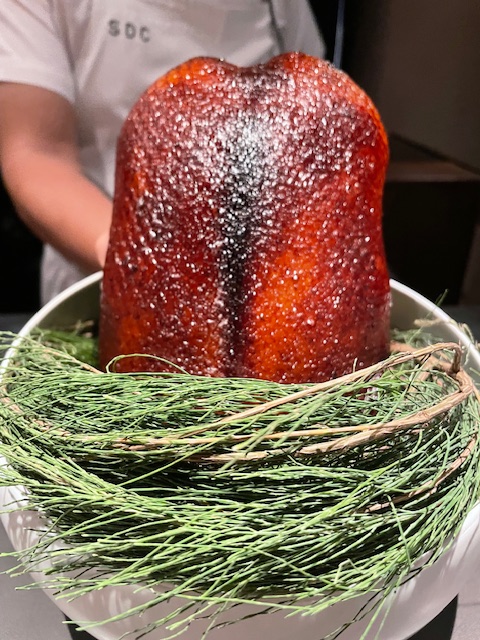
Karma works in funny ways. I had my own Vermont ex-boyfriend moment recently (but not on my own dime), at a buzzy new restaurant on Charoen Krung Road (arguably Ground Zero for buzzy new restaurants). Specializing in modern Thai cuisine, it had won plaudits internationally and had correspondingly taken some lessons from fine dining restaurants in the West. There was an understated, almost hidden entrance leading to a hushed sanctuary within, and the necessary pre-dinner moment of contemplation (15 minutes minimum) where we could focus on original artworks exclusive to the restaurant. The menu (in courses, obviously) didn’t list the dishes themselves, but instead the chef’s inspiration and musings on how the dishes came about, in the sort of teeny-tiny writing that is the bane of old people everywhere. And then there was the food: reimagined classics, or showcases for technique, dishes saddled with names reminiscent of early stage Gaggan (or maybe late stage Gaggan too, I haven’t been to Gaggan in a while).
If I haven’t said this before, let me state this explicitly: I don’t believe in “authentic” Thai cuisine. I believe that the evolution of Thai food is a necessary part of keeping the cuisine alive and vibrant, and that Thai food has been able to remain vital by doing just that over the past few centuries. There is no “real” recipe for green curry, or anything else, aside from the fact that it uses Thai ingredients and starts from a paste (hopefully pounded in a mortar and pestle, but not etched in stone, even though I will judge you, but who cares). I’ll even loosen the Thai ingredients thing if you’re a restaurant abroad, because I believe that great cuisines can evolve from monetary (and customer taste) constraints, just like how Chinese-American and Japanese-Peruvian cuisines were created (and they are great cuisines). I want to see new cuisines sprouting from Thai food. I want to see people innovating and expanding the boundaries of what make Thai food possible. I want it to incorporate elements from everything that is around it, just as it has successfully done since the birth of Thai food.
But I hated this meal. I hated the fact that, today, fine dining = courses, frequently more than you can stand. I hated how seriously everything was presented, in the face of dish titles that highlighted an overarching desire to be a part of the West (you can accuse me of unconscious projection here, even though consciously I do all I can to fight that in spite of my terrible language skills and overall demeanor. You understand my dilemma). I hated that there was plenty of intellectualizing, but no emotional element to the food (this is also a Western trait because post-Rousseau, the West distrusts emotion). And I hated that there was barely any rice, except for a cursory nod at the end, in honor of Thailand’s agricultural roots, of course.
I’ve come to understand that what I hated, really, was the system in which food like this has become necessary. We must have wine pairings like in Western restaurants in order to be taken seriously, even though that’s not our tradition. In the same vein, we must have courses, even though our food is not meant to be eaten that way. Some restaurants (Aksorn, Samrub for Thai, Haawm) thread this tiny hole in the needle by presenting courses at first before serving everything Thai-style at the end. I am OK with this, because I understand that many of us live in a sort of twilight world where we are one thing but also the other at the same time. I respect this because — OBVIOUSLY — and because that is also what modern Thai cuisine is, a “luk krung” (born from two parents or lifetimes of different cultures). And like any “luk krung”, there is the overweening temptation to fall all the way over to the side that is “stronger” (again: my Thai language skills). The dislike for the obvious Western slant in some modern Thai restaurants comes from a dislike of my own weaknesses. But that doesn’t mean that I’m wrong; adhering to a system started by someone else inevitably puts all of your work at a disadvantage. Playing by Western rules for Thai food will always allow people to categorize Thai food as inferior to that of the West.
Time to listen to “Any Major Dude” again, I think.
 Bangkok Glutton