Author Archives: Bangkok Glutton

Bangkok Glutton's avatar

About Bangkok Glutton

Eating and writing in Bangkok.

Saying Goodbye

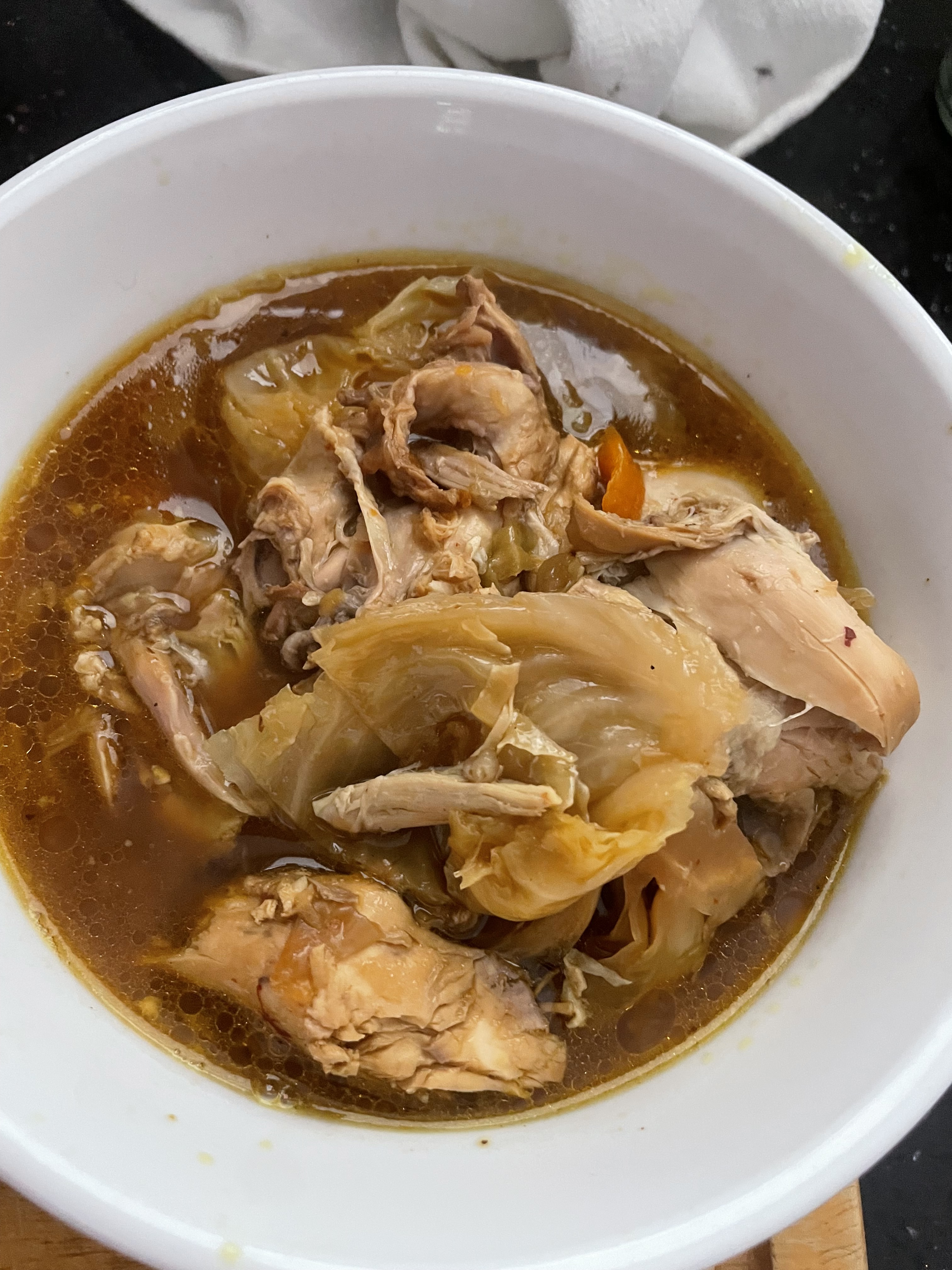
Gang taypo from Or Tor Kor

If you follow astrology, you will have read that there is a big shift in the world from the sun exiting Capricorn and entering Aquarius. Of course, if you follow the news, you are already well-aware that a big shift in the world is underway, and that things are unlikely to ever return to how they were before. Personally, I have experienced more than my fair share of changes over the past 12 months. I have (unwillingly) moved out of my house, am an empty nester, and find myself free from any writing projects for the first time in at least two years.

Maybe because of this, I have had a hard time shifting out of the grieving process — grief for my old house, of course, but also for my old life, which wasn’t perfect, but was perfect for me. What makes things more difficult is that I have to put on a brave face for my husband, who feels bad when I grieve, so here I am on the Internet, grieving in front of an audience of mostly strangers. I erroneously believed that Joan Didion once wrote “Growing old is saying good-bye”, but she would never write something that simple-minded. She wrote “It is easy to see the beginnings of things, and harder to see the ends” and also about being nodding acquaintances with your past selves, all of which I understand well now but wish I didn’t. Some other things that I’ll have to say good-bye to this year:

  1. Money (that Lonely Planet payday went quickly!)
  2. Prozac (Eli Lilly is no longer making it, citing the proliferation of dupes on the market. I don’t like the dupes, and my therapist says I don’t need them. This is all a good reason for me to hide away in my new abode, as I fear what will happen with an unmedicated me unleashed on the world).
  3. Any pretence that I’ll get to read “A Dream of Spring” by George R.R. Martin
  4. My hair

Since Joan Didion didn’t write about saying good-bye and getting old, I’ll say it. The longer you spend on the planet, the more used you become to saying good-bye and doing without. There will be other, much more difficult good-byes than the ones I’ve had to deal with coming up. But since this is ostensibly a food blog, I’ll have to focus on something that we never thought we’d have to say good-bye to, and that is curries.

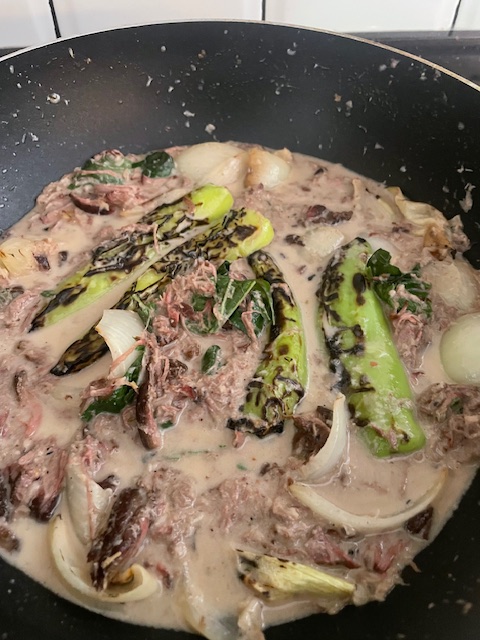
“What?” you say. “Curries are everywhere,” and that’s mostly true, though a recent stop at Nang Loeng Market shocked me when I saw that Khao Gang Rattana had shrunken to half its former size (street food Ozempic!) When I talk about disappearing curries, I’m not talking about the heavyweights like green curry and massaman curry, the Bruce Springsteens of the Thai curry world. I’m talking about curries that are harder to find: the thom kati (things simmered in coconut milk), the gang taypo (red curry with morning glory and tamarind juice), the gang ki lek (cassia leaf curry), and the super-regional stuff like white curry (from the Deep South, it has no chilies in its paste base). These are dishes I get excited about when I see them, so when I find myself at Or Tor Kor, I invariably end up at Mae Malee, where these curries rub elbows with their more famous brethren.

But even Mae Malee, and famous curry rice shops like The Originals Mae On’s Curry Over Rice in Saphan Han, have been forced to follow the times and offer more stir-fries, fried chicken and one-dish specials for diners, who are used to eating alone. One-dish meals, like pad kaprao and pad see ew are the new staples of the Thai table, supplanting curry, which 1. is wildly labor-intensive if made from scratch and 2. often requires a whole battery of other dishes to accompany it to round out the samrub (meal). Even when you do eat curry by yourself, you are all too aware of your alone-ness; after all, curry is meant to be a communal dish, as communal in spirit as hotpot and Korean barbecue. While eating these things alone is possible (and believe me, I’ve seen it), it also makes one all too aware that it wasn’t designed with the solitary diner in mind. Perhaps this is why there is a proliferation of Japanese restaurants (hand roll bars are the new Wine Connection) and pad kaprao spots. Everyone eats alone, even at home, where people are getting used to having separate meals together (thanks, Line Man, and shoutout to “Being Alone Together” by David and David, and if you know what I’m talking about, congratulations, you’ve been saying good-bye for a while now).

I’m not railing against the end of the institution of eating one Thai meal en famille; I’m saying good-bye to it. It’s what we inevitably do, if we stick around long enough. A few days ago, I shot something for a documentary at Klong Toei market with two young Spanish filmmakers who reminded me of my kids. One of them, Uri, said he supported national culinary boards that would protect the cuisine of each country from veering too far away from the publicly mandated path. I felt like it was a Sisyphean task. “As time goes on, you have to say good-bye to things, that’s what getting old is all about,” I proclaimed, pretending to be wise. On the way home, I bought green curry paste from the market and, because it was just for me, my favorite part of the chicken (that would be chicken blood) to make a solitary curry for myself. It felt like a good-bye, though at the time it was just a good-bye to my market.

When I have knee surgery in a few weeks (again, I’ve been around a while), I will be saying good-bye to my old knee, and seeing what delights the new one has in store for me. Until then, I have the time to say good-bye properly: to my knee, to my medication, to curry, though maybe not to my hair.

2 Comments

Filed under Uncategorized

Caring about Thai Food

Gang Lork, or “fake curry” from Phetchaburi at Khao San Sek

I briefly found myself in my old neighborhood and passed by a place called “Lomo” occupying the former No Idea restaurant space. It had the look of a South Pacific-style restaurant in the vein of Trader Vic’s, and relishing the idea of a pupu platter within closer Skytraining distance than the actual Trader Vic’s in Thonburi, I asked my husband if we could go to “Lomo” someday soon. And that’s how I found out what “lomo” is. It’s not a Trader Vic’s-style restaurant.

When it comes to Thai food, I come face-to-face with things I haven’t seen before all the time. That’s one of the things I love about Thai food. I was recently served “gang lork” at Khao San Sek by Chef Worakan “Grace” Krittisirikul, who hails from Phetchaburi (recently designated a UNESCO City of Gastronomy). In a nod to her roots, “gang lork” appeared as part of the samrub (Thai meal) and I was enchanted, both by the taste and by the name. No less an authority than Hua Hin Today (I am not being facetious, HHT is a treasure trove of information, seriously) says that “gang lork”‘s name came from the fact that its non-spicy nature made Phetchaburians skeptical about its curry bona fides, since, to them, curries must make your head sweat and your ears ring.

But Hua Hin Today doesn’t cover everything. And there are times when even my husband can’t explain something about Thai food to me. In those cases, there’s really nothing more valuable than a living database about everything to do with Thai Gastronomy that you can think of (and some things that you didn’t know even existed). Enter: Ros Chaad Thai, a “living archive of Thai gastronomy”, created by the Chef Cares Foundation of Thailand to collect recipes, document changes, and share knowledge about cooking techniques, ingredients and history — a living food library available to everyone for free.

A useful “Top Picks” section gives you a handy geographic rundown of regional specialties — including for Western Thailand and Phetchaburi! — with timely info on things like “Winter Dishes of Northern Thailand”, useful given the amazingly still-cool weather.

Gang gradan in Chiang Mai

There’s a collection of recipes for meal inspiration divided Western-style into appetizers and desserts, plus things with rice (important) and even nam prik (hard to find!) Of course there’s a whole section of Royal Thai Cuisine, but there’s also a handy index on Thai food ingredients with explanations and, even more importantly, recipes for how to use them, extremely valuable when you’ve been to the fresh market and have no idea what to do with the hairy-fruited eggplant you just picked up.

Flowering long beans in Mae Rim

There’s even a section on “Thai Food Wisdom”, which could loosely be defined as “Thai people think it’s important you know this stuff.” This means topics like “samrub Thai”, aka “how to eat Thai food”; “the circle of rice”, aka “why you shouldn’t waste rice”; and “a real Thai kitchen”, aka “why you shouldn’t use a blender for everything”. There’s even a great tab called “Discover” where you can delve deeper into Thai wisdom stuff or find out where to eat certain dishes — really crucial to any Thai food lover and something that should be extended to every country in the world for every awesome dish. And finally, there’s a “Rare Cookbooks” section that allows you to delve into both notable Thai cookbooks and the funeral cookbooks of some of the Great and Good, which is really kind of amazing. What can’t this “living library” do? Aside from actually cook this food for me? Or do “lomo”?

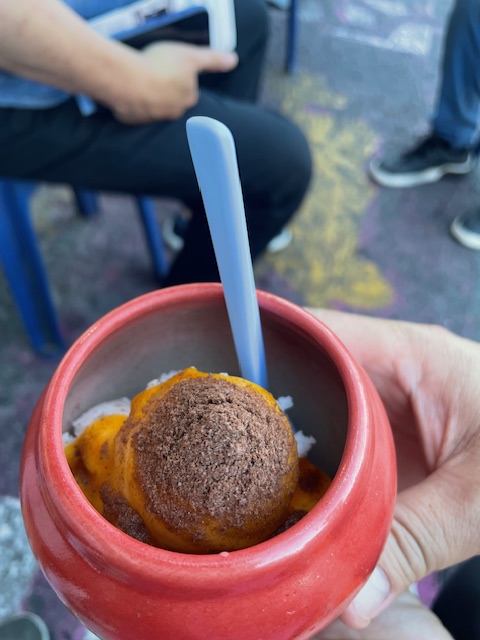
The Phuket shaved ice dessert of “ao aew”

5 Comments

Filed under Uncategorized

Changing with the Times

Fried chicken wings at E-san Bangkok

I have, sadly, been up to my neck in edits (some of which are in our upcoming cookbook). This is widely recognized, I believe, to be the most tedious part of the getting-a-book-you-wrote-onto-a-bookstore-shelf process. Because I have been busy pinpointing some stupid POI on a map that bears only a passing resemblance to Google Maps, or Googling “1/2 cups desiccated coconut to g” all day long, I have had little time for anything else, including this blog.

But I am a liar. I did have time to go out with friends to Charmkok for the first time, the latest in what is likely to become an ever-expanding collection of “Charm” restaurants helmed by Chefs Jai and Aew. Like real siblings, all of their restaurants are interesting in their own ways: Charmgang, the critically-acclaimed eatery featuring regional specialties; Charmkrung, the upscale wine bar where you take your guests from out of town; and Charmkok, the gastropub or “Thai izakaya”, an unheard-of concept way back in 2010 when I first started sincerely writing about food.

Back then, people barely knew what an izakaya was, much less the nuances between a yakitori joint that just happens to have other, izakaya-like dishes (like Yakitori Ise) or an actual izakaya with fewer culinary pretensions, focused on pushing as much beer and shochu as possible (like Kenshin Izakaya). When you talk about a real Thai “izakaya”, you are talking about a glub glaem (Thai drinking food) restaurant like the places littered around the edges of Klang Toey Market at night, pulsing with neon lights and menus full of sun-dried meats and sticky rice. But the gourmet “Thai izakayas”, a trend which arguably started all the way back in 2010 with restaurants like Soul Food Mahanakorn and Issaya Siamese Club, has become the go-to setting for new Thai restaurant openings, marrying decent tapas-sized bites with lots and lots of booze. Charmkok is one of those establishments, and does it very successfully, drawing lines of people on a street chock-full of cool places to eat.

The menu is full of great little surprises like old-fashioned kanom jeen sao nam (fermented rice noodles with coconut milk, pineapple and shrimp) and Southern Thai khao yum (rice salad), but what struck me most were the dishes clearly inspired by Japanese cuisine, like the “chirashi” of Thai seafood scattered over rice, or grilled chicken thigh on bamboo skewers, served with sticky rice and a healthy dollop of jaew bong (Isan chili dip).

As if to continue on this Japanese-y theme, chopsticks were available at the table right next to the fork and spoons — not because the servers were sick of fetching them for Westerners keen on showing off their chopstick skills, but because young Thais, used to years now of sashimi and ramen, have taken to eating their kanom jeen and papaya salad with chopsticks, in the same way they now don the elephant pants and shirts that once signified that you were in the presence of the most clueless of tourists. It’s ironic but not; we Thais, too, eat with chopsticks now, because eating with a fork and spoon is just too easy and convenient (but you still won’t find pad Thai — the culinary third rail of a Thai person in Thailand — on any of these menus).

To boil all of this down: Thai food is in the midst of yet another revolution. It’s always been a chameleon, adapting either through force (during the Rama V period) or through fun (when the Portuguese brought those chilies), and this period, as terrible as it seems, is no different. There were the Italian-central Thai experiments of the ’90s and the French-Thai-“Oriental” amalgams of the ’80s that made everyone scared of using the word “fusion”; today, we are, more than ever, looking northeast to Japan and Korea as their restaurants take up more and more real estate all over Bangkok. The number of Japanese restaurants alone is now around 2,700 in Bangkok from 1,400 in 2015, and judging by new openings, that trend isn’t likely to die down anytime soon. Even more interestingly, the same people who were rending their garments and beating their breasts over green curry pizza and tom yum spaghetti are strangely silent when it comes to kai yang skewers and tom yum ramen.

Some restaurants have full-on made fusing Japanese with Thai their identity. Take, for example, E-san Bangkok, mixing the flavors of Japan with those of the Thai northeast (Isan lolz get it?) Isan food is ripe for this kind of spin, especially the char-grilled meats and fried chicken, though there are also ludicrous dishes which seem more like Instagram bait than anything else:

Grilled corn kernels at E-san

Indeed, Isan cuisine is proving ripe fodder for all sorts of fusions, twisting what was once a little-known regional cuisine (globally, at least) into new and surprising shapes. I was denied a seat at Coffee Beans by Dao (in my old condo, no less) and ended up stumbling into the next closest restaurant, Jaonua, which serves a mix of Isan and Italian cuisine, because why not? Alongside charming dishes like “khao mai pla mun” (“new rice, fatty fish”, an Isan saying that ushers in the cool season) are Western-style salads that add fermented fish sauce (pla rah) and pastas that include cured Isan sausages, and, of course, Caesar salad (because every Western restaurant in Thailand must have Caesar salad).

Grilled beef tongue with two sauces

But wait, I’m getting away from the Japanese thing. Perhaps the OG of seriously pairing Thai with Japanese food is Chef Black of Blackitch Artisan Kitchen, who became interested in cooking while studying in Japan to become an engineer (this also helps explain Chef Black’s preoccupation with all things fermented). When we were able to grab a table during COVID, Chef Black actually sent out an entire tasting menu of Japanese dishes (he said he missed traveling to Japan). This time, Chef Black came out with a series of dishes that included really good handmade soba, two types of sausage with grilled vegetables on skewers (what would modern Thais do without yakitori?), and beautifully treated shellfish with blanched mustard greens, a slice of tamagoyaki, a Japanese-style croquette, and the daintiest of pickled vegetables.

What does all this mean? It means that, after brushes with Great Britain, France, the Netherlands and the US, we have finally been colonized, and we are 100 percent on board with it. Maybe, if I want to brush up on my Thai cooking skills, I’ll have to start firing up the charcoal grill, boiling up some yakitori sauce, and soaking my bamboo skewers. I might even have to get better at eating with chopsticks.

4 Comments

Filed under Uncategorized