I am losing a step. Actually, I believe the technical term is “becoming an idiot”. To be honest (“At least you’re being honest!” says my friend Chris, champion of dad jokes), … wait a minute, I forget what I was going to say. Maybe it will come back to me later.
It comes slowly, and then all at once. I have always had a problem with double-booking appointments, or forgetting appointments completely if they have not been written down in my real brain, the calendar on my phone. Now I find myself triple-booking, even after checking my calendar the first time around. I will tell myself that I have to buy kimchi after seeing it displayed at a corner of the supermarket (it’s too sweet at that corner), only to get distracted by a cheese display and promptly forget what it is I was intending to buy in the first place. Don’t even get me started on words; “thingamajig” and “whatshisface” are common nouns to me, nowadays.
I was alarmed initially, but I am beginning to accept it. After all, once it happens, I won’t remember why I was so alarmed in the first place. I’ve had two grandparents with dementia, on both sides of the family. My hope is to become one of those women who wears flamboyantly eccentric clothes, gets lost in the woods once in a while, and is mostly tolerated by those around her. The more likely truth is that I will join my grandparents’ ranks, forgetting all other (half) languages that I was once able to speak, a stranger in a foreign land once again. I remember visiting my grandmother Jeannette in Chiang Rai on one of the last trips we would see her: “Qui est ce gosse?” she asked her helper, who of course thought she was speaking gibberish. She was speaking of my son. “Pud mai loo luang,” the helper said, feeding her her lunch. This, I know, is my future in Thailand.
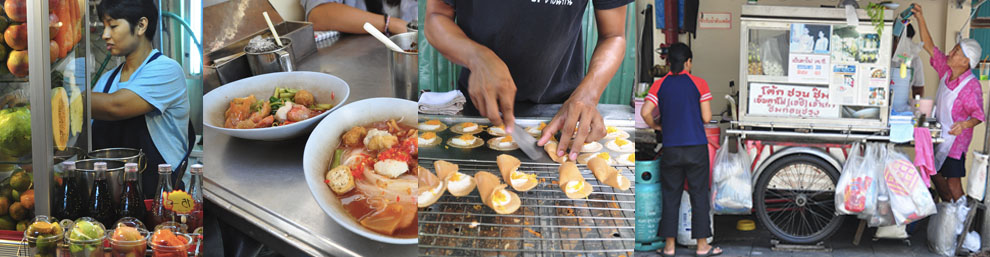
Thai noodles have, for a while now, been similarly lacking in the upstairs department. I am speaking, of course, about peanuts. They used to be scattered all over all sorts of noodles, both fried and soup varieties, with peanut powder also provided in the condiments trays along with all the other essentials for noodles, like fish sauce, pickled peppers, and chili powder.
Today, you only see peanut powder (maybe) for tom yum noodles served with minced pork meatballs. Peanuts have been démodé for a while now, relegated to canisters on supermarket shelves and boiled in their shells hawked by intersection vendors, not even served on Thai airplanes on domestic flights. This is a result of many factors, like the increasing number of people who are violently allergic to them. I also thought that maybe Thailand, after embracing peanuts wholeheartedly after the Portuguese brought them in the 1600s, had fallen out of love with them, having witnessed countless restaurants abroad slather peanut sauce willy-nilly over every dish on their menus in a bid to make them “Thai” (and to use up extra satay sauce), when actually (this is my last comma I promise), spicy peanut sauce is Malay.
Today, you don’t see peanuts on noodles that often; you see them on green papaya salads, in massaman curries and in the occasional chili dip. But the reason isn’t because Thais don’t love peanuts anymore. It’s because peanuts and Thais were a bad romance — “une mauvaise romance,” if you will — and for years, peanuts had been deemed “dirty” and prime agents for spreading mold by the government. Yes, peanuts fought the law, and the law indeed won. This reputation has clung to them even now, when even my husband, who won’t pay more than 50 baht for a haircut, will only buy his favorite snack of boiled peanuts at Emporium of all places, at 3 times the price of a vendor on the street.
Maybe it’s time to bring peanuts back. When boiled, they are great with rice against the depredations of a spicy curry, delicious foils when roasted in spicy yum salads, and yes, lovely as a light scattering of powder over a bowl of spicy chicken and bitter melon noodles. They are solid antidotes to chili and integral in providing crunch, aromatic in hot sauces and sweet in chili dips. They are a great protein and filling when you are hangry and have forgotten to eat. For once, peanuts are a case when being nutty is a good thing.
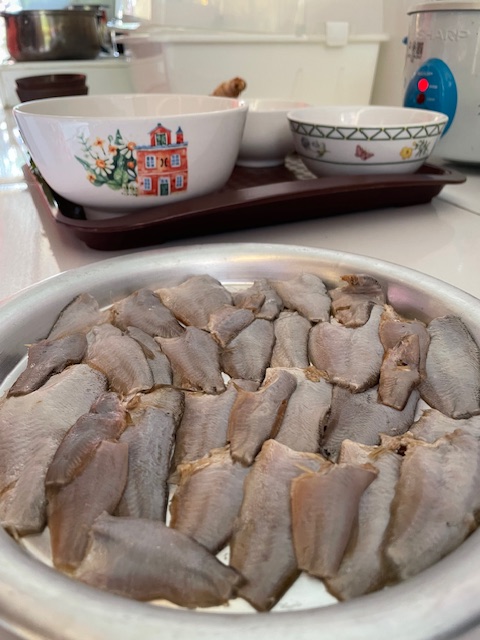
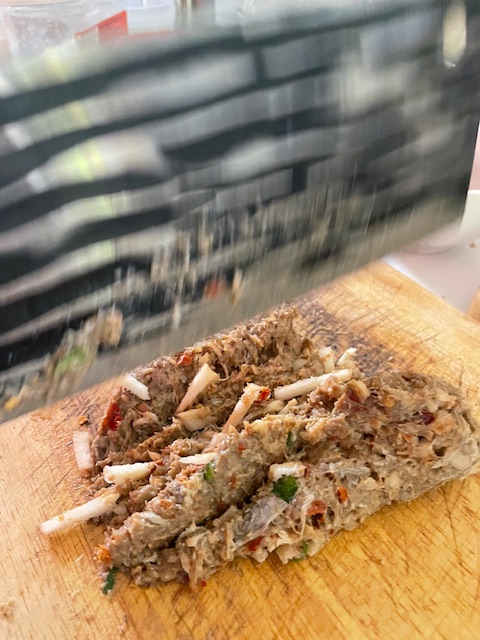
Lauren and I are working on our next cookbook, and just started testing recipes again — me doing the easy ones, Lauren stuck with the hard ones. One of the very easy ones I’ve tested is this pla rah sub (minced fermented Thai anchovy), which is also known among Isan-ers as jaew bong, and even larb pla rah. The only thing you have to do is put your back into it, literally, while you are chopping up this mince into beyond-tartare near-infinitesimal pieces. You want to think of yourself as a super-ninja dealing with their vanquished foe, but maybe that imagery isn’t very appetizing; think more super-ninja preparing a well-earned breakfast.
If you don’t like to make this yourself and live in Thailand (and why would you prepare this yourself, if you live in Bangkok or Isan), then get yourself to your local market or Bangkok’s Aor Tor Kor, where my mother’s favorite vendor sells a great version of this dish. No real need to turn your biceps into jelly unless you really, really need to!
Pla Rah Sub aka Jaew Bong aka Larb Pla Rah
Makes 4. You can eat this with sticky or regular rice, steamed and/or boiled veggies, any kind of fresh leaf like pennywort, mango leaves or even plain lettuce.
Ingredients:
1.75 ounces (50g) pla rah marinated for at least 6 months in salt (or anchovies)
2 tablespoons tamarind juice or crushed tamarind pods
2 tablespoons kaffir lime leaves, chiffonaded
2 tablespoons lemongrass, sliced
2 tablespoons galangal, sliced
2 tablespoons dried red chilies, sliced
1 tablespoons red shallots, sliced
1 tablespoons garlic, crushed
You can sear the pla rah lightly in a pan or use as is. Start by mincing finely with chilies, then add sliced galangal and mince further. The point is to mince it as finely as you can until everything is well incorporated and resembles baby food or a very fine tartare. You will notice that by now a nice, fragrant aroma is emerging from your mush. Add kaffir lime leaves and repeat the process. Then tamarind, then shallots. You are like Sisyphus, but with a cleaver instead of a boulder, and with the reward of a delicious dip at the end. Continue until everything is incorporated.
Scrape into a bowl and serve as part of an Isan meal of grilled meat, soup and sticky rice, or with fresh or boiled vegetables and eggs.
There is a scene in “Exorcist 3” that is considered one of the scariest of all time. When things are labeled like that on Youtube, it’s not hard to roll your eyes and say, “yeah whatever” and continue scrolling down to something else. However, I took the time to fill my screen and turn the volume all the way up. Even with the warning, I jumped. It’s an effective scene, and it’s all in the rhythm. The scare comes at the exact wrong time, while you’re still breathing in.
It’s funny, because in real life, I am the jump scare.
You won’t expect it. I’ll say I’m hungry, and I’ll have been waiting for you to finish shopping for about half an hour. It’s maybe only 12:15. I did have a few bites for breakfast, so it’s not like I was fasting. I’ll be walking down the street. Maybe one or two places didn’t pan out, already full with diners or too difficult to find. You might make an innocuous remark about having a different kind of food. And I will kill you.
It’s scary because it’s unexpected, at least to me. Other people will see my face and guess that I’m about ready to snap, but I’m not aware of it. The only person who is expecting it is my husband, who will simply tell me “no”. But be warned: if I’m not fed, you will all die. You will be like the nurse in “Exorcist 3”. It’s beyond my control.
I was trying something new in Japan that I hadn’t tried in years. There’s this thing where, if you are a woman (and, I’m seeing nowadays, also a man), people feel emboldened to make comments about your body. This is doubly true if you are Thai. Comments like “you gained weight” and “you’re fat” are just par for the course for some of us, but it doesn’t mean that you just shrug your shoulders and say, “oh well, this is me now, I guess I’ll just live my life”. The thing in the back of your mind doesn’t really allow you to do that for some reason. Somehow, the self-loathing eventually kicks in, even after years of “you’re fat”.
But I vowed to eat whatever I wanted, whenever I wanted, for the 15 days I was in Japan. I hadn’t done that since my first trimester with my son, when all I could stomach were potato chips with sour cream-and-onion dip and ginger ale. I ended up weighing 77 kg after nine months. Where would I be after 2 weeks?
So we braved Sunday brunch lines at Eggs ‘n Things to make my son happy. We braved crushing crowds in Tsukiji for sushi breakfast to make ourselves happy. We loaded up our plates at the breakfast buffet at our ski resort, where I would daily consume two heaping bowlfuls of Japanese rice with miso soup, pickles, and a styrofoam cup of natto, whipped exactly 50 times with mustard and tare sauce to activate the gooey fibers. In the evenings, dinner came in the form of a bubbling cauldron of nabe, a mere appetizer to a succession of gut-busting fish and beef courses, all washed down with plenty of umeshu, beer and bourbon.
Pork belly nabe
In Disneyland, we embarked on a full-day popcorn safari, taste-testing everything that would fit into our gaping maws and empty souls (verdict: black pepper popcorn was best, followed by curry, with soy sauce and butter a distant third). Greasy chicken legs, long “naan” stuffed with tomato bolognese, green dumplings shaped like aliens’ heads — all were fodder for our ambulatory kamikaze dive into emotional oblivion. When we reemerged back in Tokyo, I had to get new pants.
Only to head south to Yokohama, home to the Shin-Yokohama Ramen Museum. I had somehow heard of this place for years but never gone, because I am even lazier than I am greedy. But finally the demands of the stomach grew too strong to be denied, and so there we were in Yokohama, a town I hadn’t been near in 20 years, wandering the streets in search of a sign featuring a pair of chopsticks dipping a bowlful of yellow noodles into nothingness.
There are things in the ramen museum like noodle-making workshops and the opportunity to craft your own instant ramen bowl. There is also a LOT of text explaining the history of ramen in Japan (it’s a Chinese dish that started with shio ramen, before soy sauce ramen was created in Asakusa and spread out from there) and a bit on the different varieties (very roughly: Hokkaido is miso, Tokyo is soy sauce, and Kyushu is tonkotsu broth). This is all interesting, but any minute you are not spending queueing up in line in the basement is a wasted minute. Head straight to the basement, do not pass go, do not collect 200.
The basement is a replica of 1950s Tokyo, and there are not just a bunch of ramen shops there, but also a few little shops (candy, an ice cream bar, another ramen shop with natural wine) tucked into the alleyways. Because I have no chill and no strategizing sense, I went straight for number 1, which ended up being the most popular ramen shop with a 30-minute wait. Obviously, I bitterly regretted my decision, especially after seeing Karen head off to a different shop and my son and husband going to a third, all without waits. But then I finally got to sit down and eat, and of course everything changed.
I got the spicy miso “mini” size, and in the first few bites, you’re realizing you are eating a pretty good bowl of noodles, unctuous and savory and more-ish with umami up the wazoo. It’s after a few more sips of the broth when it hits you that you are in the presence of something great, and that the minutes you are spending from then on with your bowl of soup will be some of the best minutes you will have that day. In the end, alas, it’s all gone, but there’s the option to go back out in the line and queue again, bitterly regretting your choices until your name is called once more to sit down.
My husband and son dallied over their bowls of ramen (identical, an opportunity wasted), chosen because the shop was the oldest in the museum. Of course, they did not take pictures, so all I have to offer you is this link. Nicha ended up following my lead and queueing up after me at the same spot, a decision I did not blame her for because the ramen was that good. Karen, meanwhile, made much use of her time, trying a special anniversary edition shio ramen at the second shop to the right:
Before going to the ramen bar tucked away in the balcony for an even-better tonkotsu ramen:
And then we had dinner.
The next day, I had attempted to bite my daughter’s head off at lunchtime because I was hungry and wanted to have sushi, but not at a sushi place I’d ever tried before, because that would be too easy. We zipped to and fro through Ginza only to find ourselves in a department store at the kind of restaurant that Bill Murray and Scarlett Johansson end up in after Bill Murray sleeps with that Sausalito chick. Which is to say that it was both soulless and expensive. But at least I was angry.
So that night, we decided to keep things simple by eating at a cheap izakaya across the street from our hotel, the kind with 300 yen beers and pictures of butts plastered all over the walls. Imagine my surprise when I go through the door to see my daughter and husband at a table but startled to see me. “Didn’t you get my messages?” my daughter asked. “Knup can’t come in here.” And believe it or not, the thought did not cross my mind that a place like Japan, where beer is sold in vending machines, would prohibit a 13-year-old from joining his family for dinner at an izakaya. “Oh,” I said. “I guess we’ll find somewhere else,” and we promptly left that place, feeling a little strange because it’s not every day when you’re turned away for dinner with your family by your family? But then again, I had tried to kill my daughter earlier so…
I wasn’t wearing a coat, and Knup wasn’t equipped with much of a palate, so we roamed the streets for quite a while, eschewing Tokyo-style sushi with rice seasoned with red vinegar made from sake lees; soba with shrimp tempura; and grilled eel donburi. We were hemming and hawing between McDonald’s and a soy sauce ramen shop when my eye caught sight of a grill over a charcoal brazier in a dining room. Upon stepping inside, the man asked me if we had a reservation. “No,” I said, but something in my expression was so pathetic that the man relented and seated us after making sure that we could eat lamb.
It was a yaki-Hokkaido lamb shop, specializing in all cuts of the animal: skin (very chewy, no matter how much you grill it), tongue (tender), “arm” (similarly tender and simple), liver (delicious) and most popularly, loin topped with chopped leeks. There was also brain, wrapped in foil to keep it moist:
So happy was I in Knup and my food luck that when my family contacted me to ask where I was (why would I be waiting in the lobby when there’s a whole city of food out there?), I only felt a twinge of resentment before sending them our coordinates. Before long, five of us were crowded around a grill, running the staff ragged with order after order and singing along to a soundtrack of Howard Jones and Asia. If the server regretted letting me in, he didn’t let on. Or maybe he knew that as long as I was fed, Tokyo would be safe from the monster. Whatever he thought, it was the perfect way to end our stay.