Author Archives: Bangkok Glutton

Bangkok Glutton's avatar

About Bangkok Glutton

Eating and writing in Bangkok.

Every Tom, Pad and Curry

Pla tu sathia in Samut Sakhon

I’ve been a low-key fan of the Spinners for a while now. I really do think one of the great love songs of the past century is “Do You Think I’m Falling in Love” — up there with Peter Gabriel and the boom boxes, Robert Smith with his Mary Poole, the Police and the umbrella and whatever else prompted their song. Every Gen X girl dreams of songs like that eventually written for them, but none of these songs really captures the uncertainty and vulnerability of actually falling in love, not the certainty but the gradual realization and all of the happiness but also terror that this means. I feel all of that in the Spinners song, even in the easy tempo and lovely melody and beautiful voice. To copy from Greg Kihn, “They don’t write like that anymore.”

Another song I really love — if only for the first 4 minutes — is, of course, “Rubberband Man”. It’s a song I don’t play often because, let’s face it, it lasts forever and ever and doesn’t end until you’ve given up all hope for the next song to begin. At least, I really believed that until I listened to it, again, on the way to Hua Hin where I am thinking of living for 50 percent of the time, but that’s neither here nor there and not a story for this post. I realized, finally, after hearing it for so many times, that the latter half of the song is a series of variations on a theme, a “jam”, as it were, the band jamming until the song has reached its natural end, playing just like the Rubberband Man himself. Sometimes a couple of the variations sound similar, and sometimes there’s a big twist, but the theme is still there, even if what you hear is a little different.

The Thai “tom” — always spelling “tom” in English even if it’s really “thom” — is one of Thailand’s best known yet simultaneously underrated categories of food. It’s also one of Thailand’s oldest. Everyone knows “tom yum goong”, or thinks they know it, even when the broth is muddied up with some kind of milk and it tastes like sweet-and-sour cream. Chef Andy Ricker once called it a “cliché”, but it’s only a cliché because it’s so good (when it’s a clear broth) that everyone knows it, just like “London Calling” was a good song until everyone used it when the characters — even the freaking “Friends” crew — went to London because no one has any imagination or creativity (though what other song could be used for London? “Solsbury Hill”? And everyone agrees the Paris equivalent is “Ça Plane Pour Moi” by Plastic Bertrand, yes? What would you use instead? “Do You Hear the People Sing?”)

There are many other “toms” besides tom yum, an entire family tree of “toms” that precede and follow it. There’s its close sibling, the night market standard “tom leng”, made up cleverly of the cheapest butcher’s cut there is, the pork or beef spine, boiled with a boatload of chilies that pile up on the bone so that it looks like the diner is the world’s bravest caveman when you take a picture (because that’s the whole point of this dish, the picture). Then there’s arguably the one more famous than “tom yum”, the “tom kha”, named after galangal but based on a coconut milk broth and usually featuring chicken. It’s the Taylor Swift of Thai soups, perfectly fine, one supposes. And finally there’s what some believe is the “big daddy” of “toms”, “tom kloang”, a true Central Thai creature sweetened with tamarind juice and fresh tamarind leaves, which might be analogous to Sister Rosetta Tharpe, if a soup could sing gospel and play electric guitar at the same time.

Among all of those “toms” (and there are many others), one is “tom khem”, which roughly translates to “salty soup”. Unlike some of the others, this one is Chinese-inspired, with lots of soy sauce and palm sugar but without the star anise and cloves used in a Chinese-style “pullo”, spices that some Thais find to be smelly. Just like its cousins, it is frequently served as a soup, but there are times when it’s allowed to reduce down to almost nothing, making whatever’s in the pot the main player all on its lonesome. That’s the idea behind the dish “pla tu tom khem”, or “Thai mackerel in salty soup”: sometimes served as a soup, but just as often served as a fish dish after all the broth has been lost to the ether, probably because the cook was off listening to the entirety of “Rubberband Man”.

Samut Sakhon (and neighbor Samut Songkhram, really) are all about Thai seafood; after all, they are home to most of the seafood markets that supply Bangkok eateries. That’s why, when you go to these provinces, you want to try a truly Thai seafood — pla tu, Thai mackerel, a sea fish that, like Thais themselves, likes to play with boundaries. In pla tu’s case, it’s in the brackish water at the mouth of the river where pla tu thrive, somewhere neither truly sea but not river either.

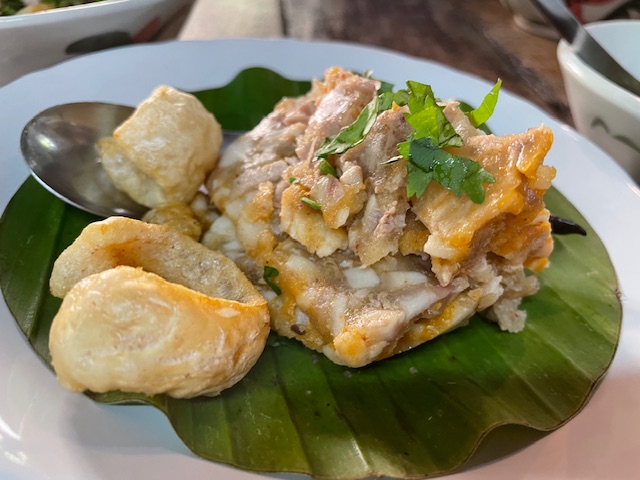
At Khun Toom Restaurant in Samut Sakhon near Mahachai Market, the pla tu is served in a “sathia”, the local word for “tom khem”, piled over an inky pool of soy sauce and confit garlic and garlanded with a fresh tangle of coriander leaves. It’s not cooked for so long that the bones melt into the flesh; unlike aristocratic Thai families, the cooks here don’t have time for that (maybe if they listened to Jethro Tull? But who would wish this fate on anyone?). But if you are willing to spend the time and enjoy a bit of a challenge, the pla tu pile makes for a nice early dinner with a plate of rice, especially these days when it’s constantly raining and it feels like the world is about to end.

Khun Tum isn’t just known for its Thai mackerel. Their most famous dish is, of course, crab: either simply steamed, with an abundance of orange roe obscenely spilling out onto the plate, or already picked and stir-fried with green peppercorns, torn makrut lime leaves and sneaky smashed green bird’s eye chilies.

There are a ton of restaurants just like Khun Tum in Samut Sakhon (and Samut Songkhram), all variations on a delicious theme. Like “Rubberband Man”, there are different (again, delicious) variations that set them apart from the others; the sweet-and-sour “tom som” with deep-sea pomfret at Jay Meaw in Samut Songkhram comes to mind, as does the “pla tu tom madan” (Thai mackerel soup with sour cucumber) at Khun Ja Restaurant. Of course, if you don’t like the theme (that would be seafood), the variations would be very tedious indeed. But if you are a fan, why not clear some time out from your schedule and give it a whirl?

6 Comments

Filed under Uncategorized

Glutton Abroad: Tokyo Chow

The famous Mitsukoshi lion in his latest outfit

I (but really, my friend Nat) had been planning this trip to Tokyo for months, but I did not expect the fervor with which I would come to regard Japanese cuisine, thanks to the Youtube channel Nushi Kitchen Life. The countless images of cozy eggplant stir fries, innumerable miso soups, and freshly baked bread hooked me almost instantly, and on my flight there, I dreamed of square omelet pans with which I could cook my own tamagoyaki (rolled omelets), sharkskin graters for fresh wasabi paste, and even making my own tororo (gloopy mountain yam) on rice. Meanwhile, Nat had reserved two well-regarded sushi restaurants one right after the other, both with vastly different chefs and philosophies.

The first, Sushi Yoshitake, had been in the Michelin Guide until recently, when they — like quite a few other Japanese restaurants — requested they be removed from the guide. They had reached the pinnacle of what Michelin could give (that would be 3 stars), but after recently being downgraded to 2, they preferred to bow out from the game gracefully rather than seeking to win back Michelin’s favor. The atmosphere was hushed, the service solicitous, and the chef (who also makes his own whisky, meant to pair perfectly with the sushi) very obviously a master of his art. From his deft hands, tender slabs of squid, surf clam, and mackerel pike would appear, perfectly shaped over mounds of reddish vinegared rice that always seemed on the verge of crumbling. A shame, then, that I would become so full somewhere in between the fatty tuna and the sea urchin that I almost had a panic attack. At least I got beautiful photos out of it, right? Alas, no. It turns out they are not allowed, as I was informed after attempting to shoot a beautiful dish of steamed abalone blanketed with abalone liver sauce. “They don’t allow photos anymore after getting the three stars,” my friend Cha said.

Stung once, I didn’t even attempt to bring my phone to the second night’s reservation at Nishiazabu Taku. This proved to be a mistake, since they allow photos. They also have private sushi bar rooms, which are a lot of fun since you basically have your own sushi chef for your private party. Ours, Chef Satoshi, served sushi the way a good musician would play music: without a set list, he made his selections depending on the audience’s reaction. A finely vinegared slab of in-season sanma (Pacific saury) or a tottering roll stuffed to the brim with fresh ikura (salmon roe, only fresh in the autumn) would be interspersed with refreshing salads or grilled vegetables, so that the meal never made you too full. They took their sake seriously here; certain bottles would not be served if they clashed with the fish you were having at that time. By the end, I was full, but not suicidal like I was the night before.

After two towering sushi meals like these, it seemed silly to seek the cut-rate stuff out in a Shinjuku back alley or among the tourists at Tsukiji. So we focused our attentions on something I’ve been obsessed with for a few years now: OG-style yoshoku (Western-style Japanese food), which was born during the Meiji Restoration in the 19th century when Japan, like Thailand, was battling the forces of colonization. Like Thailand, this “fusion” came out of a sort of “if you can’t beat them, join them and then they’ll leave you alone” philosophy (which, incidentally, worked).

Spaghetti naporitan and beef curry at Rengatei

Arguably one of the most famous restaurants of this genre is Rengatei, said by some to be the first ever restaurant to serve omu (omelette) rice, a dish made even more famous by yoshoku rival Tameiken of “Tampopo” fame. There is a line an hour before opening, one of the rare Ginza eateries to elicit such demand among the Japanese themselves. Probably because this was Western fusion and not strictly Japanese, nary a tourist could be found here.

Another offshoot of the yoshoku genre is the kissaten, the old-fashioned Japanese coffee shop. The first of these, Cafe Paulista, was predictably born in Ginza in 1911. I’d visited another famous shop drawing huge queues, Ginza Tricolore, but did not realize the sheer number of retro coffee shops in the neighborhood until now.

Our first stop was at Tsubakiya Coffee, which seemed as grumpy as Walter Matthau on a couch in his underwear. You get the picture immediately when you are greeted at the door with this sign:

Another nearby, possibly a little more famous, is Cafe de L’ambre, hushed and as dark as a Bangkok speakeasy bar. The service is stressed but efficient, and the seats at the counter have a strange swivel that ensures you look like an idiot whenever you try to move, no matter how many times you’ve been there. It’s a place to give you humility after a few too many sushi bar meals.

But back to the cooking. Willing to help in the face of obvious signs that I would be terrible at Japanese food, our friend Ami drove us to Taito City, where an entire street of cooking pots, knives and ceramic ware exists, ripe for the picking. Our destination was Kama-Asa, where I went crazy and bought the aforementioned square copper omelet pan, a hammered aluminum saucepan, and a bread knife that is so precious to me that I will never use it.

Later I discovered they have branches in Paris and Brooklyn. But that’s neither here nor there now that I’m in my kitchen after transporting half of a Tokyo grocery store to my house.

So I filled my omelette pan half full with oil and let it simmer for 15 minutes. I threw old vegetable scraps into the water in my aluminum pan in order to cure it. I hid my knife in a shelf in its box. Since then, I’ve made two rather bad tamagoyaki in my pan, grated fresh wasabi (and some of my hand) for steak, and made fried tororo, “Midnight Diner”-style (for which I got rashes on my wrists from the calcium oxalate crystals and saponins in the mountain yam’s “mucus”). I am up to my ears in miso, mirin and dashi broth. Even though my plate is completely empty when it comes to projects, I feel like it’s going to be a productive fall for me.

1 Comment

Filed under Uncategorized

What’s Cooking: Pad Mama

Writer M.F.K. Fisher, patron saint of bookish Western foodies everywhere, wrote her most famous book, “How to Cook a Wolf”, during the second world war when food shortages ran rampant and the real threat of a family member’s death hung over most households. The “wolf” in question, of course, was the dreaded “wolf at the door”, taken usually to mean the looming specter of financial ruin. Even then, Fisher believed, one should be able to live with dignity and eat well (Note: in these fraught times, quoting someone else’s words directly can be dangerous, but I think M.F.K. Fisher remains an uncontroversial figure):

“I believe that one of the most dignified ways we are capable of, to assert and then reassert our dignity in the face of poverty and war’s fears and pains, is to nourish ourselves with all possible skill, delicacy and ever-increasing enjoyment. And with our gastronomical growth will come, inevitably, knowledge and perception of a hundred other things, but mainly of ourselves. Then Fate, even tangled as it is with cold wars as well as hot, cannot harm us.”

It’s hard to believe that, almost a century later, these sentiments would be so revolutionary. Today, decades into our post-9/11 “Forever Wars”, we have become so steeped in the religion of capitalism that we believe that CEOs with inherited wealth are inherently better than the rest of us, and that the people who are “worse at capitalism” don’t deserve to enjoy even a single moment of their lives with a sip of soda or a taste of candy. Today, we give tax cuts to the richest of us, but consider the poorest of us as eyesores to be hidden away. Today, there are many different wolves at the door, not just the ones promising financial ruin, and they are all demanding to be let in at a time when all we can afford are stick houses.

What better dish for these times, then, than “pad mama”? “Mama”, of course, is the most famous instant noodle brand in Thailand, but any instant noodles will do (even Shin or Nissin). I was reminded of this dish after my friend James ordered five in one sitting, from where he didn’t know; he was just craving pad mama at that moment. Sometimes, one needs a reprieve from Mama as it’s usually eaten (that would be in soup noodle form), and few dishes are as forgiving and wallet-friendly as Mama that’s undergone a few rounds in a hot pan.

Most recipes call for cabbage and carrots and some protein like minced pork, but, as in the case of pad mama’s spiritual brethren “khao pad” (fried rice), anything that’s lingering in the refrigerator will probably work. Having just subscribed to the weekly Onela Market vegetable box, my fridge was still stuffed full of red cabbage, the saddest winged beans on earth, and a handful of cherry tomatoes, so I added those to a hot pan greased up with pork lard and a couple of minced garlic cloves. I set my Mama (the minced pork flavor) to cook in a saucepan of boiling water with all the seasonings, and just before I thought the noodles were fully cooked, I lifted the noodles into the pan with the vegetables. A quick rummage through the half-empty sauces yielded gochujang, sweet chili sauce, soy sauce and sesame oil, and I added a teaspoonful of each. A couple of quick flips in the pan to distribute all the sauce throughout and the noodles were done, topped with a single egg over easy (cooked just enough to squirt egg yolk when broken into), a dash of Gold Medal Sriracha sauce, the very last remaining fresh coriander leaves, and a modest sprinkle of “kak moo” (pork crackling bits left over from rendering pork lard).

You can follow my recipe below, but to be honest, the very best thing about this dish is that there’s no real recipe you need to follow. If you want to use roasted chili jam (nam prik pao) instead of gochujang, go right ahead; mashing garlic and fresh chilies up in the mortar and pestle and adding those to the party is also a good idea. Making minced pork meatballs to do a take on Italian-American spaghetti is fun, as would adding cut-up hotdogs and ketchup (the world is ending, why not enjoy yourself?). If you prefer a Japanese take, you can add umeboshi paste, shelled edamame and julienned shiso leaves as a garnish, or, for a Korean take, you can add cut-up kimchi, grated ginger and a sprinkling of sesame seeds. If you have tom yum flavor Mama, you can add canned tuna, tamarind paste and makrut lime leaves, or go all out with river prawns and a healthy dash of seafood dipping sauce. Bacon, Maggi, sugar, deep-fried shallots: pad mama will take anything that comes its way (even an entire pack of wolves). This makes it a wonderful role model for everything that’s in store for all of us, somewhere, sometime, at the end of the tunnel that is whatever all this is.

Pad Mama, today’s version

(Serves one)

  • A dollop of pork lard or unscented oil
  • 1 package of instant Mama noodles (minced pork flavor), cooked al dente and drained
  • 2 cloves garlic, minced
  • 2 sad outer leaves of a red cabbage, julienned
  • A handful of hopeless winged beans from the bottom of a drawer in the refrigerator, chopped
  • 3-4 lonely cherry tomatoes, halved
  • 1 egg from the stall next to the motorcycle stand
  • 1 heaping teaspoon Gochujang (for heat)
  • 1 teaspoon soy sauce (for salt)
  • 1 teaspoon dipping sauce for fried chicken or sukiyaki (for sweetness)
  • 1 teaspoon sesame oil (for aroma)

Garnish:

  • 1 slick of Thai Sriracha (for the egg)
  • The very last leaves and stems of fresh coriander, chopped
  • A shower of leftover pork crackling

In a hot pan or wok, add lard or oil until sizzling, then your veggies: garlic, cabbage, winged beans, tomatoes, or what have you. Give them a few stirs until they look wilted or softened, and then add your noodles and give them a good stir or a few flips in the pan. Next, add your seasonings, making sure they are distributed evenly throughout the noodles; give it a taste and then decant into a bowl when it’s ready. Break your egg into the pan and cook according to what you prefer (I like over easy but with a soft yolk). Add your egg to the top and season with Sriracha, then garnish the whole thing with fresh coriander and pork cracklings. Today’s pad mama is done! (Note: No wolves were harmed in the making of this dish).

2 Comments

Filed under Uncategorized