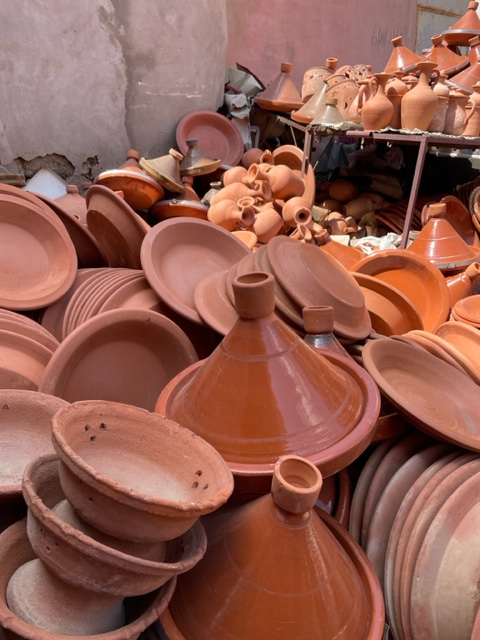
In Morocco, it’s impolite to eat with your own little plate. Everyone must eat together from one large platter, typically a tagine, where the food is cooked over charcoal. These tagines are typically made of clay, because Moroccans feel that is healthier than glass or steel. All of their kitchenware, including the double-handed long-necked containers they use to keep olive oil, are made of it.
A tangle of cookware in Taroudant
Because meat is valuable, it is nestled in among the vegetables — the potatoes, the carrots, any green and leafies — and eaten only after the patriarch breaks it apart himself, dividing it into equal pieces for every member of the family. Everyone eats with their hands, in a circle. Moroccans believe it is a way to strengthen bonds between family members and friends.
I’m thinking of this because Thais eat in a similar way, from common plates set in the middle. No one has their “own” tom yum soup, for example, and absolutely no one orders the same curry, eating it from a platter set in front of them like the biggest Cheesecake Factory entree ever. I’m also thinking about this because in Spain, there are a lot of plates. Small plates, even. You might have heard of them? They are called tapas.
Toast with sweet breadcrumbs and pork belly in Alicante, Spain
Yet tapas also serve as a social glue, probably because they are more often than not accompanied by a lot of wine. You can’t go anywhere in Spain without a tapas bar or two on every block, featuring at least one table of boisterous guests laughing over glasses of beer or, if they’re a tourist like me, red wine sangria. All the same, our tour guide warns us that bars with large photos of the dishes out in front, accompanied by large signs, are places to avoid. I think eateries back in Thailand that look like that should similarly be left alone.
Granada, in southern Spain, is an interesting mix between the Moroccan and Spanish philosophies, having spent a long time under Muslim rule. Its last Muslim rulers, the Nasrids, commanded the last Muslim state on the Iberian peninsula before being taken over by the Catholics in 1492 — but not before leaving Spain with The Alhambra, a gorgeous testament to 16th century Moorish architecture and alternately (with the Sagrada Familia in Barcelona) the most-visited site in the country.
Getting a closer look at the tiles
Like in Morocco, the beauty of a place is hidden behind a mostly plain exterior. I’ve been told many times that it is to keep neighbors from feeling jealous, but I liked our Alhambra tour guides explanation of Muslims being introverted better. I also liked that the complex was made of mostly humble materials: local stone, local wood, even stucco, which through sheer skill was made into a thing of beauty. It must have been a beautiful place to live in at its height in the 16th century, and I understood why the Nasrids would spend so much money to bribe the Christians into staying away. Unfortunately, they did not stay away forever; our guide said that when the Nasrids started planting orange trees, everything started going wrong for the kingdom. The orange trees are still there, but no one eats the fruit.
At least they left behind their food. At Jardines Alberto, you can order their entire roster of Nasrid dishes, as well as a whole other list of what they call “local cuisine”, which is apparently different from Spanish food in general. One of these “local dishes” was an unusual salad of steamed codfish with potatoes, black olives and slices of the aforementioned cursed oranges, harbingers of the Nasrids’ fall. This being Spain, it was all topped with a hard-boiled egg.
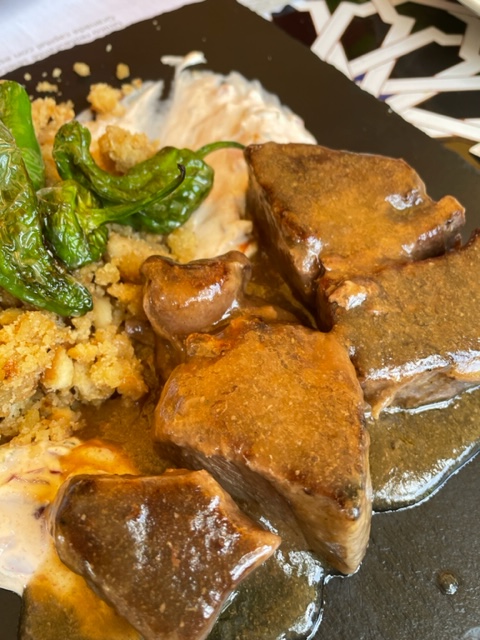
But back to the Nasrids. We ordered a fresh spinach salad scattered with cubed cheese and raisins, and a dish called “vizier’s lamb”, a slow-cooked boneless lamb leg paired with a mountain of breadcrumbs for texture and a mild yogurt sauce. If you just pictured Jafar from “Aladdin” eating this lamb dish, you aren’t alone.
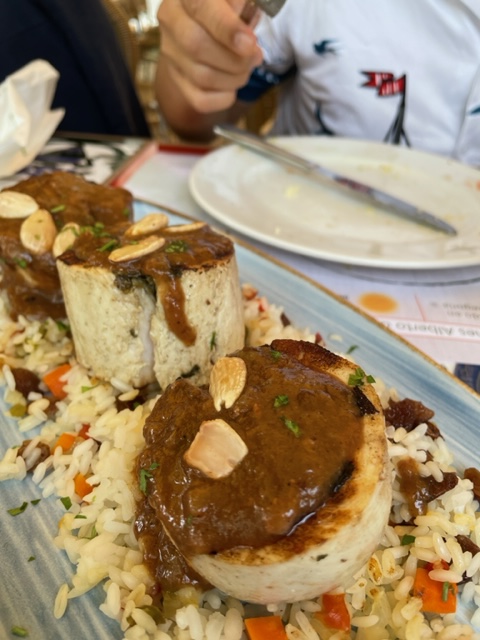
But the specialty of the house is the “Nasrin-style chicken”, tender ballotines made of the breast and stuffed with spinach and garnished with almonds and a honey sauce.
Was it something I’d go back for? Well … no. It looks like I prefer the Christian Spanish food. But it was the perfect punctuation mark to a day full of history, the remnants of a fallen kingdom, left behind for people to share over a common plate.
My friend James is a repository of useful foodinfo, so when I learned that I was visiting the actual homeland of James’ ancestors, of course I was quick to ask him about what to eat. He came back with reams of information, including the fact that Cape Verde is home to a host of interesting and rare deep water fish and shellfish — think marlin, wahoo, yellow fin tuna, percebes, limpets and a meaty fish called forcado, with thick hollow bones like a cow. He told me about caldo de peixe (fish soup), made with big chunks of fresh fish and hearty root vegetables, and regaled me with tales of the delicious coffee of Fogo, grown in the soil in the crater of a volcano.
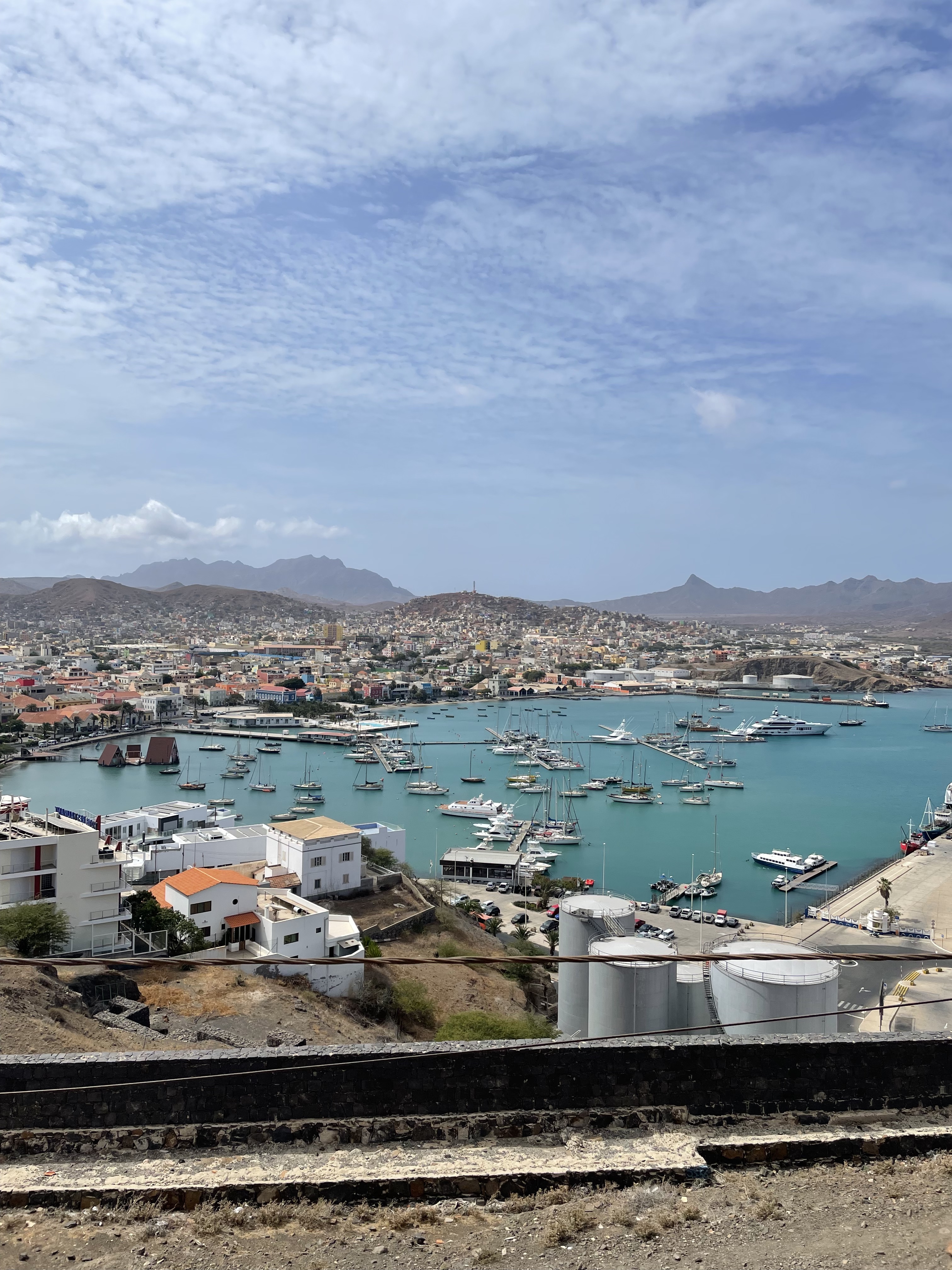
I did not get to sample these treats, but I fell in love with Cape Verde anyway … or at the very least, its cultural capital Mindelo, located on the island of Sao Vincente, one of the country’s 10 islands. This is the birthplace of Cesária Evora, the world’s most famous singer of morna, a musical art hailing from Cape Verde. Sao Vincente is also famous for its panoramic vistas, making it, in James’ words, the “Edinburgh of archipelagos”.
View from an abandoned hilltop fort
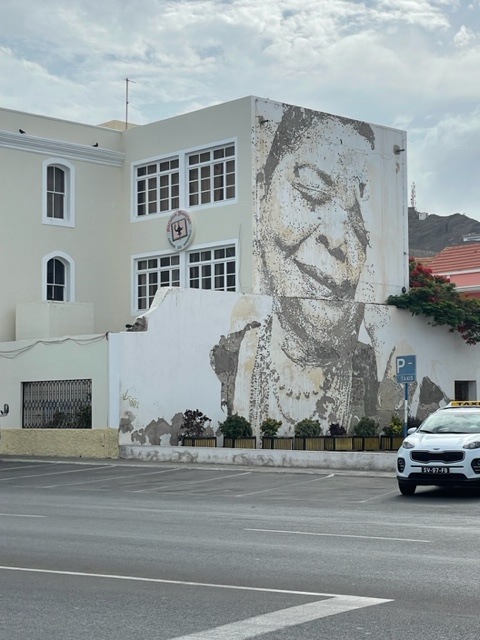
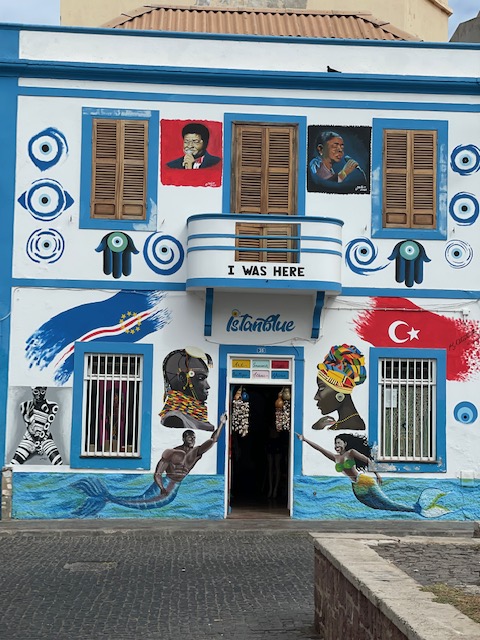
I’m not sure about Edinburgh, as I went at the age of 15 and remember almost nothing about that trip, but what I’d say about Mindelo at least is that it’s a beautiful city full of art, flowers, and bright buildings.
It also harbors a charming set of beaches, one of which appears to be ruled by a pack of very healthy and happy looking dogs, and another of which is home to a clutch of fishing boats that apparently no one will steal. When I find a place that I really like, I automatically pick out a home there, and my chosen place on Sao Vincente is a two-story shophouse with a bay window overlooking this spot.
We also saw a music performance accompanied by local dances, performed by a heartbreakingly beautiful woman and her younger brother. During the show, we were served three types of local liquor: grogue, like Brazilian cachaca but meant to serve as a “pick-me-up”; tamarind rum; and bondcha, a potent alcoholic syrup tasting of honey. The drinks were strong enough that members of the tour spontaneously started to dance in the dining room. I was just happy that there were also little salted fish nibbles to eat so that I did not stumble back out into the street rip-roaring drunk.
But it wasn’t until our tour was over when we managed to get to the meat — literally — of our day. We walked back out of the ship to a tempting restaurant I spotted called Nautilus , where I figured we would enjoy a nice leisurely lunch far away from the bustle of the boat. So it was a big surprise when we arrived and ended up encountering half of the other people on board, no doubt fruitlessly hoping for a nice leisurely lunch far away from the bustle of the boat themselves.
As a result, service was painfully slow, but we were so grateful to finally get our food that our server giggled. We’d ordered catchupa, a filling stew of beans, corn, cassava and meat described on the menu as Cape Verde’s national dish. James says that leftover stew can be drained the next day, fried into a patty and topped with a fried egg to make one of his favorite dishes called “catchupa guisado”.
Local catchupa with chicken and chorizo
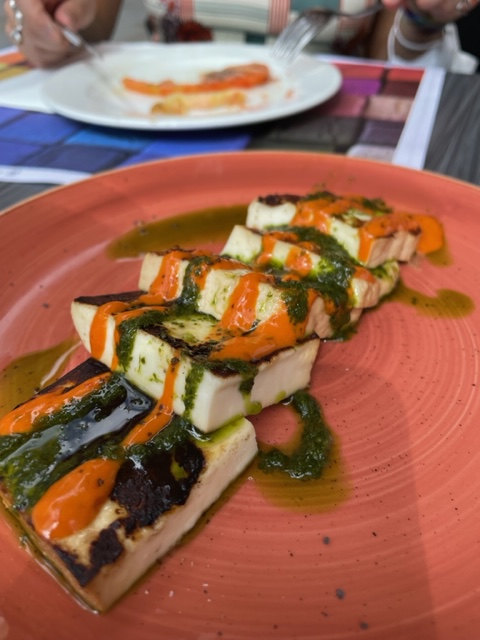
We also had braised octopus and conch with good bread, alongside cubes of the local goat cheese with olives.
To pair with the meal, we chose a local wine called manecon, made from grapes grown on Fogo. Perhaps because of the wait, or perhaps because we just liked it so much, no matter: we ended up with two bottles, which pretty much put a stop to the rest of our day.
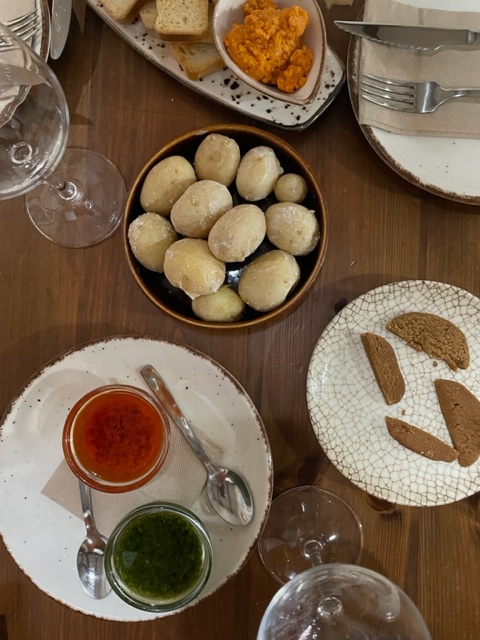
We then sailed to Santa Cruz de Tenerife, one of the Canary Islands, which made many people happy because finally their phones worked again. Here, obviously, the food was very Spanish-inclined, but with a few staples that seemed very “Canarian”: wrinkled potatoes, cooked in heavily salted water, paired with a garlicky green sauce and a mildly spicy red one; a handmade bread of mashed nuts, meal and honey with a consistency (and taste) like cookie dough; and the ubiquitous goat cheese, either sliced simply or mashed with garlic and paprika as a dip.
It was here where we also ended up wandering aimlessly into a movie set, spying a heavily bearded Gerard Butler. After upsetting his plans a second time by hooting and hollering from our table, well into our third and fourth servings of wine, several members of our party managed to walk up to the van in which he was hiding from us and finagled selfies out of him. Of course, I was not one of those people. I did, however, enjoy explaining to my tablemate Richard from London the vast lexicon of Mr. Butler’s films (“Plane”, no not that one; the one where he saves the president that’s not Channing Tatum; that horrible movie with Katherine Heigl that’s not “27 Dresses”; don’t you know “300”?)
We now are in the real homestretch of our around-the-world journey, and I have to say, I’m ready to go home. So is everyone else. Bring on Spain proper. Paella and ham, here we come.
The Atlantic Ocean between Namibia to Senegal is generally considered a hotspot for pirates. These pirates usually target cargo ships, as they are low to the water and slow-moving, but they have been known to try to board a cruise ship or two. As a result, we have been doing passenger drills in the off chance that pirates will attack our ship.
These drills involve basically fleeing to our suites and shutting the blinds when the captain says something that sounds like “Alert Yellow Papa”. When he says “Alert Orange Papa”, it basically means that we are to stay in our rooms, but to be more concerned about it. “Alert Red Papa” is when we are supposed to go out into the corridors and lay down in front of our doors as the captain attempts evasive maneuvers. The fleeing into the corridor is an attempt to convince invaders that no one is there, but it seems like a hard thing to ask when it’s an enormous cruise ship with hundreds of rooms.
In preparation for pirates, other guests who have been on the world cruise before have been regaling us with tips on what the boat will do when or if they attack. Some of these things have ended up being true (pouring hot oil down the sides of the ship so that pirates will have a hard time clambering aboard) and very not true (playing “Toxic” by Britney Spears because that is supposed to distress pirates’ delicate music sensibilities). However, if all else fails, we also have mercenaries on board who stick out like a sore thumb because they are 1.) extremely ripped and 2.) pretty young. One even has an eye patch! And is a fan of the lunch buffet.
I have to say that, although it has been eye-opening, all the preparations have been worth it, because we have experienced our very first visits to West Africa (for our family at least). It’s not the first place that travelers think of to visit — indeed, North Korea has had more visitors than Togo — but honestly worth it in the most traditional spirit of travel: to actually learn stuff.
Which is how we found ourselves in a fairly old bus with the windows open on our way to a small village in Togo, an hour away from our pier. We were on our way to a “voodoo” ceremony there, where we would be shown how practitioners channel spirits in ways that prove useful to their own lives: for health reasons, to foretell their fortunes, to help make connections. This particular ceremony we would be witnessing would be to assist villagers on an upcoming hunt.
On the way, we passed much greenery and lots of goats, and also much poverty, even though Togo is very rich in natural resources (this is a theme that has echoed itself throughout much of the continent. Why is there so much oil and gold and diamonds but many people are still living hand to mouth? Food for thought). Finally, we reached a street lined with street vendors selling bread and barbecued meat on skewers, which led us to a sort of sandy parking lot in front of a space bordered by concrete walls.
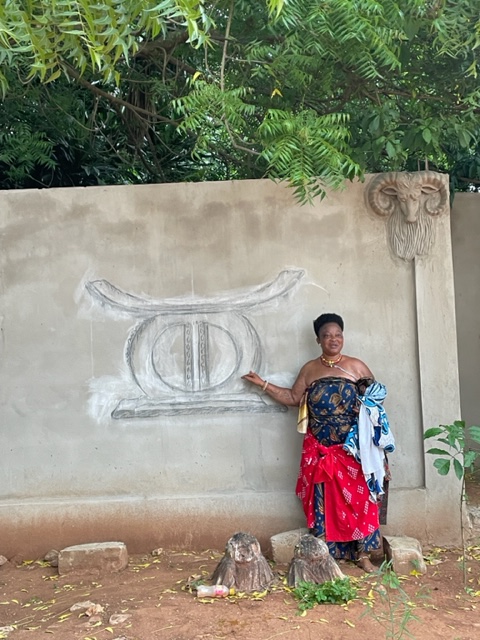
On one end of the lot, a concrete wall bore a drawn-on symbol, with a doorway leading to a forest behind it. We were told by our guide, Nicole, that this was a sacred forest, where priests meditate before a ceremony and where people are taken when they need to collect themselves. We were not of their religion, so of course we couldn’t enter. The other side of the lot bore a drawing of an actual voodoo ceremony, behind what appeared to be a shrine centered by a small statue.
In front of the sacred forest
Music was already playing when we arrived, but we still had to wait outside because the priests were not ready for us yet. We were under the mistaken impression that voodoo practitioners were under the influence of some sort of drink, but that is actually not true: the practitioners themselves are completely sober, but have the ability to allow their gods or spirits to possess them. Indeed, they go into training for months or even years in order to hone this ability. The head priest, who guides the practice, readies himself for a ceremony days in advance with preparations like not lying with his wife, or eating food cooked by his wife if she is menstruating. This is in order to stay “pure” (why women are considered unpure even though they are the way life is brought into the world is another subject entirely, and is a question that extends to Buddhism as well).
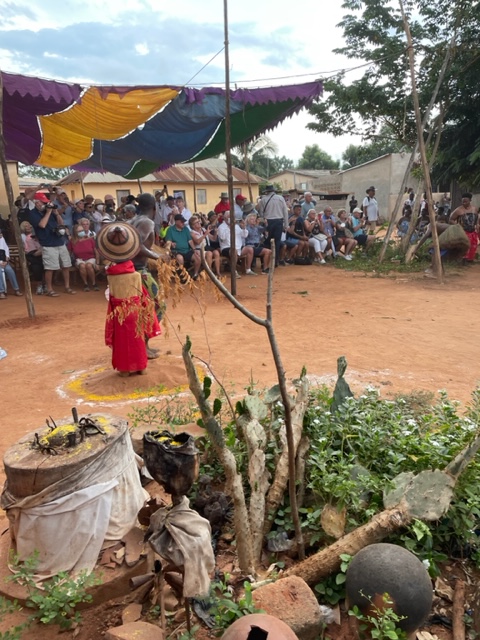
When we were finally allowed to enter the ceremony grounds, we filed into an open space centered by a large network of cacti draped with other vegetation, enclosed by a line of stones. Some visitors were obviously on their phones, recording the whole setup as we arrived, so I found it amusing that a few of the villagers were doing the same thing to us, recording a mostly septuagenarian horde clad in faded baseball caps and Regent Cruise windbreakers. To the plant circle’s left was a wooden statue loosely resembling a human form with a hat and a painted-on face, which practitioners appeared to be greeting with a shake of their heads and a loose shake of their mouth that we in yoga call “horsey lips”. When we do this in practice, it is to get rid of tension after a series of difficult asanas. I can’t say whether that is the case here, but I would totally understand it. Imagine performing religious rituals sacred to you which a crowd of onlookers would likely not understand and misconstrue?
Luckily, we had Nicole. The practitioners, mostly men but a couple of women, had colored powder on their faces and in their hair. They were already in their trances and dancing, as Nicole explained, in ways that their gods were telling them to dance, spinning and occasionally standing stock still, or shaking hands with onlookers. Off to the far end, a band was playing, beating out a loud rhythm, and villagers who were just there to have fun were dancing and drinking plum wine. Most people wore colorful cloths tied around their waists, including the practitioners. It seemed like a fun party for the most part, with the actual practitioners mostly dancing on their own. A couple of villagers wended through the crowd, offering beer and soft drinks.
The plant circle and statue
But one man broke away to rummage through the garbage, ending up with a green glass beer bottle that he broke over his head. Blood started to pour out of his forehead, and other practitioners raced over to him to restrain his body and pour white powder onto his cut. As he stiffened and finally stopped resisting, they carried him over to the sacred forest so that he could calm down. “He did something wrong in his preparations,” explained Nicole. “So his god punished him.” Meanwhile, the other practitioners and band carried on as villagers picked up the glass pieces, which would be brutal on their bare feet.
Then another practitioner began throwing hands and getting into what looked like an altercation with a different man. A female villager ran up, I assumed to stop what looked like a wrestling match, only to snatch the brightly colored cloth away from the fighting practitioner to reveal regular basketball shorts underneath (I guess she was worried it would get dirty?) Eventually overpowered by several people, he, too, was carried away. The ceremony continued as if nothing had happened.
This is where it became confusing for yours truly, because I am essentially Thai and loud noises and what looks like altercations are scary to me. The spontaneity of everything, the unpredictability, made me mentally exhausted. How is it that one minute, a smiling man would walk over to the plants, breathe in the scent and lay a hand over his heart as if well contented, and then a few minutes later pick up a heavy wooden chair, stalking his way towards the partygoers and band? In wresting the chair from him, a woman gets punched in the face and another man behind him gets a sharp elbow. It seems hard to maintain order at a ceremony, especially as no one knows what other people’s gods are telling them.
But then the man who had originally cut his forehead with a bottle appeared, completely cleaned of powder and blood-free. Some of the other pracitioners who had been ushered into the forest had also returned, dancing and whirling, including the man in the basketball shorts. He drew a circle with white powder into the ground, and then a white cross. He then piled more white powder into the center of the circle before setting a vase with the bottom broken off over the mound. From somewhere, another person brought water, which he then poured slowly into the vase, bit by small bit. It was well over 10 minutes before the water started spilling from the bottom of the vase, obscuring one side of the circle.
Drawing the circle
“You must leave now,” bellowed one of our tour guides from a megaphone, and as we still stood, slow to turn around, he says it again: “YOU. MUST. LEAVE. NOW.” The reason why we will never know, but we finally turn and leave, still processing what we’d seen (I am still processing it even now).
As I head to the lot, a couple of women pass me on the way back, and I recognize them as the women who were caked in powder and whirling earlier. One of them doubles back to proudly stand next to the symbol on the wall to the sacred forest, posing for photographers. The ceremony had been performed, some people had been punished for indiscretions, and it was all over now. It was time to get back to regular life, leaving me as the only person unable to draw a line under things and move on.