
I find that I am frequently starting my posts with the announcement that I had intended to write something else and was suddenly diverted from my brilliant plans. That is once again the case today, after learning of the death of Christine McVie at 79. Like Christine McVie herself, her manner of death was not strange or out of the blue — she had lived to a decently ripe old age. Classy to the end, her departure was met quietly with little news on her side; her bandmates weren’t even informed of her illness. The outpouring of grief came afterwards, after she was gone. It’s the way I would have liked to go, if I had left behind a body of great songs and a long history of performing for millions of fans.
Christine McVie wrote well-crafted, catchy, and understated pop songs that erred on the side of classy. Obviously, it is strange that I would be a fan. But it’s not just her songs that I enjoy (I’ll admit it now that I’m old, my favorite composition of hers is “Got a Hold on Me”) but her whole persona. It takes a very interesting and secure woman to allow Stevie Nicks the creative (and literal) space to twirl around in her scarves and skirts, singing about witches and gypsies, as she stays at her station, behind the keyboard, off to the side of the stage, doing her job. It takes a smart woman to last, period, among all the drama queens that Stevie, Lindsay and Mick surely were (especially during their cocaine — I mean “Tusk” — era). And of course there were the mutual heartbreaks over the course of recording “Rumours”, and the ways they were used to fuel that incredible spasm of 24-karat creativity; I admire all of it. It’s inspiring for me to see her, on my laptop screen or on TV, exhibiting excellence in her own way. Not everyone has to be Stevie Nicks, you know.
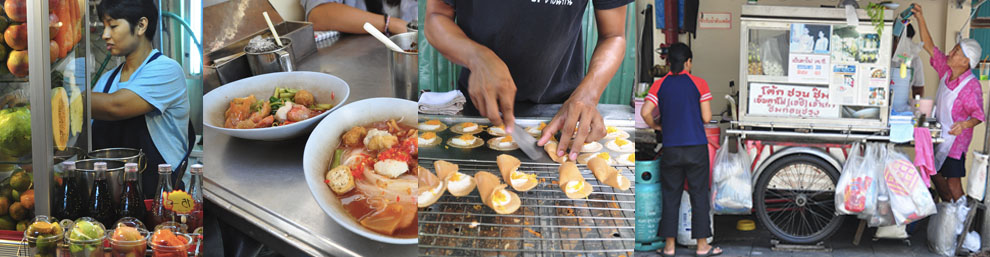
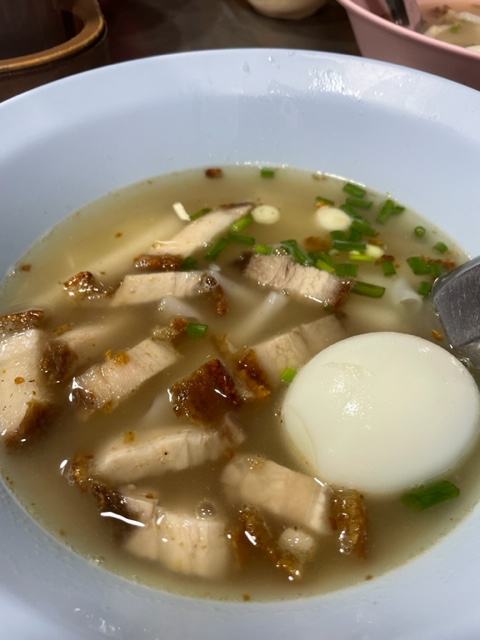
For over half a century, Chanchai Tangsupmanee — aka Nai Oun — toiled away in front of an abandoned movie theater, chopping up pig parts in the sweltering heat by the side of Yaowarat Road. He was no wealthy hitmaker, and few would call him a genius. But, at his street food stall Oun Pochana (MRT Wat Mangkhon), he was an artist in his own way, churning out bowls of pork noodles for the masses. After decades in obscurity, a huge number of loyal customers brought this humble guay jab vendor to the attention of none other than Me Myself (and also later Michelin). The fact that these accolades all came from a simple bowl of rolled Chinese noodles swimming in broth with pig parts and a boiled egg is fairly remarkable. It’s even more remarkable that it’s for guay jab nam sai (clear broth), arguably less popular than its nam khon (thick broth) counterpart due to the impression that clear broth hosts less flavor.
Now, guay jab is no Stevie Nicks. It doesn’t compare, glamor-wise, to other dishes like the noodles on the sizzling hot plate and the morning glory in the wok with the flames reaching up into the heavens. It doesn’t even compare to other soup noodles: egg noodles in tom yum broth leaves it in the dust when it comes to Instagram, and even a bowl of lowly fish meatball noodles with a spray of deep-fried garlic manages to outshine it. Let’s not get started on braised beef noodles. Face it, guay jab is not a pretty dish.
What set Nai Oun’s bowls apart from the rest is the broth, which is clear, yes, but also peppery and full of pork flavor, yet still also clean-tasting. There really isn’t anything else like it on that street, and that is saying a lot. Even after Nai Oun passed away from Covid, and his son Adulwitch took over, the bowls remained the same. If anything, the crowds have gotten larger and more insistent. My last visit there, I was seated so far back I was reminded of the time I visited Oun Pochana’s bathroom (don’t ever do this). Oun Pochana’s popularity has only grown over the years, turning this vendor into one of the road’s few real must-trys, even among native Bangkokians. A bowl of hand-rolled noodles with pork did that, a sign of real craftsmanship with staying power.