Author Archives: Bangkok Glutton

Bangkok Glutton's avatar

About Bangkok Glutton

Eating and writing in Bangkok.

Dream fuel

kanombueng

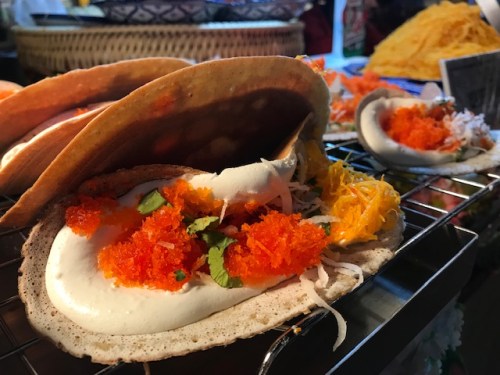
Kanom bueng, a Thai dessert “taco” of candied prawn and meringue at Icon Siam

Nothing is more snore-inducing than listening to someone else talk about their dreams, so here are mine. There was the dream about the bees that kept chasing after me, and another one where I was chased by crocodiles in a water park. In another one, I tried to jump out of a high-level window into a shallow lily pond to escape from some invaders who were … also chasing me. I’m sensing a theme. In any case, the dream that recurs most often is the one where I’m at a sprawling buffet (although sometimes it’s a jewelry store, or an underwear sale) where everything looks good and I can’t quite decide what to get, but once I make my choice what I want is gone or lost (“this is difficult to interpret,” said no one, ever).

It’s rare to encounter in real life what you’ve already experienced in your dreams, but this is what happened to me when I dropped by for lunch at Icon Siam. In case you haven’t been to Bangkok in a while, Icon Siam is the latest high-profile mall opening in a city that is chock-a-block with them, but on the Thonburi side of the river instead of in a majorly trafficked part of downtown Bangkok. It’s the first really big development in Thonburi, so only a handful of vendors have been displaced and the street food scene in general there is still pretty robust.

Full disclosure: I was approached a couple of years ago to help consult on a “street food” section for Icon Siam when it was still gestating, but was never contacted again. So — as with anything that I write about “Game of Thrones” the TV series, or most Asian food television programming — anything that I say about Icon Siam can and probably should be interpreted as sour grapes.  That said, the last few GOT seasons have been trash, marred by illogical storytelling and huge misinterpretations of key characters. Icon Siam is not as bad as Season 5 Sansa.

You encounter the thoughtfulness they’ve put into how they present their “street food” the instant you step through the door. They’ve built a Vegas- style “canal”, with careful lighting and nicely dressed vendors set up at various stalls alongside the water, a nice nod to Thai street food’s origins. The food up in front — mostly sweets and snacks — really does look great. It’s just a shame there IS NO ENGLISH LANGUAGE SIGNAGE.

lookchoop

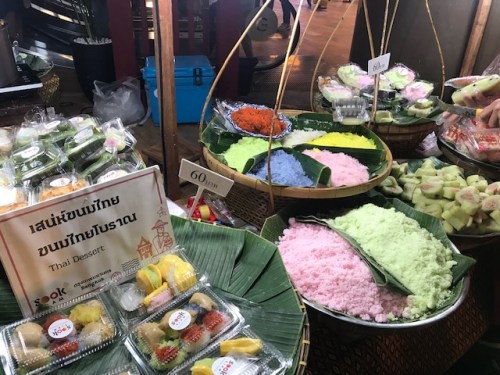
Look choop, mini-fruits made from mung bean, part of the Portuguese-influenced dessert cart

Existing translated signage is wonderfully vague, even in Thai.
thaidessert

As you proceed further in, food translations get better, featuring both Chinese and English. Not surprisingly, these areas were busier.

chickentoesalad

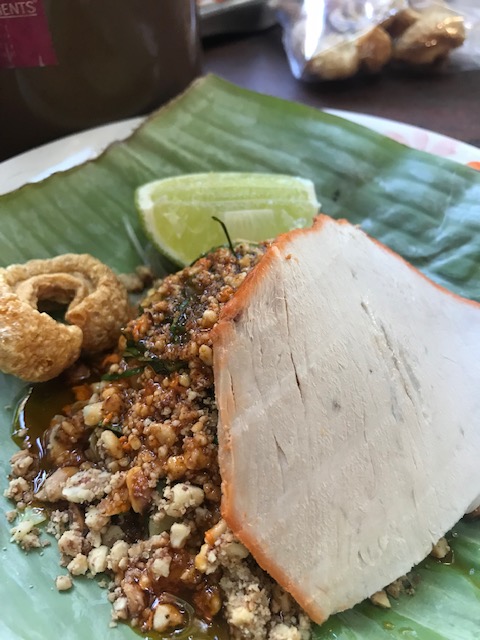
Chinese translations for spicy chicken “toe” salad, heart cockle salad, and fermented pork salad

All the same, it was daunting to get a bowl here, because a dearth of places to sit meant latecomers like myself would be doomed to eating fish-sauced specialties with their dishes balanced precariously on their knees. Come on guys. I am a very clumsy person. Smelling like fish sauce is bad when you are taking public transport. And the chi-chi section in the back, where there actually are seats, serves “nice” stuff that I didn’t feel like eating, like Chinese seafood and Dean & Deluca-style deli salads.

They tucked the best vendors off to the side, like kids who hide their favorite dishes from the table by sticking it behind their elbow. These are the savory vendors serving big-ticket one-dish meals like kanom jeen (fermented noodles with curry) and popular snacks like satay and tod mun pla (deep-fried fish cakes).

Here, the signage was extensive. But the seating,  just like at an actual outdoor floating market, comprises a bunch of tiny child-size stools and is the opposite of extensive. I get the “replicating the floating market” thing, but you are still in the mall, so you have already made a choice. You chose to include air-conditioning, so why not more substantial seating? Of course, this is coming from someone whose butt is too big to sit on a seat that resembles the stool you put your purse on in fancy restaurants.

kanomjeen

If you are wondering where the rest of the street food is, some of it is tucked up even further out of view in the mezzanine or “UG” section, accessible via TWO escalators in the same quadrant of the mall (one in the central area, one in Takashimaya). This is annoying because I discovered it only after finally choosing a place to eat, which was, just like in my dreams, nowhere near as good as what I could have been eating (like the soup noodles or pig’s trotter on rice in the mostly deserted UG section, which actually had seating). Instead, I ended up choosing yakitori on the ground floor of Takashimaya, which was the dumbest thing I could have done because yakitori needs smoke and a real grill to be good, and those things are impossible to do in a mall. Also, all of the plating was done in plastic cups, including salad (!) and cold edamame (!!) Is this a tailgate party? Are we in a parking lot? Not surprisingly, I was completely alone.

giphy

To be fair, Icon Siam’s food “court” isn’t completed yet. There’s still a market off to the side that needs to be finished, and a bunch of vendors needed to fill out the mezzanine section (and maybe better signage for that too, since the Thai massage parlor on that same level was also completely deserted). As with all ambitious undertakings, Icon Siam will need a little time, and it’s only just begun. This already puts it in a better position than “Game of Thrones” Season 8.



1 Comment

Filed under Uncategorized

Changes

khaoklukkapi

Khao kluk kopi on the pass at Raan Nai Ngow

It’s January, so obviously I have been on a diet. After a few weeks of abstaining from all sugar, starchy foods and alcohol, I have managed to gain 2 kg. This, of course, serves to highlight the fact that my body has become trash. I will stick with this for now though, because I am dieting for my health. Like the Trump administration’s sliding scale of guilt (never talked to Russians = saw some Russians once = OK we talked but it’s not illegal = OK it’s illegal but I didn’t know about it), I now have a sliding scale of what will make me happy vis-a-vis my body (I need to lose weight = I am doing this for my health = I’m fine with being called “handsome” by people who are trying to be nice).

Unlike my body, some things change for the better. Khao Sarn Road, which was once in danger of being cleared of all its vendors despite hosting a high concentration of backpacker tourists, has seen a return of food carts, but the pad Thai and spring rolls of a few years ago have been replaced by Isaan-focused som tum-filled mortars and pestles and meat grilling on skewers. This, to me, means that the tourists coming to even the most touristy areas of Bangkok are growing more sophisticated with their Thai food knowledge. They are now basically eating like everybody else in Thailand.

But you know that old saying, “Plus ca change … and I forget the rest”. There are things that you can count on, even amidst all of the change and chaos that sometimes threatens to overwhelm us all. The longstanding vendor in front of Baan Chaophraya, Raan Nai Ngow (112 Phra Arthit Road, 087-021-0213), is one of those things. Nai Ngow serves up highly sought-after helpings of khao pad nam prik long ruea (rice fried in sweet pork chili paste) and kanom jeen sao nam (fermented rice noodles with a sauce of coconut milk, shrimp powder, pineapple, ginger, garlic and chilies). But their specialty is khao kluk kapi (rice in shrimp paste with Chinese sausage, sweet pork, egg, mango, green beans, dried shrimp and dried chilies), a central Thai dish that acts like a fried rice dish but is actually a salad. Combining the fresh crunchy snap of fresh veg and fruit with the comforting sweet fat of sausage and pork, acidity of fresh lime juice, and the complicating umami of dried shrimp and shrimp paste, this dish has something for everyone: a feast for every sense except for maybe the ears. Just mix like your life depends on it and resign yourself to the fact that some stuff is going to end up on your shirt by the end of the meal.

In a food world dominated by Chinese-derived dishes like soup noodles and stir-fries — Thai street food’s origins come from Chinese immigrants, after all — Nai Ngow specializes in actual Thai food dishes that are becoming more of a rarity on the street due to the profusion of ingredients and complicated assemblage. If you find yourself in the area with a few minutes to kill (and are no longer on a diet, note to future self), it’s worth it to take some time out from all the change coming at you and shelter your face in a plateful of some shrimpy-sweet rice.


2 Comments

Filed under Uncategorized

Discoveries

guaythiewbae

The aptly-named guaythiew bae at Khao Perb Yai Krieng

I’ve given a lot of thought to this today, so I’ve decided to share with you my findings. There are, at heart, three basic categories for the faces that guitarists make in music videos. There is the “I’m surprised” expression, made famous in the MTV heyday of the 1980s, in which the guitarist appears to be saying, “I can’t believe I know how to play this instrument!” There is the tongue-hanging-out or licking expression, during which the guitarist seems to say, “You are so lucky to be nowhere near me at this moment.” And then, of course, there is the “O face” expression, first described in the (blink and you missed it) TV series “Ben and Kate”. “Ben and Kate” was the Dakota Johnson vehicle which I felt was under appreciated at the time, but now that she is a movie star and dating Chris Martin, I feel better for her even though presumably she sometimes has to listen to his music. I don’t know anything about Chris Martin’s O face.

giphy

This is John Mayer, not Chris Martin

Tl;dr — I am basically saying that you can categorize anything. But sometimes you come across things that defy categories. For example, street food. I’m often asked why I love Thai street food, but the answer is always the same: I discover something new all the time. Whether it’s some fusion-y newfangler like ramen in a tom yum broth, or an old-fashioned tidbit brought back to life by some enterprising foodie, it’s something that stymies the typical categorizations that you see in Thai street food, like stir-fried noodles, soup noodles, plated rice dishes, porridge, or Isaan.

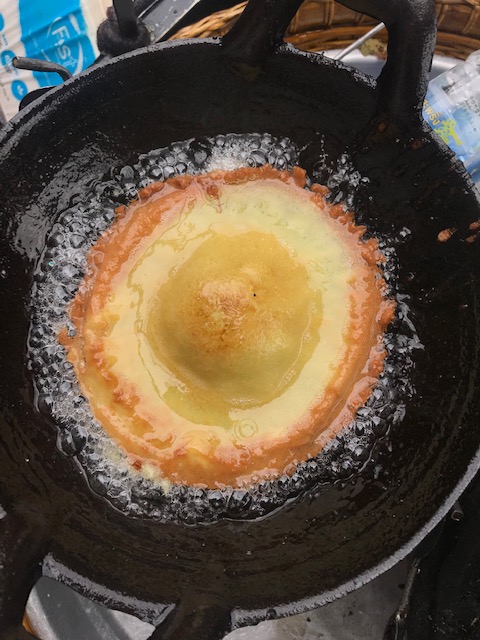
Just yesterday, while walking in the Old Town, I came across a woman in a flat-topped straw hat selling a sweet snack I’d never seen before. Called khao thid din (“down-to-earth rice”), it’s actually a deep-fried batter of banana, coconut milk and rice flour cooked to form an airy puff in the middle like this:

khaothitdin

Located between Tani and Phra Sumen roads

The flavor is only slightly sweet, the texture light and spongey. The vendor has been selling this treat in the Old City since she was a young girl, but claims to be the only person in Bangkok offering it. Eyes: opened. Again.

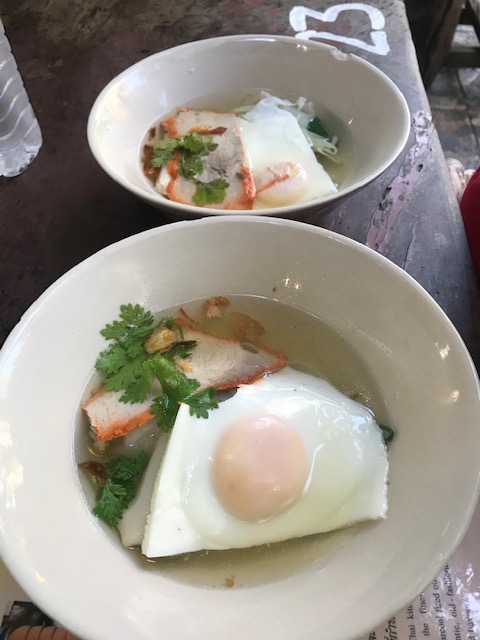
I came across some other dishes new to me while on a never-ending drive north to Chiang Mai from Bangkok, a trip that typically takes 9 hours. About an hour north of the old Thai capital of Sukhothai, a 40-year-old open-air eatery called “Khao Perb Yai Krieng” (Ban Tuek, Si Satchanalai, +6687-036-0060)  serves … you guessed it, khao perb, a steamed rice noodle stuffed with greens and served in a clear pork broth with egg and fresh coriander.

khaoperb

Khao perb is pretty good, don’t get me wrong, but in my opinion the namesake dish should be guaythiew bae, rice noodles paired with a generous rectangle of pork and seasoned with the region’s prized limes, peanuts, sugar, shredded crispy pork and garlic. Add some slivered green beans, and you could very well have guaythiew sukhothai hang,  or Sukhothai noodles without broth.

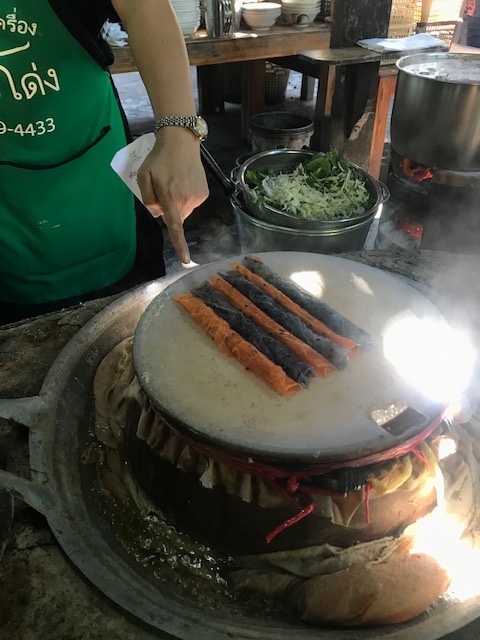
Another specialty is mee pun (this place has a lot of specialties, all cooked in front of you in a thatched-roof, open-air kitchen using traditional implements and charcoal). These sausage-like cylinders are a steamed mixture of rice noodles and bean sprouts, encased in a homemade rice wrapper and served on a banana leaf.

meepun

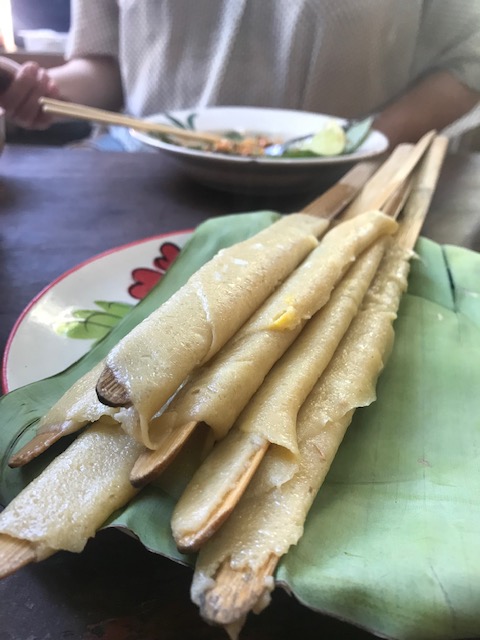
The only thing keeping the dishes khao ob and khao pun from joining the roster of Yai Krieng’s signature dishes is availability. When the place gets crowded, you can no longer order stuff served on skewers. But if you are lucky, as we were, you are able to sample anything you like, yakitori-style, in a jumble on the same platter. Instead of the more traditional khao ob we opted for khao pun kai, a steamed rice noodle (but more of a rolled crepe) seasoned with egg and herbs. But they also have a version seasoned with a dash of pork soup, and another with chilies because of course.

khaopunkai

The only caveat to all of this hard-to-find grub is that, well, you have to get there. But if you find yourself in the area, it is well worth a stop when you’re sick of scarfing down regular Sukhothai noodles or 7-11 mieng kham-flavored potato chips and want to get a (much needed) break from the road.

sign

1 Comment

Filed under Uncategorized