Author Archives: Bangkok Glutton

Bangkok Glutton's avatar

About Bangkok Glutton

Eating and writing in Bangkok.

Finding the Om in Nom

lunch

You may start with a 30-minute run, or a group barre class. It’s boring and/or excruciating, but after a week, you’re hooked — the pain is nothing when compared to the glow of self-congratulations after the fact. I AM AWESOME, you think, so you do it again. After a while, like a drug, that hour-long class seems like old hat; it’s new heights of boredom and pain that you now seek. Some find that backbreaking solace in Crossfit, or marathons, or iron man competitions. Others take a different route: meditation, a cleanse, or detox.

It’s easy to say “I’m detoxing for 30 days, don’t feed me anything good”, and then eat soup and be mean to your husband all month long. But if you really want to do it, and to be held accountable, you go to something like Samahita Retreat in Samui, where detox, yoga, and, yes, weight-loss programs are available for anywhere between 7 to 14 days.

Samahita’s slogan is “Breathe into a new life”, but my friend Trude would say a more honest one would be “Luxury fat farm”. Open since 2003, Samahita means “centered” and its default setting is its “yoga/core/cycle” program, which every guest automatically gets once they book into the retreat. This basic default mode means that you aren’t required to stay the minimum of 7 days that it takes for the detox or weight loss programs to take effect. So naturally, this is what Trude, Fiona and I chose. It was not until I arrived on the premises that I discovered that “yoga/core/cycle” means yoga, core, and cycling classes because duh (I thought it meant some sort of yoga like “sun cycle”, only “core cycle”. Whatever ok?)

giphy

Gwyneth judges me

The “yoga/core/cycle” program involves up to 5 hours of classes, including morning meditation and breath work, yoga flow, core class in the afternoon, spinning, and then a gentler, “restorative” yoga. In the evening, you get another hour of meditation if you want. There is a morning banana and coffee and tea from 6.45 on, and a “hot” breakfast available from 9.30 while you are already in yoga class, but the bulk of the eating is done from 11am to 8 at night, when the dinner buffet closes down. In the afternoon lull at 3pm, you get a “snack” that is invariably a fruit that skinny girls always seem to eat, like papaya, watermelon or dragonfruit. I am detailing this as clearly as I can because 1. I am a pig and 2. this is ultimately what Samahita is all about.

In other words, besides being “centered” and working the crap out of you with its fitness and yoga classes, Samahita is mainly about (excuse my French) “le poop.” If you have problems in this area, Samahita is there to fix it with its smoothies, its juices, its poop-y fruity snacks, its all-you-can-eat lunch and dinner fiber buffets. I can attest (again TMI) to going to the bathroom twice a day; my companions, three. In any other setting, this would be cause for alarm and a trip to the pharmacist. Here, it was merely a byproduct, evidence of our detox.

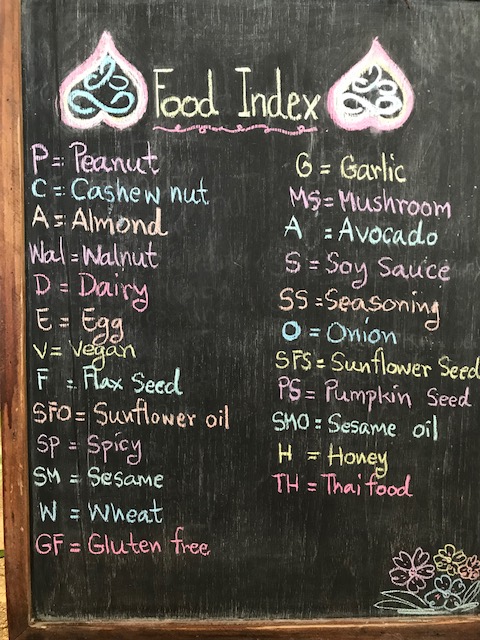
And the food? The food. The food is a portal through which any culinary pathology can pass and thrive, uninhibited. Gluten-intolerant? Lactose-free? Vegan? Wary of garlic and onions? Every food phobia you can think of is acknowledged, cosseted, tended to like the weary feet of a tourist at an upscale Thai spa. There is even a handy food index:
index

Note the “Thai food” warning

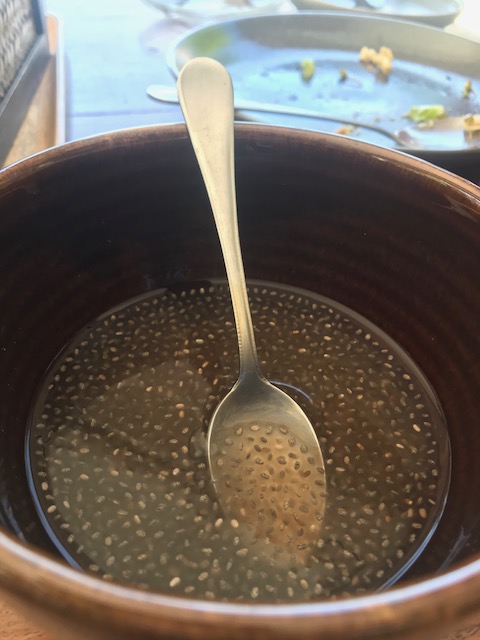
Not surprisingly for a place that must denote its Thai food dishes, the clientele is overwhelmingly Western, with a smattering of Singaporean and Japanese guests. Many, if not most, of the guests knew Thailand solely through their experience at Samahita. This might explain why the food caters to a crowd that prizes purity first and taste second: the buffet changes daily but always features a salad, steamed veggies, a dip with crudités and a “green power soup” that I strongly suspect are the pureed steamed green vegetables from the night before. The focus is on freedom from meat, from sugar, with the occasional nod to dairy, wheat, eggs and even fish.  Things that hint at “sweet” are simply nods at those things, security blankets that don’t mean anything. This comes into focus most clearly in things like the “chia chocolate pudding”, which Fiona calls “the most anorexic pudding ever” and tasting as if “a chocolate bar had been waved over it during assembly”.
chia

Perhaps this is why much of the Thai staff, when confronted with an actual Thai and a Thai-speaking farang like Trude, did not really take us to heart. Even Fiona noticed, telling us, in case there was any doubt, that “Yeah, they really don’t like you guys.” I think the underlying assumption (because it couldn’t possibly really be us!) was that farang whose only experience of Thailand would be this retreat would be expected to indulge in crazy things like vegan food and 5 hours of fitness classes a day. Why on earth would other people who really know Thailand do it though? To opt for a garlic-free mash of grilled green peppers instead of nam prik num, to content oneself with flat rice noodles in a vegetable-and-arrowroot gravy instead of real guaythiew lard na? In their eyes, what were we thinking?

What we were thinking was that it was nice, for once, to feel so exercised, healthy and self-righteous. All the same, three days was enough. So enough, that we plan to do it again, later this year. I will bring athletic shoes this time, so I can go spinning. It won’t be any longer than three days, of course.

twins

Twinsies

On the way home, I bought a wildly overpriced bag of Doritos (extra Nacho flavor) and ate them outside, in a courtyard of the cray-cray Samui airport built to resemble a suburban US shopping plaza. It was the best Doritos I’d ever had, everything I’d been missing: satisfyingly crunchy, aggressively umami, yo-yo flavors both salty and sharp. That alone seemed worth the trip.
5 Comments

Filed under Uncategorized

Sincere eats

tapioca

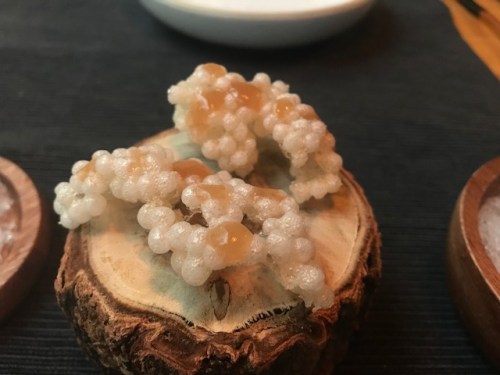
Crispy tapioca cracker with mieng kum sauce

(Note: If you think I can be bought with a bottle of Pinot Noir and some nice dinner conversation … you are right? Not a question. Dinner came courtesy of Haoma and Extrovert PR & Marketing.)

One of the best things about Anthony Bourdain was his refusal to be diplomatic. This really set him apart in the food world, where usually the best thing to do when you have nothing nice to say is to say nothing at all. But such was the force of his personality, his charisma, his barefaced intelligence, that people were willing to let him slide for it, even though he had the best job in the world and was therefore a worthy magnet of our jealousy and envy.

Karen sent me a list from insidehook.com detailing all the targets of his social media ire over the years. This includes the movie “Baby Driver” starring Ansel Elgort, whose face never fails to remind me of the guy who rolls his eyes when I complain that the music is on too loud at the cafe near my house. Also, the soundtrack is vastly overrated. So I agree with Bourdain, whose writing was always best — and he was a wonderful writer — when he was raging against something.

But I don’t always agree with him. Here, this list of the edible things he has insulted suggests that he was woefully misguided on matters like hot chicken (too spicy? lol) and Frito pie (which he compared to dog poo), but very much correct on club sandwiches (like Al Qaeda), Kobe sliders (Douche City), house-made ketchup (ditto), and unicorn frappuccinos (barfarama).

Here, my own list of culinary pet peeves would have to include:

  1. Dry ice. It makes me instantly suspicious of what is underneath all that haze that is obscuring it, like the sunglasses and huge visors that plastic surgery patients always wear after a procedure.
  2. The movie “The Hundred Foot Journey”. I know it’s not food per se. But every time I think of it I fly into a rage. The idea that a young Indian cook has to prostrate himself before some old French lady in order to become a proper chef still makes me want to throw a vat of dal over Lasse Hallstrom’s head even today. India has no long culinary history? That dates back to before the people who became French had ever heard of pots? Those were not questions.
  3. Cynicism. Sometimes it’s expected, like when McDonald’s tries to sell cold brew coffee. But sometimes it comes out of left field, in a restaurant where the chef is clearly capitalizing on his name, a bare-bones operation masquerading as something else, clearly designed to make the owners some money, finally, because it’s their time now and kids are expensive, yo. It’s the restaurant equivalent of Rod Stewart’s entire post-1977 career. Not as obvious as frozen pizzas, but not that far away, either. It’s an outpost in Las Vegas where the owner never visits.

So when I go to a restaurant like Haoma — which is not Chinese, but named after a sacred plant in the Zoroastrian religion brought to earth by divine birds — I am struck first by its naked sincerity. The brainchild of former Charcoal chef Deepanker Khosla, Haoma labels itself as an “urban farm”, where the herbs that perfume your dishes and cocktails are grown in profusion in the garden in front of you, and the fish available for your dinner is plucked straight from a barrel next to your window.

cauliflower

The current veggie main course of roasted cauliflower and long beans in a curry cream with crispy Job’s tears

You don’t have to worry about not understanding what each dish is, because someone, even Chef Deepanker himself, will be there to stare earnestly into your eyes as he explains exactly what went into your food. No worries if you rudely take photos of your food as he speaks — he’ll wait for you to finish. It’s this kind of obvious care that permeates every bit of the experience; it’s not a marketing gimmick, it’s not a trendy ploy.

After leaving Charcoal, Chef Deepanker said he took a food truck around the country, attempting to make sustainable food with as little waste as possible. After a few months, a friend told him it was time to go back to fine dining. Haoma, set deep into the residential wilds of Sukhumvit 31, was the result. Chef Deepanker, who lives next door, hopes to eventually harvest the root vegetables in his own garden and incorporate them into Haoma’s menu. Helping him in the kitchen is sous-chef Tarun Bhatia, christened “San Pellegrino Young Chef of 2017” by the powers that be at Asia’s Top 50.

The garden is already pretty extensive, providing the sorrel for the caramelized milk bread or the Job’s tears for the bread. The grouper with lettuce cream is the restaurant’s first 0-km dish, featuring ingredients plucked from its own grounds. It could seem precious until you remember how people have gotten sick from eating contaminated spinach or Romaine lettuce, how fish are disappearing from the water, and how pigs and cows are killed, and then you think, This might be how we will have to eat from now on. Purposefully and with an eye to the future, like the ascetic monks in the Zen temple who eat every grain of rice.

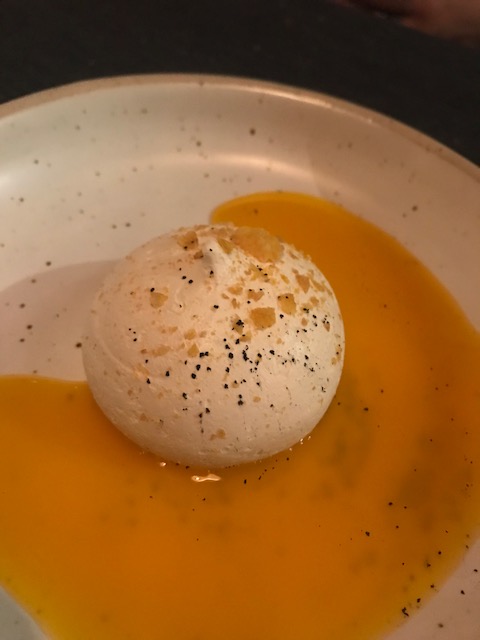
meringue

Meringue with passionfruit

And then you remember how uncool it is to be so sincere, and go back to listing all the stuff that you hate.


1 Comment

Filed under Uncategorized

Lost Youth

There was a time when you would catch a glimpse of someone in passing via car mirror or window and think, “Who’s that?” but in a good way that made you want to look at them again. The shocking realization that the reflection was yours was a nice feeling.

But there comes a time when the sudden reflection is shocking in a bad way, like the realization that you’ve signed onto an expensive dinner where you are starving, there are only three courses to be served and that one of them will be chicken. You catch a reflection of yourself while riding on a motorcycle taxi where the mirrors are angled in just that way to showcase the growing dumpling underneath your chin and the impressive bags under your eyes. The thought that springs to mind is not “Who’s that?” Instead it is “Oh shit.”

This is the theme of what is commonly known as “middle age.” The Starks have the direwolf and the house words “Winter is Coming.” If “middle age” had a house sigil and words, it would be a bathroom scale, placed inside an hourglass, the number creeping inexorably higher as the sand accumulates on top, the words OH SHIT lettered neatly underneath. OH SHIT indeed.

I used to judge people who posted very old photos of themselves in their lost youths, but now I am one of them. My friend Trude, who should work for the IRS or FBI, ferreted out this old video after I mentioned that my first commercial involved Vaseline lotion and a floating umbrella over my head. And lo and behold, here it is….


That was the year I was 24, and the golden age of me, oblivious of the hourglass and inevitable shifting of the sands. Just like Bangkok’s street food, poised on the threshold from which there will be no return. (Oh, the lengths I will go to just to post an old commercial! Sad!)

I recently spoke with Vallop Suwandee, the architect of the street food cleanup in Bangkok, who was quite candid about how much of it was precipitated by the complaints of real estate developers anxious about their property values. Ultimately, he was aiming for the Singapore model, but added that sub-sois — like Convent Road and even Ari — would be left alone. Next on the chopping block: Klong Toey, which is interesting, given that vendor protests have roiled the market before.

All the while, Chinatown (the birthplace of Thai street food) and Khao Sarn Road (home of mediocre pad thai and cold fried egg rolls) are said to be left untouched because of their reputations as a tourist draw. But once the subway stop to Chinatown opens up, who is to say that property values won’t change, and the temptation to “clean up” take root? BMA officials are currently positioning the street food drama as a struggle between agricultural workers using street food as a way to make extra money in the city after the harvest season, like toddlers setting up lemonade stands on their front lawns. Meanwhile, upright, tax-paying Bangkokians simply want to be able to walk on their sidewalks. But simple observation would suggest that this is not completely true. Bangkokians are also making street food, year-round, and eating it to survive.

Jek Pui (25 Charoen Krung, 19 Soi Mangkorn, 02-222-5229) is a textbook example of the Bangkok boogeyman, the vendor blithely clogging up the sidewalk. This curry rice vendor, which sells from a cart placed at the corner of Charoen Krung and Mangkorn Roads on the edge of Chinatown, forgoes tables in favor of more plastic red stools in order to seat more people at a time. Because of this, it has earned the nickname of “Musical Chairs Curry”.

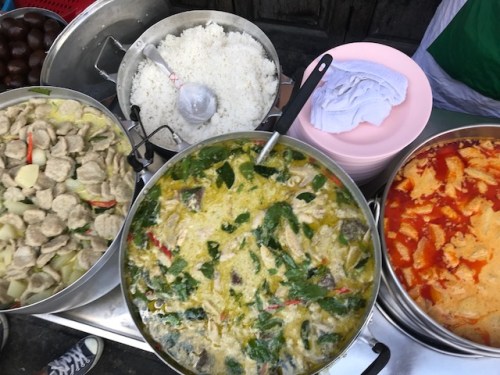
curry

What’s on offer at 2.30: green curry with fish meatballs, green curry with chicken, mild pork curry 

But it’s been around for 70 years, set up by the grandfather, who immigrated to Thailand from China and made his way by selling curries from a bamboo pole. When his daughter turned 13, she, too, helped sell her father’s curries, walking the streets for so long she eventually developed a hump in her back.

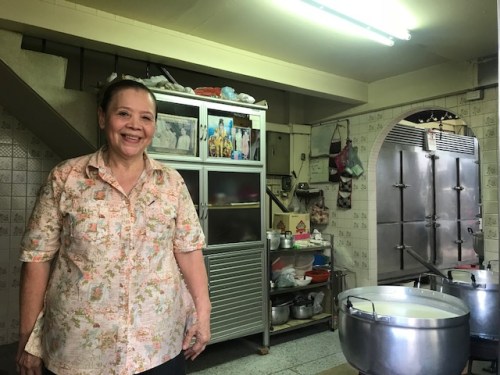
ama

In the kitchen

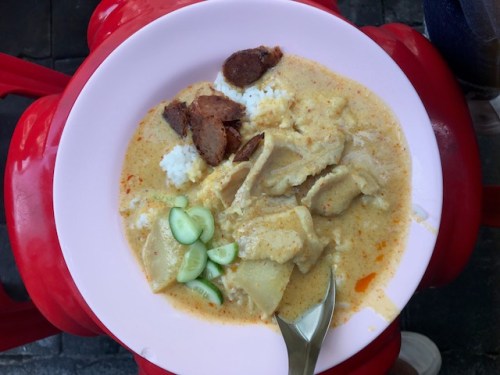
Today, “Jay Chia” does the bulk of the cooking, but the business is run by her children. The cart-and-stools setup started over 20 years ago, for which they have obtained full permits from the government. The specialty of the house, however, remains the one that Jek Pui (aka “Uncle Chubby”) toted around all those years ago: gaeng garii moo, or mild Chinese-style pork curry, topped with a healthy sprinkle of sliced, deep-fried gun chieng, or Chinese-style sweet sausage.


pork

As with all things in the waning days of their golden age, it is best to sample this street food as soon as possible, for as long as it is available. Who knows when the next time you accidentally find yourself in Chinatown will be, scouring the streets for a bite to eat that does not come from Starbucks, KFC or a tourist restaurant? OH SHIT indeed.

2 Comments

Filed under Uncategorized