Category Archives: Asia

Glutton Abroad: In the Japanese hinterlands

To celebrate the season: grilled matsutake and tuna sushi at Garyu in Tokyo

To celebrate the season: grilled matsutake and tuna sushi at Garyu in Tokyo

The sign said it would take 3.5 kilometers to reach the lip of the crater overlooking Tamagawa Onsen, a hot spring resort in northern Honshu that is believed to host the most acidic waters in all of Japan. This — paired with the presence of a radioactive stone thought to aid health and even combat cancer — has drawn the health-afflicted from all over the country, to lie near the fissures that hiss a thick, hot sulphuric steam.

Now, I’m not one to say what does or doesn’t work, healthwise or any-which-way-wise, really. But I am hesitant to lie on steaming hot rock smelling egg salad farts all day if there’s not a great reward guaranteed at the end of it — something like David Chang hand-feeding me Korean tacos maybe, or the Steelers winning a single game.  Neither of those things looked likely. We were going to go for a walk.

A rock-strewn path winding through the “onsen” — a collection of steaming vents around which people were lying or sitting — turned into several stories’ worth of stairs, and then a muddy incline riddled with rocks and tree roots. Treachery lurked everywhere, in every slippery stone, slick of mud, thorny branch. Whenever one stretch was finished, another would peer out from around the corner. I consoled myself with thoughts of recent meals: mashed mountain yam topped with a wasabi-flecked seaweed; peanut tofu daubed with more wasabi; a virtual downpour of awamori, an Okinawan liquor brewed from Thai rice and kept in urn-like earthenware vessels for decades. In Okinawa, despite the occasional monsoon-like shower, the sky was always blue, people were always smiling, and taco stands, inexpensive fresh fruit and ice cream cones (with seasoned salt!) were everywhere to be found.
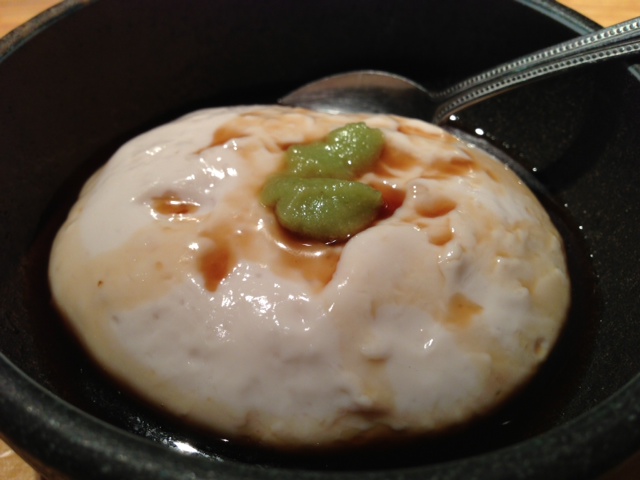
Peanut tofu at Shine of Ryukyu in Okinawa

Peanut tofu at Shine of Ryukyu in Okinawa

But Akita was something different. Proud of its rice and udon noodles, and abundance of apples, and mountainous terrain: Akita held little to fall in love with for a Glutton like me. And now stranded on a thickly wooded hillside — did that sign say I’ve only walked 1.8 kilometers?! — I was running out of steam.

Singing along to what appeared to be a Discman, an old lady — maybe 70, although it is hard to tell here in Japan — emerged on the trail, laughing when she saw my husband and me. A quickfire barrage of questions in Japanese ensued, to which we could only smile and nod. That made her love us  more. Declaring us wonderful, she took our picture, and then when we made motions like we would, against our better judgment, continue on the path, she followed, chirping happily all the way.

Now I feel that, despite much evidence to the contrary, I am actually a pretty fit person. I work out with a trainer 2-3 days a week, do a day of TRX training a week, and run an hour on the treadmill on my off days. Just this past April, I walked 200 km on the Camino de Santiago. But this septuagenarian lady wearing what looked like orthopedic shoes smoked me on the trail. Huffing and red, with sweat stinging my eyes, I could only watch as her trim figure clambered up the rocks and jutting tree trunks ahead of me. She turned around to offer encouragement. “All this walking will make you slim!” she said, effectively sealing my humiliation.

Powered by the knowledge that turning around and walking back would be just as hard as forging ahead, the hope that our walk was nearly done, and our lady friend’s occasional interjections of “GO GO GO DE GOZAIMASU”, we finally reached a ridge where we could see the white barren crater that marked the top of our hill, and the onsen stretching below. Our friend said we had 300 meters to go, which is, in the normal world, nothing, a mere walk to the grocery store.

But this 300 meters yielded an exercise in sheer WTF-ery: a steep ascent carpeted with cut bamboo stalks that ensured a slip with nearly every step. As if to mock us, ropes hung from some sections that were particularly steep — up to 80 degrees. After a few minutes, that was it: I was okay with curling up and dying, and with the thought of my body eventually washing away on the rotting bamboo into the waiting valley below. We had been walking for more than two hours. Above us, our friend scrambled from point to point like a mountain goat, exclaiming things in Japanese to either us or to herself. “You can do it!” my husband said, trying to boost me, but since it was not in Japanese or from the mouth of a friendly old lady, I wanted to punch him in the face.

Yet it was easier to pull oneself up, each step by agonizing step, than to turn around to face Lord knows what. Better to deal with it later. Eventually, in spite of myself, we made it to the top. The Japanese lady, of course, was nowhere to be found.
 

7 Comments

Filed under Asia, food, Japan

Glutton Abroad: Still full, lah

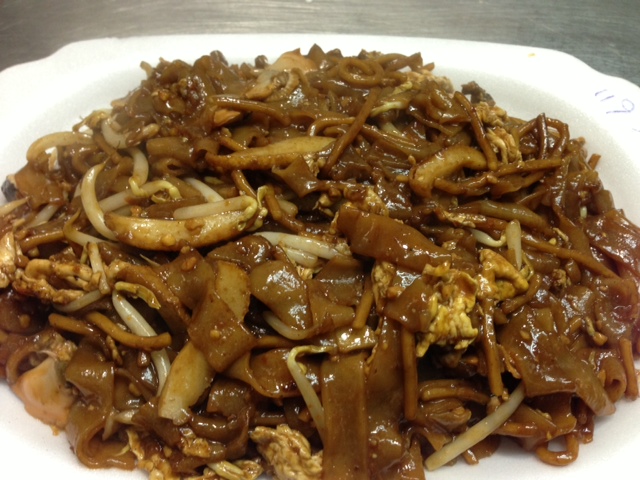
Stir-fried guay thiew at perennial street food favorite, Newton Food Centre

Stir-fried guay thiew at perennial street food favorite, Newton Food Centre

Singapore and Bangkok are often seen as flip sides of the same coin. Where Singapore is clean, orderly, and green, Bangkok is … not. What can you say? Both have their advocates: light vs dark, security vs chaos, angel vs devil. One will never be mistaken for the other, but there are more than a few similarities, the most prominent of which is a nearly debilitating obsession with food.

Yes, Singaporeans love their food. Like in Thailand, food forms the backdrop to every social interaction, is the insistent hum underlying almost every conversation. While you are eating, let’s discuss where we are eating next. Did you try this yet? We can shoehorn it in between that other place and the one down the road and, oh, that reminds me of the place across the street too. Let’s take a walk and look at other restaurants while we’re eating dinner. Why not? Also: I love this. I feel you on this, Singaporeans. I feel like you get me. Let’s be friends.

Bina and Poh Sun get me. This is why, minutes after we have settled into our hotel, they come to pick me up for dinner. They have a plan … for the entire weekend. No meal will go unattended, a lazy stroll down some sidewalk and a quick dart into the first fast food venue that beckons. That is not for us. Every meal is a learning experience, aka a chance to stuff my piehole with something different. Because — despite its relatively tiny size of 660 sq m — Singapore still contains multitudes. I would try to consume them all.

First stop: Newton Food Centre. We acknowledge that it is one of the island nation’s more touristed spots, but it is also one of the biggest, and the easiest way to jump into Singapore’s street food scene. All the favorites are represented: stir-fried noodles, birthed in volcanically hot woks with lashings of dark soy and chili sauces; satay, paired with fresh chunks of cucumber and oddly-comforting wedges of sticky rice; egg prata, a gossamer-thin slip of dough filled with egg and veggies; and roti John, a baguette stuffed with what you would find in a regular murtabak, accompanied by a sweet, neon-red chili sauce and a perfect fusion of Anglo and  Muslim influences.

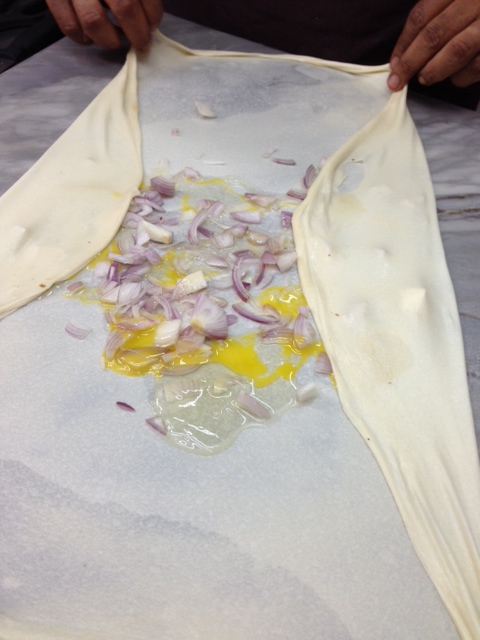
Prata in the process of being made at Al-Noor Biasa

Prata, mid-make, at Al-Noor Biasa

Of course, there are also “touts”: people who “help” newbie tourists — instantly recognizable by the dazed expressions on their(my) faces(face) — by suggesting tables and then plying them with laminated menus that promise delicious seafood. That seafood may very well be delicious, but buyer beware: the story of the tourist who paid S$800 for four prawns is something I still remember quite vividly.

But if touts are your biggest worry during your street food experience, there would seem to be very little for you to be concerned about. Street food in Singapore is a carefree, diverting experience, and one that is perfectly suited to Singapore. My opinion on the possibility of herding the cats that masquerade as Bangkok’s many food stalls (and their customers) into their own food centers, however, has not changed. Vendors here are perfectly happy forming their own little collectives — the more, the merrier the chance of encouraging more foot traffic. But to cut the spontaneity and autonomy out of the decision-making process would be to cut out all the fun — anathema to Thais. Of course, I could be wrong and railing against what may be an inevitable result of a city shedding its sordid, cluttered past and evolving with the help of a lot of money (see: Hong Kong). But to have to travel to a food center to get my street food (instead of, say, stepping out onto the corner and even at the edge of my driveway to find a stall has spontaneously sprouted somehow from the concrete) would make me sad.

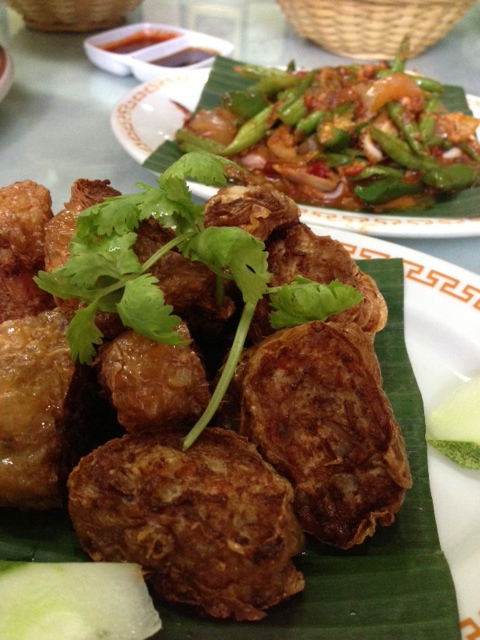
Next stop: Katong. If Singapore is downtown LA, Katong is … oh forget it, I don’t know LA. Let’s say Singapore is Manhattan and Katong is Brooklyn. And in Katong is a wealth of great Malaysian and Peranakan (a mix of Chinese and Malay) places that provide great food at prices that are actually reasonable. At Glory Catering (www.glorycatering.com.sg), an array of stir-fries, curries and noodle dishes await the extremely hungry; particularly recommended are the brinjals (garlicky, peppery stir-fried eggplant) and the porpia (soft “egg” rolls stuffed with vegetables with a tart-sweet chili sauce, freshly made with every order). At House of Peranakan Cuisine (210 East Coast Road), the ayam buah kelua — chicken curried with stuffed Indonesian nuts that are also macerated and cooked into the sauce — may not be black enough to satisfy devoted Peranakan food lovers, but the long beans, stir-fried with bits of baby octopus, and meatballs are delicious enough to make up for it.

Meatballs and long beans at House of Peranakan Cuisine

Meatballs and long beans at House of Peranakan Cuisine

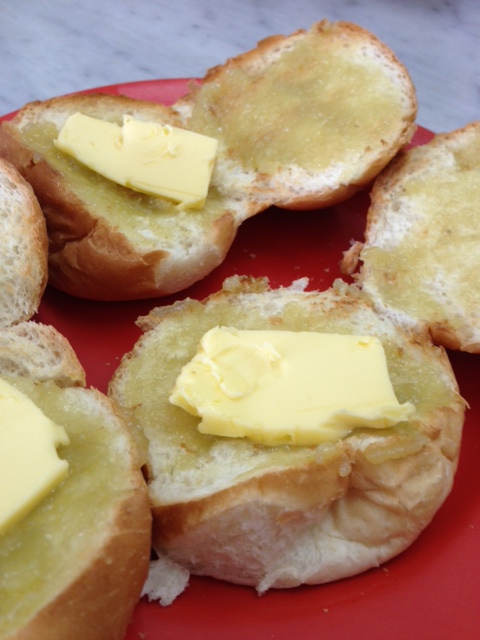
Possibly best of all are the hot buns, dripping in kaya (a mix of eggs, coconut milk, pandanus leaf extract and, of course, sugar) and baptized with an obscene square of butter at Chin Mee Chin Confectionery (204 East Coast Road). With a cup of sweet coffee and an egg boiled just enough to form a thin white skin over the yolk, this is enough for any lunch. Although the two other lunches before then were pretty good, too.

Buttered buns at Chin Mee Chin

Buttered buns at Chin Mee Chin

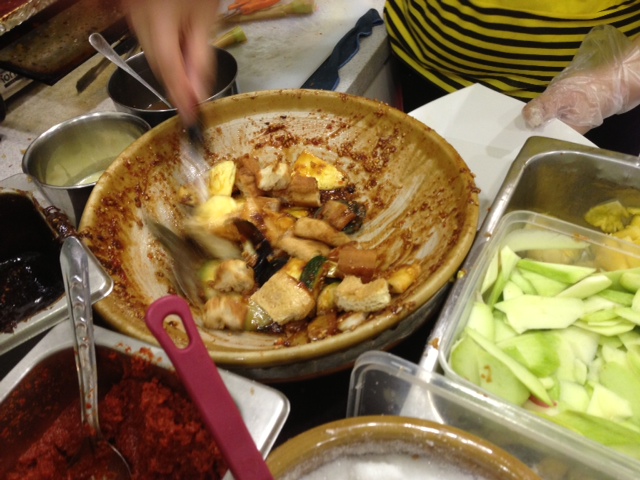
Third stop: Far East Plaza. Alongside all the aspiration that pervades much of Orchard Road is a humbler collection of downmarket shops and no-frills Asian eateries known as Far East Plaza, the Singaporean equivalent of Bangkok’s MBK. Amidst the sushi bars, Malay-style curry stands and yong tau fu (sort of DIY noodle shops featuring fresh veggies and your choice of protein) shops is William’s Rojak, the first purveyor of the Chinese-style salad made up of chunks of green mango, pineapple and rose apple tossed in a sauce of shrimp paste, chilies and pulverized peanuts and garnished with bits of torch ginger and patongko (Chinese-style flat fried bread). It reminds me of Thai-style som tum in that its main fanbase is predominantly female. The similarities pretty much stop there. There is also a Malay version hewing closer to the standard idea of a vegetable salad, as well as an Indian version that simply tosses out everything that is healthy about this dish and then fries it twice. I have yet to try those. But I doubt I’ll like them more than I like this.

The beginnings of a rojak

The beginnings of a rojak


Have I gotten into everything that I’ve tried in Singapore? Hell no. I have a reputation for laziness to maintain. Do I look forward to trying more on my next trip there? Of course I do. You’re on notice, Singapore.

9 Comments

Filed under Asia, food, Singapore, Thailand

What’s Cooking: Elvis Suki

_DSC8156

Scallops ready for the grill

(Photo by @karenblumberg)

Elvis Suki (Soi Yotse, Plabplachai Rd., 02-223-4979, open 17.00-23.00 daily) is one of my favorite places to take visitors from out of town. Its specialty — the Thai-style sukiyaki after which it is named — is an unglamorous but delicious goop of glass vermicelli, a blank canvas on which a yin-and-yang-likedrama is played out nightly: blanched seafood or meat versus the vibrant thrashings of a spicy-sweet-tart chili sauce, like the Meg underpinning a buoyant Jack.  That said, it’s still the Cleveland of street food dishes, solid but unlamented, probably a nice place to live but unlikely to haunt your dreams.

Their scallops, however, are another story. Other people make scallops like these: an unlikely pairing of scallops and a dab of pork, minced or otherwise, both doused liberally in a sweet, garlicky butter. Yet somehow no one can hold a candle to Elvis Suki’s version.  Maybe it’s the atmosphere? (no-nonsense open-air shophouse or, if you are fast enough, no-frills air-conditioned room?) Maybe it’s the people? (A mix of families and office workers). Or maybe it’s the service? (Probably not). In any case, few diners leave Elvis Suki without those scallops.


Elvis Suki’s grilled scallops with pork (makes 4)

What you’ll need:

–       4 large scallops

–       1 slice (about 60 g) pork neck

–       2 Tbs butter

–       2 large cloves garlic, finely minced

–       Salt and pepper (to taste)

–       Sugar

To make:

  1. Make garlic butter by mixing garlic with softened butter
  2. “Dry brine” pork by coating in salt for 15 minutes. Before using, pat dry.
  3. Clean scallops and place 1-inch-long piece of pork alongside scallop on the shell. Season both with salt and pepper.
  4. Dot with dollops of garlic butter and sprinkle both scallops and pork with ¼tsp of sugar.
  5. Grill or broil in oven for about 5 minutes, keeping a close eye so that the scallops do not burn.
  6. Take out and serve while hot.
The grilled scallops at Elvis Suki

The grilled scallops at Elvis Suki


3 Comments

Filed under Asia, Bangkok, food, food stalls, Thailand