Category Archives: Bangkok

What’s Cooking: Moo Jum

Image

Finally, a decent approximation

Isaan food is a celebration of simple things, put forth very directly and forcefully. Your finger-licking renditions of gai yang (grilled chicken) and nuea nam thok (spicy beef salad) aren’t content to sit mutely on your tabletop, requesting your appreciation; slightly smoky and full of heat, they practically shout I AM DELICIOUS as you cram morsel after succulent morsel down your throat. Paired with a hank of sticky rice and the battalion of condiments that Thais cannot resist pairing with everything, they are unstoppable, a food army that cannot be resisted, taking up all the valuable real estate in your gut that you have reserved for something useful, like beer.

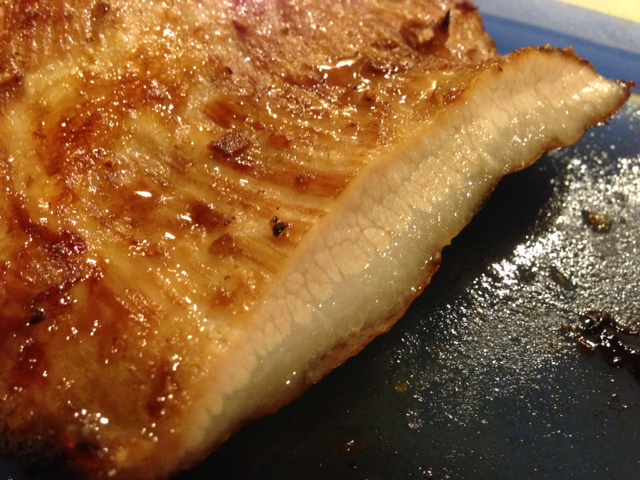
Moo Jum (located at the entrance of Suan Luang Soi 3 after 6pm) specifically traffics in these very dishes, the ones that make you sorry you stuffed yourself silly. Like most great Isaan cooks, they focus on straightforward simplicity. The namesake dish, an Isaan-style sukiyaki, is a spicy-tart broth in which unwitting vegetables, sawtooth coriander, Thai basil, pork and an egg are dunked, creating an aromatic melange good enough to eat even on sweltering hot nights. A simple spicy squid salad, rings of flesh barely blanched, dressed in sharp shards of Thai celery stalk and chili. And of course, their famed kor moo yang (grilled pork collar): sweeter than up north to be sure, charred at the edges from the grill, lacquered like a freshly-baked pie, as brown as the skin of a dedicated bodybuilder.

For all its supposed simplicity, I have struggled with this recipe. The basic recipe (as outlined in Chef McDang’s “The Principles of Thai Cookery”) uses a basic marinade of mashed garlic cloves, pounded coriander root, 1/4 cup of soy sauce, and 10 white peppercorns that is then slathered onto the meat. Very traditional, but nothing to set hearts aflutter. I tried to build on that recipe by going back to the marinade’s roots, substituting fish sauce for soy and adding some palm sugar. The result: ho-hum. I then tried to add molasses paired with fish sauce: NO DO NOT DO THIS EVER. It appears that where modern versions of kor moo yang are concerned, it is best to stick to soy sauce and build on that.

So last night, alongside an odd pairing of roasted cauliflower and soba noodles, I made some more pork collar for unsuspecting victims-slash-guests who had come over expecting dinner. The result was not awful! This is the best iteration of Moo Jum’s kor moo yang so far.

Kor Moo Yang (serves 4, just barely)

– 400 g pork collar (or shoulder)

– 4 garlic cloves

– 2-3 coriander roots, washed

– 1/2 tsp white peppercorns

– 1/4 cup soy sauce

– 1 Tb brown sugar

– 1 Tb sweet soy sauce

To make:

1. As in Chef McDang’s recipe, mash garlic, peppercorns and coriander root into a paste with mortar and pestle. Add soy sauce and sweet soy sauce and mash that all together to form marinade. Add brown sugar.

2. In a large mixing bowl, pour marinade over pork and allow to infuse meat, ideally overnight, or at least four hours.

3. When ready, grill meat until brown and charred a bit at the edges. If you, like me, don’t own a grill (why are American males so into grilling?), heat up a nice heavy pan (I use a cast-iron one) that has been oiled beforehand, and brown the pork until it’s a nice caramel-ish color. Then stick this into the oven that’s been set at 180 degrees Celsius for about 15 minutes, or until the edges gain the same charred edges and sticky-looking exterior that you would have gotten via grilling.

4. Slice and serve with a tamarind or sweet chili sauce, along with some sticky rice.
6 Comments

Filed under Asia, Bangkok, food, food stalls, pork, Thailand

What’s Cooking: Jay Fai Take 2

Image

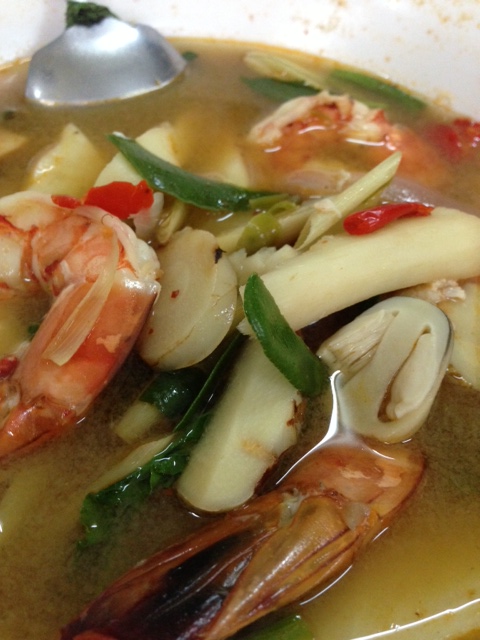
Jay Fai’s spicy lemongrass soup

(Note: spoilers for “Game of Thrones” viewers and A Storm of Swords readers, published in 2000)

(Note take 2: I already tried making this soup. What gives? Unhappy with the first version, I tried it again. I am happy to report that, like “A Song of Ice and Fire”, this soup gets better!)

There are rules to things. Although I’m all for culinary experimentation, and switching things up for almost everything, some rules are set in stone(heart), and the breaking of them renders you cursed in the eyes of gods and men. One such rule: the guest right. Once you have partaken of your host’s bread and salt, you are supposed to rest assured that your host won’t start taking his brand-new set of Wusthof knives to your internal organs.

Yes, the “Red Wedding” was tragic, the King in the North was killed through black treachery instead of on the battlefield, Robb is dreamy, yada yada yada. But what angered me most was the hosts’ callous violation of the guest right, this most important of all rules governing Westeros, more so than even kinslaying or having sex with your sister. THASS JUST PLAIN RUDE. What’s next? Forgetting to wipe your blade before moving on to your next hapless wedding guest-slash-victim? Allowing stray blood spatters to sully the mashed neeps and jellied calves’ brains? Starting the slaughter before anyone’s had even a bite of wedding cake? WHAT IS UP WITH THAT. One lesson learned: never, ever go to Argus Filch’s house for dinner.

Immutable rule no. 2: tom yum, the spicy lemongrass soup served at almost every Thai restaurant you know, is an infusion. That’s what makes it the most Thai of soups, unlike dishes like gaeng jued (clear broth soup), which is adopted from the Chinese and hence based on a broth. The base of tom yum is water. You add all your aromatics and seasonings to it after it comes to a boil.  

That’s probably part of the reason why it’s so easy to mess around with, and why modern-day cooks have started to play fast and loose with this poor soup, adding everything from nam prik pow (roasted chili paste) to milk and even sweetened condensed milk (I AM SHOCKED). The fact is, as great an invention as tom yum goong is, the contemporary tongue wants MORE. They want the drama, they want the spectacle, they want the gore. They want to be surprised. 

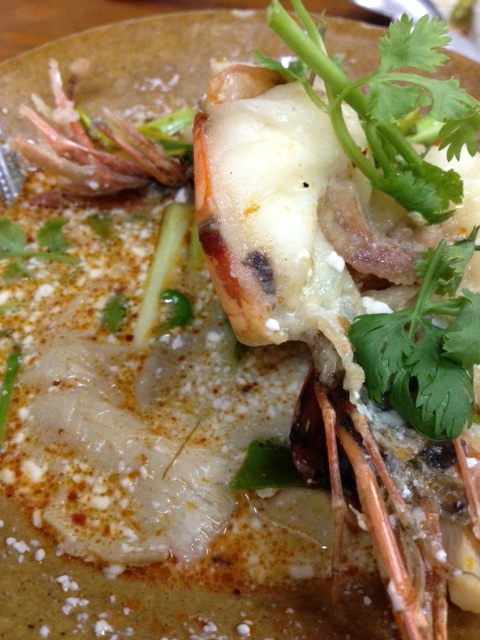
So it’s no wonder, then, that even “old-style” eateries like Chote Chitr are dressing their tom yums up to better fit in with the times. Here, Chote Chitr includes fat tiger prawns, yes, and a healthy dash of milk:

Image

Chote Chitr’s tom yum goong

The result is sweeter and fattier than the bracing, astringent herbal brew you (I) might have expected. It’s not really tom yum. It’s something else. How to make a proper rendition of this dish, but make sure it has enough flavor?

Well, you could take a cue from Jay Fai’s (1,500 baht) version, which caters to modern tastes while staying true to the spirit of the soup. In Jay Fai’s case, the difference is most certainly roasted chili paste. Although it is not strictly traditional, it adds the heat and flavor to an infusion without murking up all the flavors. Another thing: scraping the shrimp heads into the water, and allowing the heads to “infuse” alongside the kaffir lime leaf, lemongrass and galangal. This one hopes that — unlike breaking the guest right — these relatively newfangled additions will not curse you in the eyes of god and men.

Jay Fai’s tom yum goong (serves 4)

– 5 cups water

– 6 jumbo prawns with heads, deveined

– 6 large slices galangal

– 5-7 kaffir lime leaves (it’s a lot, but if you are cooking in the spirit of Jay Fai, you will want this soup to “go up to 11” — her personal motto.)

– 4 lemongrass bulbs (purple part), bruised

– 1 shallot, sliced

– 4-8 red chilies, bruised (this depends on your heat tolerance)

– 1 heaping tsp roasted chili paste

– 1 cup mushrooms (I used oyster, but straw or button mushrooms also fine)

– 1 cup young coconut shoots (if you can’t find these, you might want to use something else that is tender yet crunchy, like peeled white asparagus)

– 5 Tbs fish sauce

– juice of 2 limes

To make:

1. Bring water to a boil. Stir in roasted chili paste.

2. Add galangal, kaffir lime leaves, lemongrass and chilies. Allow to infuse for about 5 minutes, then bring to a simmer.

3. Add shrimp heads, first scraping their contents into the soup. Wait 5 minutes, then season with fish sauce. Add mushrooms and coconut shoots.

4. Wait half an hour, or until shoots are tender. Skim gunk off of surface and discard shrimp heads.

5. Turn off heat, then add cleaned shrimp, and stir to turn the shrimp “pink”.  Season with lime juice. Taste and adjust seasoning accordingly.

6. Serve immediately, paired with rice and a Thai-style omelet, or in individual small bowls.

Image

My improved tom yum

7 Comments

Filed under Asia, Bangkok, food, food stalls, seafood, Thailand

Mr. Right Now

Image

The khao soy vendor’s kanom jeen nam ngiew

Like a dog at a bone, I am constantly worrying at my love for the northern Thai dish kanom jeen nam ngiew, watching it fray at the edges as I sample dish after watered-down dish, chasing after the What when I don’t have the Where, Who or How. Because, you see, I live in Bangkok, where street food is wonderful, but northern Thai street food sometimes less so.

The Bangkok attitude to the north appears to be how Northeastern Americans view people living in the Southern US. They may be “charming” and “quaint” at best, or characterized as “rural” or “backward” at not-best. Both regions might house poorer residents and nurse chips on their shoulders about being looked down upon by the “educated elite”. The people of both areas might speak more slowly, in voices that might sound like sticky drawls. And both places certainly have incredible food where meat plays a major role, yet their cuisines might be looked at askance by the less adventurous as “weird” (please Google “The Ravenous Guide to Eating Like Elvis”) or just plain bad for you (ditto).

But the stomach-minded — and there are many of us out there — may see this food as achingly exotic. That is the case for me when I’ve been in Bangkok for a while. And although there is plenty of tried-and-true Isaan food to be had (the real stuff, not the sugary red candy posing as grilled chicken or pork shoulder at some Bangkok stalls) thanks to the city’s many Isaan residents, for some reason (and no, I don’t really know why this is), northern Thai food here is not as well represented.

So when a northern Thai food stall turns up just around the corner from the end of my street, in a barren expanse of concrete next to what appears to be a government compound, it’s exciting to me, the way a barbecue place in New York might be exciting to someone else. And it might not really be the same as what you’d find in its home setting (think of that NY barbecue place), but it’s good enough. Meet khao lad gang (curry rice) stall Khao Soy Chiang Mai (71 Ajnarong Rd., 02-672-7711) and its collection of northern Thai specialties like gang hang lay (Burmese-style pork stew), gang ho (northern Thai-style goulash), sai oua (northern Thai sausages), nam prik ong (pork-and-tomato chili dip), excellent larb moo kua (minced pork salad), and of course, khao soy and kanom jeen nam ngiew, without which northern Thai street food would be irreparably hobbled. Competent renditions all, with some green curry and shredded fish curry to go with your kanom jeen when you’re just not feeling the northern Thai food at the mo.

Image

The sign for Khao Soy Chiang Mai

It’s that little watering hole in the desert. The exit from a crowded dance floor. The guy who invites you out at 6:30pm on a Friday night. It’s not the end-all be-all. But it’s good enough for now.

6 Comments

by | 02/22/2013 · 10:51 am