Category Archives: Bangkok

Glutton Abroad: No place like home

What I love most about traveling, is, of course, all the (you already know how this sentence ends). Everybody does it differently. (Insert noun here) comes in different permutations; a humdrum thing like (insert something else here) becomes something completely new when somewhere else. I love that. I love thinking “Oh, that’s how they do that” or “I’ve never seen that before” or “Hey! I’m going to try that at home!”. It’s the best part of going anywhere for me.

For example, Sweden. When confronted with the everyday 7-11 or corner souvenir shop, you are presented with this spectacle …
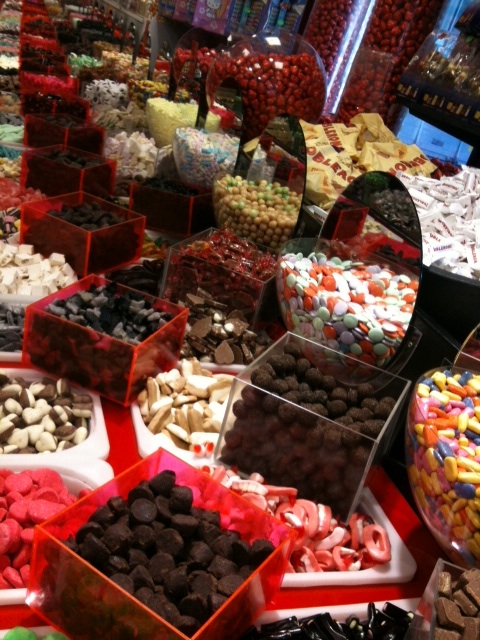
… which is just one corner of the store. You can then draw very generalized and probably extremely off-base conclusions like, “Oh, Swedes must harbor a devil-may-care attitude (about cavities), fast metabolisms, and act somewhat batshit crazy.” I’m right, right? I mean, we’ve all read Stieg Larsson.

As for Poland, well we all have our little stories, and this is one of them:
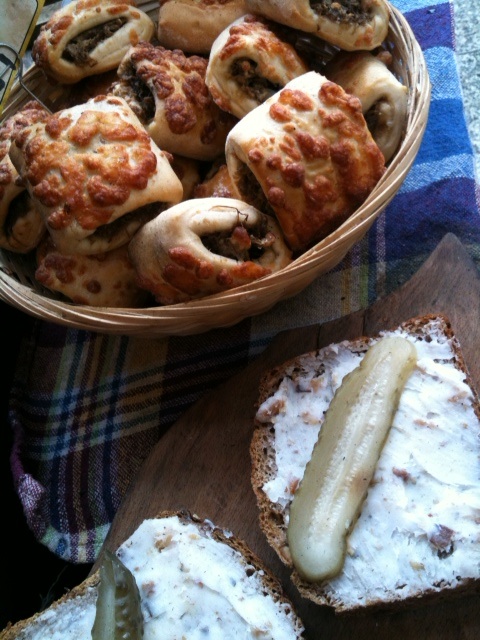
Polish street food in Warsaw

First of all, a surprise: Polish food is delicious. Sour cream, dumplings, freaking Polish DILL PICKLES — what’s not to like?!  Let people pooh-pooh lard on toast — um, that lard has bay-con bits on it, ok? And it’s topped by a freaking Polish DILL. Who’s laughing now?

So it may be freezing, and the only street food stand you’ve seen for miles around is manned by a dour-faced old lady who obviously has been hiding from you, afraid that you will order something. And she burns your first pierogie on the grill. Who cares? She finally cracks a smile when a band of schoolchildren pass by, making “ching chong” noises at you as you wait for her to lard up your toast. You get your food, and it’s pretty good, and lunch is just around the corner. It’s a good day. Did I mention Polish food is delicious?

Czech food is a different proposition. It’s heavier, not as prone to flights of fancy like herring, or making soup out of fermented rye. There is also street food, though, and thanks to Prague’s many hungry bar patrons, that street food is thriving. There are flat pizza-like dishes, and hot honey wine in the mornings (DO NOT inhale as you sip, or you will regret it), and this:

Czech trdelnik

Sweet and crispy and straight from the, uh, rollers. Best of all, there is Prague ham, which sounds simple, but is so so good — thick haunches of pig, skewered and rotating over an open flame, fat dripping into the fire, juicy hunks hacked off onto a paper plate and festooned with thick slices of rye bread. Eaten standing up next to the clock tower at night, really, it is the best thing in the entire city, a meal that makes you feel like the world is an essentially good place.

But, still. There is nothing like reaching home, finally, after days and days and days of airports and trains and, uh, I guess the word for some of the hotel rooms would be “surprising”? Surprising hotel rooms. There is nothing better than a bowl of snail curry (gaeng kua hoy kom), stir-fried sweet pumpkin shoots (pad pak maew), a tiny beaker of spicy nam prik prik Thai aun (black peppercorn chili dip), some just-boiled duck eggs. A handful of steamed rice. And a tart-spicy “salad” of fried eggs with chilies and coriander (yum kai dao), what food writers think of when they write of Thai food as a “jumble” or “melange” or “cacophony of tastes.” There is no place like home.

Fried egg "yum" at Ruea Thong
20 Comments

Filed under Asia, Bangkok, Czech, food, Poland, restaurant, Sweden, Thailand

Noshing in Nan

For years, sleepy Nan was sheltered from the rest of the country by a string of richly forested mountains that kept the northern Thai village relatively isolated. Maybe that is why the “Nan-style” Northern food bears a different imprint from that of the rest of the “spine” running down Thailand, punctuated by Lampang, Chiang Mai and Chiang Rai. With more Lao influence, less traces of a Burmese presence, Nan cuisine still boasts the earthy, bitter undertow characterizing much northern Thai food, but more stripped-down — think Peter Luger instead of, like, Gramercy Tavern.

An example of this might be the down-at-heel open-air shack lining the street off of Kha Luang Road named Pu Som Jiao Gow (take the right at the three-way intersection at the end of Kha Luang Rd., 50 m to the left after the turn; 080-674-1658, 054-750-486), which boasts a menu that is heavy on jaew (dipping sauce), various types of thom (boiled soup), grilled meaty bits and, because we are a-truckin’ along with the times that are a-changin’, various items stir-fried with oyster sauce.

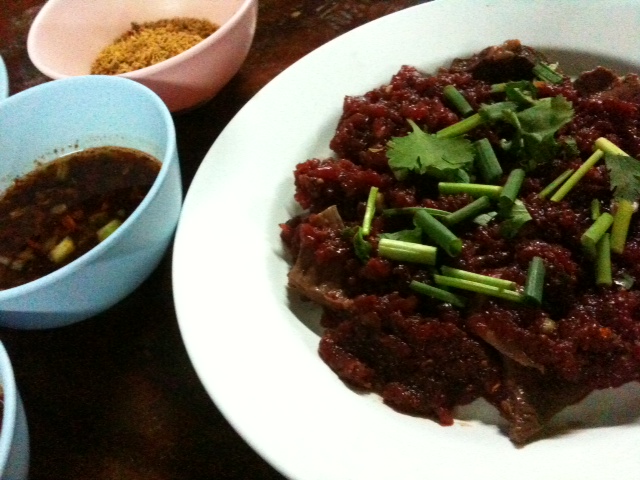
Raw beef larb with bile

Another popular dish type on the menu: various raw meat salads such as larb kom (translated as “bitter larb”, pictured above, made so with the addition of nam dee, or bile) and saa nuea (“beef salad”. Confusingly, saa here refers only to meat instead of vegetables). In addition to jaew, Pu Som serves an additional dipping sauce called kom, liberally flavored with bile and reminiscent of liquid air freshener. There is also raw pork salad, which, to be honest, is the menu item I greeted with alarm; everyone has a line, and that one there is mine. No raw pork, thanks (unless it is guaranteed to be delicious, like naem. I have standards!)

The menu is also heavy on the thom (boiled meats in soup), all appearing to be a variation on the famed Isaan standby thom saeb (spicy, tart soup), but with varying degrees of spiciness. There is thom kom (there is never too much bile) and, if you’re a great big scaredy-cat, thom om (which is what I ordered and still very spicy), free of the freshness and dill you see in Isaan but also without the satisfyingly deep flavor of a gaeng you might find in the rest of the north.

Thom om

And then there is awful. Oh, I mean offal! I usually like it, especially liver (here grilled and dressed in a yum-like sauce — yes, I’m talking about thub waan) and tongue (here referred to as lin yang, thin slices of beef tongue grilled). But I must admit, I have never had the pleasure of encountering a plateful of pigs’ lungs until this trip, where they are steamed and referred to as maam nung, resembling something a bit like boudin noir but spongy, with the slightest hint of springiness, tasting so gamey as to recall the deepest, glow-in-the-dark depths of the sea: the stuff you find in the opened crab shell, the dead man’s fingers and the like. That is maam nung. I managed two pieces.

It was one of the more adventurous meals I’d had in a while, made more so by having a giant bottle of Chang Beer to myself  (honestly, is there really no other size?) and having to navigate a crowded street crossing (watch out for that bicycle!) on the way home. In a few days, I look forward to returning to Japan, where my biggest challenge will be to keep myself from breaking a bone out on the ski slopes. Nihon ni ikoo!

Steamed lungs

9 Comments

Filed under Asia, Bangkok, food, Isaan, Northern Thailand, restaurant, Thailand

Infatuation with Isaan

"Thum pa" in Udon Thani

There are certain ways people are supposed to talk about things. Like, unless you are a commie weirdo freakazoid, you have to say Tim Tebow is “inspiring”, or “great”, or at least “intriguing”. Or, as long as you aren’t one of those strange people who hates freedom and puppies and all things wonderful, you obviously think the “Game of Thrones” HBO series is the best thing EVAH and don’t feel any need whatsoever to read the books, instead harping on and on about how you can’t wait until the next installment airs so you can find out what happens next instead of picking up a book and, uh, actually reading it (no, it doesn’t bother me that much, why do you ask? I’m just plucking an example out of thin air, I say!)

There are also ways, it seems, to talk about whole groups of people. For example, when someone is Asian, they are invariably described as “technical” or “proficient” or, if you are really good at describing, “technically proficient” (read: good at violins and math). Asian food gets similar treatment.  If you write about Asian food, you have to make sure you are as reverent as possible. References to old recipes from the 17th century get you extra points (and more if, like, you can go back to the Bronze Age. Everyone wants to know what those guys were eating!) You should consider it a monolithic “whole” that never, ever changes in order to ensure as much “authenticity” as possible. And, for God’s sake, make sure to use a poncey know-it-all tone so that people who don’t know what you are talking about feel ashamed and bad about themselves. If you cook, everything has to come out properly; if you eat, everything has to be difficult to find and hard to consume.

I try as hard as I can to adhere to these rules. Sometimes it works out splendidly. But today, it might not work out so well, because, to tell you the truth, I don’t know all that much about Isaan food. Yes, you’d think I would, since I know a bit about Northern Thai food and, since Northerners also use sticky rice, then Northern Thai and Isaan foods are OBVIOUSLY ONE AND THE SAME CUISINE. But those uppity Northerners and Isaan-ers insist that their cuisines are completely different. What do they know, right? I just can’t wait for that next “Game of Thrones” episode.

So when I trekked up to the Northeast and had my first bite of thum pa (jungle som thum), I was blown away. Rice noodles instead of grated fruit or veggies? A fishy, earthy dressing, heavy on the fermented Thai anchovy? The inclusion of everything but the kitchen sink: some shards of bamboo shoot, a few stray strands of acacia, a handful of unripe tomatoes, a few lost snails, the occasional bashed-in green bean. Thum pa (also referred to as thum sua or thum mua, “confused thum“) incorporates what Isaan is all about — fire, earth, and even water (if you include those fermented fish) — with the relatively newfangled addition of kanom jeen “noodles”. I had to find some in Bangkok!

It was harder than I expected. Bangkokians really love their som thum Thai, what can I say? But finally, on Rachadapisek Road across from the Esplanade shopping center, Saab Wan (or “Yummy Day”, 081-751-3181, parking at the gas station next door), where thum sua (40 baht) is on the menu.

Saab Wan's thum sua

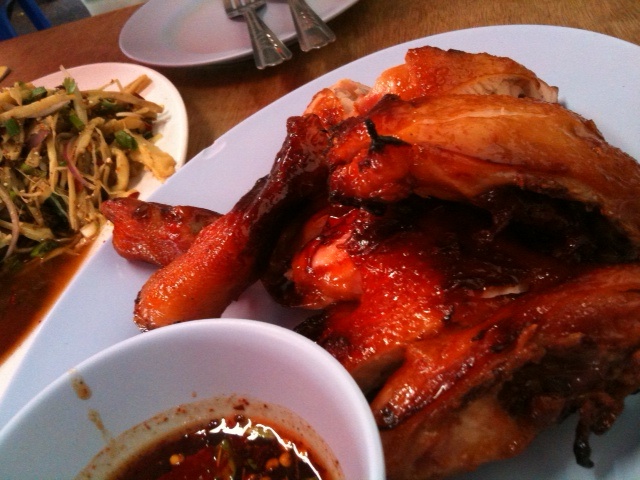
This is a nice melange of crispy bean sprouts and tiny deep-fried fish with the smooth slithery silk of noodles, papaya and bamboo shoots, spiked liberally with chili and pla rah (fermented anchovy). But even more startling is the so-called gai yang (80-150 baht), which turned out like this and, at a glance, explains the rampant popularity of this street food stall:

Saab Wan's gai yang and bamboo shoot salad

You and I know this is not Isaan-style grilled chicken. This is a lacquered Kim Kardashian of a chicken dish, a bastard child of American barbecue and Chinese sweet pork. This is sugary, sugary stuff — in spite of the fact that Isaan food is not supposed to have any sugar in it. No wonder this stand is packed at all hours of the day! Bangkokians are stuffing their pie holes with the saccharine-sweet oblivion that only sugar can provide.

Of course, this has inspired me to open my own Isaan food stall, using beer-butt chicken instead of gai yang, a grilled corn thum on the side, and maybe a white barbecue sauce alongside the jeao (Isaan-style spicy dipping sauce). Think I’m kidding? Watch this space.

4 Comments

Filed under Asia, Bangkok, chicken, food, food stalls, Isaan, som tum, Thailand