Category Archives: Bangkok

Grumpalicious

N

Lunch at Silom Pattakarn

I try to write something here once a week, because life without forcing yourself to do something is a life far too enjoyable, but sometimes, things happen. Last week, and the week before that, and the week before that one, and, oh, this week too, that thing has been the Cold Monster. The Cold Monster rarely visits, so I had little idea what to expect, but it’s a stubborn creature, and pretends to leave only to show up in fuller force when you are at your most jaunty and hatching plans to make an ass of yourself in public again. So that’s what I’ve been up to. Fighting the Cold Monster.

Obviously, I have also been eating. Alas, the cold medication that I have tried all I can to avoid is the only thing between me and utter destruction at this point, but it renders everything I eat either tinny or tasteless. There are only a few things that have broken through this cold-medication curse, and sans further verbal tap-dancing, I have listed them below. Not surprisingly, they are from my favorite kinds of places: shabby, taciturn, and ancient. They are grumpalicious.

Pong Lee (10/1 Ratchawithi Soi 9, 02-644-5037, open 11am-9:30pm)

Why I like it: My grandfather, bless him, is no longer the gourmet he once was. But there was a time when he liked nothing better than to tell other people what or where to eat, and this was invariably one of his favorite choices. It’s changed little since we took him here last — the decor is the same (shabby unchic), as is the clientele (“vintage”). Not surprisingly, the menu has also undergone little renovation. Although people like to order the deep-fried duck, our family has our own little favorites.

What I like: Old-school Thai-Chinese versions of “Western” dishes are also represented on the menu by way of Pong Lee’s deep-fried pork chop, swimming in a thick tomato sauce and peas. It sounds kind of gross, and maybe is if you are not familiar with this very specialized subset of old-style fusion food, but it is the dish my brother invariably goes for. Steamed seabass and hae gun (Chinese-style deep-fried shrimp rolls) are standbys, as is the odd vegetable dish of what appears to be canned white asparagus garnished with a murky seaweed. Sometimes (only if I am there), we order the stewed goat. Pong Lee’s specialty, however, is said to be the Hokkien-style fried egg noodles, garnished with shredded pork floss.

Egg noodles with pork floss

Sanguansri (59/1 Wireless Rd., 02-252-7637, open 10am-3pm)

Why I like it: Is it habit? Is it the food? I can’t tell anymore. Sometimes I am absolutely appalled by the service (but cannot say anything because, let’s face it, some of the servers are my grammy’s age). And sometimes I am perfectly happy to sit there, ignored, serving myself water from the counter and fighting to pay my bill. All I know is that I first came here when, well, I first came to Thailand, and eating here makes me think of that time. Also, the food seems to have only improved since then (as illustrated by the growing and increasingly-ravenous lunchtime crowd).

What I like: What can I say? It’s all about the kanom jeen nam prik. Sure, some other places also have kanom jeen (Mon-style fermented rice noodles) with vaunted reputations, but Sanguansri deserves it. Their nam prik — a mellow, chili-flecked, coconut milk-based curry — is genuinely delicious, layered and complex, sweet and mild but with an earthy undertow. Noodles come pre-mixed with greens for convenience’s sake (theirs, not yours), and sometimes they forget silverware and/or dishes, but whatever. As for everything else, it … skews sweet. Another favorite is the gluay chuem (bananas cooked in syrup), which comes drizzled in coconut milk, a further play on the salty-sweet thing.
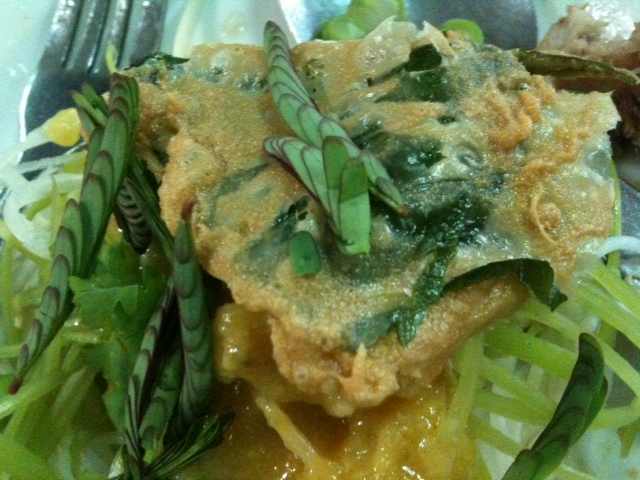
Kanom jeen nam prik

Silom Pattakarn (Soi Silom Pattakarn, the soi after Silom Soi 15, 02-236-4442, open 10am-9pm)

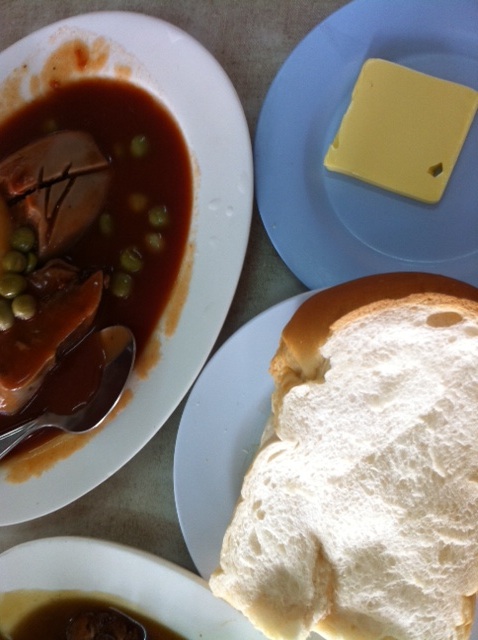
Why I like it: Among the oldest remaining examples of Thai-Western fusion food, Silom Pattakarn specializes in something that is increasingly in danger of becoming extinct (see: Restaurant, Carlton) — Thai-Chinese versions of “Western” dishes such as “stew” (tomato-based sauce, peas, and pork, oxtail or ox tongue), corn soup, Chinese-style “chicken curry” (the national British dish), and “steak” (here seared perfectly and cooked medium to medium-well — no bleu among germ-phobic Thais!) accompanied with a simple salad in a sweet vinaigrette. There are also “fancy” Asian dishes such as fish maw soup, either cooked dry or nam daeng (“red broth”) and mee krob boran (old-style crispy thin noodles), which, unlike the lacquered khunying hair-like confections atop so many “traditional” restaurant tables today, arrives simply and humbly, mixed with minced shrimp, touched only a bit with sugar.
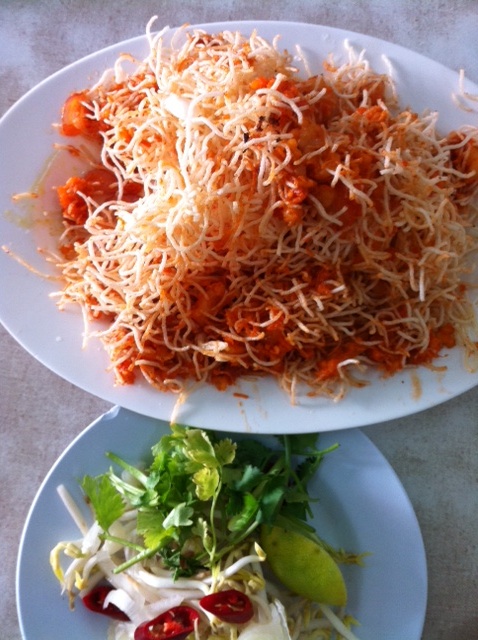
Old-fashioned mee krob with garnishes

What I like: Uh, I think I went over that already. But honestly, I also just love the place: it’s breezy in the wintertime, the ladies are lovely, and everything comes with a fluffy tower of white bread and ginormous pat of butter. With the loss of the Carlton Restaurant on Silom (another “fancy” place frequented by blue-hair types who remember its heyday in the ’50s and ’60s), Silom Pattakarn has possibly become the remaining purveyor of this slice of post-World War II Thailand, when the country was young and budding and the future seemed bright (I remember this time vividly, you see). The restaurant is up for sale (granted, for the past 6-7 years), so this may be the last chance you get to see, and taste, progressive mid-century Thailand.
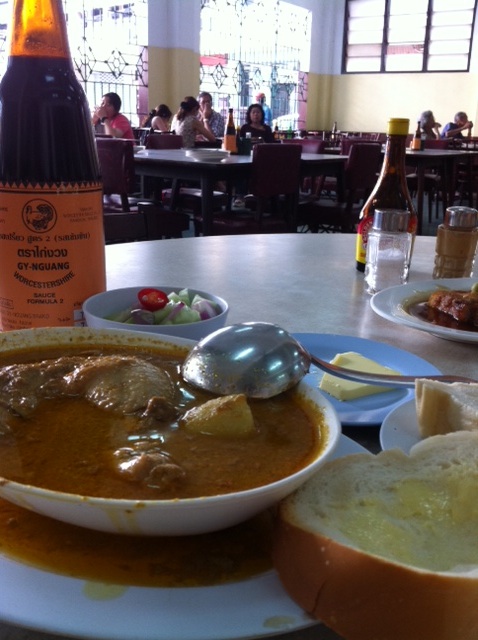
Chicken curry and the dining room
9 Comments

Filed under Asia, Bangkok, chicken, curries, food, noodles, restaurant, Thai-Chinese, Thailand

Confusion about Fusion

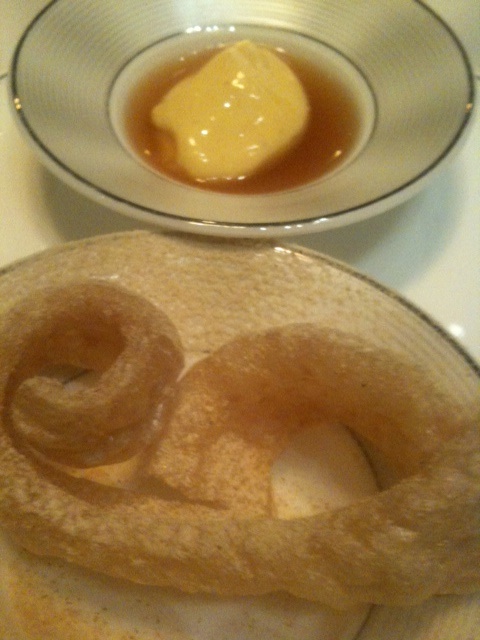
Pork rind with spice powder and miso dip at Sra Bua

Sra Bua by Kiin Kiin sees itself as a traditional Thai restaurant with a modern twist, but it’s not. The sister restaurant to Copenhagen’s still-Michelin-starred Kiin Kiin, Sra Bua offers nothing that could ever qualify as “traditional”, from its curry ice creams to fizzy pop-rock-laced gelatos, its dizzyingly formal parade of odd tiny bits to its extremely strict reservation policy (don’t even think of bringing an extra body to dinner at the last minute, folks — the usual mai pen rai will undoubtedly come from you, not them). There is spherified lobster essence and foam masquerading as coconut sauce. There are globules and powders and custards galore to entertain any reasonable diner. But this vision of “molecular Thai” is not traditional, and not really Thai food.

In case you are wondering, yes, this is indeed going to be a great big grump-fest about krazy kids and their krazy food, and why the neighbors are so loud with their terrible music and why the numbers are too small on my cordless talking-thingy. And yes, I hated Sra Bua. So that is out of the way. To be fair, the menu has recently changed. It may be awesome now. But the meal I had was a procession of dishes with nods to Ferran Adria and Rene Redzepi tossed in but which all basically tasted the same — creamy and sweet — with some grumbling undertones of spice and salt and maybe some fishiness and smoke somewhere in there, possibly, like a stain that’s been furiously scrubbed and everything hastily ironed out again to look shiny and happy. It was shiny happy food, without the bits of drama like the lurking bitter pop of a baby eggplant, or stink of smelly fish paste. It was Thai food on Prozac.

This got me thinking. After helping Chef McDang with his first English-language cookbook, “The Principles of Thai Cookery”, I have been lucky enough to get to work with him on his second, to be called, tentatively, “Modern Thai Cookery”. The recipes — Thai-marinated pork wiener schnitzel, or green curry osso bucco — are straight-up fusion, Thai ingredients melded with Western cooking techniques. But the flavor profiles remain staunchly, resolutely Thai. What is Thai? According to Chef McDang, it’s fish sauce. Palm or coconut sugar. A natural acid, like lime or water olive or tamarind. A paste base. An unscented oil. It’s simple, and allows for flexibility, because neither of us is an authenticity troll (an entirely different, equally problematic can of Sriracha-drenched worms).

This then got me thinking about rebels. The English “aesthetic movement” of the late 1800s stripped away boundaries between the arts and angered establishment figures. Impressionism inspired derision amid people who didn’t get the strokes and colors; the term itself was meant to be an insult. And there was punk, which many many people hated, and then hated again after it was defanged and sanitized. In the book “Retromania” by Simon Reynolds (thanks @sjmontlake!), critic Julie Burchill wrote of punk’s inevitable demise: “I’m just a cranky old punk past its prime. But the alternative is hideous, and it is the only alternative. It is to believe in ROCK’S RICH TAPESTRY.” (ppg. 6-7. I haven’t gotten very far).

Maybe Sra Bua is part of “Thai food’s rich tapestry”, with its winks and grins and gastro-references. And I could just be a grumpy old person, like those guys who hated Monet, crawling out of my cave every once in a while to scarf down a bowl of noodles and bellow at the occasional squirrel. I do believe that, with the explosion of restaurants worldwide, diners are now demanding new tricks and gimmickry, ever-more gimcracks and bonobos. They want to be entertained. And if it tastes good, well, that’s great too. But this is the opposite of what I want. I guess this means I am old-fashioned. I just want the food.

17 Comments

Filed under Bangkok, food, restaurant, Thailand

Stories we tell ourselves

Kai gata in Udon Thani

We all have our own little stories that we choose to believe, and this one is mine: We have Vietnam War-era American GIs to thank for two of the more beloved dishes in our culinary lexicon. One is a hastily-stirfried hodge-podge of sliced processed hotdog, ham, raisins, peas, and rice, lubricated with a generous dollop of ketchup and topped with a fried egg, sunnyside-up. This dish, a big ol’ smile on a plate, is generally known as “American fried rice” and can be found just about anywhere you can find a wok and a cook, and sometimes not even the cook. Just bring your two hands and a bottle of oil.

The other, because of its Vietnamese roots, is more prevalent in the Isaan region and known as “kai gata” (or “kai kata” or “kai gataa” or “kai kataa” … sometimes, you just have to close your eyes and point a finger and hope that it’s darn near close enough). Eggs are broken into a small metal pan and baked or cooked gently atop a grill, accompanied by sliced gun chieng (sweet Chinese sausage), veggies and  moo yaw (which, according to Chef McDang, was born as a Chinese cook’s approximation of European pate at the court of King Rama IV). And don’t forget the “bread” — usually a disarmingly sweet white bun, cleaved into two, buttered thickly and stuffed with ham, moo yaw and/or sausage. The story is that this dish was the closest an American GI could get to an American breakfast. What I see it as is 1960s-70s Asian-American fusion (just like me!): hearty and welcoming, pragmatic and resourceful, just what is needed sometimes to start what once threatened to be a deadly dull day.

Happily, you can find this dish in Bangkok. You just need to know where to look or, barring that, know who to pester. In my case, it’s my friend Winner, who knows the culinary ins-and-outs of Banglamphu like no one else. Gopi Hia Gai Gi (37 Siripong Rd., 02-621-0828. There is another one at the Wisut Kasat intersection), alongside stuff like Chinese-style flat stuffed noodles, dim sum and, uh, steak, serves up a mean kai gata, drizzled with minced pork and peas and, of course, accompanied by the mini white bread bun stuffed with moo yaw.  Best of all, it’s open from 7 am to 8:30 at night — a chance at kai gata at any time you think you might need to restart your day.

Banglumphu's version

8 Comments

Filed under Asia, Bangkok, food, food stalls, Isaan, Thai-Chinese, Thailand