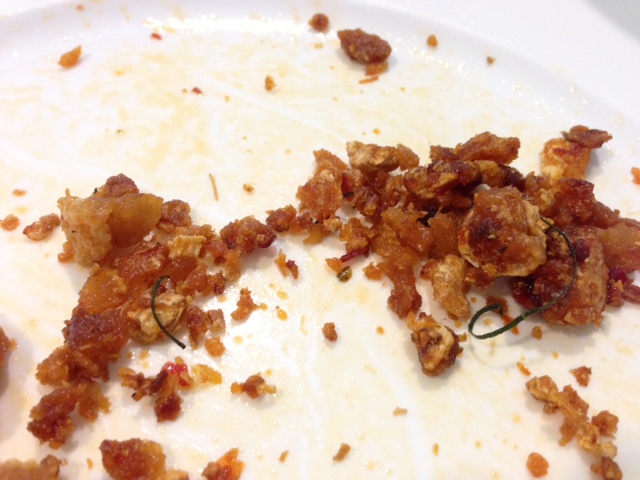
Scraping the plate clean: the remnants of a “gra moo” (pork crackling stir-fried with herbs)
Whenever a group of people talk about the nature of Thai food, talk inevitably alights on how Thai food is “spicy” and “wild” and whatever other adjective suggests something is “too much” for foreigners. I don’t have to tell you that this drives me up the freaking wall, but I’m going to do it anyway — and tell you twice, and maybe three times. This drives me up the wall. Almost as much as when someone eats rice and curry with a fork or chopsticks (how do you keep the sauce on the rice? Drive me up the wall x2), or when someone orders something like stir-fried morning glory or thom kha gai (coconut lemongrass chicken soup), and then proceeds to bogart the entire thing themselves (it’s meant for the entire table. Drive me up the wall x3).
But one rant at a time. The origins of the myth that Thai food is too challenging for Western palates are murky, but believing in it is still considered as Thai as, well, cherishing the right to take to the streets in protest: equivalent to the French fondness for going on strike. Thai food — much like the Thai political situation itself — is too difficult, too complicated and nuanced for foreigners to understand. And, let’s face it, it’s just too spicy. Hence the need for a gatekeeper to explain it to them, to tame those culinary zigs and zags that Thais take for granted, to turn them to those neutered bowls of green curry and plates of pad Thai, things that are tailored to welcome foreigners to the bosom of Thai food instead of pushing them away. Because ultimately, Thai food — as deemed by Thais themselves — is too strange, and too “other”.
Hence the creation of parallel menus in Thai restaurants abroad, and, in essence, an entire parallel cuisine. I can’t tell you how many times I have gone to a Thai restaurant in, say, Ardmore, and had a menu taken away from me by a Thai waiter, proclaiming it “not what I’m used to”, followed by a promise that they will get me something cooked for the staff. Another gatekeeper: this time in the reverse direction. But why the need for guarding Thai food like a bouncer at a nightclub in the Meatpacking District? I used to think it was a form of self-hatred, that the feeling that Thai food was too “weird” was akin to masking one’s own quirks in order to keep from scaring off a blind date. But now I think it’s something else. Real Thai food is ours, and you can’t have it. It’s too complicated and challenging because we are special snowflakes incapable of being really understood by a bunch of outsiders (aka dumbasses). To be honest, I cannot really count myself among those special snowflakes, because I have been tainted by my long stay in the West. Maybe I am being paid off by an Isaan som tum purveyor.
So the next time someone says Thai food is too “spicy” or “difficult” for foreigners, I want to ask them why the diner can’t make the decision for himself or herself? I feel like Thai food is so wide-ranging, with so many great regional variations of incredible complexity, that it’s a shame it’s being parceled up into these foreigner-friendly packages when it doesn’t need to be. I certainly haven’t had the experience of a Brazilian dissuading me from trying acaraje or a Japanese person telling me to avoid natto because it’s grody to the max. In fact, they are quite happy to let me shove fish sperm or fermented squid guts down my throat without any warning whatsoever (maybe this is just the kind of crowd I am running with). Maybe Thais — many of whom are grossed out by pla rah (fermented Thai anchovy) and sometimes even eschew fish sauce (my husband) — could cede culinary control in a similar way. It could win Thai food — a cuisine that is indeed nuanced, and varying, and detail-oriented, and special — even more fans than it already has.



 Bangkok Glutton
