Category Archives: beef

Glutton Abroad: Two Faces, One Stomach

When I lived in Tokyo, there was a period of time when, inspired by Annie Hall, I spent every weekend in Omotesando dressed like Diane Keaton. Even then, no one ever came up to me, not even once, and tried to punch me in the face. That tells you how polite people can be.

I mention this because the one thing I was struck by during my time in the northwest U.S. was how polite and nice everyone was. EVERYONE wanted to know if I was having a good day, had advice on what to get and where to get it, or just wanted to shoot the breeze about the weather. At times, unnerved, I would try to play along, but people can sense masked awkwardness and instinctively move away (because, let’s face it, am I Rachel Ray? No. No, I am not).

Nice, laid-back people, Dungeness crabs, and Kurt Cobain — good things have traditionally come out of the Pacific Northwest. At the same time, this area is also well known for being a haven for scary psychos of the first order. As well as the home of sparkly vampires. So there’s also that to think about. This duality also shows up in the region’s food scene. There is bad and there is good (usually when cooks aren’t trying so hard). And then there is the I Don’t Really Know What To Think Yet. This category is the most infuriating of all.

SEATTLE

Beautiful berries at Pike Place Market


You know, people talk about how weird Seattle is, how people walk around in plaid all day long and don’t take showers and eat only tofu. Well, there is a little bit of that, but the Emerald City is also a surprisingly food-oriented kind of city (I totally loathe the term “foodie”. Not because of any ridiculous, stupid backlash, but because it’s often used to divide people “in the know” from “everyone else” and suggests that people who like food also need to spend lots of money on good food. As a person who loves street food, I obviously don’t subscribe to that). So Seattle is “foodie” (gag), but in a very laid-back, natural and unpretentious way.

The embodiment of that would be emmer&rye (1825 Queen Anne Ave., (206) 282-0680), where local, seasonal produce meets up with gently twee surroundings and the chef’s great touch with vegetables and makes you feel like you’re in a Wes Anderson movie. But The Royal Tenenbaums, not Fantastic Mr. Fox. Favorites: a cauliflower and kale salad, steamed clams with strips of bacon in their cooking liquid, a perfectly grilled strip of beef alongside rings of squash.

Steamer clams appetizer at emmer&rye

There was also the nearly impossible-to-find Walrus &  the Carpenter (4743 Ballard Ave., (206) 395-9227), named after the creepy rhyme in Alice & Wonderland (what oyster lover wants to imagine walking, talking, baby-like oysters? Terrible). Aside from the terrific seasonal mollusks (half off before 5pm), there are truly great non-oyster sides (which change from week to week) like grilled lamb’s tongue, steak tartare and the best deep-fried brussels sprouts this side of anywhere. An even cheaper oyster alternative is Jack’s Fish Spot at Pike Place Market, which serves great quilcene oysters ($1 a shell), plus a no-frills menu of chowder and crab cocktail.

Oysters at Jack's Fish Spot

Rancho Bravo Taqueria (at 45th St and 2nd Ave) is not technically a restaurant, but a food truck — too bad the cat’s out of the bag on this one, locals. Great burritos (get either “Rancho” with sour cream or “Bravo” without) stuffed with either the typical fillings or tripe or beef tongue (recommended) make the wait for your plate a lengthy one at lunchtime. Dick’s Drive-In (three throughout Seattle) is a lot quicker, but the menu’s more limited too; the “Deluxe” is a double-beef patty cheeseburger with all the traditional fixings. If you’re a breakfast person, you have your choice between the super Eggs Benedicts or corned beef hash at Glo’s (1621 East Olive Way, (206) 324-2577) or the pancakes or “migas” (it’s a sort of breakfast tortilla, not the Spanish dish “migas”) at Portage Bay Cafe (4130 Roosevelt Way, (206) 783-1547). Finally, there is a great non-meat alternative serving good, tasty food: Araya’s Place (the only kind of Thai I’ll eat in Seattle, since vegan Thai is impossible to find in Bangkok). Recommended: the tofu “larb” (1121 45th St., (206) 524-4332).
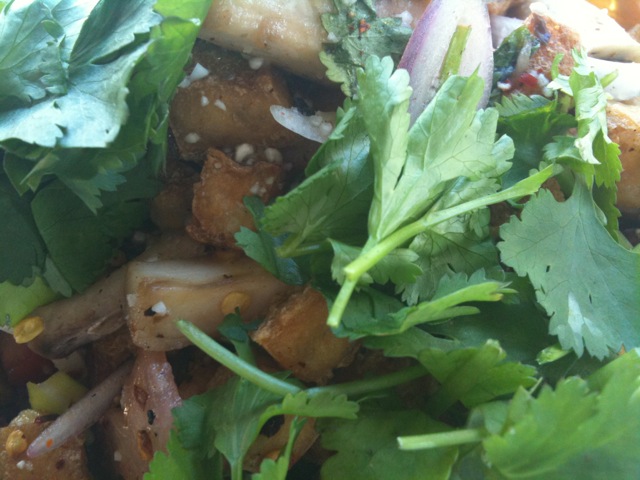
Araya's tofu larb

PORTLAND

What to say about Portland? I don’t know myself. Maybe I didn’t spend enough time here. Maybe I was disgruntled about the hugely long line outside of Voodoo Doughnuts. Maybe I just didn’t get it. But my time here was spotty. First, there were the towering pastrami or corned beef sandwiches and flavorful chopped liver at Kenny & Zuke’s Delicatessen (1038 Stark St., (503) 222-DELI). But then there was the overhyped, confused, and sometimes just plain too-salty fare at Castagna.

Kenny & Zuke's matzo ball soup

Did I have too many expectations of The Oregonian’s 2010 “Restaurant of the Year”? Of one of Food & Wine’s “Best New Chefs of 2010”? Maybe so. But while the matsutaka with shaved, pickled marrow and roasted elk loin were delicious, the pine curd and roasted chanterelles with boullion and tea-poached cardoons with smoked sturgeon powder were overly salted, conceptual messes. And I still don’t know what to think about the “pickles of today’s harvest” with cured scallops, which taste sort of like new car smell.

OREGON COAST

Ever have that feeling where you mentally slap yourself over and over again until you can’t feel anything anymore because you have gotten yourself into a stupid situation? No? It’s just me? Well, okay. Maybe it is just me. In any case, I must have done that about 1,000 times over the last five days, spent on this or that golf course, menacing deer and humans with various stray golf balls. The situation was mitigated somewhat by after-golf lunch, which became my highlight of the day. The best: Bandon Fish Market ( 249 1st St., Bandon, OR, (541) 347-4282), where the mascot may be a dead fish (unnerving) but the fish and chips are fresh and tasty — possibly the best I’ve had in a long while. Halibut is more flavorful and firmer than the traditional cod.
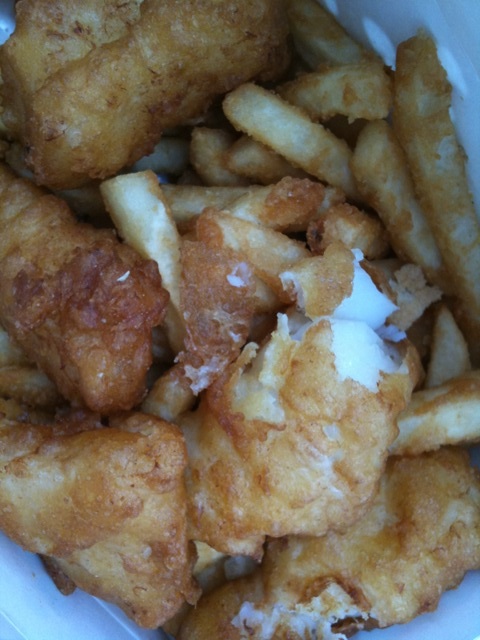
Cod fish & chips at Bandon Fish Market

The Pacific Northwest. What more to say about the Pacific Northwest? Shall I say I saw lots of people I really liked and had lots of fun despite the horrible, truly awful weather? Shall I say I enjoyed every meal, no matter where, because no matter what, the service was good and people still tried hard? Or shall I say I learned to stop blathering on because it solves nothing, and I believe in quality over quantity (obviously I’m lying)? This I’ll say: I have yet to be punched in the face. There’s still a chance, dear reader! Catch me if you can.

6 Comments

Filed under beef, fish, food, Pacific Northwest, restaurant, seafood, United States

Glutton Abroad: Full of crab in HK

I never miss hairy crab season in Hong Kong. For the past six or seven years, when the “cold” weather comes around, I have faithfully trekked to this sun-soaked little spot in South China. The thing is, I sometimes end up having to do some strange things in order to get to that hairy crab (without having to endure a corresponding dent in my bank account, that is. Ahem).

Which brings me to this packed supermarket in Wan Chai, staring at a row of beer bottles, and debating whether to choose the popular Tsingtao or the vastly less expensive Pabst Blue Ribbon (half the price of the Chinese beer, to be exact). Not a beer drinker myself, I am tempted to spring for the PBR and let the chips fall where they may. I then remember that I will soon be sailing in the middle of a very large body of water, and that some people on board will want to throw me into it.

We are buying supplies for a boat race from Hong Kong to Shenzhen, a boat race that ends up not being a boat race (at least on the first day), halted by authorities of something for some reason or other in the hours before it is due to start. My heart silently lifts, thinking I will be spared a five-hour boat ride to the mainland, only to plummet minutes later when it is decided: we will “go at around the same time other people go, to the same destination”, my husband acting in some important sailing capacity and me as weight.

I could bitch and moan for pages about the rest of that trip; how I endured moments of terror each time our boat tipped through another white-lipped swell, and how later, when I got sick, I didn’t care what happened to us.  But I’ll leave it at this. I’m still alive. And I had plenty of hairy crab to console me.

Holy crab!

Hairy crab, also known as “freshwater crab”, are called that for the seaweed-like “hair” around their claws, and come from eastern Asia. They are prized for their sweet, tightly bound meat and, at around the end of each year, the dabs of glutinous rice-like eggs underneath their carapaces, which are too yummy to be adequately described. The best and biggest, I am told, are said to come from a certain lake near Shanghai, where the “slime” at the bottom is apparently ample, giving each crab a proper workout. Although hairy crabs are sourced from all over the place, only a handful of HK restaurants have a certificate allowing them to purchase crab from this one lake. The following place is one of those restaurants.

Hang Zhou (1/F, Chinachem Johnston Plaza, Johnston Rd.)

Before I start, I’d like to talk about an invaluable tool to anyone who wants to ensure they get a good meal in Hong Kong (aside from very accommodating and generous friends, which we also had): www.openrice.com. This site recently started up an “English” version, enabling tourists to get the nitty-gritty from the locals.

However, I put “English” in quotation marks, because a lot of the time what is said is a little too local. For example: “I ate (insert Chinese character here), which was so so good! Make sure you (insert Chinese character here)” — turning a lot of reviews into a sort of madlib in which you can feel free to insert whatever your heart desires at the moment. I find this strangely mirrors a lot of interaction in HK nowadays, where people seem to speak a lot less English than they used to (“why don’t anyone speak amerikin, goddamit?!”), making verbal interaction a sort of mental madlib where there is only one right answer.

Ordering in Hang Zhou — and everywhere else we went, for that matter — went a little like this: “I would like honey ham.” “Huh? Somethingsomethingsomething ham somethingsomething pork?” Then you would be forced to repeat “honey ham” over and over again like an idiot until someone said “Ah! Honey ham!” In a way, it was a little like ordering in Thailand for me, but in English instead of Thai.

So, here, we did finally get that honey ham: slivers of ham paired with crackling skin, shoved into a steamed white bun and dipped in the ham’s honey-like sauce. There was a succulent baked fish with halved cherry tomatoes for eyes; a virtuous mound of braised spinach; shell-on shrimp in a shallow pool of tea; and row upon row of hairy crab. There was also what we were told was a “beggar’s chicken”: an entire bird wrapped in lotus leaf and baked — easily our favorite discovery here.

The "special baked chicken"

Him Kee Hotpot (1 & 2/F, Workingfield Commercial Building, 408-412 Jaffe Rd)

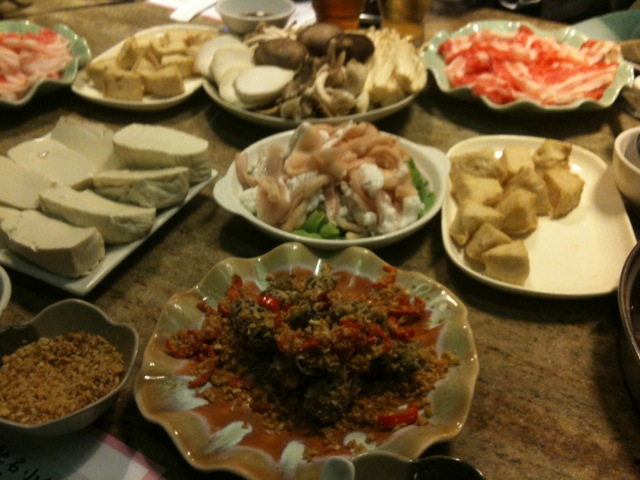
Woman need not live by hairy crab alone. This friendly and, uh, aromatic hotpot place allowed us to order a host of ridiculous things and two different broths (one, mild with corn and carrots; the other, thick with the tongue-numbing, thick-shelled Sichuan peppercorns). We ate many things, most of which we did not finish: a mountain of tofu, platters of mushroom caps, baby bok choy, slivers of beef, and goose intestines — delightfully springy and creamy, all at once. My favorites were the pre-hotpot offerings of snails, slathered in chilies and deep-fried garlic. But — sob! — the plates of bacon were left half-eaten.

An immobile feast

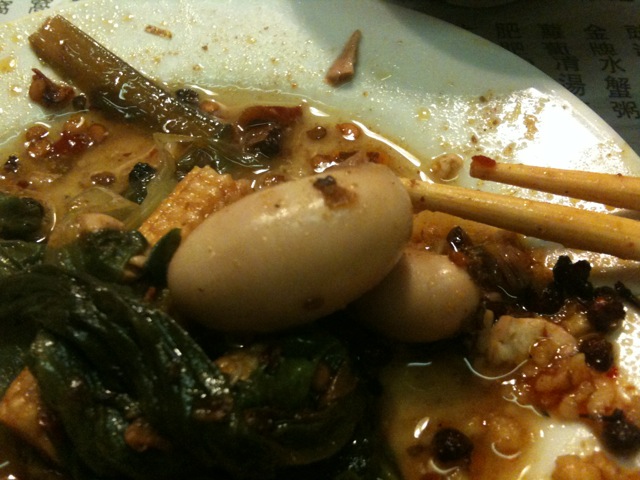
A new thing for me: chicken testicles. They ended up being surprisingly big, if I may say so myself (a little bigger than the pad of my thumb). Blanched in the broth, their tense, elastic texture gave way to a creamy burst of liquid when bitten into (and this will be the first and last time you read a sentence like that on this blog).

Dude, where's my balls?

Spring Deer (42, Mody Rd., 1st Fl., Tsimshatsui Kowloon)

I had been looking forward to going to a Peking-style hotpot restaurant ever since reading about it on @e-ting’s blog. How bitterly disappointed I was, then, to discover that it was FULL on the only day I was free to go. Thinking I would then end up wandering around the Elements mall, the lovely concierge at the W pressed this card into my hand and said, “This is very traditional. I will make a reservation.”

Needless to say, I lurved it. And not really for the food. Spring Deer is mainly serviced by a staff of white-coated old men, reminding me of the very old restaurants in Rome where the average age of the server is around 55. Unobtrusive, swift, and discreet (no guffaws of incredulity at the amount of food we order, the server simply tries to run away when he thinks we’ve had enough), the service here is among the best we’ve ever had in HK, and that’s including Caprice et al.

The signature dish, of course, is the “world famous Peking duck”, a dish we’re told requires two staff cooks who make 100 ducks a day. It’s different from the kind we get in Bangkok: rounds of smoky flesh are still attacked to the crispy skin and wrapped in thicker, floury pancakes with slivers of cucumber and leek and an inky plum sauce.

Spring Deer's Peking duck

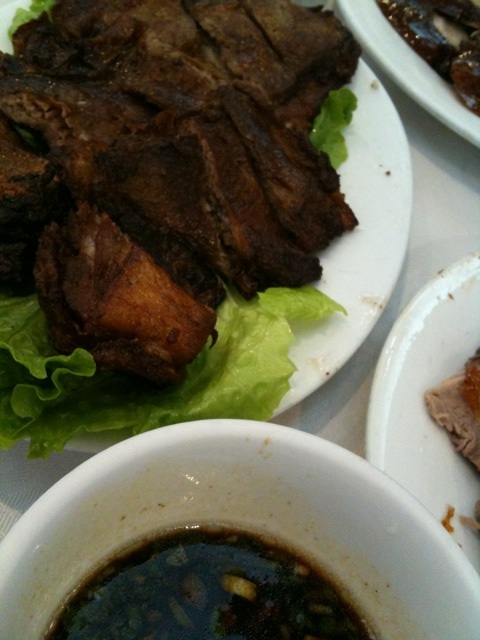
Aside from a multitude of other dishes that I’ve clean forgotten (unable to gauge when a lot is too much, we usually stop ordering when the waiter tells us “I think that’s enough”), we ordered deep-fried mutton, not as nice as the duck. Chewy like a sort of makeshift jerky, it’s paired with a vinegary sauce that is meant to cut through the fattiness but doesn’t quite manage it.

Deep-fried mutton

Yung Kee (32-40 Wellington St.)

Everyone knows Yung Kee. But I’d never eaten here before. I am ashamed to say I can’t tell you how many times I passed by this restaurant on my way to some dodgy place in Lan Kwai Fong. So when our friend suggests going here, there is nothing to do but agree.

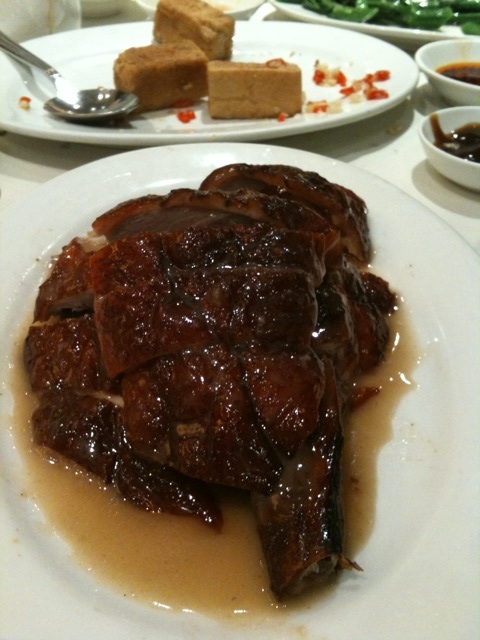
This restaurant is, obviously, an HK institution — the equivalent of what La Tour d’Argent used to mean to Paris. We’re told it seats thousands of people per meal, and that the higher the floor, the better the food. Of course, the dish we are all supposed to order is the roast goose. So we do, and we do again (no one here stops us, or even blinks an eye). We order deep-fried spare ribs, goose webs in abalone sauce, sauteed scallops in XO sauce, deep-fried beancurd, eggplant with mushrooms, braised duck in orange peel and platter upon platter of garlicky greens. We order until we can’t bear to look at our plates again, and after that, we order mango pudding. We order a lot.

Goose, goose, deep-fried beancurd

Kam Fung Cafe (41 Spring Garden Lane)

Our last meal before boarding the plane involves sweet, soft hot buns split and stuffed with heart attack-inducing slabs of salted butter, surprisingly savory eggy tarts that break apart when you bite into them, and cup upon cup of milky tea. We’re at Kam Fung Cafe, sharing tables with strangers who are surprisingly friendly, and watching locals consume bowls of what appears to be an HK-style version of Western food: soupy macaroni or egg noodles, topped with a runny fried egg or slivers of cooked ham. The ultimate in comfort food, after days of fatty fowl and chicken balls, trekking from Shenzhen to HK and back again, enduring seasickness and a rugby game where I am accidentally doused with beer by an irate NZ fan aiming at a gloating Aussie (in all fairness, he was pretty annoying). I am tempted, but still too full.

Breakfast

Next up, I will embarrass myself not once, not twice, but FIVE times on various golf courses throughout the Pacific Northwest, all for the privilege of dining at Portland’s Castagna and Seattle’s Lark. Because someday, eventually, I will be hungry again.

4 Comments

Filed under Asia, beef, chicken, Chinese, dessert, duck, food, Hong Kong, pork, restaurant, seafood

What nam ngiew means to me

Proper pork nam ngiew at Pa Suk in Chiang Rai

(Photo by @SpecialKRB)

Everyone has a dish that reminds them of their childhoods. This — and the “last meal” that a person would select were he or she able to choose — are two of the most illuminating things you can know about a person, telling you how they see themselves, and how they grew up. I’m not the only person to think this (although there is no “childhood meal” book — I mean, we have the TGI Friday’s menu for that); in 2007, photographer Melanie Dunea asked some of the most famous chefs in the world what meal would be their preferred parting shot, and the result was “My Last Supper”.

It turns out chefs are as varied as regular people when it comes to what they want, and the setting: Daniel Boulud likes Versailles, Gordon Ramsay likes home. Jacques Pepin, characteristically elegant, wants a hot dog; BLT chef Laurent Tourondel, a Krispy Kreme doughnut. Some even chose soundtracks, with U2 making an appearance (why? If it’s post-“Unforgettable Fire”, I shake my head and judge).

I really don’t know what my last meal would be. I used to say a cold lobster with mayonnaise; sometimes I think I prefer meatloaf with a side of mac and cheese. But neither of these dishes says anything about me. The dish that figures most prominently in my childhood, and the one I keep coming back to again and again in Bangkok (like a culinary Don Quixote, or an idiot) is kanom jeen nam ngiew, a Northern Thai dish of minced pork and/or beef and dried ngiew blossoms.

Nam ngiew at Yui Lee on Sukhumvit Soi 31

It is a widely accepted fact that good Northern Thai food is hard to find in Bangkok. This is not just a bunch of Northerners pissing and moaning about Central people mucking around with beloved old favorites (although there is some of that). For some reason, something is lost in translation that isn’t when it comes to any other region in Thailand, be it Isaan or Southern Thai. It’s not heat: actually, Northerners cannot compare to Southern Thais when it comes to spicy food. I think it’s the shortcuts that people are tempted to take with northern food, which features a lot of cut or shredded herbs and painstakingly put-together pastes (plus a lot of fatty cuts of pork to combat the “cold” weather). I cannot tell you how many nam ngiew noodles I have had missing the dried dok ngiew, or ngiew flowers, which resemble sawed-off broomsticks. The fact they still serve it without essential ingredients suggests laziness, and disrespect to the customer.

Yet I haunt every food stand serving nam ngiew, and order it at restaurants when I know I shouldn’t; against all logic, I want to find The One that will bring me back home. Home to New Castle, Pennsylvania, where I wanted to dine on cavatelli (“cavads”) like everyone else in my predominantly Italian-American town, and look forward to wedding soup or pasta fagioli (pronounced “fazool”) on holidays. Home, where I would see my dad in his pajamas stuffing his own sai oua on the floor of our kitchen and feel unaccountably embarrassed. Home, where my dad would have to refer to nam ngiew as “Thai spaghetti” to get us to eat what he cooked after a 14-hour work day. And it does resemble bolognese, after a fashion (possibly a reason why I LURVE spaghetti bolognese). But it’s much, much better — meaty and rich and a little bit macho, and, if you’re from Chiang Rai, skimpy on the girly tomatoes that effete Chiang Mai-ers use to balance out all that heft (Chiang Mai people, I jest. My mom’s family is from Chiang Mai).

So where is the best place to get this very special dish? My house, where I keep two bags of sauce at all times. Also, Chiang Rai’s Pa Suk, which probably has the best nam ngiew on earth (sorry, Chiang Mai). The sauce comes in pork or beef versions (beef is VERY beefy), with fermented rice noodles (kanom jeen) or regular guay thiew (rice noodles). Also, they offer a wide variety of pork rinds (kaab moo) because no bowl is complete without them.

Beef nam ngiew at Pa Suk

(Photo by @SpecialKRB)

But where in Bangkok? Ah, well, other people are probably better guides. (This one is good.) But I urge you to do something really crazy. You can do it yourself. Alas, the Duangnet family recipe is out of bounds. But if you don’t mind the tomatoey Chiang Mai style, here is the recipe from my great-aunt, Jiao Sri na Chiangmai.

Nam Ngiew (for 10)

Preparations:

1. Nam Prik: Grind the following together well

Dried pepper,     30 pieces

Dried Bird Chillis,   30 pieces

Shallots,    0.2 Kilo

Garlic,     0.1 Kilo

Shrimp paste (Kapi),   0.1 Kilo

Lemon Grass,    3 pieces (stems)

Salt,     1 tablespoonful

Grilled dried pickled bean paste, 0.2 Kilo

2. Next, boil until slightly soft:

Pork spare ribs, cartilage parts, 1 Kilo, cut into 1 inch pieces. Save cooking liquid.

To cook:

  1. Fry “Nam Prik” in hot vegetable oil in a big pot until it “smells good” (the inside of your nose tickles). Add 1 Kilo of ground pork and the cooked spare ribs. Stir until cooked. Add the soup from the cooked spare ribs. Then add 1 Kilo of cherry tomatoes, add cooked pork blood in pieces and 0.1 Kilo of dried “Ngiew Flowers”. Add 0.2 Kilo of Black Tao Jeao.

Boil in medium temperature until well blended. Before serving on kanom jeen, add fish sauce and lime juice to your taste.

  1. Serve with:
    1. Deep fried chopped garlic
    2. Chopped shallots
    3. Cut shallots
    4. Cut limes
    5. Cut pickled greens
    6. Ground deep-fried dried chillis

Bon appetit!

9 Comments

Filed under Asia, Bangkok, beef, Chiang Rai, food, food stalls, noodles, Northern Thailand, pork, Thailand