Category Archives: Chinese

Caught in the culture wars


Thai food: a focal point of the culture wars


I vowed never to talk about this again, but Sunday’s “Bangkok Post” opinion piece about the state of Thai cuisine drove me, once again, to the keyboard (I don’t have many interests, and nothing else to talk about). Like a Katherine Heigl movie, it starts out reasonably enough, and then somehow turns crazypants somewhere in the middle.

The basic premise is, modern Thai food has atrophied as a result of the culinary shortcuts commercial cooks take today, resulting in processed dreck that bears little resemblance to the dishes they are supposed to be (while this is very true, it sounds a little to me like running into a McDonald’s and complaining, “Why do they only use cheap ingredients? Why is everything so poorly made? Where is the care and thought put into my hamburger?”)

The media also deserve blame for the commodification of Thai food, concerning themselves only with “tasting this or that dish” and on “atmosphere and decor rather than offering any real knowledge concerning the food” (Because NO ONE cares about that stuff! Silly journos. Tell me once again about how the Indians and/or Portuguese inspired coconut milk-based curries).

Because of these shortcuts, Thais DESERVE to lose their mastery of their own cuisine. Because we’re so stupid! Now David Thompson has blown into town and his place is packed and that sucks, because our lives suck and so his should too! But we’ve done this to ourselves, because we bear witness to culinary crimes like this:

“…pizza with a dry version of gaeng kiew waan luk chin pla or with dry tom yum goong. These combinations are a slap in the face to both the Thai and Italian cooking traditions.”

First of all, what’s with all the slaps in the face? Is there no other way for writers here to convey getting insulted? No tug on the ear, perhaps, or maybe a kick in the pants? Get a new rhetorical device!

Secondly, well, I am no fan of crap-topped pizza either. That said, I’m sure someone probably thought tossing spaghetti with pla kem (salted fish) and dried chilies was once a daft idea, too. Now you wouldn’t bat an eye seeing this dish on a menu. And how did Thais take to the first bowl of khao soy, a “fusion” creation of egg noodles and coconut milk said to be invented by cooks in Chiang Mai from a dish originated by the Chin Haw Chinese-Muslim minority group?


Khao soy at Khao Soy Islam


(photo by @SpecialKRB)

I was lucky enough to get the chance to help work on the first English-language cookbook by Thai TV chef McDang (“The Principles of Thai Cookery”, in case you’re interested — it’s very good! Not that I’m biased or anything …) In it, Chef McDang discusses quite clearly how all the different parts of a Thai meal fit together (a minimum of five elements: a clear soup, a curry, a fried dish, a stir-fried dish, and a kreuang jim, or chili dip with vegetables), why Thais use forks and spoons (in order to kluk, or mix the different elements of the meal together to your liking), and how all the ingredients in a Thai dish are supposed to interact. That’s why traditional Thais get all crazy about substitutions like onions for shallots, or adding spring onions instead of coriander leaves.

That said, Thai cuisine is also the beneficiary of a number of foreign influences that have seeped in from interaction with the rest of the world over the course of Thailand’s history. In the Sukhothai period (1238-1438), we were scarfing down fish, fruit and wild boar on rice flavored with peppercorns, cilantro roots and palm sugar. And then, in the Ayutthaya period (1351-1767) the Portuguese came along, and gave us this:
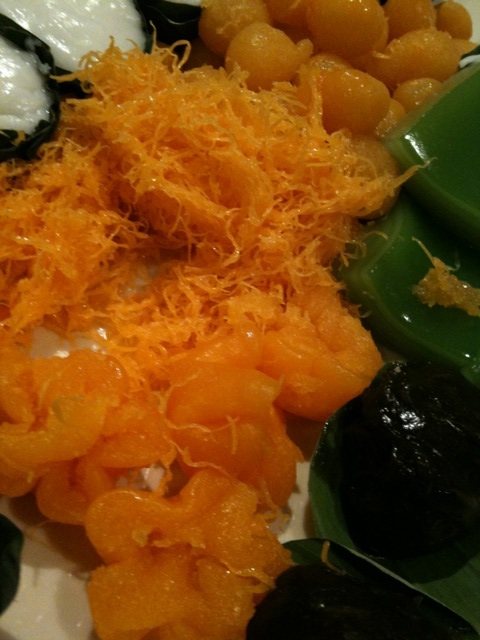
 

"Golden threads" and "golden drops": traditional Thai sweets that are also Portuguese


They also introduced us to eggs, tomatoes, potatoes, eggplants and sugarcane; co-introduced us to savory uses for coconut milk; and showed us a crazy new way to flavor our food with these things called “chilies”. They also found a way to form a curry custard by mixing fish and egg and steaming it; the result was called hor mok:


Steamed seafood curry at Aor Thor Kor


(Photo by @SpecialKRB)

And then there were the Chinese. What to say about the Chinese? Without them, Thai food would not be “Thai food”. From them we got: shrimp paste, fish sauce, the use of duck meat in cooking, pans, stir-frying, and frying. Another innovation: an interesting alternative to rice in the form of long, thin strands of rice flour (and sometimes egg-based flour), which can be served in soup, blanched, fried, or even in desserts. They are popular in Thai street food, so keep your eyes peeled for this rare, strange delicacy:
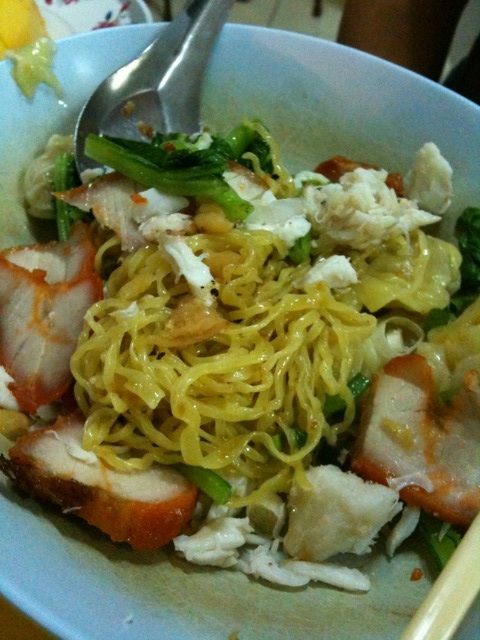
 

Bamee at Sukhumvit Soi 38


So sometimes fusion isn’t so bad after…..zzzzzzzzzzzzzzzzzzzzzzzzzzOh, sorry, you’re still here?

Thailand is at a point in its history where its future — like that of the rest of the world — is uncertain. Maybe people are unsure of where they stand and so long to return to a time when things seemed more secure. Food serves as a convenient stage on which to act out this current identity crisis. But that doesn’t mean we should shut out foreign influences, or, for that matter, a foreigner who is doing the exactly same thing as us.


27 Comments

Filed under Asia, bamee, Bangkok, celebrity chefs, Chinese, curries, food, food stalls, Japanese, noodles, Portuguese, restaurant, rice, Thai-Chinese, Thailand, TV chefs

Markets: the Original

Where I grew up, there where a place where the cool kids used to hang out called “the O”. It stood for “the Original”, although to be frank I have no idea how many versions of this Pittsburgh hot dog shop had to exist in order to necessitate singling yourself out as the “original” one. It’s not like Pittsburgh is awash in hot dogs — although I do remember fondly the O’s “disco fries” (our version of the Canadian “poutine”, which does not seem like a very evocative name for these cheese-slathered, bacon-topped deep-fried potato slivers. Heaven on a plate!)

What’s that? I’m supposed to be talking about something you might be interested in? Oh yes, that’s right. This:

Thai "pla tu" on sale at Nang Lerng market

It’s Nang Lerng market, located in the Banglamphu area on Nakhon Sawan road. This is supposed to be the very first wet market to ever sprout up in central Bangkok. What I do know for sure is that, like all of Thailand’s wet markets, it’ a load of fun to visit and the go-to place for some pretty hard-to-find old-style delicacies, such as the glutinous pork-filled rice balls, eaten with lettuce leaves, fresh coriander and chilies — a sweetly piquant mass of satisfying goo in the mouth.

Or old-style haw mok (steamed seafood mousse in banana cups), a Portuguese-influenced concoction combining local ingredients with European technique:

Steamed seafood mousse topped with coconut cream and shredded kaffir lime leaves

Then there are the delicacies that you actually do want to eat, like coconut ice cream trad-style, in a little plastic cup and festooned with roasted peanuts.

Fresh coconut ice cream

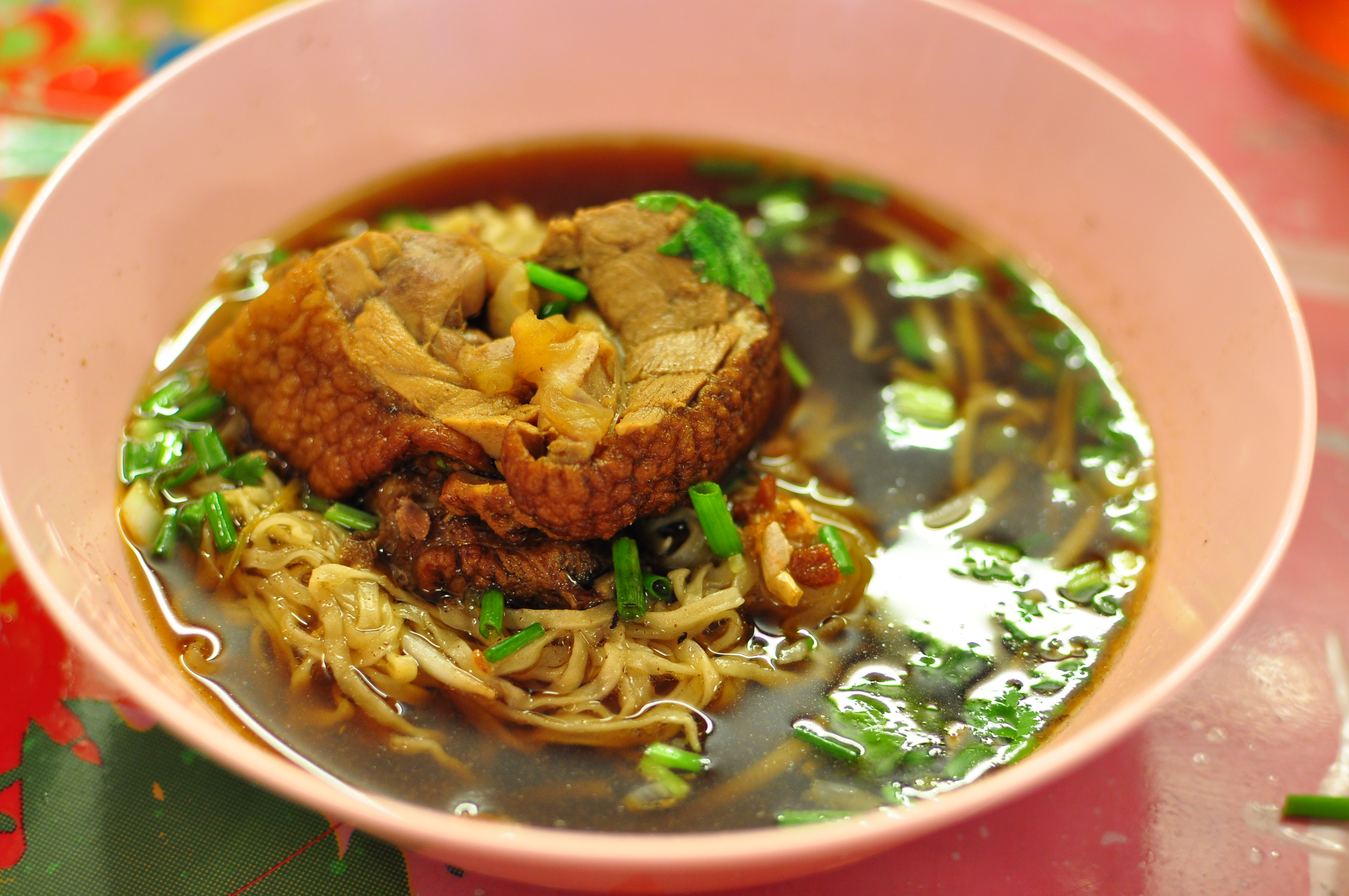
But if you do make it over there, do not miss Roongroj, the duck noodle shop at 141,143 Nang Lerng market. A popular with politicians who send their drivers over at noon for some lunchtime takeaway, Roongroj deserves its reputation as a shop with an extensive menu, efficient service and generous portions of sweet, toothsome duck.

Egg noodles with duck

The choice is extensive: stewed duck, braised duck, duck in pullo (Chinese five-spice and cinnamon broth) are all there, plus stewed chicken, barbecued pork and some very  nice giew (Chinese dumplings). Yes, if the duck or noodles haven’t tipped you off already — this food is Chinese. But then again, what noodle stand in Thailand ultimately isn’t?

Three different orders at Roongroj duck noodles

It’s open every day, and from late morning to well into the evening, so it’s hard to miss out on getting yourself a bowl. Do yourself a favor and trek over into the old part of town; basking in the atmosphere of the “original” wet market is worth it.

(Photos by @SpecialKRB)

1 Comment

Filed under Asia, bamee, Bangkok, Chinese, duck, food, food stalls, markets, noodles, Thai-Chinese, Thailand

Thai comfort food

Everyone has a comfort food. For a lot of people, it’s something bland and baby food-like — khao thom gub (plain boiled rice porridge, traditionally served with sides like minced pork omelette, dried salty fish and stir-fried morning glory) is a popular one among Thais, the Thai version of mashed potatoes. For others, it’s something that reminds them of their childhoods. Personally, I have always turned to spaghetti bolognese in times of stress, because it reminds me of the Italian-American town where I grew up.

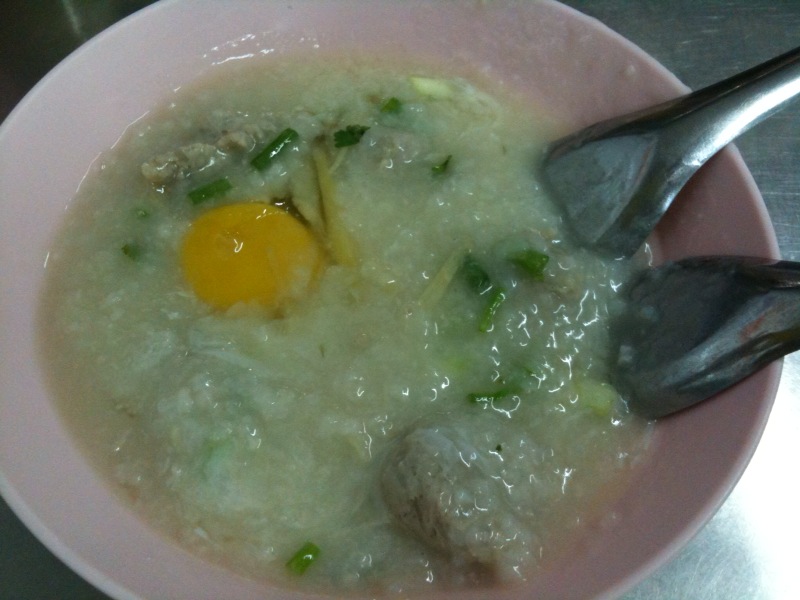
But as disparate as comfort food dishes usually are, they are almost all invariably one thing (er, two things): starchy and filling. For a lot of people, Thai Chinese-style rice porridge (jok) usually fits the bill. An old-style fusion between Thai and Chinese cuisines, Thai jok differs from its Chinese counterpart in terms of seasonings used, and is set apart from the more Thai-style khao thom by the smoother texture of the porridge and runnier rice grains. Thai jok almost always comes with slivered ginger, chopped scallions and chiffonaded coriander leaves, and is usually studded with pork meatballs, pork innards and, if you wish, the inclusion of a hot whole egg, added at the last minute and meant to poach gently in the hot porridge as it is brought to your table. The final touch: deep-fried dough squiggles for crunchy texture, or Chinese-style flat doughnuts (pathongo), for their extra-oomphy starch power.

Because variations on jok are fairly limited, it’s pretty hard to find a terrible jok vendor (but they do exist, they just have to work hard at being bad). It’s equally as difficult to find a truly outstanding one. Many Thais will say that the jok at the Greenhouse Coffee Shop at the Landmark Hotel is exemplary, simply because it is clean, air-conditioned, and hews most closely to the porridge found in Hong Kong (it’s also relatively expensive).

But another great vendor — found on a side-street off of Sam Yan wet market — is Jok Sam Yan (Chula Soi 11). What sets it apart? Tightly wound and reasonably hefty meatballs, made of pork so well-seasoned that this vendor does a brisk trade in minced pork sales alone (180 baht/kg).

Chinese-style rice porridge with pork meatballs and egg

Also drawing kudos is their version with preserved, or “century” egg ( Thais refer to it as kai yiew maa, literally “horse pee egg”, an especially apt name).

Chinese-style rice porridge with preserved egg

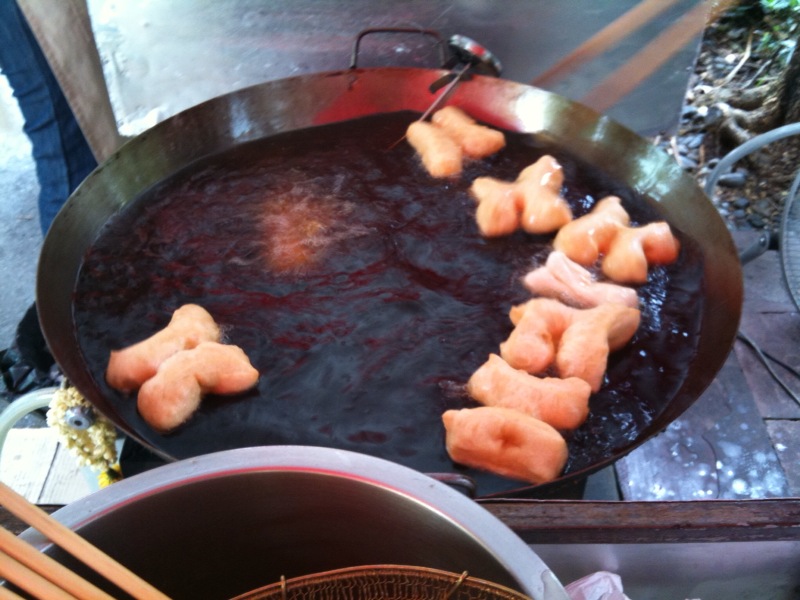
But don’t forget the best supporting actor: those lovely, pillowy cushions of deep-fried dough so soft, so comforting, that Thais often order them on their own, with a side of sweet custard, without the porridge. Among the best vendors is, inexplicably, Kanom, a poncey Thai cafe more known for its egg tarts. Their pathongo are rolled and cooked outside of their Sukhumvit 39 branch, and served hot and fresh from the wok with a choice of plain, green or pink custard dipping sauces. As you can see, they are hard to resist, especially by people with a penchant for deep-fried dough (and who doesn’t?).

Leave a comment

Filed under Asia, Bangkok, Chinese, food, food stalls, pork, rice porridge, Thailand