Category Archives: fish

What’s Cooking: Nam prik kapi

People have different opinions on things, even though they are all wrong. One of those opinions is that pad krapao (stir-fried meat with basil on rice), crowned with a fried egg, is the ultimate Thai “square meal”.

I don’t see it that way. Nutrition-wise (your protein, carb AND fiber), my money’s on nam prik kapi (shrimp paste chili dip), accompanied by fresh veggies, rice and a couple of nice plump Thai mackerel for good measure. THIS is what a lot of Thais think of when they think of nam prik. This — dare I say it? — makes it one of Thailand’s most iconic dishes.

Nam prik platu (for 2 people with semi-hearty appetites)

-2 Tbs small green eggplants (makuea puong)*

-3 Tbs dried shrimp, blanched to minimize fishy smell

-3 Tbs small chilies

-3 limes

-4 large garlic cloves

 -1 heaping Tablespoon shrimp paste

-1 heaping teaspoon palm sugar

-juice of one small orange (preferably of the kiew som variety)

-1/2 Tablespoon fish sauce

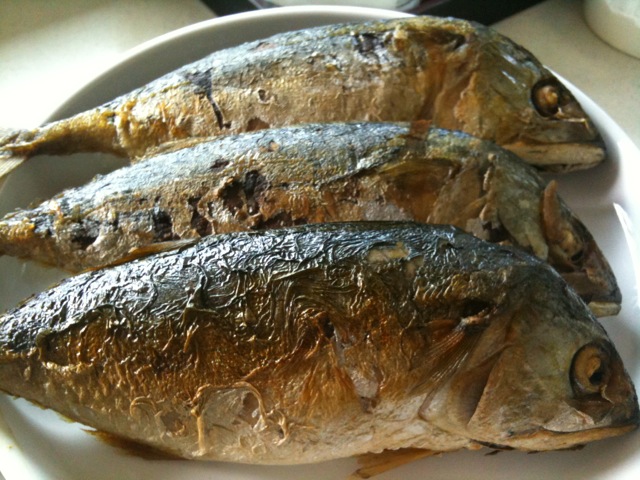
-2 Thai mackerel (see below)

For fresh veggie accompaniment:

-handful of white turmeric (cumin khao)

-handful of long beans, cut into 4-inch segments

-cucumber, peeled and cut on the diagonal

-2 Thai eggplants (makuea proh)
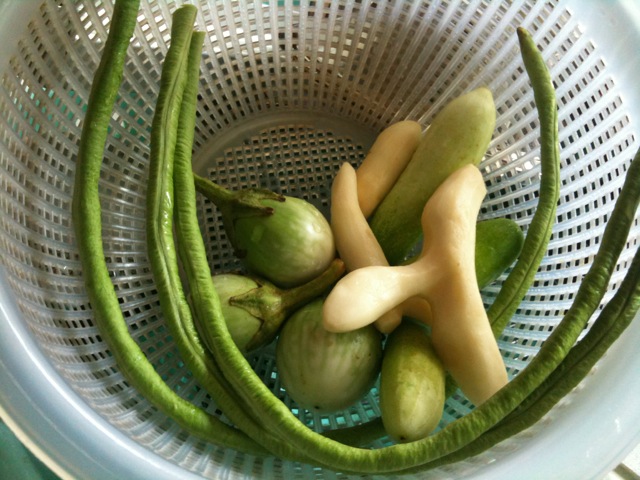
1. Pound shrimp paste, small eggplants and garlic with mortar and pestle until mixed.

2. Add chilies and pound. The peppery smell that begins to waft from the mortar means you are finally getting somewhere.

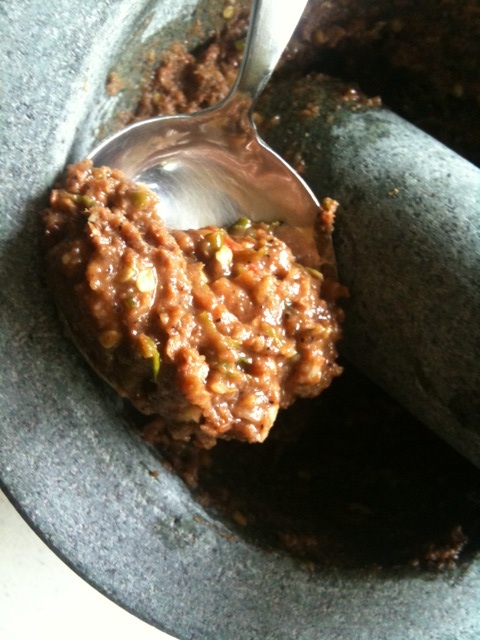
3. Add palm sugar and mix thoroughly. Now this is when Chef McDang, who believes in all-natural ingredients, would give me the side-eye, but: also add a teaspoon of granulated sugar, if you can. It will add to the flavor, I promise.  Mix well until the paste becomes glossy. It will look like this:
4. Add shrimp, fish sauce, 1 Tbsp lime juice and orange juice to mortar. Then add 1 Tbsp hot water so paste takes on a more liquid consistency.

5. Garnish with whole chilies, add more lime juice if needed, and accompany dip with fresh veg, rice and fried Thai mackerel.

(For Thai mackerel)

-Heat oil in wok or deep frying pan and fry until skin is brittle and slightly browned (10 minutes).

-Drain on paper towels and dab to get rid of excess oil.

Note: Instead of simply putting everything on separate plates, you can also take a dollop of the chili dip, flake some fish flesh off the bone, and fry it all with a bowl of rice. Add a little bowl of dip and fresh veggies on the side, and it becomes one of my favorite Thai meals!
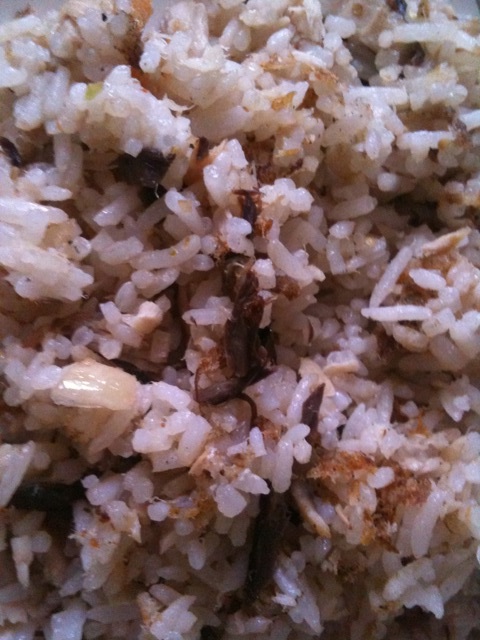
* These little guys are frequently maligned by people who dislike their bitter taste, but their tannic quality offsets the spiciness of the chili dip perfectly, so try not to leave these out! Sometimes, hairy eggplants (ma uk) are used instead.
2 Comments

Filed under Asia, Bangkok, fish, food, rice, seafood, Thailand

What’s Cooking: Nam prik platu

Chili pastes, or nam prik, form one of the main pillars of a Thai meal, and of Thai cooking in general. As dip-like condiments, or krueng jim, they incorporate easily portable protein and vegetables, and are frequently the main protein source for a Thai during the day. As the base for a dish, or nam prik gaeng, they build the foundation to a curry, soup or stir-fry; they also make great de facto salad dressings and marinades. In fact, there are few savory dishes that do not incorporate some form of chili paste.

This is the condiment kind, a well-known chili dip that is the main meal for many Thai families. It is also very nutritious, using Thai mackerel (omega-3!), fresh and blanched vegetables (fiber!) and very little, if any, oil.

Nam Prik Platu (for four)

-2 pla tu, or Thai mackerel*

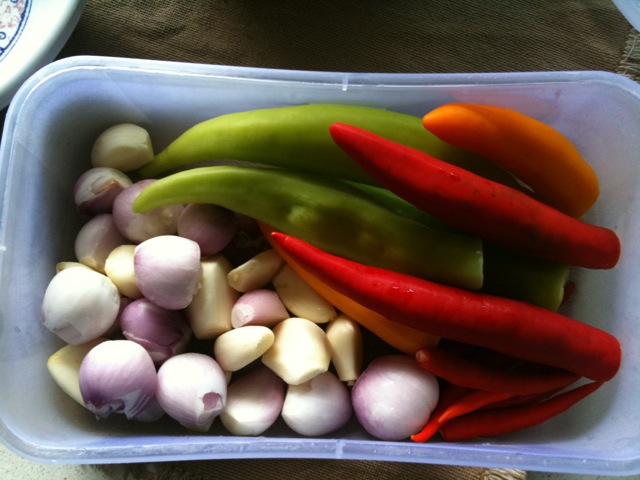
-4-5 red and yellow prik chee fa, chopped

-4-5 prik yuak, sliced

-10 garlic cloves

-16 halved shallots

-6 small red chilies

For fresh vegetable garnish:

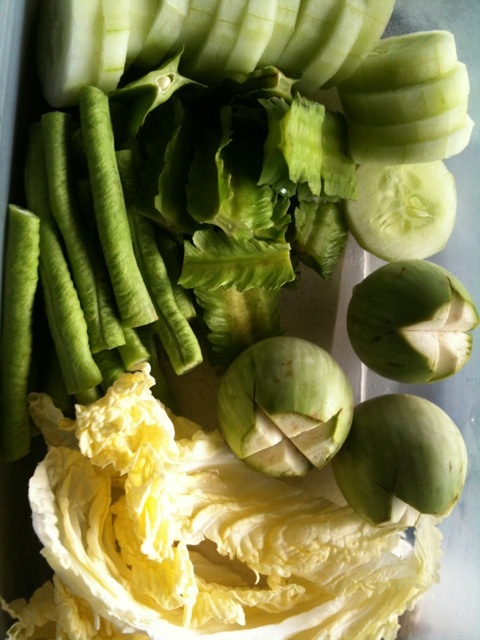
-1 cucumber, peeled and sliced

-handful of savoy cabbage leaves, washed and trimmed

-2 Tbsp winged beans, cut into 1-inch sections

-3 Thai eggplants (makuea proh)

-2 Tbsp long beans, cut into 4-inch sections

For blanched vegetable garnish:

-1/2 nam thao, or green gourd, blanched, peeled and sliced

-handful of blanched morning glory (pak boong)

-handful of blanched long beans

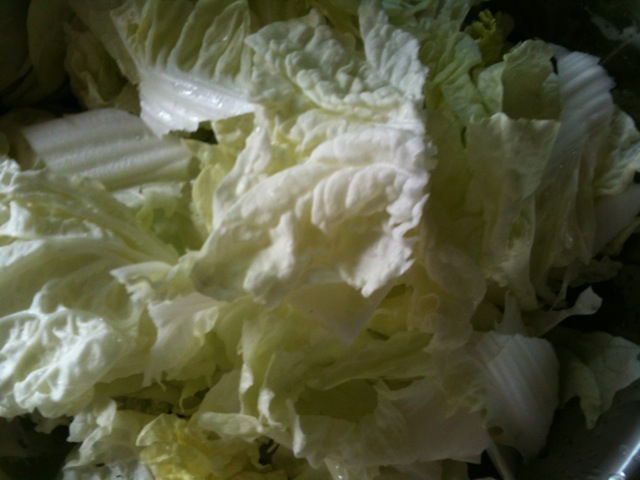
-1 head cabbage, chopped and blanched

-1/2 head savoy cabbage, chopped and blanched

-1/2 cup chicken stock

-2 Tbsps fish sauce (plus more to taste)

-juice from 1 lime

1. Make chilies, garlic and shallots fragrant by dry-frying them (the process is called kua) in a wok or deep frying pan. Continue until the flesh begins to take on a “blackened” appearance. Take the opportunity to practice your flipping so you can show off to your friends later on and they will think you are a really great cook. (You can also kua by skewering your chilies, garlic and shallots and placing them in an oven at full whack until the flesh blisters and blackens a bit).

Your chili mixture will look like this:


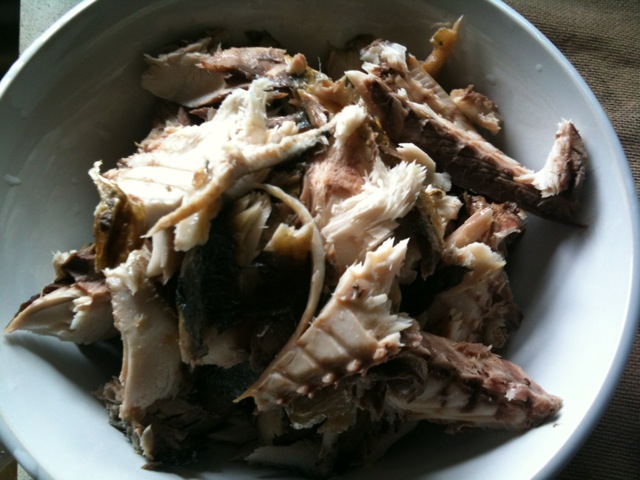
2. Deflesh your fish with your fingers, taking care to catch the tiny bones in the tail section. Set aside fish flesh. It should look like this:


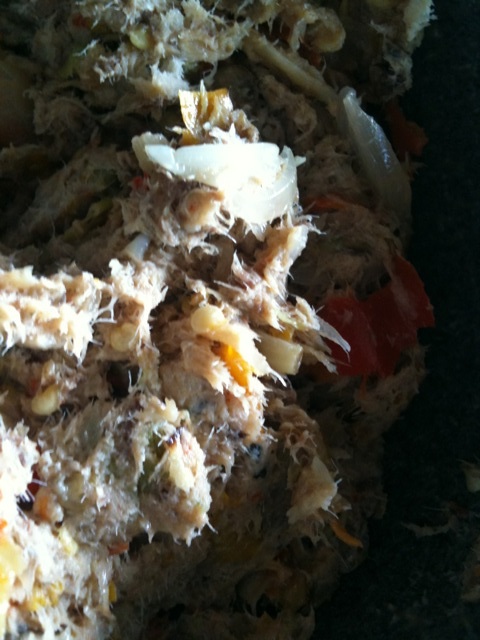
3. Once your chilies are fragrant, pound them in a mortar and pestle, in batches if necessary. Add fish flesh as you go along until everything is incorporated (of course, you can also whizz in the food processor, but it only serves to slice the ingredients, not crush them into oblivion. Also, why not get a great biceps workout while you’re at it?) When you are finished, the paste will look like this:


4. Add your chicken stock and 2 Tbsp fish sauce. Taste for seasoning and add more fish sauce if needed.
Your finished chili paste will look like this:


5. Just before serving, add juice of 1 lime, but if keeping for later, make sure to refrigerate (duh). Reheat and add lime juice just before serving, accompanied by fresh and blanched vegetables and rice.

*The best store-bought pla tu apparently must have a short face, crooked neck and (obviously) thick belly.

Next up: nam prik kapi, Thailand’s traditional square meal.

2 Comments

Filed under Asia, Bangkok, fish, food, seafood, Thailand

What’s Cooking: Gaeng om

If there’s a good place to start for a Thai food cooking virgin, it’s with this tasty Northeastern Thai “soup”. It’s full of good-for-you greens, bright and light with fresh, herbal flavor, and crazy easy to make. Felt like I robbed a bank with this one.

Gaeng Om (for four)
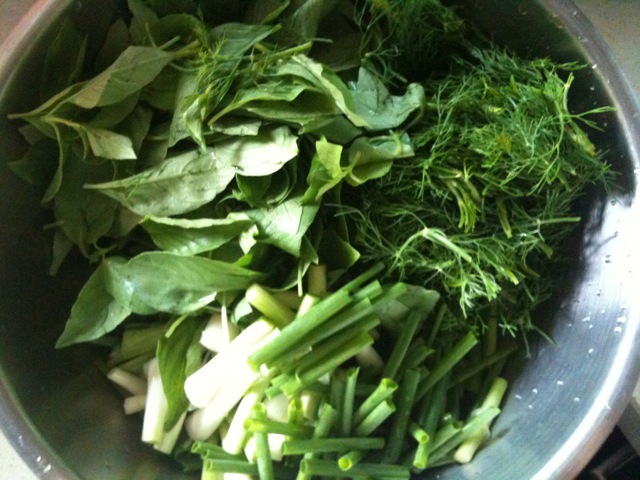
-1 head white cabbage, chopped

-2 g Thai lemon basil (bai maeng rak)
-2 g dill, chopped
-2 g scallions, cut into 1-in pieces

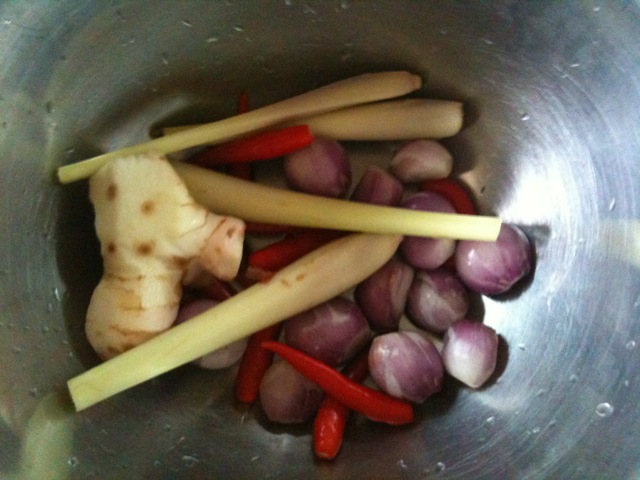
-2 stalks lemongrass, cut in half
-1 large piece galangal, sliced
-12 shallots
-12 small red chilies

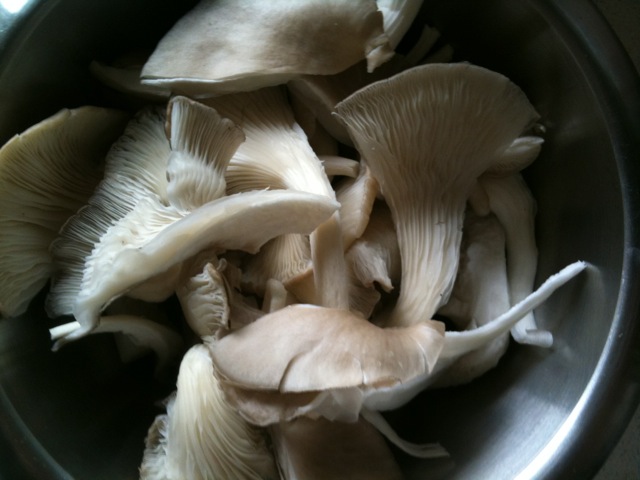
-3 g oyster mushrooms (het nang rong)

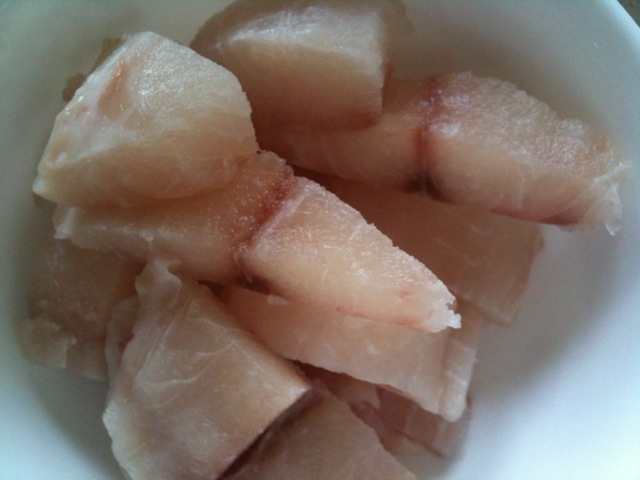
-300 g white fish filets, skin-on, cut into pieces*

-2 Tbsp fermented Thai anchovy juice (nam pla rah)**

-200 g chicken stock

-200-300 g water

-1 Tbsp fish sauce (plus more to taste)***

1. Set water and chicken stock to simmering boil in pot. Meanwhile, mix lemongrass, galangal, shallots and chilies in blender or food processor until finely diced.
2. Once simmering boil is achieved, add chili mixture to stock.
3. Add pla rah juice, 1 Tbsp fish sauce and fish pieces. Do not overstir, or fish will get mushy. Cover.
4. Increase heat to rolling boil. Add mushrooms and white part of scallions.
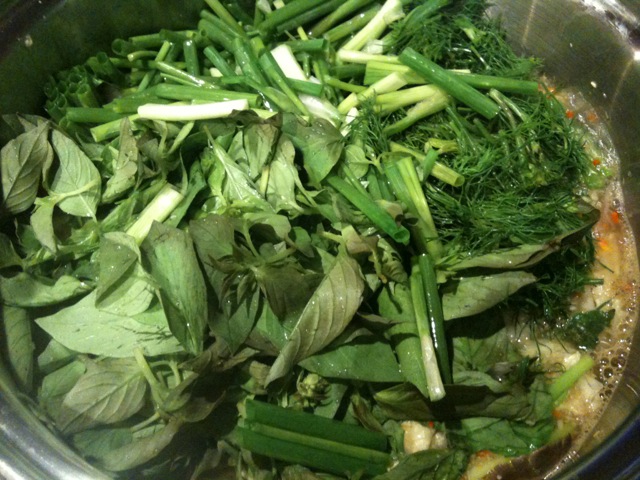
5. When water returns to the boil, add cabbage and the rest of greens. The pot should look like this:

Cover.
6. When vegetables lose some volume, carefully “fold” into broth. Taste and add more fish sauce if needed.
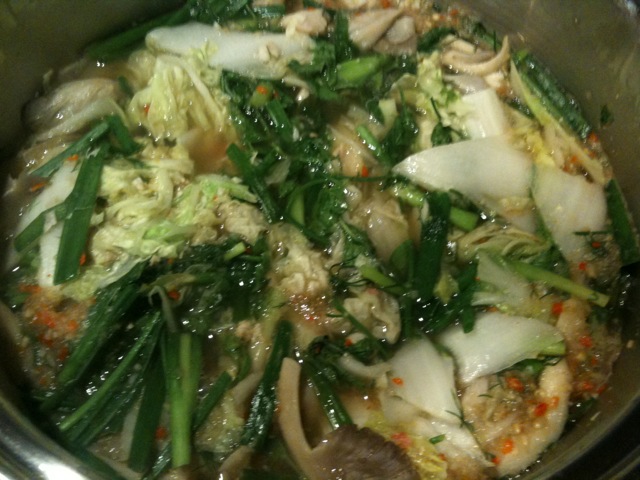
7. Shut off flame. Pot should look like this:

Cover and let “marinate” for a few hours (cool and place in fridge if leaving overnight).

*If you’re a meat person, use sauteed chicken wings or pork ribs instead.
**You can buy Thai anchovies in any supermarket here in Thailand, but Khum Gon, my Thai food tutor, claims homemade is best (obviously). Fermented Thai anchovies look like this:

If this isn’t available to you, try mashing regular good-quality anchovies instead.
***Khum Gon believes that fish sauce from shellfish (such as razor clams) is best because it smells less fishy than other types. Frankly, I am not that sensitive to the smell, but if that is an issue, then take Khum Gon’s advice.

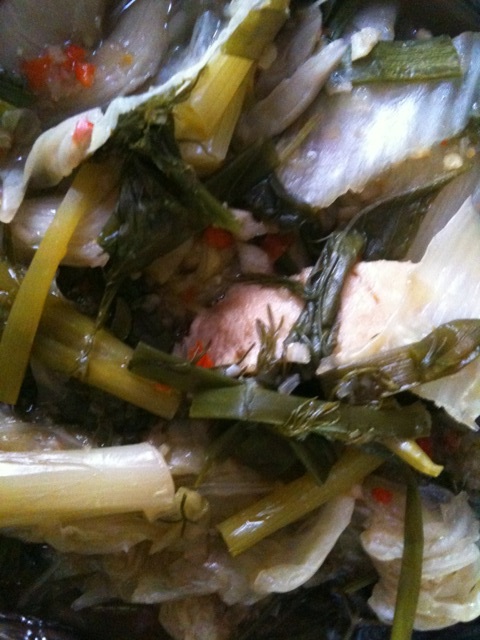
What we ended up with:

Lunch

In the end, it was … pretty good. I’d use all chicken broth next time. And more Thai anchovy juice. But it was everything I expected and wanted from my first Thai cooking experiment. Next up: a veggie-rich gaeng liang.

12 Comments

Filed under Asia, Bangkok, fish, food, Isaan, seafood, Thailand