Category Archives: food stalls

Getting to the meaty part of Chiang Mai

Fish larb at Raan Larb Pa Than

Northern Thailand is a lovely place full of peace-loving people, but their food betrays a bloodthirstiness not readily apparent to the casual observer. There is the dish of light and butterflies known as khao soy and the barely perceptible calf muscle exercises called “Lanna dance”, yes, but there is also bile and blood and innards and raw meat, the stuff you see in the aftermath of a hyena attack, the stuff that people shy away from in the wet market. This is real northern food.

Raan Larb Pa Than, out past the Pa Than bridge, specializes in this type of food. Like everywhere else in the north, it’s full of fun-loving gentle northerners strapping on the feedbag big time; unlike everywhere else, this restaurant specializes in larb dee kom, or minced salad of anything considered delicious, like fish, pork, or beef (no chicken, and pork and beef also come in raw versions). A particular stand-out is their larb of freshwater fish, lighter and more delicate than its bloodier counterparts.

Our neighbor’s table

But larb is not the only thing they have. There is also saa, which, contrary to my earlier understanding, does not refer only to vegetables, but appears to be a term nearly interchangeable with yum — a spicy, tart salad made with chunks of stuff. There is lupia, yet another meat salad term that refers to combining the minced protein with blood and lemongrass to diminish any hints of gaminess. There is yaw (tripe) and jin nung (steamed bull, really) and sai tod (fried innards) alongside the usuals you would want to run to like a child to its mother like gaeng om (clear, tart soup) and som tum (minced vegetable or fruit salad). It’s a place of serious meat eaters AND drinkers — the Saeng Som was out in full force at lunchtime on a Tuesday. It’s food for people who work hard, flavored with dipping sauces and a nam prik tha dang (red-eye chili paste) spicy enough to blow steam out of your ears.

You might need this

Another spot for people who, at the very least play hard, is Midnight Fried Chicken (also somehow known as Midnight Sticky Rice, or Midnight Fried Pork, or likely anything else this place is good at) on Kamphaeng Din Road. As the name suggests, it is open like clockwork at the stroke of midnight, every day, until 5 in the morning.  The clientele reflects this accordingly: young, T-shirted hipsters out on dates or in groups, stuffing themselves with fried things right before bed, as the young frequently do. It is not a place for me, but I was here all the same, and would come again, if only for the heavenly fried pork which, in all fairness, should be the name of this food stall.

Midnight Chicken

You will probably be able to pick out this stall from the queue of hungry clubgoers waiting patiently outside; if you are lucky, as we were, you will get a table roadside instead of a table on a lower level in the back. You pick out your choices by checking the names of dishes you want (in Thai); you serve yourself water from a jug and bin of ice behind the partition. It is, to put it mildly, a down-at-home kind of place. That doesn’t mitigate the enjoyment of stuffing your face full of delicious fried meats with sticky rice and nam prik (chili paste), not one bit. So what if it’s a weeknight? Sleep in late tomorrow, and indulge tonight.

Stuff your face

(All photos by @SpecialKRB)

6 Comments

Filed under Asia, beef, Chiang Mai, chicken, fish, food, food stalls, Northern Thailand, pork, restaurant, som tum, Thailand

Breakfast in Hua Hin

Congealed pig’s blood in soup — a common Thai breakfast dish

It doesn’t happen very often, maybe, but it might — somehow, for no reason at all, you wake up at 6 in the morning with an empty stomach, having picked at a watermelon salad at the neighboring hotel the night before. You are starving. You need food, pronto.

Luckily, Hua Hin has it all covered. This once-sleepy seaside town — the traditional weekend getaway of time-pressed Bangkokians everywhere — may be an amateur when it comes to approximating any sort of nightlife, but is everything a morning person with a love of food could possibly want. By 6, it’s already buzzing: steam rising from curry-filled pots; dough rolled out for the morning’s first patongko (Chinese fried bread) order; monks out strolling the market, bowls in hand.

When I get to Pa Choung (4/3 Amnuaysin Rd., 082-212-4490, open 6-noon), she is in the middle of making merit. On the hob: a fiery gaeng som full of little shrimp and dok kae (what I’ve seen referred to on some menus as cowslip blossoms), pad ped moo pa (stir-fried curried wild boar), dried and butterflied fish, sun-dried beef, deep-fried pork cutlets and a green curry full of slivered bamboo shoots.

Green curry and deep-fried pork: breakfast of champions

This isn’t all of it. She says she is finished making all of the food at 8. But it’s usually gone by 8:30. I’m happy with the smattering of curries already there.

But while Pa Choung is a one-woman curry-making machine, Raan Kafae Jek Pia (intersection of Naebkehardt and Dechanuchit Roads, open 6:30-1:30pm) is clearly Breakfast Central for the entire town. Every table is occupied, and on nearly every tabletop is a mug of sludge-like kafae boran (old-fashioned coffee), flavored with a layer of condensed milk. But this is not the main attraction. Instead, it’s the collection of stalls that service Kafae Jek Pia’s customers: jok moo (Chinese-style rice porridge with minced pork); khao thom pla (rice porridge with fish); guaythiew (noodles in soup); and, most intriguing of all, gow low lued moo (pig’s blood in soup), traditionally served for breakfast here, in a country not really known for its breakfast foods.

Cubes of pig’s blood blanched in broth

Pig’s blood cubes are taken from a chilled bowl and blanched in boiling broth for a few minutes. They are then added to slices of pork, blanched Thai watercress, some Thai celery for freshness, and a dash of deep-fried garlic for bitterness and punch. There are bits of innards too: intestine and liver and slices of heart. It’s a one-stop shop for piggy flavor. Sometimes, if you pair it with a plain bowl of rice, you can drop some of that in there too, or take a spoonful and dunk it, watching the grains soak in the broth, a bite at a time. It’s the best antidote to thinking too much that, well, I can think of. What else is breakfast for, if not that brief reprieve before the start of the day?


7 Comments

Filed under Asia, food, food stalls, Hua Hin, pork, rice, Thailand

Not just for old people

Noodles with chicken and bitter melon

Someone once asked me “Why the obsession with age?” I was surprised; I hadn’t noticed how much I was writing about my old, old oldness. But why wouldn’t I be — I am staring down the barrel of 80, people I knew five years ago no longer recognize me, and, I can’t believe I’m saying this, but I can’t eat like I used to. I cannot even be bothered to work, which is okay, since it gives me time to focus on the truly important things in life, like watching reruns of “Revenge”. Ah, youth! Its innate arrogance and unconscious cruelty and all the things we took for granted. Never to return again.

Another sign of my inexorable march to watching “Dancing With the Stars” on a religious basis: my newfound appreciation for guaythiew gai mara, or chicken-and-bitter melon noodles. Bitter melon, also known as bitter gourd or bitter squash and indigenous to the tropics, is one of those fruits that is hard to make out. Like taciturn people, they seem to offer nothing — wrinkled, waxy green flesh; a bitter, dry-mouth crunch — without a lot of work. But everyone that grows them has found some sort of use for them: sliced and scrambled with eggs in Okinawa; curried in India; souped up with shrimp in Vietnam. In Thailand, they are stuffed with minced pork and stewed for hours in a broth coaxed from pork bones to make gaeng jued mara yad sai, or stuffed bitter melon in clear soup. It’s one of those dishes that requires an introduction like “This is very good for you” (it’s supposed to be good for sore throats). Thais like to joke that you are starting to get old if you begin to appreciate it.

But rarely is there any mention of chicken-and-bitter melon noodles. That’s strange, because they are not hard to find at all. Tucked in amongst the ubiquitous papaya salad, egg noodle and rice porridge stalls are the vendors who display halved bitter melons and chickens on their carts, the ones who, inevitably, already have two or three people waiting in line. They are open for breakfast and lunch, because chicken-and-bitter melon noodles are a daytime dish. They are almost always mobile vendors, or vendors who, like the one between Emporium and Benjasiri Park, offer stools as tables with shorter stools as chairs (you are supposed to eat with your back to the traffic so road dust doesn’t fall into your bowl, but really, is this really cheaper than springing for a couple of tables?).

My favorite is the one on Sukhumvit 24 road, in front of a massage parlor and kitty-corner to another one (and a few feet down from yet another one). Noodle choices are thick (sen yai), egg (bamee), Mama (yes I know), and rice vermicelli (sen mee). The chicken, which from a distance looks like it is smoked, is actually gai jae, or boiled chicken. And the piece de resistance, the broth: sweet to offset the bitterness of the melon, aromatic with an almost cinnamon-y scent, stewed with bits of mara, old bones, and the remnants of my writing career.

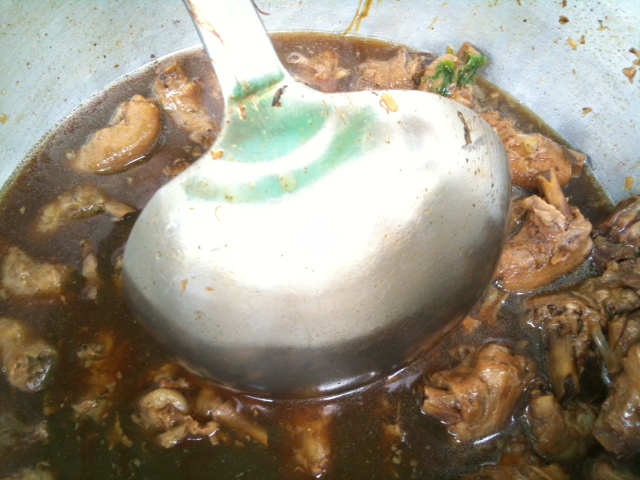
Chicken-and-bitter melon broth

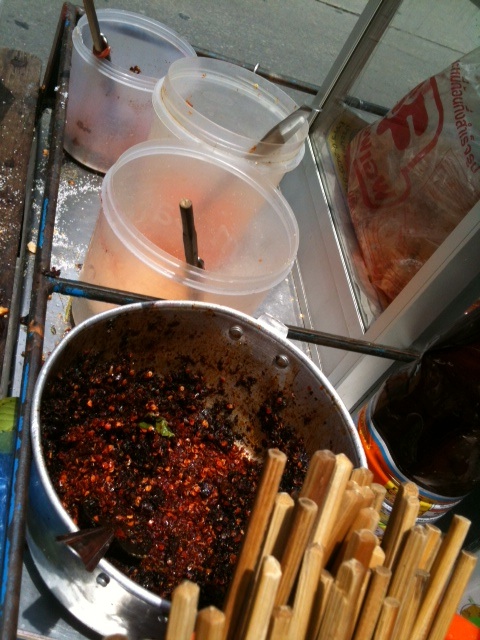
Before you take it home, you are invited to juice up your noodles with any combination of condiments: sugar, dried chili flakes, pickled peppers in white vinegar, crushed peanuts, roasted chili paste. The end result is what the best Thai food always is: a study in contrasts between the flavors of the melon and the broth, the texture of the crisp crunchy greens with the soft give of the noodles, the comfort implied in the chicken and the spice of the roasted chili paste. Really, can you blame me for giving this a go?

Condiment bar

4 Comments

Filed under Asia, bamee, Bangkok, chicken, food, food stalls, noodles, Thailand