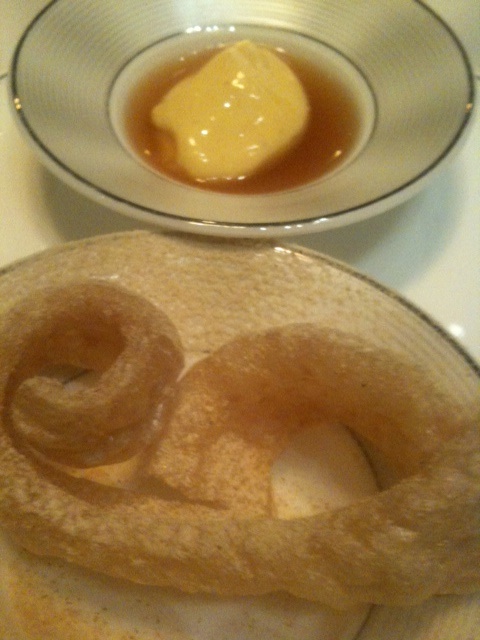
Pork rind with spice powder and miso dip at Sra Bua
Sra Bua by Kiin Kiin sees itself as a traditional Thai restaurant with a modern twist, but it’s not. The sister restaurant to Copenhagen’s still-Michelin-starred Kiin Kiin, Sra Bua offers nothing that could ever qualify as “traditional”, from its curry ice creams to fizzy pop-rock-laced gelatos, its dizzyingly formal parade of odd tiny bits to its extremely strict reservation policy (don’t even think of bringing an extra body to dinner at the last minute, folks — the usual mai pen rai will undoubtedly come from you, not them). There is spherified lobster essence and foam masquerading as coconut sauce. There are globules and powders and custards galore to entertain any reasonable diner. But this vision of “molecular Thai” is not traditional, and not really Thai food.
In case you are wondering, yes, this is indeed going to be a great big grump-fest about krazy kids and their krazy food, and why the neighbors are so loud with their terrible music and why the numbers are too small on my cordless talking-thingy. And yes, I hated Sra Bua. So that is out of the way. To be fair, the menu has recently changed. It may be awesome now. But the meal I had was a procession of dishes with nods to Ferran Adria and Rene Redzepi tossed in but which all basically tasted the same — creamy and sweet — with some grumbling undertones of spice and salt and maybe some fishiness and smoke somewhere in there, possibly, like a stain that’s been furiously scrubbed and everything hastily ironed out again to look shiny and happy. It was shiny happy food, without the bits of drama like the lurking bitter pop of a baby eggplant, or stink of smelly fish paste. It was Thai food on Prozac.
This got me thinking. After helping Chef McDang with his first English-language cookbook, “The Principles of Thai Cookery”, I have been lucky enough to get to work with him on his second, to be called, tentatively, “Modern Thai Cookery”. The recipes — Thai-marinated pork wiener schnitzel, or green curry osso bucco — are straight-up fusion, Thai ingredients melded with Western cooking techniques. But the flavor profiles remain staunchly, resolutely Thai. What is Thai? According to Chef McDang, it’s fish sauce. Palm or coconut sugar. A natural acid, like lime or water olive or tamarind. A paste base. An unscented oil. It’s simple, and allows for flexibility, because neither of us is an authenticity troll (an entirely different, equally problematic can of Sriracha-drenched worms).
This then got me thinking about rebels. The English “aesthetic movement” of the late 1800s stripped away boundaries between the arts and angered establishment figures. Impressionism inspired derision amid people who didn’t get the strokes and colors; the term itself was meant to be an insult. And there was punk, which many many people hated, and then hated again after it was defanged and sanitized. In the book “Retromania” by Simon Reynolds (thanks @sjmontlake!), critic Julie Burchill wrote of punk’s inevitable demise: “I’m just a cranky old punk past its prime. But the alternative is hideous, and it is the only alternative. It is to believe in ROCK’S RICH TAPESTRY.” (ppg. 6-7. I haven’t gotten very far).
Maybe Sra Bua is part of “Thai food’s rich tapestry”, with its winks and grins and gastro-references. And I could just be a grumpy old person, like those guys who hated Monet, crawling out of my cave every once in a while to scarf down a bowl of noodles and bellow at the occasional squirrel. I do believe that, with the explosion of restaurants worldwide, diners are now demanding new tricks and gimmickry, ever-more gimcracks and bonobos. They want to be entertained. And if it tastes good, well, that’s great too. But this is the opposite of what I want. I guess this means I am old-fashioned. I just want the food.





 Bangkok Glutton