Category Archives: food

What’s Cooking: Nam prik kapi

People have different opinions on things, even though they are all wrong. One of those opinions is that pad krapao (stir-fried meat with basil on rice), crowned with a fried egg, is the ultimate Thai “square meal”.

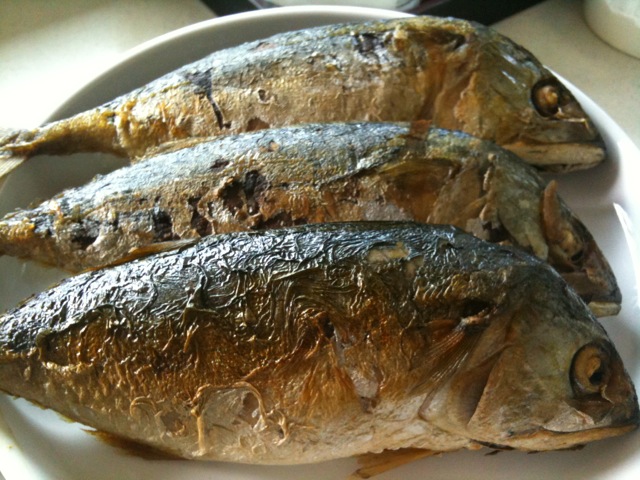
I don’t see it that way. Nutrition-wise (your protein, carb AND fiber), my money’s on nam prik kapi (shrimp paste chili dip), accompanied by fresh veggies, rice and a couple of nice plump Thai mackerel for good measure. THIS is what a lot of Thais think of when they think of nam prik. This — dare I say it? — makes it one of Thailand’s most iconic dishes.

Nam prik platu (for 2 people with semi-hearty appetites)

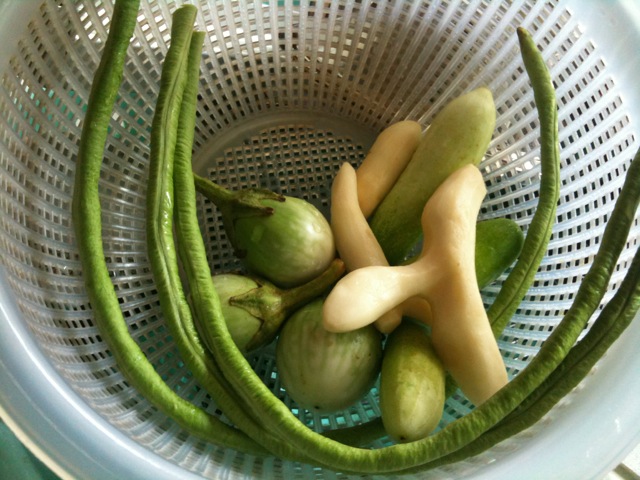
-2 Tbs small green eggplants (makuea puong)*

-3 Tbs dried shrimp, blanched to minimize fishy smell

-3 Tbs small chilies

-3 limes

-4 large garlic cloves

 -1 heaping Tablespoon shrimp paste

-1 heaping teaspoon palm sugar

-juice of one small orange (preferably of the kiew som variety)

-1/2 Tablespoon fish sauce

-2 Thai mackerel (see below)

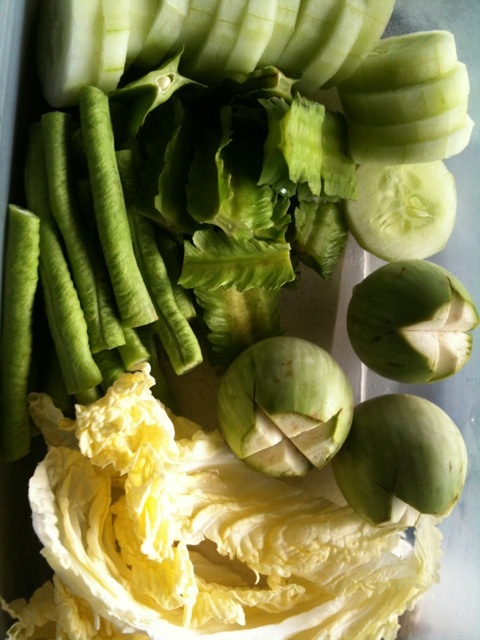
For fresh veggie accompaniment:

-handful of white turmeric (cumin khao)

-handful of long beans, cut into 4-inch segments

-cucumber, peeled and cut on the diagonal

-2 Thai eggplants (makuea proh)
1. Pound shrimp paste, small eggplants and garlic with mortar and pestle until mixed.

2. Add chilies and pound. The peppery smell that begins to waft from the mortar means you are finally getting somewhere.

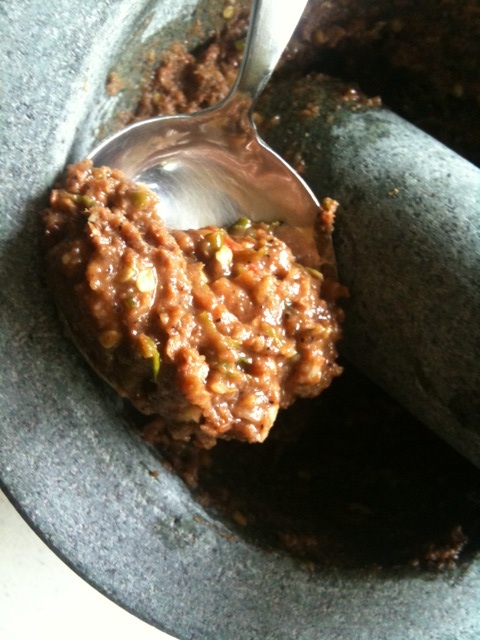
3. Add palm sugar and mix thoroughly. Now this is when Chef McDang, who believes in all-natural ingredients, would give me the side-eye, but: also add a teaspoon of granulated sugar, if you can. It will add to the flavor, I promise.  Mix well until the paste becomes glossy. It will look like this:
4. Add shrimp, fish sauce, 1 Tbsp lime juice and orange juice to mortar. Then add 1 Tbsp hot water so paste takes on a more liquid consistency.

5. Garnish with whole chilies, add more lime juice if needed, and accompany dip with fresh veg, rice and fried Thai mackerel.

(For Thai mackerel)

-Heat oil in wok or deep frying pan and fry until skin is brittle and slightly browned (10 minutes).

-Drain on paper towels and dab to get rid of excess oil.

Note: Instead of simply putting everything on separate plates, you can also take a dollop of the chili dip, flake some fish flesh off the bone, and fry it all with a bowl of rice. Add a little bowl of dip and fresh veggies on the side, and it becomes one of my favorite Thai meals!
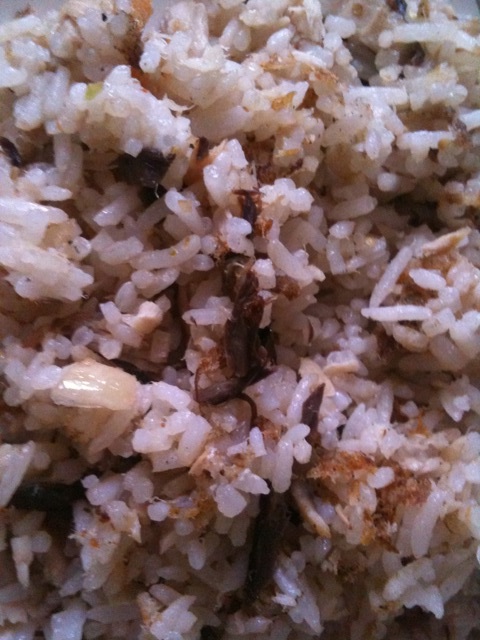
* These little guys are frequently maligned by people who dislike their bitter taste, but their tannic quality offsets the spiciness of the chili dip perfectly, so try not to leave these out! Sometimes, hairy eggplants (ma uk) are used instead.

2 Comments

Filed under Asia, Bangkok, fish, food, rice, seafood, Thailand

Veggie delite

Papdi chat at the India Emporium

On a recent trip to Ayutthaya to buy sausages (I know what you are thinking, that I have no life, but did I mention that these are GERMAN-STYLE sausages?), I encountered something very troubling and did something totally out of character. At the restaurant, there were many dogs, but one was tied up and two little boys were trying to force the poor dog into a tiny little cage, prodding her with sticks and occasionally giving a kick for good measure.

This is not something I want to see while I am trying to stuff my face with frankfurters and deep-fried pork knuckle, or anything else, for that matter. I tried to intervene several times, chastising the boys and looking to their freaking PARENTS for some back-up. Finally, after forcibly removing the stick from the boys and yelling at them to STOP, I asked the parents why this dog was tied up.

Apparently, the dog was “bothering customers” by being overly friendly, and so rather than letting her “bother” customers, they tied her up. Somehow, the thought that seeing this defenseless animal abused might bother their customers did not occur to anyone. Or that having their kids disciplined by some random stranger was a bad thing. This trip made me rethink a few things, namely: 1.) the “evil” of corporal punishment on obnoxious, mean-spirited kids, 2.) whether I can ever go back to that restaurant again, no matter how good the sausages are supposed to be and 3.) if I can’t stand to see animals being mistreated, what about the meat that I eat every day?

So I’ve been trying to eat less meat, and I haven’t exploded from yearning or frustration yet. What has helped: the southern Indian (read: vegetarian) stand at the food court in Pahurat’s India Emporium (561 Chakapet Rd., 02-623-9301), a magical place promising gastronomic delights of all descriptions — Thai and non-vegetarian included — but brimming (unusually, for a place like Thailand) with all matter of vegetarian dishes and flavors.

Truth is, real vegetarian (when it’s not Buddhist Lent) is hard to come by in a country where fish sauce is part of the essential flavor profile (although I did meet two Thais the other day who found fish sauce “smelly” and used light soy sauce and salt instead. What is this world coming to? Next thing you know, chilies will be too “spicy” and Tabasco will be considered living on the edge. Thailand: the Erie, Pennsylvania of the future.)

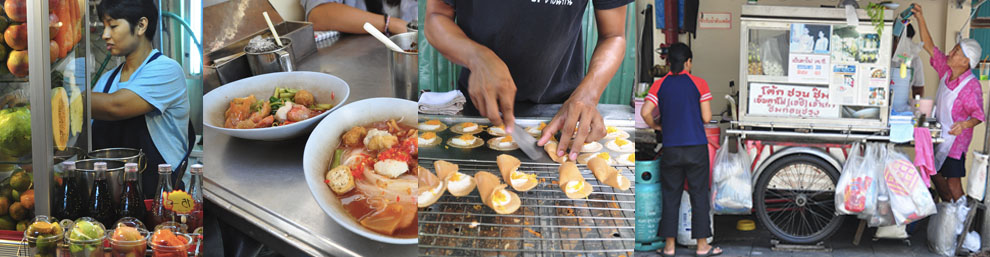
So being a vegetarian here can be a bit of a chore, especially if you want to eat on the street (which explains why a lot of people go pescatarian when they live here). And while the food court at India Emporium is hardly the sweltering, National Geographic-worthy adventure that a trek into, say, the side-streets of Yaowaraj can be, it IS in one of the most exciting neighborhoods in Bangkok — full of color, interesting smells (not ALL unpleasant) and food you won’t easily find anywhere else. A case in point:

Masala dosa

These thin crepe-like dosas are made fresh before your eyes and stuffed with masala and, if you like, cheese, before they are served with a vegetable soup, yogurt and chutney. If, say, you went crazy and started ordering everything you saw because you were so moved by the color and chaos of the surrounding neighborhood and also got lentil fritters, soaking in a red-tinged vegetable broth, and papdi chat, puffy air-filled bits of dough slathered in yogurt, coriander chutney and tamarind sauce AS WELL AS a lovely rasmalai (cottage cheese dumplings in milk with almonds) and a double order of gulab jaman (uh, too sweet here, not aromatic with cardamom like it should be), the nice young man at the counter won’t bat an eye or judge you (too much) for your Gluttony, not at all. No, he’ll be fine and you can go on living like you are completely normal. For realz.

Veggie soup

So, India Emporium food court: the place of non-judgmental face-stuffing. And, much of it is vegetarian. Also, no crappy 7-year-old sociopaths. These are all good things.

8 Comments

Filed under Asia, Bangkok, food, food stalls, shopping, Thailand

What’s Cooking: Nam prik platu

Chili pastes, or nam prik, form one of the main pillars of a Thai meal, and of Thai cooking in general. As dip-like condiments, or krueng jim, they incorporate easily portable protein and vegetables, and are frequently the main protein source for a Thai during the day. As the base for a dish, or nam prik gaeng, they build the foundation to a curry, soup or stir-fry; they also make great de facto salad dressings and marinades. In fact, there are few savory dishes that do not incorporate some form of chili paste.

This is the condiment kind, a well-known chili dip that is the main meal for many Thai families. It is also very nutritious, using Thai mackerel (omega-3!), fresh and blanched vegetables (fiber!) and very little, if any, oil.

Nam Prik Platu (for four)

-2 pla tu, or Thai mackerel*

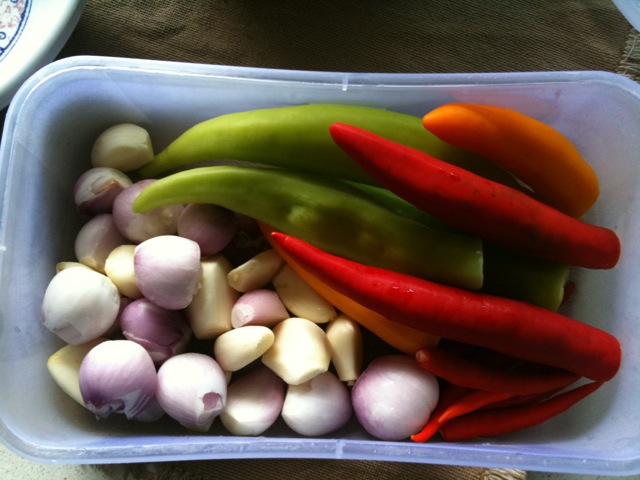
-4-5 red and yellow prik chee fa, chopped

-4-5 prik yuak, sliced

-10 garlic cloves

-16 halved shallots

-6 small red chilies

For fresh vegetable garnish:

-1 cucumber, peeled and sliced

-handful of savoy cabbage leaves, washed and trimmed

-2 Tbsp winged beans, cut into 1-inch sections

-3 Thai eggplants (makuea proh)

-2 Tbsp long beans, cut into 4-inch sections

For blanched vegetable garnish:

-1/2 nam thao, or green gourd, blanched, peeled and sliced

-handful of blanched morning glory (pak boong)

-handful of blanched long beans

-1 head cabbage, chopped and blanched

-1/2 head savoy cabbage, chopped and blanched

-1/2 cup chicken stock

-2 Tbsps fish sauce (plus more to taste)

-juice from 1 lime

1. Make chilies, garlic and shallots fragrant by dry-frying them (the process is called kua) in a wok or deep frying pan. Continue until the flesh begins to take on a “blackened” appearance. Take the opportunity to practice your flipping so you can show off to your friends later on and they will think you are a really great cook. (You can also kua by skewering your chilies, garlic and shallots and placing them in an oven at full whack until the flesh blisters and blackens a bit).

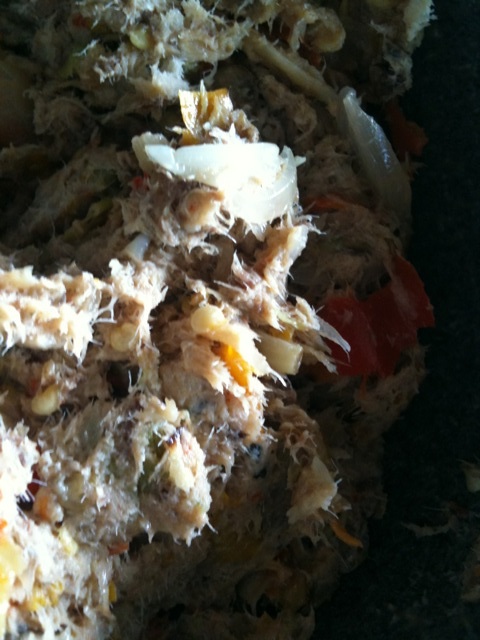
Your chili mixture will look like this:


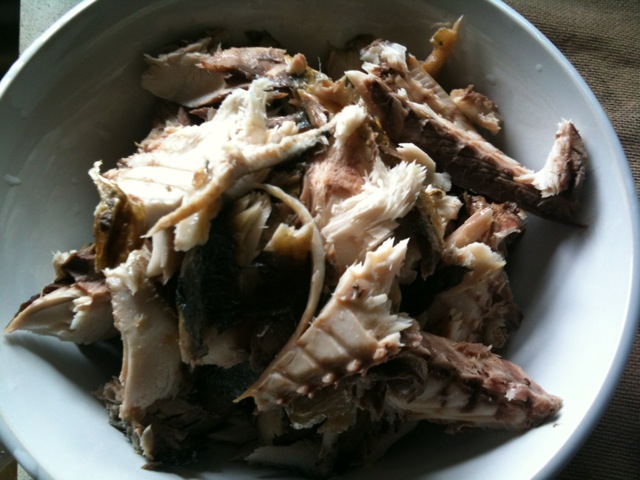
2. Deflesh your fish with your fingers, taking care to catch the tiny bones in the tail section. Set aside fish flesh. It should look like this:


3. Once your chilies are fragrant, pound them in a mortar and pestle, in batches if necessary. Add fish flesh as you go along until everything is incorporated (of course, you can also whizz in the food processor, but it only serves to slice the ingredients, not crush them into oblivion. Also, why not get a great biceps workout while you’re at it?) When you are finished, the paste will look like this:


4. Add your chicken stock and 2 Tbsp fish sauce. Taste for seasoning and add more fish sauce if needed.
Your finished chili paste will look like this:


5. Just before serving, add juice of 1 lime, but if keeping for later, make sure to refrigerate (duh). Reheat and add lime juice just before serving, accompanied by fresh and blanched vegetables and rice.

*The best store-bought pla tu apparently must have a short face, crooked neck and (obviously) thick belly.

Next up: nam prik kapi, Thailand’s traditional square meal.

2 Comments

Filed under Asia, Bangkok, fish, food, seafood, Thailand