Category Archives: food

Thai comfort food

Everyone has a comfort food. For a lot of people, it’s something bland and baby food-like — khao thom gub (plain boiled rice porridge, traditionally served with sides like minced pork omelette, dried salty fish and stir-fried morning glory) is a popular one among Thais, the Thai version of mashed potatoes. For others, it’s something that reminds them of their childhoods. Personally, I have always turned to spaghetti bolognese in times of stress, because it reminds me of the Italian-American town where I grew up.

But as disparate as comfort food dishes usually are, they are almost all invariably one thing (er, two things): starchy and filling. For a lot of people, Thai Chinese-style rice porridge (jok) usually fits the bill. An old-style fusion between Thai and Chinese cuisines, Thai jok differs from its Chinese counterpart in terms of seasonings used, and is set apart from the more Thai-style khao thom by the smoother texture of the porridge and runnier rice grains. Thai jok almost always comes with slivered ginger, chopped scallions and chiffonaded coriander leaves, and is usually studded with pork meatballs, pork innards and, if you wish, the inclusion of a hot whole egg, added at the last minute and meant to poach gently in the hot porridge as it is brought to your table. The final touch: deep-fried dough squiggles for crunchy texture, or Chinese-style flat doughnuts (pathongo), for their extra-oomphy starch power.

Because variations on jok are fairly limited, it’s pretty hard to find a terrible jok vendor (but they do exist, they just have to work hard at being bad). It’s equally as difficult to find a truly outstanding one. Many Thais will say that the jok at the Greenhouse Coffee Shop at the Landmark Hotel is exemplary, simply because it is clean, air-conditioned, and hews most closely to the porridge found in Hong Kong (it’s also relatively expensive).

But another great vendor — found on a side-street off of Sam Yan wet market — is Jok Sam Yan (Chula Soi 11). What sets it apart? Tightly wound and reasonably hefty meatballs, made of pork so well-seasoned that this vendor does a brisk trade in minced pork sales alone (180 baht/kg).
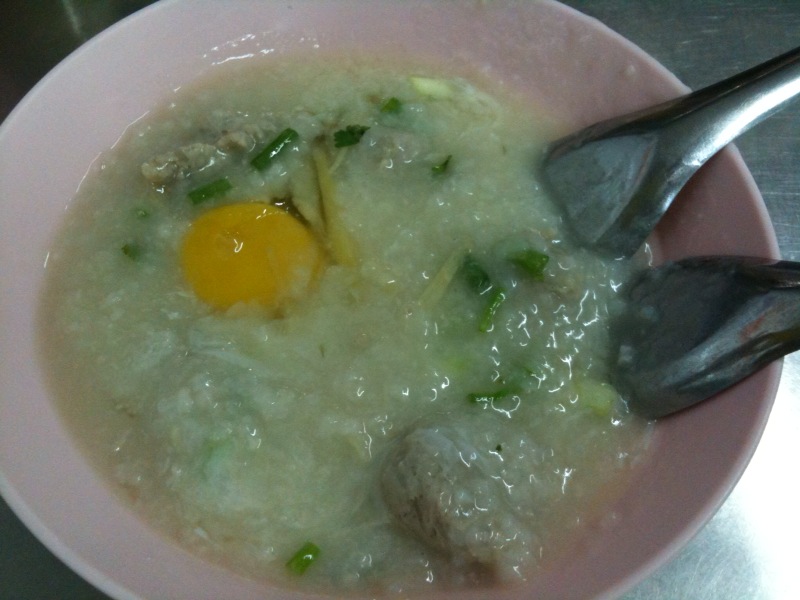
Chinese-style rice porridge with pork meatballs and egg

Also drawing kudos is their version with preserved, or “century” egg ( Thais refer to it as kai yiew maa, literally “horse pee egg”, an especially apt name).

Chinese-style rice porridge with preserved egg

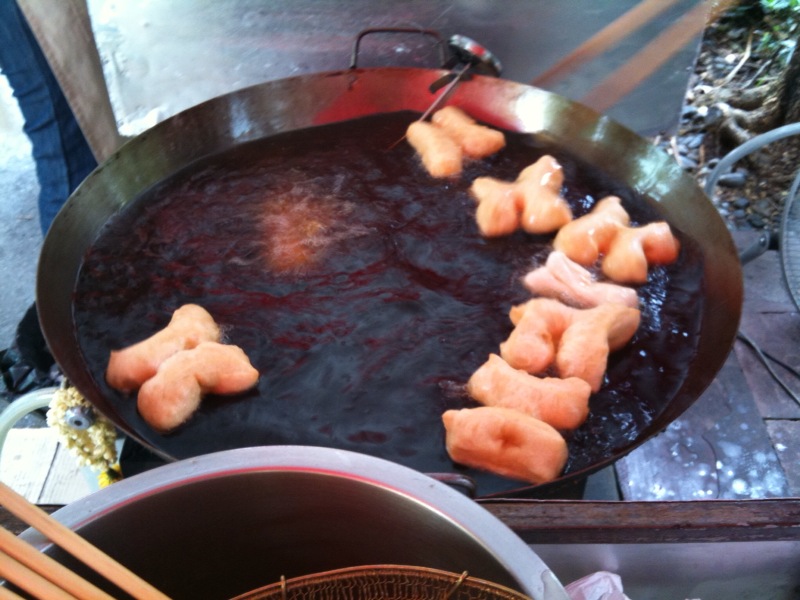
But don’t forget the best supporting actor: those lovely, pillowy cushions of deep-fried dough so soft, so comforting, that Thais often order them on their own, with a side of sweet custard, without the porridge. Among the best vendors is, inexplicably, Kanom, a poncey Thai cafe more known for its egg tarts. Their pathongo are rolled and cooked outside of their Sukhumvit 39 branch, and served hot and fresh from the wok with a choice of plain, green or pink custard dipping sauces. As you can see, they are hard to resist, especially by people with a penchant for deep-fried dough (and who doesn’t?).
Leave a comment

Filed under Asia, Bangkok, Chinese, food, food stalls, pork, rice porridge, Thailand

Not good for you, but so what?

A weekend in Pattaya was a welcome reprieve from the clamor in Bangkok (literally: workers are fixing a hole in my roof) and also turned up some truly tasty Thai seafood at Nong Ae in Banglamum, the best meal I’ve had in weeks. On offer: an aggressively spiced gaeng som with fish eggs, round and alarmingly transparent like mini-balloons; a lovely nam prik (pepper dip) of crab eggs; sator (a lima bean-like bitter vegetable) stir-fried Pattaya-style in fermented brown bean sauce; a surprisingly yummy fried head of cabbage slathered in black peppercorns (the original Thai spice, long before the Portuguese introduced Thais to chili peppers); and a whole pomfret, steamed with pickled plums, whole cloves of garlic and shiitake mushrooms.

The last was the best, but least Thai of the dishes — Thais traditionally deep-fry their fish because they usually pluck their dinner from the nearby rivers, and frying ensures that any worms are killed before consumption. Steaming is a Chinese innovation, which is why a lot of Thai seafood joints are Chinese-Thai in origin.

I would show you pictures, if I had any, but I was busy stuffing my face. Instead, I can show you this:

What I had for lunch

And this:

Disapproves of what I had for lunch

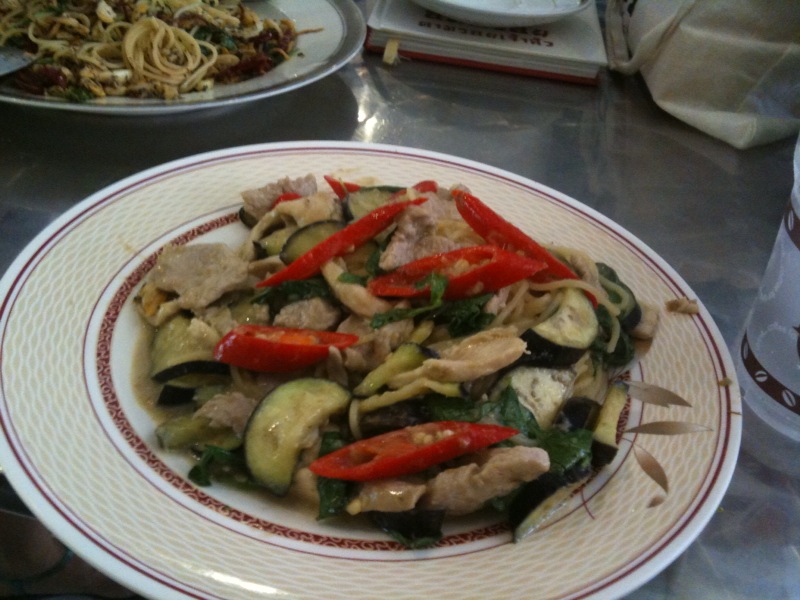
But this post is not about Pattaya, or even about Thai-Chinese seafood. It’s about things that are bad for you. We are all guilty of indulging once in a while — otherwise, we wouldn’t be human, or we would be Madonna. Things that are bad for you include: passing out after a hefty lunch of pasta (guilty); an all-day 30 Rock marathon when you are supposed to be working (yeah, that too); following Thai political developments (actually, not so much. I have a strong instinct for self-preservation).  Add to that list: kuay thiew kua gai, which is basically 3-4 different ways to a heart attack, stir-fried with a gallon of oil and served with a smidgen of lettuce in an effort to pretend it isn’t the coast of Louisiana on your plate. Believe it or not, it’s yummy. And among the best purveyors of this menace to your cholesterol levels is Nai Peng (20, Chula Soi 20, Suan Luang Market).

Flat fried noodles with chicken and egg

It looks like the murky remnants of a stir-fry chef’s pan, wrapped lovingly in egg, but it is so much more than that. Silky noodles, slightly charred at the edges, large chunks of chicken, or, if you are “watching your health”, seafood, and the most important part of all, the bits of lettuce that just manage to save this dish from falling over the edge into Greasy, Unappetizing Mess. If you are hell-bent on living high off the hog, Nai Peng offers these noodles with “Taro”, a salted fish product processed to look like squid. White vinegar studded with orange chili pepper slices and generous lashings of sweet chili sauce finish this picture.

It’s good, quick and tasty, the Thai equivalent of the KFC “Double Down” sandwich — best eaten late at night, after a few rounds of beer, when you are feeling young and invincible and not thinking about the encroaching specter that is middle age. Enjoy, while you can.

4 Comments

Filed under Asia, Bangkok, chicken, food, food stalls, noodles, Thailand

Gluttony in Hua Hin

When I was 12 (bear with me here, I think I’m going somewhere), we had a Secret Santa exchange at my dorm before the Christmas holiday. I combed the mall for something I could get for Leela, a sort of serious, studious older girl who was a prefect (I think she ended up going to Brown, so studying hard does get you somewhere, people). I ended up with caramel corn, which I thought was the perfectest gift ever: sweet and crunchy, with an underside of salt.

Unfortunately, Leela didn’t like caramel corn, although I made her eat at least three handfuls before I turned away and she could chuck her present somewhere else. Poor Leela. But I thought back to that caramel corn when I traveled to Hua Hin last week to sample some edifying sticky rice desserts that play with the sweet/salt balance that Thais are so fond of.

Long before Werther’s Originals, way before Guy Martin started making ice cream out of fennel and black olives at Le Grand des Vefours, eons before Gramercy Tavern was turning out caramel tarts sprinkled with sea salt, Thais were turning sugar and salt into dessert. And this salt does not come in the form of a hit of peanut butter, or a slip of fleur de sel: shrimp, dried fish, kaffir lime leaf, cumin — these are the ingredients of many a traditional Thai dessert, including  khao niew sarapat (sticky rice with toppings and steamed in banana leaves). It is hard to find in Bangkok but readily available in the beachy (and very crowded) resort town of Hua Hin.

These sticky rice offerings, bought at the central Chatchai Market opposite the Meechai Hotel on Petchkasem road (you cannot miss this main road, mainly because you will be stuck in traffic there next to the rest of Bangkok on the weekends), involved black rice, which is mixed with coconut juice to sweeten and soften it (white sticky rice is often mixed with cumin to turn it yellow and contrast it nicely against the red or brown toppings). The toppings themselves were myriad and intriguing: minced, sweetened shrimp; sweet, sticky dried fish; sankaya (coconut milk custard); gracheek (shredded, sweetened coconut) and shredded glauy, a type of root vegetable that is apparently a bitch to prepare — it is dug out of the jungle floor and alternately washed under running water and dried for 15-20 days. If not prepared correctly, it can make you drunk. 

Black sticky rice topped with dried fish and coconut cream

The effect of the seafood-topped desserts was strange and illuminating: the salt actually enhanced the sweetness of the rice, added sugar and coconut milk, while the fishiness added a titillating savory edge.  

Black sticky rice with minced shrimp

 There are other ways to play with seafood-y desserts. Meechai, a mango sticky rice stand next to the Meechai Hotel, sells a sweetened shrimp topping you can put on your own mango sticky rice, or to eat on its own if you like it that much. While many vendors bulk up their minced shrimp with shredded coconut due to the expensiveness of the shrimp, Meechai serves it full-on, with a bit of chiffonaded kaffir lime leaf for flavor. It adds that extra bit of danger to your mango or sankaya sticky rice — even if that danger comes in the form of lines that stretch down the block for a trifling bit of dessert.

Duo of coconut milk custard and sweet shrimp toppings

4 Comments

Filed under Asia, dessert, food, food stalls, Hua Hin, seafood, Thailand