Category Archives: noodles

Things to be Thankful For

Yes, I know. “You’re late, beeyotch”, you say. I am indeed a day late, but last night, sitting among friends and a table groaning under the weight of delicious food, I found myself, for once, momentarily forgetting to complain about my sad-Jen-Aniston-dust-bunny-in-a-girdle existence. Instead, I found myself feeling thankful. And I don’t want to let go of that feeling just yet.

So here, in no particular order, are Things to Be Thankful For:
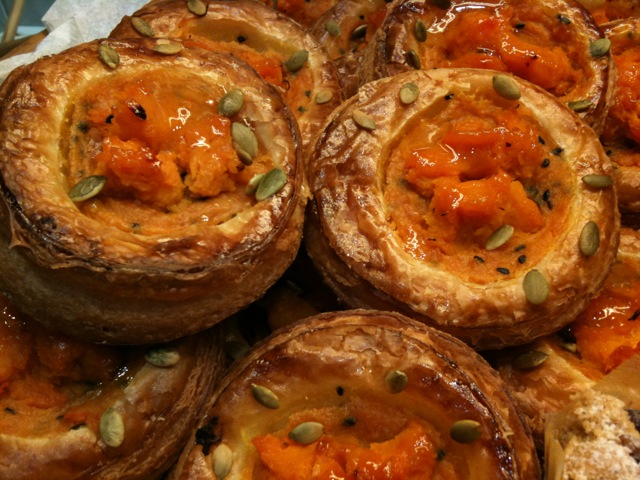
Pumpkin danish from La Creation de Gute in Hong Kong

Pastries. Need I say more? This is the entire reason people still get up for me on the Skytrain (cuz pregnant ladies be needin assistance!)
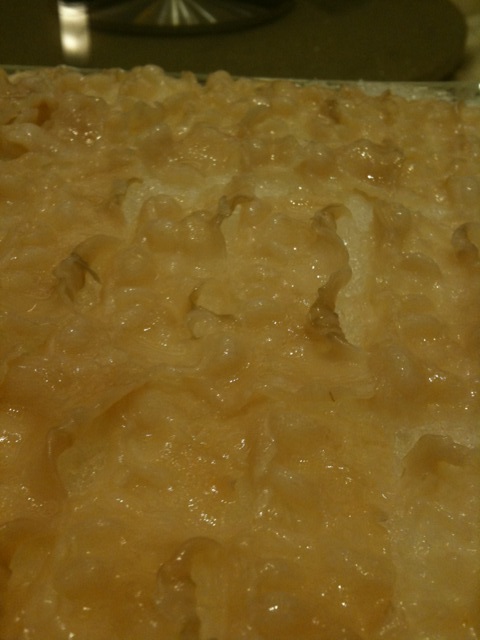
Geoduck sashimi in Shenzhen

Travels. Going anywhere new gives you (and by you I mean me) the golden opportunity to 1). meet great people, 2). try things you’ve never tried before, like this geoduck sashimi in China, and 3.) blather on about it endlessly in blog posts that make no point. How lucky is that?
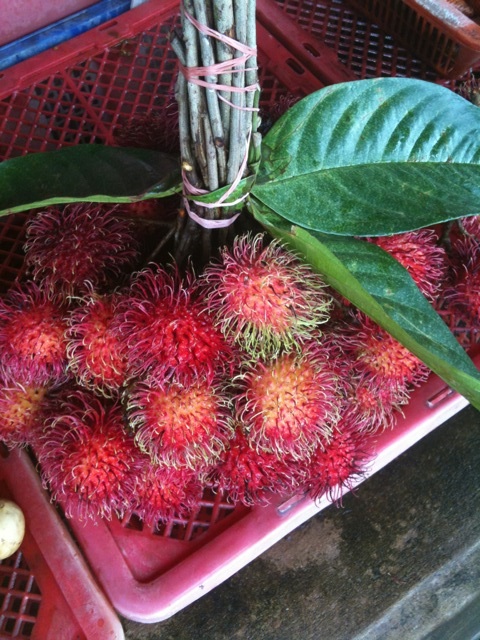
Rambutan in Chantaburi

Thai fruit. It’s the best in the world. Really! The range and variety of fruits in this country are dazzling. And they are all delicious, in their own different ways and in their own various seasons.

Thalad Gow in Chinatown

Outdoor markets. Is there a more fascinating place to explore? From France and Hungary to Vietnam and Japan, outdoor markets are my favorite place to go to find out about a place. Someday, I may even work up enough courage to try out this pickled crab stand in front of the Old Market in Chinatown.
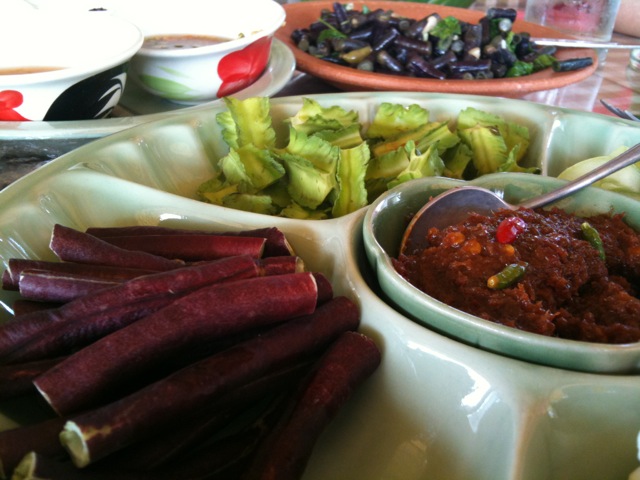
Tamarind chili dip with purple long beans in Sukhothai

Chili dips. They are my favorite part of a Thai meal. And they are so criminally underused, especially in Thai restaurants abroad! Tamarind, shrimp paste, crab eggs, lohn (coconut milk-based dips) — krueang jim are the dish that packs in a significant amount of protein and a wide variety of veggies, making it (and a bowl of rice) a complete, nutritionally balanced meal for millions of Thais, every day.
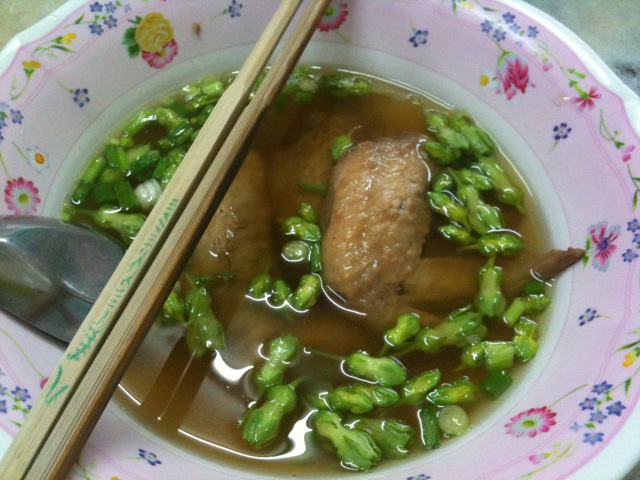
Chicken wings in kajorn blossom broth at Guaythiew Pik Gai Sainampung

How could I go this long without mentioning street food? Thailand, obviously, has some of the best in the world. People may be up in arms about farangs taking to their own mortars and pestles in restaurant kitchens, but Thai food’s real heart comes from the street.

Family. In a fit of earnestness (which will die at the end of this sentence), I am actually posting a real family picture and not a shot of the Kardashians. Of course, I am not in it.

Other things for which to be thankful: great wines (I would include a picture, but let’s face it, when I start being thankful for wine is the exact moment when I start being incapable of taking a picture); good friends; air-conditioning; the Steelers (haterz gonna hate!); people who are bored enough to occasionally read this blog (thanks, really); and the fact that my infant son is so readily diverted by a tissue.

Oh, and this:

Nam ngiew

I’m off to Chiang Rai next week for even more. Enjoy the start of your holiday season!

6 Comments

Filed under Asia, Bangkok, Chantaburi, chicken, Chinatown, dessert, food, food stalls, Hong Kong, markets, noodles, Northern Thailand, restaurant, Thailand

What nam ngiew means to me

Proper pork nam ngiew at Pa Suk in Chiang Rai

(Photo by @SpecialKRB)

Everyone has a dish that reminds them of their childhoods. This — and the “last meal” that a person would select were he or she able to choose — are two of the most illuminating things you can know about a person, telling you how they see themselves, and how they grew up. I’m not the only person to think this (although there is no “childhood meal” book — I mean, we have the TGI Friday’s menu for that); in 2007, photographer Melanie Dunea asked some of the most famous chefs in the world what meal would be their preferred parting shot, and the result was “My Last Supper”.

It turns out chefs are as varied as regular people when it comes to what they want, and the setting: Daniel Boulud likes Versailles, Gordon Ramsay likes home. Jacques Pepin, characteristically elegant, wants a hot dog; BLT chef Laurent Tourondel, a Krispy Kreme doughnut. Some even chose soundtracks, with U2 making an appearance (why? If it’s post-“Unforgettable Fire”, I shake my head and judge).

I really don’t know what my last meal would be. I used to say a cold lobster with mayonnaise; sometimes I think I prefer meatloaf with a side of mac and cheese. But neither of these dishes says anything about me. The dish that figures most prominently in my childhood, and the one I keep coming back to again and again in Bangkok (like a culinary Don Quixote, or an idiot) is kanom jeen nam ngiew, a Northern Thai dish of minced pork and/or beef and dried ngiew blossoms.

Nam ngiew at Yui Lee on Sukhumvit Soi 31

It is a widely accepted fact that good Northern Thai food is hard to find in Bangkok. This is not just a bunch of Northerners pissing and moaning about Central people mucking around with beloved old favorites (although there is some of that). For some reason, something is lost in translation that isn’t when it comes to any other region in Thailand, be it Isaan or Southern Thai. It’s not heat: actually, Northerners cannot compare to Southern Thais when it comes to spicy food. I think it’s the shortcuts that people are tempted to take with northern food, which features a lot of cut or shredded herbs and painstakingly put-together pastes (plus a lot of fatty cuts of pork to combat the “cold” weather). I cannot tell you how many nam ngiew noodles I have had missing the dried dok ngiew, or ngiew flowers, which resemble sawed-off broomsticks. The fact they still serve it without essential ingredients suggests laziness, and disrespect to the customer.

Yet I haunt every food stand serving nam ngiew, and order it at restaurants when I know I shouldn’t; against all logic, I want to find The One that will bring me back home. Home to New Castle, Pennsylvania, where I wanted to dine on cavatelli (“cavads”) like everyone else in my predominantly Italian-American town, and look forward to wedding soup or pasta fagioli (pronounced “fazool”) on holidays. Home, where I would see my dad in his pajamas stuffing his own sai oua on the floor of our kitchen and feel unaccountably embarrassed. Home, where my dad would have to refer to nam ngiew as “Thai spaghetti” to get us to eat what he cooked after a 14-hour work day. And it does resemble bolognese, after a fashion (possibly a reason why I LURVE spaghetti bolognese). But it’s much, much better — meaty and rich and a little bit macho, and, if you’re from Chiang Rai, skimpy on the girly tomatoes that effete Chiang Mai-ers use to balance out all that heft (Chiang Mai people, I jest. My mom’s family is from Chiang Mai).

So where is the best place to get this very special dish? My house, where I keep two bags of sauce at all times. Also, Chiang Rai’s Pa Suk, which probably has the best nam ngiew on earth (sorry, Chiang Mai). The sauce comes in pork or beef versions (beef is VERY beefy), with fermented rice noodles (kanom jeen) or regular guay thiew (rice noodles). Also, they offer a wide variety of pork rinds (kaab moo) because no bowl is complete without them.

Beef nam ngiew at Pa Suk

(Photo by @SpecialKRB)

But where in Bangkok? Ah, well, other people are probably better guides. (This one is good.) But I urge you to do something really crazy. You can do it yourself. Alas, the Duangnet family recipe is out of bounds. But if you don’t mind the tomatoey Chiang Mai style, here is the recipe from my great-aunt, Jiao Sri na Chiangmai.

Nam Ngiew (for 10)

Preparations:

1. Nam Prik: Grind the following together well

Dried pepper,     30 pieces

Dried Bird Chillis,   30 pieces

Shallots,    0.2 Kilo

Garlic,     0.1 Kilo

Shrimp paste (Kapi),   0.1 Kilo

Lemon Grass,    3 pieces (stems)

Salt,     1 tablespoonful

Grilled dried pickled bean paste, 0.2 Kilo

2. Next, boil until slightly soft:

Pork spare ribs, cartilage parts, 1 Kilo, cut into 1 inch pieces. Save cooking liquid.

To cook:

  1. Fry “Nam Prik” in hot vegetable oil in a big pot until it “smells good” (the inside of your nose tickles). Add 1 Kilo of ground pork and the cooked spare ribs. Stir until cooked. Add the soup from the cooked spare ribs. Then add 1 Kilo of cherry tomatoes, add cooked pork blood in pieces and 0.1 Kilo of dried “Ngiew Flowers”. Add 0.2 Kilo of Black Tao Jeao.

Boil in medium temperature until well blended. Before serving on kanom jeen, add fish sauce and lime juice to your taste.

  1. Serve with:
    1. Deep fried chopped garlic
    2. Chopped shallots
    3. Cut shallots
    4. Cut limes
    5. Cut pickled greens
    6. Ground deep-fried dried chillis

Bon appetit!

9 Comments

Filed under Asia, Bangkok, beef, Chiang Rai, food, food stalls, noodles, Northern Thailand, pork, Thailand

Caught in the culture wars


Thai food: a focal point of the culture wars


I vowed never to talk about this again, but Sunday’s “Bangkok Post” opinion piece about the state of Thai cuisine drove me, once again, to the keyboard (I don’t have many interests, and nothing else to talk about). Like a Katherine Heigl movie, it starts out reasonably enough, and then somehow turns crazypants somewhere in the middle.

The basic premise is, modern Thai food has atrophied as a result of the culinary shortcuts commercial cooks take today, resulting in processed dreck that bears little resemblance to the dishes they are supposed to be (while this is very true, it sounds a little to me like running into a McDonald’s and complaining, “Why do they only use cheap ingredients? Why is everything so poorly made? Where is the care and thought put into my hamburger?”)

The media also deserve blame for the commodification of Thai food, concerning themselves only with “tasting this or that dish” and on “atmosphere and decor rather than offering any real knowledge concerning the food” (Because NO ONE cares about that stuff! Silly journos. Tell me once again about how the Indians and/or Portuguese inspired coconut milk-based curries).

Because of these shortcuts, Thais DESERVE to lose their mastery of their own cuisine. Because we’re so stupid! Now David Thompson has blown into town and his place is packed and that sucks, because our lives suck and so his should too! But we’ve done this to ourselves, because we bear witness to culinary crimes like this:

“…pizza with a dry version of gaeng kiew waan luk chin pla or with dry tom yum goong. These combinations are a slap in the face to both the Thai and Italian cooking traditions.”

First of all, what’s with all the slaps in the face? Is there no other way for writers here to convey getting insulted? No tug on the ear, perhaps, or maybe a kick in the pants? Get a new rhetorical device!

Secondly, well, I am no fan of crap-topped pizza either. That said, I’m sure someone probably thought tossing spaghetti with pla kem (salted fish) and dried chilies was once a daft idea, too. Now you wouldn’t bat an eye seeing this dish on a menu. And how did Thais take to the first bowl of khao soy, a “fusion” creation of egg noodles and coconut milk said to be invented by cooks in Chiang Mai from a dish originated by the Chin Haw Chinese-Muslim minority group?


Khao soy at Khao Soy Islam


(photo by @SpecialKRB)

I was lucky enough to get the chance to help work on the first English-language cookbook by Thai TV chef McDang (“The Principles of Thai Cookery”, in case you’re interested — it’s very good! Not that I’m biased or anything …) In it, Chef McDang discusses quite clearly how all the different parts of a Thai meal fit together (a minimum of five elements: a clear soup, a curry, a fried dish, a stir-fried dish, and a kreuang jim, or chili dip with vegetables), why Thais use forks and spoons (in order to kluk, or mix the different elements of the meal together to your liking), and how all the ingredients in a Thai dish are supposed to interact. That’s why traditional Thais get all crazy about substitutions like onions for shallots, or adding spring onions instead of coriander leaves.

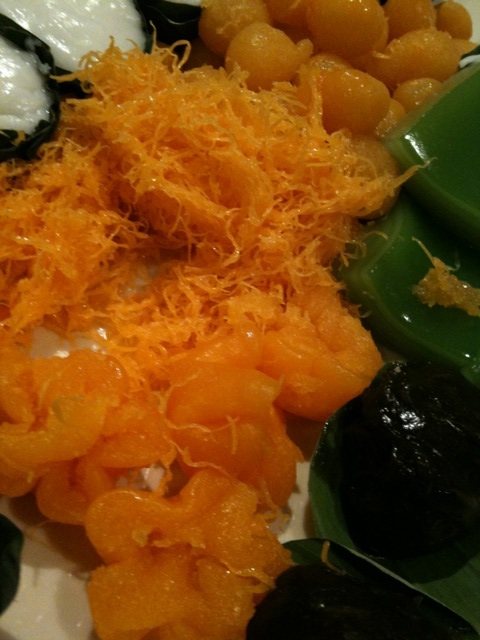
That said, Thai cuisine is also the beneficiary of a number of foreign influences that have seeped in from interaction with the rest of the world over the course of Thailand’s history. In the Sukhothai period (1238-1438), we were scarfing down fish, fruit and wild boar on rice flavored with peppercorns, cilantro roots and palm sugar. And then, in the Ayutthaya period (1351-1767) the Portuguese came along, and gave us this:


"Golden threads" and "golden drops": traditional Thai sweets that are also Portuguese


They also introduced us to eggs, tomatoes, potatoes, eggplants and sugarcane; co-introduced us to savory uses for coconut milk; and showed us a crazy new way to flavor our food with these things called “chilies”. They also found a way to form a curry custard by mixing fish and egg and steaming it; the result was called hor mok:


Steamed seafood curry at Aor Thor Kor


(Photo by @SpecialKRB)

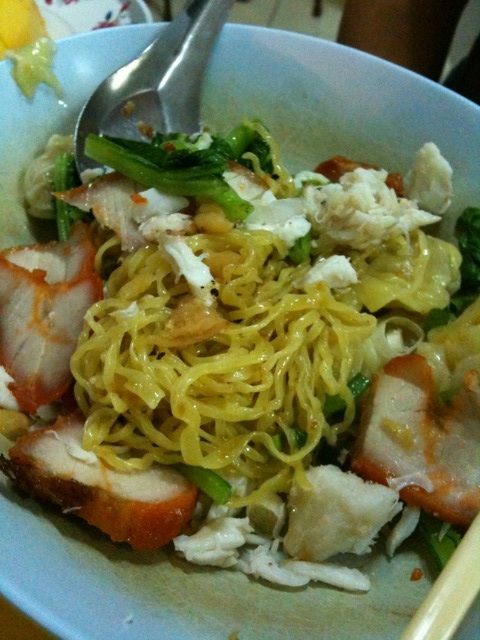
And then there were the Chinese. What to say about the Chinese? Without them, Thai food would not be “Thai food”. From them we got: shrimp paste, fish sauce, the use of duck meat in cooking, pans, stir-frying, and frying. Another innovation: an interesting alternative to rice in the form of long, thin strands of rice flour (and sometimes egg-based flour), which can be served in soup, blanched, fried, or even in desserts. They are popular in Thai street food, so keep your eyes peeled for this rare, strange delicacy:


Bamee at Sukhumvit Soi 38


So sometimes fusion isn’t so bad after…..zzzzzzzzzzzzzzzzzzzzzzzzzzOh, sorry, you’re still here?

Thailand is at a point in its history where its future — like that of the rest of the world — is uncertain. Maybe people are unsure of where they stand and so long to return to a time when things seemed more secure. Food serves as a convenient stage on which to act out this current identity crisis. But that doesn’t mean we should shut out foreign influences, or, for that matter, a foreigner who is doing the exactly same thing as us.


27 Comments

Filed under Asia, bamee, Bangkok, celebrity chefs, Chinese, curries, food, food stalls, Japanese, noodles, Portuguese, restaurant, rice, Thai-Chinese, Thailand, TV chefs