Category Archives: noodles

A very Phuket breakfast

Dim sum in Phuket

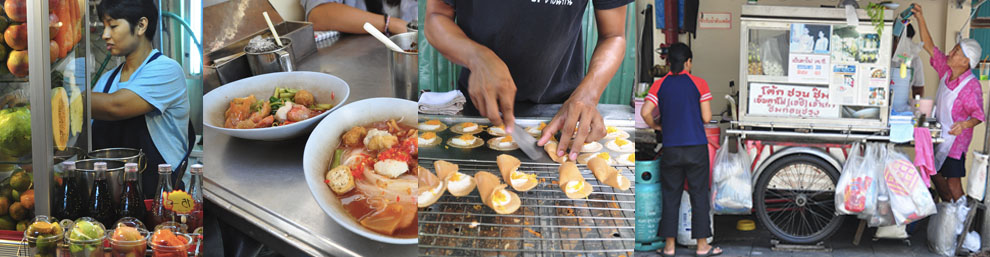
There are times when “research” means stuffing yourself with lots and lots and lots of food in a very short period of time. God help me, it was the kind of research I was doing today — namely, three promising stalls, all for breakfast.

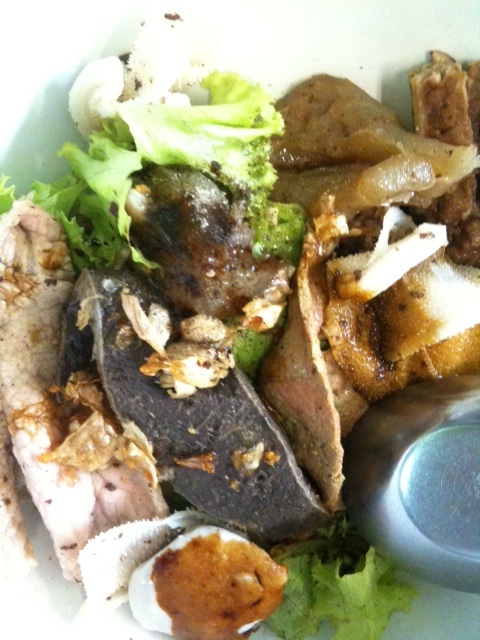
Lured by the promise of “beef bamee”, I was excited by the prospect of Guaythiew Rab Arun, a small noodlery in the shadow of Bangkok Phuket Hospital. Alas, they were not as excited by our appearance, and, double-damn, a beefy variation of the popular egg noodles with barbecued pork was also not on the cards. No, this was your run-of-the-mill beef noodle shop: choice of rice vermicelli (sen mee), thin noodles (sen lek) and thick ones (sen yai), with broth that did or did not include cow blood (nam tok). The broth was as good beef broths are, cinnamon-y and sweet; the bowl an unashamed showcase for all sorts of innards — lungs, liver and tripe.
Beef noodles without broth

All very nice — except for the bizarre delay in letting us settle the bill — but nothing I wouldn’t find in Bangkok. On the other hand, I haven’t seen anything quite like the dim sum shop we visited next. When asked the name of the place, a two-room shophouse on Sam Gong Road serving kanom jeeb (Chinese-style steamed dumplings) and a wide variety of little bits, our waitress acts like I have just asked her ATM pin code. “Just ask, everyone knows the Dim Sum Place Down The Road From The Hospital,” she said (TDSPDTRFTH for short). A trayful of plates is deposited onto your table as you sit; you pick what you want, and you are charged, conveyor belt sushi-style, for whatever you choose. Small plates are 10 baht, “big” plates (which are almost the exact same size as the small plates) cost 15.

The tray of goodies at TDSPDTRFTH

Is it the best dim sum ever? Of course not. Is it crazy cheap? Well, that depends on you, but for the most part, why, yes it is. It is indeed cheap. And that is sometimes what I am looking for.

So, a question mark on the first stall, a possible “yes” on the second. The third? A resounding I WILL BE BACK. Pa Mai (at three-way intersection of Sagul and Dibuk roads near Wittaya School, 076-258-037) specializes in curry — curry, and the Mon fermented rice noodles known as kanom jeen, what some people mistakenly translate into “Chinese candy”. A plate of the stuff is handed to you at the front by this nice lady:

Dispenser of kanom jeen

Once you receive your blank canvas, an array of curries awaits your artistry: a trio of nam ya, crab, fish and “jungle” (without coconut milk); chicken green curry, made the old-fashioned way with globs of congealed pork blood; nam prik, a speckled chili-coconut milk concoction that, unlike its terrifying name, is actually quite sweet; gaeng tri pla, or the famous — and fierce — southern fish entrail curry; and because this is the south, nam prik kapi, or shrimp paste chili dip, made to go with the innumerable garnishes that greet you at every table:

A table at Pa Mai

Is there any sight more gladdening than this one? A platter bristling with greenery: tart mango leaves, chewy cashew ones, boiled jackfruit, cubed pineapple, bitter, spice-defying baby eggplants. Soft-boiled eggs for 7 baht. Dried fish. An ajad of thinly-sliced cucumber in a tart-sweet syrup. And a happy variety of pickles (I just love pickles): cabbage, bean sprouts, lotus stems, baby garlic.

My choice (at first): crab nam ya

Best of all, you are only charged 30 baht for the kanom jeen, meaning those curries can be added, mixed, or replenished as you see fit. Really. So I first took some fish nam ya, then some crab. Some green curry. Some nam prik. And then a little left for the fiery tri pla. Don’t judge me.

We have found kanom jeen nirvana, and it is open from 7 to noon.

5 Comments

Filed under Asia, beef, Chinese, curries, food, food stalls, noodles, Southern Thailand, Thailand

Working for it: Sapporo

Smart people avoid generalizations, but I’ll just go ahead and wade on in there. Japan is a country of serious foodies. And it’s not just about the massive clusters of fine restaurants — Japanese, French, Czech, what have you — that lurk, barnacle-like, in every other basement or third floor in every big city in the country. It’s the Japanese commitment to all levels of food: the telltale chairs that stand outside popular eateries that don’t take reservations; the astronomically priced produce, swaddled like newborn babies in the supermarket; the long queues snaking through the department store basement, stacked with gourmets awaiting the next great fresh cream cake.

Sure, there is the strange-smelling beef bowl at Yoshinoya, cheap conveyor belt sushi and the bizarre affection for KFC for the holidays — but for every one of those things, there is the dazzling aging-beef display at the Tokyo Mitsukoshi, four different kinds of obscure Kentucky bourbons on sale, and mammoth albino strawberries the size of a child’s fist. Food in Japan is like Manolo Blahniks to a Carrie Bradshaw: aspirational. As with all aspirations, you have to work for it. This stuff doesn’t come cheap. And if it does, it doesn’t come easy.

Hokkaido in February for me is a whole different brand of Working For It. I don’t take to chilly temperatures; here, it’s -12 degrees Celsius in the daytime. The sky periodically drizzles snow — so much snow, in fact, that the sides of the roads loom skyscraper-like above the pedestrians, threatening avalanche at any moment.  Food, any kind of food, requires trekking out in that weather in your most unattractive snow boots, a balaclava shoved over your head to keep your nose from falling off your face.

But in Sapporo, there is plenty to make up for it. Big vats of nabe — DIY stews bristling with the freshest seafood or gently cooked slices of meat, studded with cubes of tofu and enoki mushrooms and crackly greens that somehow end up soft and sweet. One of the easiest kinds of nabe to obtain here is one featuring kani — snow, hairy or king crab, which hails from the region and is a genuine treat.

Crab and co., ready for the nabe pot

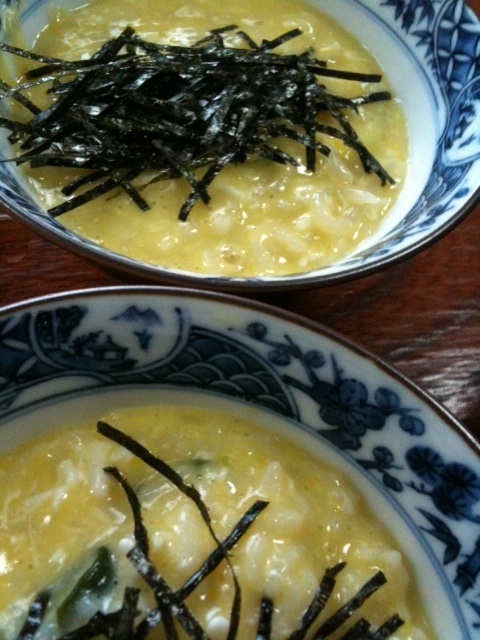
Restaurants specializing in crab — marked by a giant crab above the entrance — are scattered all over Japan, but the one we found in Sapporo, chosen solely on its proximity to the train station, was luckily also delicious: Kani Honke, which claims to be the first in Japan to focus solely on the mightily yummy crustacean. The many course menus are pretty epic: crab served as sashimi, in sushi, atop grated mountain yam, in stew, simply steamed, and finally, butter-roasted and grilled atop a hot stone. Best of all, the leftover broth from the nabe is eventually added to rice and reduced until a thick, sweet congee is formed — the best possible way to end a delicious crab menu.

Kani Honke's crab congee

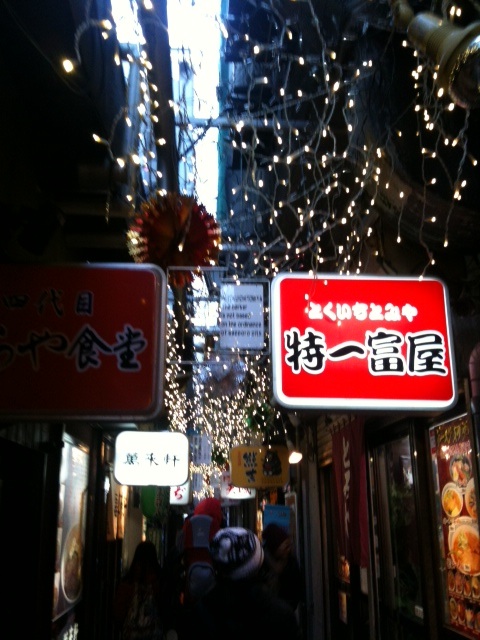
Crab is not the only thing Hokkaido is famous for. Sapporo is also the lucky, lucky home to not one, not two, but THREE “ramen alleys” — small walking streets lined by all manner of ramen shops, which offer, in Sapporo at least, the ultimate street (or alley-side) food: quick, warming, filling and relatively cheap. You can get your very interesting ramen history here, but if you are like me and think clicking is far too onerous a task, I will attempt to summarize: ramen is delicious. Just kidding. Adapted from a Chinese noodle dish in the early 20th century, Japanese ramen has since branched out into basically three main types — the tonkotsu, or pork bone-based cloudy broth of Kyushu, the clear soy sauce-based broth populated with thick noodles, and the miso-based broth of Sapporo. We visited the original “Ramen Yokocho” (Ramen Alley) and found it charming, with just about any type of ramen on offer.

Inside Ramen Alley

Of course, we were there for the miso ramen, and so opted for a shop featuring a relatively basic menu of miso, soy sauce, salt, tonkotsu, spicy, extra pork or butter (with a miso base) ramen. You can probably guess which one I went for:

A bowl of butter ramen

It turns out I’ve found a new love. Few things are better than that extra-creamy Hokkaido butter. I will be searching for it in all the Japanese supermarkets I can think of in Bangkok.


12 Comments

Filed under Asia, fish, food, food stalls, Japan, Japanese, noodles, restaurant, rice porridge

What it means to be underrated

This is the last post of 2011 for me, and because of that, I want it to be special. Many people are predictably rolling out the “Best of…Worst of…” lists to punctuate the end of this strange, strange year, but I want to devote my last post to something more special, more near and dear to my food-loving heart. And that is Jet Li.

I love Jet Li. I love him even though other people gawk and aah and ooh over the usuals, all somehow resembling that boy in high school who was so so useless but still managed to breeze through life intact and popular — you know these boys, they are infuriating. Empty vessel of man-meat Brad Pitt, or repository of broken dreams George Clooney, or — snore — Ryan Gosling — how did he happen again? — you get the picture. They are basically iterations on the same boy. They will always have a “Hi, how are you?” as they whiz past you in the hall, not bothering to listen to your reply. That guy. That one.

Jet Li is not that guy. He is little and quick and quiet. He does silly martial arts movies with strange co-stars, a la Jackie Chan, but he has the acting chops to do serious stuff, too. He is not what anyone would call “conventionally handsome”, or “handsome”, or even “quite good-looking”. He doesn’t care. He doesn’t even care if he is the bad guy. Unlike, again, Jackie Chan, he isn’t that desperate to be liked. This is what separates him from the other actors of his genre, like, uh, Jackie Chan … and, er … … … … … … ……………………………………………………………………………………………………………………………………………………………………

Jet Li is underrated. Like hua pla restaurants (see what I did there? What a seamless transition!), which are grungy and dingy and not “charming”, “glitzy” or “stylish” in the least. They have the ambiance of an underground storage space, and clientele who are well past retirement age. And the dishes they offer — well, what do you expect from a genre of restaurant named for a “fish head”?

The namesake dish, bubbling in a "maw fai" (fire pot)

Yet these hua pla restaurants resolutely cling to life on the Bangkok dining scene, scattered here and there in the unfashionable sections of town. A subset of the Chinese-Thai restaurant, hua pla places also feature stir-fried seafood dishes, fried rice and noodles besides the namesake dish, a fresh fish (usually giant pomfret, or thao theuy) in either pickled plum or taro broth (pickled plum is better), bubbling contentedly in a metal pot set over a small flame.

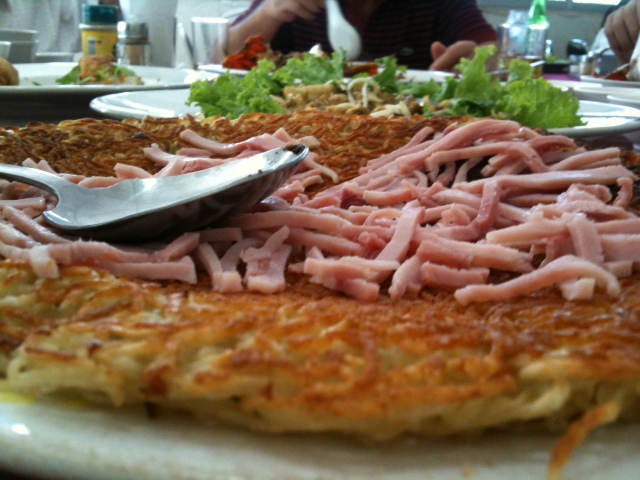
Fried e-mee noodles at Hua Pla Maw Fai Nai Kwan

Of all the hua pla restaurants in town, the one I find most accessible is just beyond the Sam Yan subway stop, across the street from Chamchuri Square. Called “Hua Pla Maw Fai Nai Kwan”, this unassuming eatery is hidden in a soi behind the parking lot to the left of Wat Hualumpong on Rama IV Road. It boasts maybe six tables, creaky old Lazy Susans, and a kitchen in back that may have seen  World War II. It is also the perfect place for a quiet, no-fuss lunch on a relaxing Sunday with the day stretching ahead of you like an empty highway. And what could be better than that?

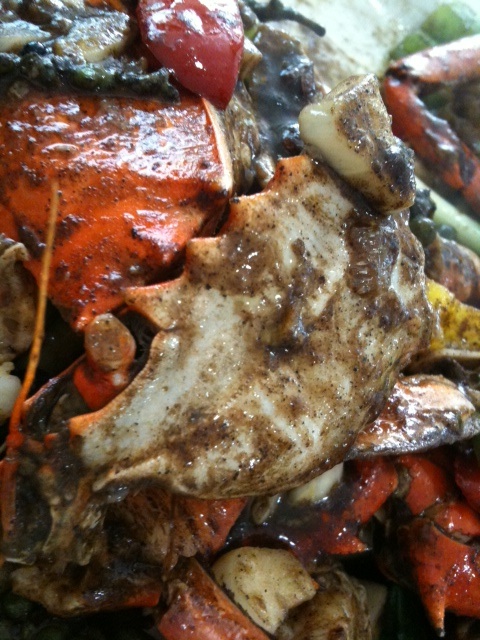
Stir-fried crab with peppers at Nai Kwan


12 Comments

Filed under Asia, Bangkok, fish, food, noodles, restaurant, seafood, Thai-Chinese, Thailand