Category Archives: Northern Thailand

The other Chiang Mai

Rot duan at Suthep Market

Sometimes you don’t feel like treating Chiang Mai like a non-stop food safari. Sometimes, the usual parade of big names — Huen Phen, Lamduan Faham, Samerjai, OMG! — makes you feel all weary inside after thinking of the inevitable throng of people in line for a bowl of khao soy. And sometimes, you just want to eat where all the other jaded Chiang Mai-ers eat.

Because sometimes, Chiang Mai people are sick to death of aharn nuea (Northern Thai food), just like how Hua Hin people get sick of crab (unbelievable, I know, but it happens). And when that happens, they go to places like Yen Ta Fo Sri Ping on Suthep Road, where the chipped plastic bowls feature al dente thick, thin or glass vermicelli noodles liberally swimming with a garishly pink, chili-flecked seafood sauce crowned with a single, perfect fried wonton (35-40 baht).

Sri Ping's yen ta fo

There is also the requisite tom yum noodle (30-40 baht) and egg noodles with red pork and dumplings (40-50 baht), but nothing is as deliciously saucy as the namesake yen ta fo, a dish sure to get on your shirt and all over your face. And yes, I did rub my eyes after eating, and yes, severely regretted it for hours afterward.

I would argue that the namesake dish at Guay Jab Nam Khon Sam Kaset, right by the city’s monument to the three kings, is not the best dish here, although it is light and peppery and includes plenty of luk lok, a sort of soft porky sausage (50 baht). The gow low (broth without noodles) centers on a richer broth that tastes of beef and plenty of coriander (50 baht), and the khao moo krob is as good as anything you would find in Yaowaraj: a mix of crackle and fat, a thick sweet sauce enveloping the rice grains (50 baht). What can I say? I really like sauce.

Crispy pork rice at Guay Jab Sam Kaset

But if it’s something light and fresh you desire — Thailand via Hanoi rather than Hong Kong — there is always Raan Fer Wiengjan on Rachadamnoen Road. You have your choice of chicken (30-40 baht), fish (40-50 baht), tofu (30 baht), and the Northern delicacy moo yaw (30-40 baht), a pork “pate” originally created by Chinese-Thai chefs seeking to replicate French meat terrines.

Pho moo yaw

Vegetarians, don’t despair: Chiang Mai is thinking of you too. Or, specifically, Raan Jay Yai on Nimmanhaemin Road is. Anything on the regular menu can be made “jay” (a stricter Thai form of vegetarianism), including great versions of khao kluk kapi (rice fried with “shrimp paste”, 35 baht), guaythiew kua “gai” (noodles fried with a chicken substitute, 30 baht) and pad see ew (stir-fried noodles in soy sauce, 30 baht).
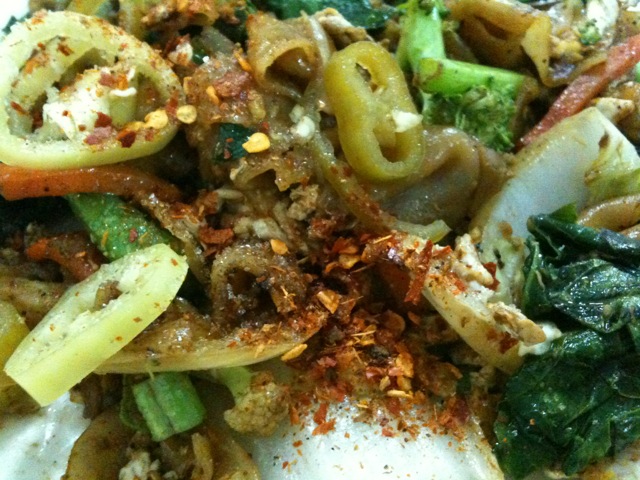
Jay Yai's pad see ew

This is all well and good, but did you really think I went to Chiang Mai without having ANY Northern food at all? What am I, an idiot? (Don’t answer that). Of course I went, and filled my face with nam prik ong and thum kanoon and sai oua and shrieked and gurgled as every Northern dish passed me by on the way to someone else, and wished myself stuffed full of everything that was good in the world. So that is how I found Haan Tung Jieng Mai (Northern dialect for Raan Tung Chiang Mai) on Suthep Road by the Chiang Mai University campus.

Khao pad nam prik num at Haan Tung Jiangmai

It’s a typical aharn tham sung (made-to-order) stall, but made achingly cool by the scraps of paper doodled by bored university students coating the tables and the kitsch-retro furnishings. That said, the food is solid, if slow, including rice fried with young green chili dip, pounded young jackfruit, and a nam prik ong that tasted suspiciously like shrimp paste (in the landlocked North, most recipes call for tua now — fermented beans, or nam pu — the juice of pulverized rice paddy crabs, instead of kapi).  Plus, there was a perfectly cooked kai ped yang matoom, a duck egg boiled just enough so that the yolk is “sticky”, like rubber sap.

No, our trip wasn’t all about food. I DO have other interests, you know. For instance, the PURCHASING of food. That is where the Saturday morning organic market off of Nimmanhaemin Road comes in. Organic producers of vegetables, fruit, rice and ready-made foods meet once a week to sell their bounty to the general public, and it’s a shame something comparable isn’t happening in much-bigger Bangkok.

Whole-wheat salapao at the organic market

Food for thought, maybe, for an organized and responsible food lover? (Not me). Maybe, just maybe, we can bring in something from Chiang Mai that doesn’t involve hastily-taped cardboard boxes and a few anxious moments by the baggage claim carousel.

Or maybe not.
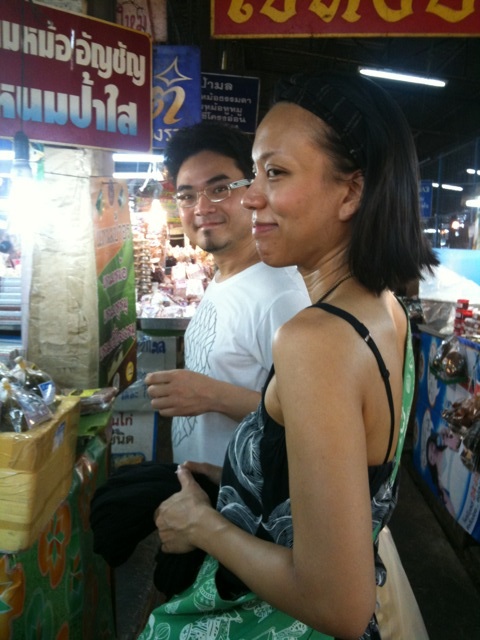
@anuntakob and @aceimage caught haggling at Suthep Market
10 Comments

Filed under Asia, food, food stalls, markets, noodles, Northern Thailand, pork, rice, shopping, Thai-Chinese, Thailand

Dishes to Try Up North

Pak ki hood, blanched and served alongside nam prik

Believe it or not, I am not going to write about kanom jeen nam ngiew or the Steelers today. I know, I know. I know this makes you sad. But I must branch out. Show all my brilliant colors. Spread my wings.

So instead, I will ramble on semi-incoherently about my childhood in the era of Rama VI, back when rickshaws ruled the North and people foraged in the jungle for food. My fascinating reminiscences include memories of being abandoned at the post office as my nanny chatted up her then-boyfriend, and being menaced by a homicidal goose tethered to a pole in the middle of her front yard. Did you know geese are thoroughly unpleasant creatures? Now you do.

I also remember my Aunt Priew, who lived right next door to my grandmother’s house — easily accessible from our yard once you managed to jump over a tiny hill of ferocious red ants. Somehow, I never really made the jump and was bitten every time I tried. Yet day after day would find me once again testing the anthill because my Aunt Priew is a tremendous cook, possibly the best cook of Northern Thai food in the kingdom.  Roasted lin fa (sky tongue) beans, julienned and stir-fried with glass noodles or paired with a fatty raw larb; a touch of magorg, or water olive, added to a fiery nam prik num (roasted green chili dip) — my aunt is full of these little touches with the local produce that set her dishes apart from the rest. Now if I could just convince her to open a restaurant …

These are some of the Northern Thai dishes that are worth the long trek up to the tip of the country. They go just as well with khao suay (jasmine rice) as they do with khao niew (sticky rice). Try them for a real taste of Northern Thai food:

(Note: Please forgive the photos. They are a little … blurry. No, it wasn’t the wine.)

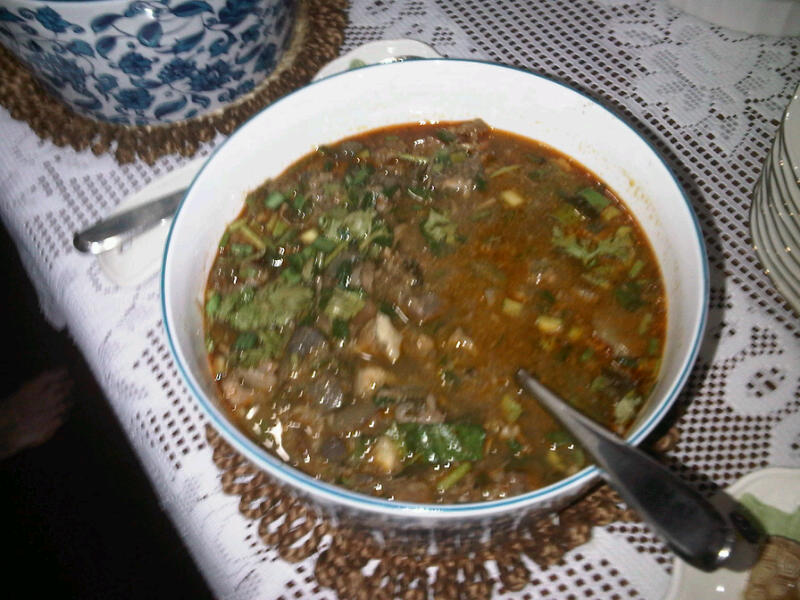
Gaeng om, Northern-style

Gaeng om, sort of


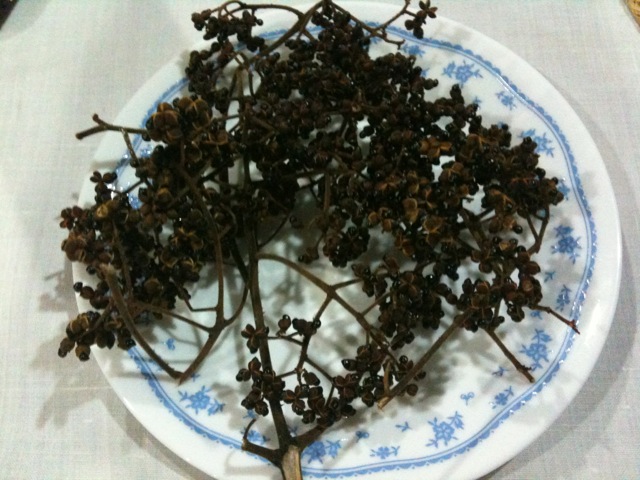
Unlike the light, prickly Isaan gaeng om, the Northern Thai version is — like much of the rest of Northern food — richer, meatier and fattier. The curry paste is that for a typical gaeng muang (Northern curry), with a couple of additions. There is lemongrass, galangal, dry chili, shrimp paste and garlic, plus pla sarak (kind of like pla salid, but bigger) and bakwan, which, if not Sichuan peppercorn, is something very similar, with the same tongue-numbing effects.

The tongue-numbing peppercorn bakwan

This paste is then fried in oil and augmented by fresh chilies, pork innards, bruised lemongrass and red shallot bulbs, and kaffir lime leaves and stewed, and then garnished with dill and coriander. It has a lingering meat taste that is very Northern.

Gaeng gadang

Pork “jelly” with pork rinds


Some dishes seem like they were engineered by mistake. Puff pastry is one; this is another. It’s basically a gaeng muang focused on kaki (fatty pork leg) and/or moo sam chan (three-layer pork), left out in the cold. It’s a distinctly “cold season” dish because traditionally it was left out overnight to congeal; today, it is chilled in the refrigerator and served in slices like a terrine. Very unusual and very porky.

Saa pak

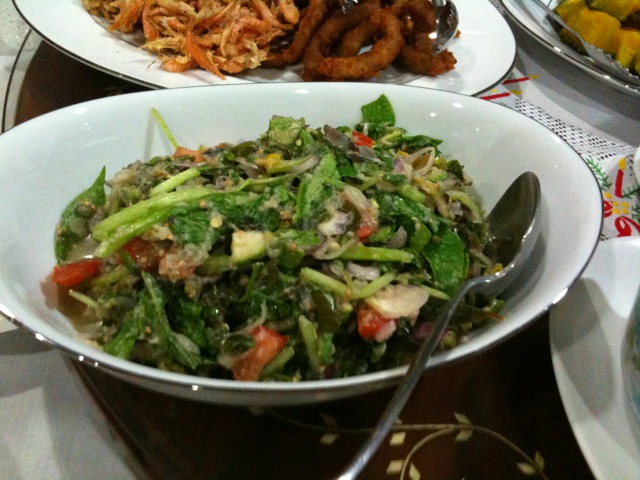
Northern Thai “salad”, or saa pak

This is hands-down my favorite dish up North, but something that, aside from a few vendors in the Chiang Rai wet market, is very difficult to obtain. The reason could possibly be the 10+ types of local leaves (pak puen muang) required for a real saa pak (“spicy leaves”).

Greenery includes thinly sliced brinjals, young mango leaves, water olive leaves, pak pu ya (“grandfather-grandmother leaves,” a kind of edible blossom), plus sliced shallots and chopped fresh tomato. It is then tossed, like a chopped or Caesar salad, with flaked fish meat which has been grilled or boiled (with lemongrass and kaffir lime leaf to lose the fishiness), plus nam prik num (roasted green chili dip) and sliced water olive.

This is a dish I am going to try to recreate at home with plain old lettuce, onions, tomato and avocado. I think it could give me a little taste of home, even in the middle of Bangkok.


9 Comments

Filed under Asia, Chiang Rai, curries, food, food stalls, markets, Northern Thailand, Thailand

The Ugly Face of Chauvinism

I have inexplicably agreed to be on a panel at the Foreign Correspondents’ Club of Thailand to discuss foreigners cooking Thai food. While I am happy to do it, I am also a little apprehensive. This is the grad student who had to give her presentations sitting down in order to keep from passing out or vomiting. This is the friend who hates talking on the phone because that form of communication is too immediate and invasive. This is one of your speakers, guys! Hopefully I have moved beyond panic attacks and am now at peace with being a gibbering idiot.

Another reason I’m worried? Because I am a great big hypocrite.

Let me explain. I have been writing a street food guide for the past year, a project I have been super-quiet about because I don’t want to jinx it (yes, I am that type of person). It’s called “Bangkok’s Top 50 Street Food Stalls” and it will be out early next year (knock on wood. Fingers crossed. Turn around three times).  In it, I detail different types of stalls — yummy duck porridge; buoyant oyster omelettes; exuberant iced coconut milk desserts; extravangantly stuffed flat noodles.

And not a mention of a northern Thai noodle dish, anywhere.

I know what I’ve done. I know there is ample khao soy and kanom jeen nam ngiew to be had on the city’s streets. Believe me, given my issues with northern Thai food I have tried almost all of them. But I feel like 1.) the best ones are branches of Northern Thai institutions, so why not go to the real one, and 2.) there are so many other great stalls out there. Really, though, there is no excuse. I am guilty of culinary chauvinism. I don’t want to believe Bangkokians can make a decent bowl of khao soy, much less approach the personal Freudian nightmare that is nam ngiew.

And, I am sorry to say, this is not my only prejudice. As long as I’m laying it all out there: watching the movie “Invincible”, I was struck by how Mark Wahlberg (who plays an Eagle) had a girlfriend (Elizabeth Banks) who was a Giants fan. Uh, WTF?! Because there is no, no, never, ever, never any way I would go within two feet of a Cleveland Browns fan. Sure, some of them may be nice and all, but to date or even marry one? Are you kidding me? (This from the person who still cannot show her face at Bully’s because she almost got into a fist fight with a Cardinals fan two years ago. He was almost 50! I could have taken him).

People tell me about close friends, open-minded in every other way, who turn into Asia’s answers to Glenn Beck when it comes to the issue of foreigners cooking Thai food. It can’t be done: farang lack the upbringing, the tastebud training, the turbo-charged metabolisms, the innate love of the color fuchsia.  We laugh at this, but I’m the same. I have my blind spots too.

So I want to make amends before I go on this panel. Here are the Northern Thai places I go to in Bangkok when I know I won’t be going up North for a while:

People desperate for good Northern Thai noodles in front of Nam Ngiew Pa Suk


You know what this is

Nam Ngiew Pa Suk (Soi Phiphat, 300 m from Silom, on the right side)

Not surprisingly, this is the branch of the venerable stall in Chiang Rai. It also serves khao soy (which I find kind of bland) and khao ganjin, or what my friend calls “crazy purple Shan rice”: rice steamed in pork blood and garnished with deep-fried garlic and fresh coriander. But the nam ngiew is almost as thick, rich and meaty as the original, and very popular, unlike many other Bangkok stalls where it’s the nam ngiew that is neglected in favor of the more well-known egg noodle dish.

Maan Mueng (Ramkhamhaeng 112)

This is a good Northern Thai restaurant overall. They do everything well here: super nam prik num (roasted green pepper dip), nice gaeng ho (a sort of “goulash” of leftovers including glass vermicelli noodles and pork), and yes, a good khao soy. The nam ngiew is sort of unusual here — a thick fermented bean base that has a deep undertow of near-fishiness. I love it. A shame it’s so far away.

Maan Mueng's nam ngiew

So there. Two places I go to again and again. And not in the hopes I find something to complain about, either. I would have tried for three, but let’s not push it.

Have a good weekend. Unless you are a Baltimore Ravens fan.

7 Comments

Filed under Asia, Bangkok, Chiang Rai, food, food stalls, noodles, Northern Thailand, restaurant, Thailand