Category Archives: pork

The other Chiang Mai

Rot duan at Suthep Market

Sometimes you don’t feel like treating Chiang Mai like a non-stop food safari. Sometimes, the usual parade of big names — Huen Phen, Lamduan Faham, Samerjai, OMG! — makes you feel all weary inside after thinking of the inevitable throng of people in line for a bowl of khao soy. And sometimes, you just want to eat where all the other jaded Chiang Mai-ers eat.

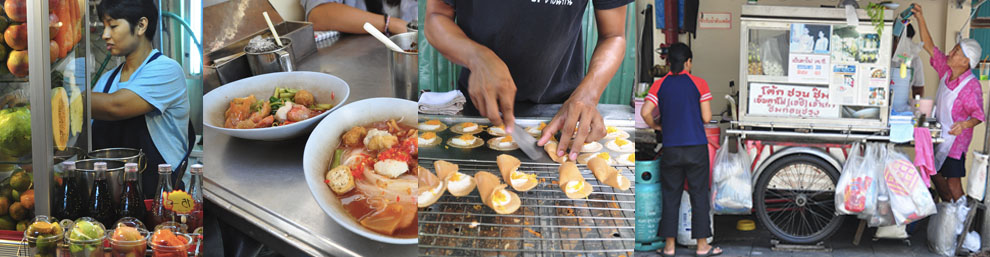
Because sometimes, Chiang Mai people are sick to death of aharn nuea (Northern Thai food), just like how Hua Hin people get sick of crab (unbelievable, I know, but it happens). And when that happens, they go to places like Yen Ta Fo Sri Ping on Suthep Road, where the chipped plastic bowls feature al dente thick, thin or glass vermicelli noodles liberally swimming with a garishly pink, chili-flecked seafood sauce crowned with a single, perfect fried wonton (35-40 baht).

Sri Ping's yen ta fo

There is also the requisite tom yum noodle (30-40 baht) and egg noodles with red pork and dumplings (40-50 baht), but nothing is as deliciously saucy as the namesake yen ta fo, a dish sure to get on your shirt and all over your face. And yes, I did rub my eyes after eating, and yes, severely regretted it for hours afterward.

I would argue that the namesake dish at Guay Jab Nam Khon Sam Kaset, right by the city’s monument to the three kings, is not the best dish here, although it is light and peppery and includes plenty of luk lok, a sort of soft porky sausage (50 baht). The gow low (broth without noodles) centers on a richer broth that tastes of beef and plenty of coriander (50 baht), and the khao moo krob is as good as anything you would find in Yaowaraj: a mix of crackle and fat, a thick sweet sauce enveloping the rice grains (50 baht). What can I say? I really like sauce.

Crispy pork rice at Guay Jab Sam Kaset

But if it’s something light and fresh you desire — Thailand via Hanoi rather than Hong Kong — there is always Raan Fer Wiengjan on Rachadamnoen Road. You have your choice of chicken (30-40 baht), fish (40-50 baht), tofu (30 baht), and the Northern delicacy moo yaw (30-40 baht), a pork “pate” originally created by Chinese-Thai chefs seeking to replicate French meat terrines.

Pho moo yaw

Vegetarians, don’t despair: Chiang Mai is thinking of you too. Or, specifically, Raan Jay Yai on Nimmanhaemin Road is. Anything on the regular menu can be made “jay” (a stricter Thai form of vegetarianism), including great versions of khao kluk kapi (rice fried with “shrimp paste”, 35 baht), guaythiew kua “gai” (noodles fried with a chicken substitute, 30 baht) and pad see ew (stir-fried noodles in soy sauce, 30 baht).
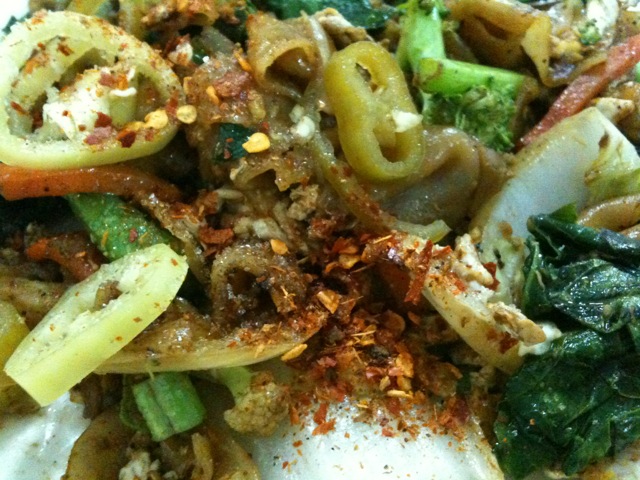
Jay Yai's pad see ew

This is all well and good, but did you really think I went to Chiang Mai without having ANY Northern food at all? What am I, an idiot? (Don’t answer that). Of course I went, and filled my face with nam prik ong and thum kanoon and sai oua and shrieked and gurgled as every Northern dish passed me by on the way to someone else, and wished myself stuffed full of everything that was good in the world. So that is how I found Haan Tung Jieng Mai (Northern dialect for Raan Tung Chiang Mai) on Suthep Road by the Chiang Mai University campus.

Khao pad nam prik num at Haan Tung Jiangmai

It’s a typical aharn tham sung (made-to-order) stall, but made achingly cool by the scraps of paper doodled by bored university students coating the tables and the kitsch-retro furnishings. That said, the food is solid, if slow, including rice fried with young green chili dip, pounded young jackfruit, and a nam prik ong that tasted suspiciously like shrimp paste (in the landlocked North, most recipes call for tua now — fermented beans, or nam pu — the juice of pulverized rice paddy crabs, instead of kapi).  Plus, there was a perfectly cooked kai ped yang matoom, a duck egg boiled just enough so that the yolk is “sticky”, like rubber sap.

No, our trip wasn’t all about food. I DO have other interests, you know. For instance, the PURCHASING of food. That is where the Saturday morning organic market off of Nimmanhaemin Road comes in. Organic producers of vegetables, fruit, rice and ready-made foods meet once a week to sell their bounty to the general public, and it’s a shame something comparable isn’t happening in much-bigger Bangkok.

Whole-wheat salapao at the organic market

Food for thought, maybe, for an organized and responsible food lover? (Not me). Maybe, just maybe, we can bring in something from Chiang Mai that doesn’t involve hastily-taped cardboard boxes and a few anxious moments by the baggage claim carousel.

Or maybe not.
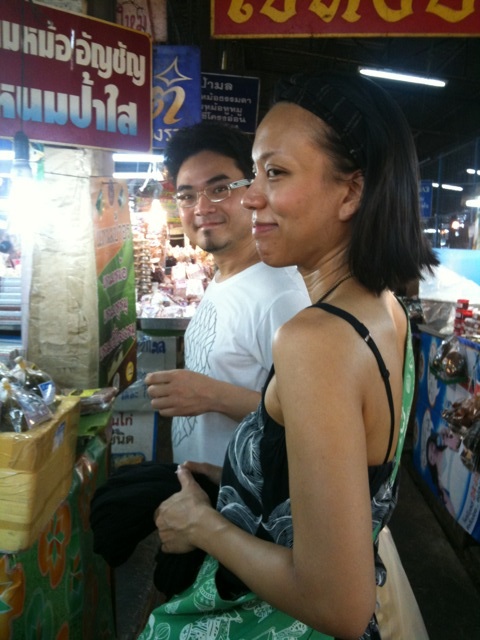
@anuntakob and @aceimage caught haggling at Suthep Market

10 Comments

Filed under Asia, food, food stalls, markets, noodles, Northern Thailand, pork, rice, shopping, Thai-Chinese, Thailand

What’s Cooking: Nam prik ki ga

Now, nam prik ki ga is not the most popular chili dip out there. It is certainly not the yummiest sounding: roughly translated, it means “crow shit chili paste”. That said, it doesn’t look, or probably taste, anything like crow poo — bright, tart and fiery, it is a perfect foil to crisp veggies, barely hard-boiled eggs and a couple of well-seasoned pork meatballs, if you like that kind of stuff.

This is Grandma Yuwadee Bunnag’s recipe.

Nam prik ki ga (serves 4)

-6 prik chee fah

-7 small red chilies

-11 garlic cloves

-1 Tablespoon kapi (shrimp paste), wrapped in foil

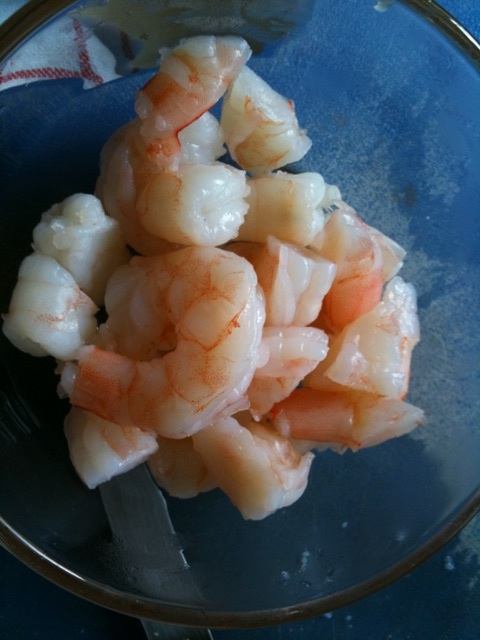
-8 white shrimp, cleaned and cooked (reserve cooking water)*

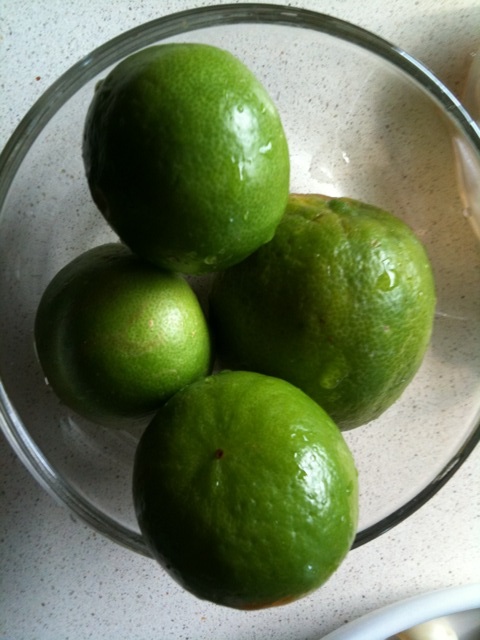
-3 limes

– 1 1/2 Tablespoons fish sauce

-1 teaspoon nam than peep (palm sugar)

-pork meatballs**

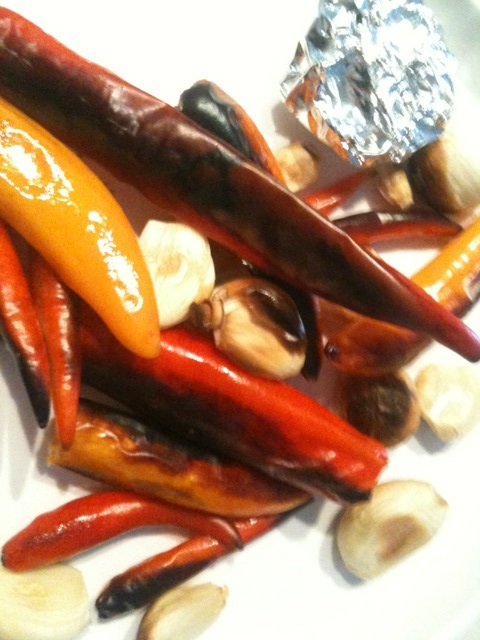
1. Set chilies, garlic and shrimp paste to roast in oven at full whack until blackened (about 20 minutes). They will look like this when done:

2. Chop cooked shrimp into pieces.

3. Squeeze juice from limes.

4. Pound garlic and shrimp paste in mortar and pestle until a paste forms. Add chilies a few at a time, taking care to peel them of their blackened skins before pounding. Add shrimp until all is incorporated.

5. Add 1 teaspoon shrimp cooking liquid, fish sauce, lime juice and palm sugar. Taste for seasoning and add more cooking liquid if paste seems too “dry”. Finished paste will look like this:

6. Serve with fresh vegetables, rice and, if desired, fried pork meatballs.

*Use dried shrimp if you can’t use fresh shrimp.

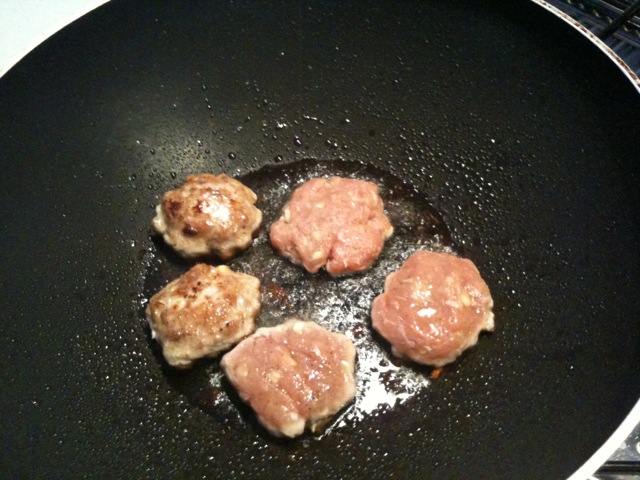
**Make pork meatballs by mixing ground pork, minced garlic, salt and pepper. Then roll mix into palm-sized patties and fry in a Tablespoon of cooking oil until browned:

1 Comment

Filed under Asia, Bangkok, cooking, food, pork, recipe, rice, Thailand

Brazilian Days, Vol. 2

Ever feel like you’ve been through some sort of time warp, doomed to a Bill Murray-like existence living the same day over and over again? That is what this interminable trip is starting to feel like, despite the loveliness of the setting and friendliness of the people.

There is plenty of both in Gramado, a Southern Brazilian town famous for its German and Italian communities, Swiss-style buildings and ludicrous number of fondue restaurants for a town of 30,000, a minute fraction of whom are actually Swiss. We are here for Marcelo and Renata’s wedding, joining 298 others in a heavy-duty bash (in case this is news to you, Brazilians like to party) incorporating an all-you-can-drink caipirinha bar, 40 bottles of whisky, 40 bottles of vodka and a whopping 220 bottles of champagne. Win and I, old farts that we are, battle valiantly to stay up past midnight. We make it to 12:30am, failing to outlast Marcelo’s 10-month-old cousin and 80-year-old grandmother, who is still out on the dance floor when we skulk out of the ballroom, pretending to make a call.

When it comes to food, however, we do our part, gorging on bottle after bottle of the local Merlot and sparkling wine and a uniquely Brazilian version of fondue bourguignone that doesn’t actually involve any fondue — a hot plate is coated with salt to keep the beef from sticking, and it is accompanied by a dizzying array of dips ranging from the usual (rose and tartar sauces, garlic-parsley butter and curry mayonnaise) to the, uh, unusual (wasabi, caramelized onion, candied pineapple, strawberry jam). Alas, the 9:30-10:00pm dinnertimes render me a gassy menace to society, snarling my digestive system and making me a deadly weapon in enclosed spaces like cars (sorry, Marcelo’s brother).

So despite the absolute loveliness of Marcelo’s and Renata’s families and promises to visit each other’s respective cities, it is with a certain sense of relief that we are left to our own devices in Sao Paulo, where no one is stuck with me but my husband and I can eat dinner at 7pm like any other tourist. Called the “locomotive of Brazil”, Sao Paulo is nearly everything Rio is not — fast-moving and unwieldy in a way that recalls Bangkok, but way more efficient; where two kisses is a common salutation in Rio (and three in Gramado), in Sao Paulo you get away with only one (time is money, after all). Sao Paulo is also way bigger than Rio: at last count, its population totaled 40 million.

It’s not much of a surprise, then, that Sao Paulo is also home to the biggest Japanese population outside of Japan. After what feels like months of going without Asian food, I insist on trying both ends of the spectrum of Japanese food in the city: slick and high-end vs. “authentic” everyday.

Kinoshita's crispy salmon

At Kinoshita (Rua Jacques Felix, 405, (11)3849-6940) you will get plenty of slick (minimalist, expensive decor, smooth service) and a whole lotta high-end (65 reals for a glass of Hungarian Tokaji). Food — with the exception of a nifty gazpacho with shrimp roe and sea urchin, some nice seared fish eggs with a dollop of wasabi and salmon drenched in ponzu and topped with tempura dribbles and ebiko — stands at the intersection of Mundane Avenue and High-Concept Hotel Dining Street. In other words, it’s the culinary equivalent of an Aman Resort: pretty and well-designed but somehow similar to somewhere else. Of course there is a foie gras course, cubes of it pan-fried and set atop cushions of Kobe that are only seared, so that the marbled fat in the meat isn’t activated. Why bother then?

More satisfying (and easier to do) was the ramen at Lamen Kazu (Rua Thomaz Gonzaga, (11)3277-4286), in the “Japan town” known as Liberdade. The menu is simply a succession of ramen variations: miso, salt, shoyu, with the usual varieties of toppings. All the same, I enjoyed my “Hokkaido” (corn, seaweed, pork, spring onion and a pat of butter) despite getting hangry (hungry+angry) and scaring the waitress and our neighbors at the table next to us.

"Hokkaido" ramen

In the end, we find we’ve explored only the tip of the iceberg that is Brazil. There is still the gorgeous green expanse across the north, and the awe-inspiring forest known as the Amazon. And imagine the food that remains uneaten! It would take weeks and weeks to do the country justice. We’ve only just started.

All the same, I feel like I’ve been on the road for a long time. The memories seem minted long ago: dining on a tableful of oysters at Kaufhaus des Westerns (KaDeWe) and rifling through stacks of scarves and evil-eye jewelry at the Turkish market in Berlin; stumbling through icy streets in Denmark and Finland on a bellyful of schnapps; discovering delicious cream-filled semla buns in Stockholm.

Semla at Vete-Katten in Stockholm

I love exploring the world through my stomach, and I can’t believe I’ve been lucky enough to actually do it for a month. But home beckons, finally. What’s for dinner?

Peppers at the Turkish market in Berlin

Leave a comment

Filed under beef, Brazilian, fish, food, Japanese, noodles, pork, Portuguese, restaurant, seafood