Category Archives: restaurant

Mahalo for the memories

Banana macadamia nut pancakes at The Gazebo in Maui

What I love most about travelling is the opportunity to find out more about a place through its food. You can discover so much about what is prized in a culture that way — for example, the way Thais try to “balance” out different flavors seems to point to the premium Thailand places on harmony and each piece of the whole doing its own part.

While high-end restaurants in Hawaii can be accused of submitting to a kind of “global fusion” ideal — pan-Asian food with a few French and local touches — the real stuff points to a culture more mixed and interesting. It’s American food (I have never eaten so many hot dogs, no joke), but different, with an incorporation of local ingredients and flavors. Macadamia nuts, pineapple and bananas liven up the impossibly fluffy pancakes at local stalwart The Gazebo (a popular restaurant improbably placed next to a hotel swimming pool); pineapple and bacon adorn a hot dog from a food truck next to the highway.

Hot dog breakfast in Maui

This emphasis on local ingredients makes ice cream flavors here a lot of fun. At Dave’s Ice Cream (it’s been written up in People magazine!), hidden away in a plaza on the outskirts of Honolulu behind a statue of Hawaiian-born sumo wrestler Akebono: the inevitable coconut, pineapple and macadamia nut flavors, plus ube (Okinawan purple yam), cotton candy, and acai.
The counter at Dave's Ice Cream on Oahu

And then there’s the actual street food, which in the U.S. means food from trucks: a lot of hot dogs, for sure, and tacos, tacos, tacos. In a town called Haiku on Maui (dotted with a lot of other towns like Haiku — one main street, one general store, about 40 people), in a parking lot in front of the (regrettably closed) Hawaiian food restaurant Hana Hou, not one but two good food trucks, one packed and one just starting out…
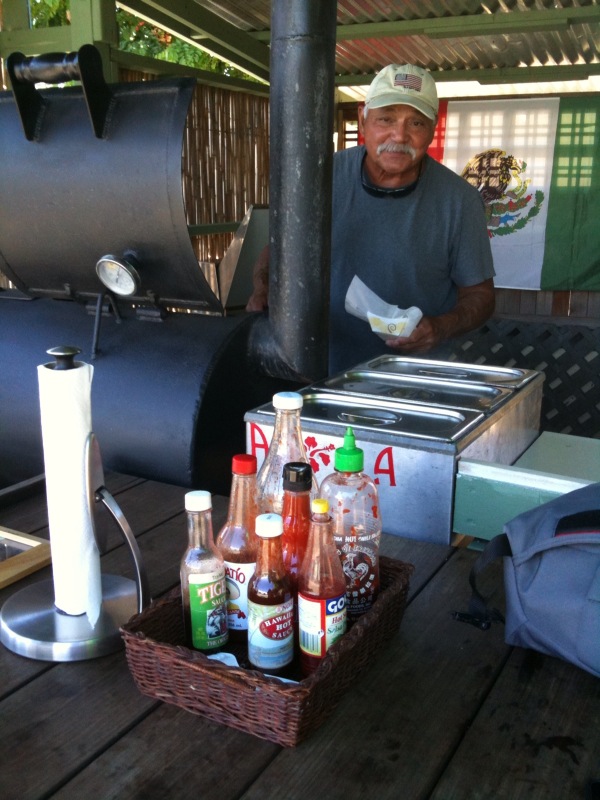
Dickie Lee of Island Tacos

Maui native Dickie Lee has worked the Texas hibachi at Island Tacos, on and off, for the past decade. His latest incarnation of the taco stand was only four days old, but still offered delicious grilled chicken, beef, pork and best of all, mahi mahi tacos ($5 each) with plenty of fixings: shredded cabbage, jalapenos, black beans, salsa, soy sauce, hot sauce, and, unexpectedly, Sriracha and Thai sweet chili sauce.
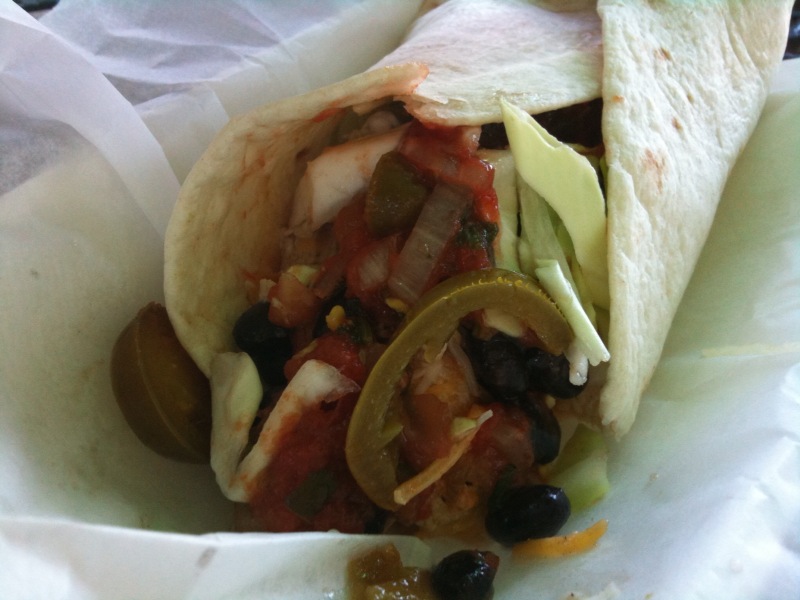
Grilled mahi mahi taco with everything

Just a few steps from Dickie, Prana Nui Cafe does a brisk trade in, uh, “vegan ayurvedic cuisine”. A collaboration between a nutritional therapist and a chef, Prana Nui makes food that might conjure up the stereotypical image of tasteless, brittle health food, but which is actually pretty delicious.  For our second lunch of the day, a great kale seaweed salad ($7) with umeboshi plum dressing and hemp seed “gomasio” (apparently a dressing used for texture), plus a “dosha” bowl ($10) corresponding to our ayurvedic type (there is a chart in front so you can diagnose yourself; @SpecialKRB and I think we are both kapha, or water, as opposed to air or fire).
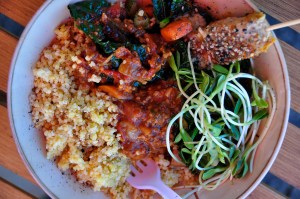
Kapha dosha bowl with millet and tempeh skewer

It may be because Maui seems to draw a disproportionate number of alternative lifestyle types, but the people of Maui sure do seem to love their greens. In Makawao, which has the feel of a Wild West border town, we encountered a counter-full of good but healthy salads at the Rodeo General Store. Some were delicious (beets and greens; raw kale Caesar; pohole fern), some not as much (ahi tuna with lavender cream; a beet-and-carrot slaw called “Got the Beets Ya’ll”), but all were interesting.

Deli counter at the Rodeo General Store

A counter-point to the goody two-shoes greens: our “favoritest doughnuts evah” at, let’s be honest, a dumpy-looking Makawao store called Komoda Store & Bakery. They are glazed and baked on a stick and cost $1.25 each! Doughnut lovers, it’s worth the trek to Maui.

Komoda Bakery's doughnuts on a stick

Some of the local bounty wasn’t as palatable. Take this local fixation on Spam. Rodeo General Store offered its own paean to this: spam “masubi” (which appears to be a sort of nigiri), which @SpecialKRB likened to a slab of cat food on a handful of dry, stale rice. Sort of an apt metaphor for the end of our drive along the “road to Hana”, which is supposed to be the most “Hawaiian” of Maui towns. Not sure what that means, unless “Hawaiian” is a euphemism for “non-existent”. What we discovered in Hana: a baseball diamond, a school, a hotel, a general store and a Thai restaurant.

Spam masubi

And the high-end stuff? I’m sorry to say this, but in general Maui’s restaurants are overpriced and afflicted by flabby, affected cooking. At the end of our stay, we ended up taking more comfort in fashioning something out of the local produce by ourselves. With both Mexico and Thailand represented at our villa (thanks @sergiomireles!), we came up with grilled steak and pork ribs, Thai steak salad, fried rice and fajitas. It ended up being our best meal on the island.

Our dinner at home

2 Comments

Filed under food, food stalls, Hawaii, restaurant

Aloha, and other stuff in Honolulu

Welcome to Hawaii

A lot has been made of this collection of tropical islands in the middle of the Pacific Ocean. Secret celebrity wedding ceremonies are always accused of being held here; ancient island curses alway threaten to ruin Peter Brady’s life. Hawaii is filled with a mystique that mere mainlanders and foreigners can never truly fathom. Or so it would seem.

The reality is that the allure of Hawaii is all too obvious: balmy breezes, azure seas, soft sands, beautiful people, ripe fruit. That may be one of the real luxuries of the tropics, the gorgeous weather that leads to such a natural abundance of food. The ready harvest gleans shoals of ahi tuna, pineapples, coconuts, sweet onions, Maui beef, and loads of other fish with strangely fitting names like opakapaka, ono and mahi mahi. And that leads to a strong preference for flavors like sesame oil, soy sauce and sugar. Especially sugar.

Ahi poke "teppanyaki style" at Roy's

The Hawaiian dish “poke” is the perfect example of the mix of local flavors: fresh, meaty fish (or steak) paired with the omniscient soy sauce and onion, with plenty of sesame oil and toasted seeds for texture. There are myriad ways to present this popular dish — sizzling on a hot plate at Roy’s, stuffed into deep-fried tacos and buried under lashings of cream at the Hula Grill, or cubed and served fresh with a splash of citrus, a bit like the poisson cru of Tahiti but without the coconut milk. We had them all.

It wasn’t all about the ahi. There were a multitude of other fish armed with confusing and sometimes similar names, to the point where @SpecialKRB said the Hawaiian language may be an elaborate joke played on the hapless foreigners with the temerity to try to master it. The fish dishes were many and varied, but mostly revolved around variations of simply grilled flesh, accompanied by something sweet, natural and generally unfussy. Attempts to go high-concept with the ingredients, like a fussy pairing of melon and hearts of palm, mainly met with disappointment.

Grilled ono with a mango salsa and pohole fern salad from Feast at Lele

And then there were the extra-special creations, examples of the evolution of Hawaiian cuisine to include more recent influences like American food, such as the strangely named loco moco (what @sergiomireles says means “crazy booger” in Spanish. Appetizing, I know.) It was many things: a lot of food, a lot of fat, a lot of grease, a lot of everything, except flavor.  The ubiquitous packet of soy sauce was supposed to shoulder that burden, I guess.

Loco moco at CJ's Diner

For many who have visited Honolulu, it probably comes as no surprise that a highlight of our time there, food-wise, was Alan Wong’s restaurant on King Street. Beautifully concocted salads included a peeled whole, fresh beefsteak tomato inexplicably paired with a “yuzu dressing” that resembled Thousand Island, as well as a wonderful aluminum pillow that, when slashed, revealed perfectly cooked shredded pork and clams. The meal ended with a luxury version of Hawaiian shave ice and a great selection of coffees from all over the islands. Alas, while the food was super, the lighting was not the greatest for taking pictures. So you’ll just have to imagine it.

I know I had almost no time, and a lot of it was spent accommodating more upmarket palates that had little to no interest in plate lunches and rickety little bakeries. I also must admit that I spent one meal eating this:

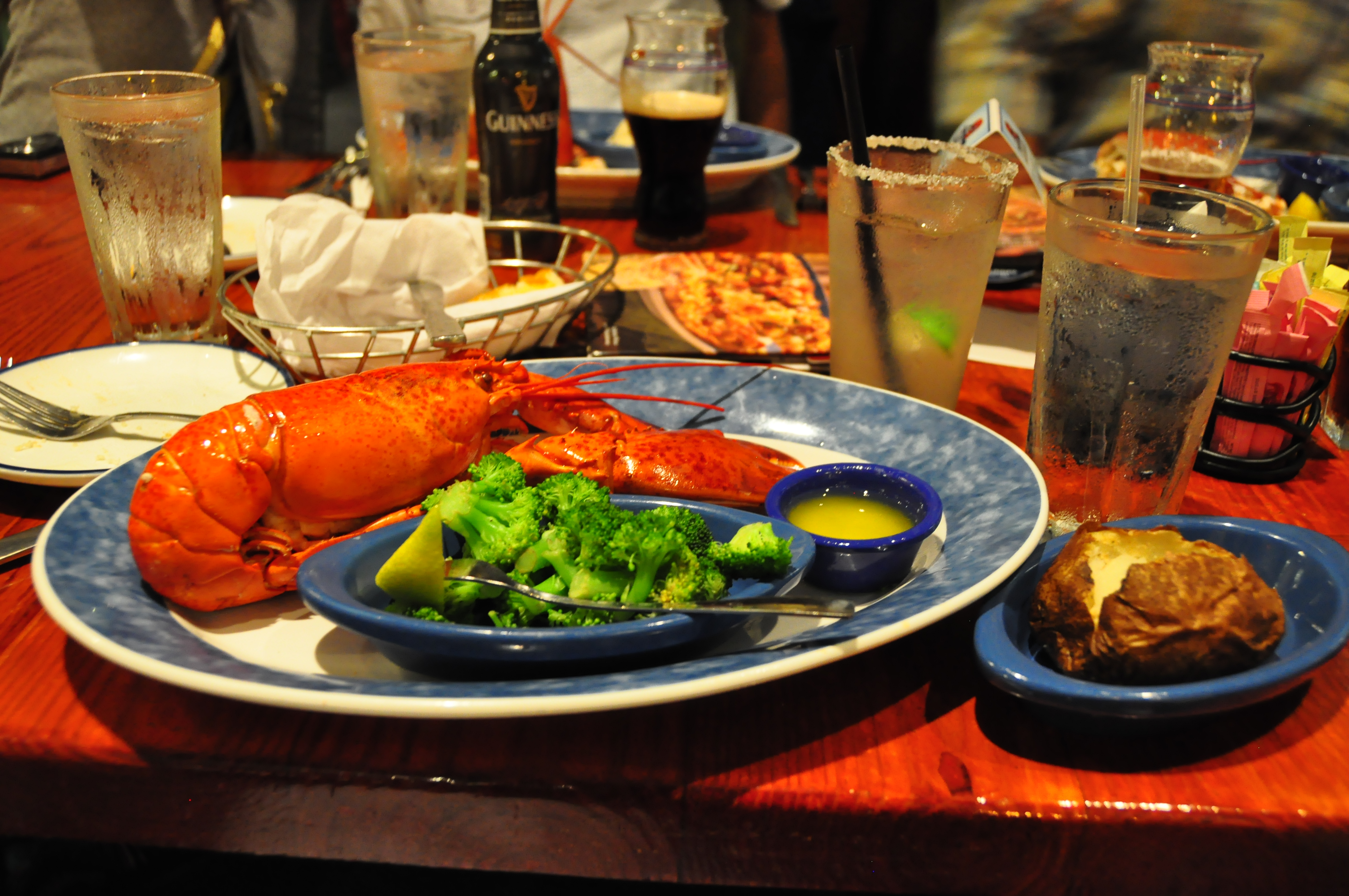
Yes, the steamed Maine lobster in Hawaii

I know, it’s Red Lobster. Let he who must deal with $60 lobsters at home cast the first stone.

Alan Wong’s Restaurant – 1857 King Street, (808) 949-2526

Roy’s Restaurant – 6600 Kalaniana’ole Highway, (808) 396-7697

Feast at Lele (yeah, it’s in Maui, whatever) – 505 Front Street, (808) 667-5353

p.s. You might have noticed most of the photos here are of superior quality to the ones you usually see on this site. That’s because @SpecialKRB is back!

Leave a comment

Filed under food, Hawaii, restaurant

Bangkok’s best, or Where do I get some gravy noodles?

A friend of mine who likes to call himself an “omnivore” once said that the only thing he hated was lard na, the Chinese-inspired Thai pan-fried noodle in a thick gravy with meat or seafood and vegetables. I understood what he meant. As great as Cantonese food can be, a big knock commonly levelled against one of the great cuisines of the world is that it is too greasy, too goopy, too much like … baby saliva. Or the guy that is constantly coughing and clearing his throat in the corner of the coffee shop in the morning when you’re trying to mind your own business and standing in line for ages and WHY DON’T YOU HAVE DECAF?! You know what I’m talking about.

Actually, you probably don’t. But you might know what I mean about guay thiew lard na, which is seriously one of the great food stand offerings of the city. If a safari hunter is always on lookout for the “Big Five”, a galloping gourmet in Bangkok is sure to bump into a lard na stand on his or her way to the egg noodle, soup noodle, pad thai or rice porridge stall down the road. This city is littered with many a lard na stand serving faithfully exact facsimiles of that goopy, steaming mess that my friend so dreads.

But he didn’t know about sen mee krob.

Some of the very best — and by “best” I mean the places that are well-known by Thais for their lard na — vendors in the city deep-fry their noodles so that the crispy crunch of the starch offsets the thick gelatinous gravy they are slathered in. Like a Japanese cherry blossom clinging to the branch in late March, this is an ephemeral delight; the noodles go limp if you dally before tucking in. But it is something very real, something very genuine, a real added dimension to a dish that would otherwise be only okay. 

It is also the reason why I am wandering down this busy, congested street miles away from the nearest air-conditioning, where DVD vendors vie for your attention and the sidewalks are littered with remote controls and stereo components. We are in Baan Maw, a neighborhood in the old city specializing in electrical equipment — and, tucked behind what appears to be a hubcap vendor, lard na with crispy sen mee, or thin noodles, studded with pork, bristling with Chinese kale.

Crispy thin noodles in gravy at Rot Tip Yod Pak

Rot Tip Yod Pak (Baan Maw) is also known for its crispy pork on rice, but the lard na is what I’m there for: a cheery crunch nestled amid a burst of porky flavor. And at about 30-40 baht a plate, it’s reasonably priced.

Which is more than what can be said for Jay Fai (327 Mahachai Rd., Samranrach Intersection). With its various interpretations of the gravy noodle — with seafood, shrimp, pork, chicken or beef — hovering at around the “250+” range on its menu, one would wonder, Why? The answer, simply put, is this:

Crispy gravy noodle with seafood at Jay Fai

Now, I have seen people wander into this restaurant, sit down, look at the menu, calculate the prices, and then walk out again. But they were obviously not thinking clearly, and their places are almost always quickly filled. A meal at Jay Fai is an investment. That is because when people ask you, What’s the best place for Thai food in Bangkok?, you will be able to tell them, with some authority, that it’s Jay Fai. You can tell them about the tom yum hang, the ubiquitous lemongrass “soup” served without the broth, redolent in galangal and kaffir lime and chili; the stir-fried wide noodle with chicken (kua gai), thick with fresh lettuce and shrimp as big as the palm of your hand; and the most expensive crab omelette (kai jiew pu) I have ever seen at 500 baht — but so engorged with crab flesh you don’t really bat an eye.

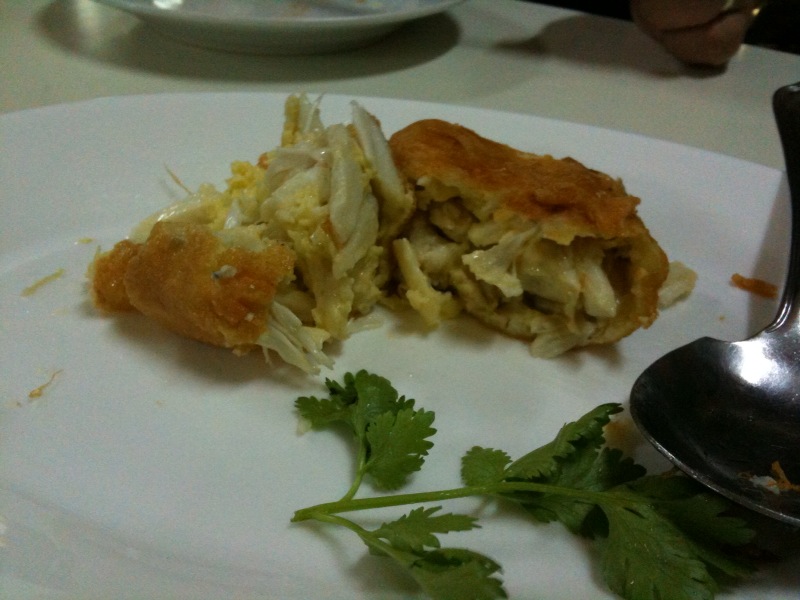
Oops! What's left of the crab omelette

There is more (for example, this place is big on serving things “dry” — dry congee, dry sukiyaki, etc), but I would miss lunch, and that would be horrible. All I can say is, I’m saving up for my next meal. And taking my friend with me.

14 Comments

Filed under Asia, Bangkok, food, food stalls, noodles, restaurant, Thailand