Category Archives: rice

Accidental Fusion


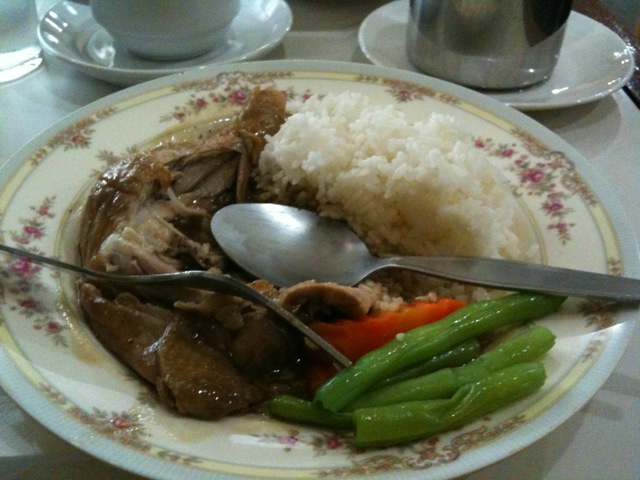
Chicken stew at Lertros


The four of you who read this blog may have noticed I’m not writing as often as I used to. The answer: I’m busy watching television. It’s called “having priorities”. Give me a break, mom, dad, @SpecialKRB and Mrs. Silverman! Haha, just kidding. My mom doesn’t read my blog.

But now that StarWorld is showing a rerun of “Britain’s Next Top Model”, I find I have the time to talk about my new favorite rediscovery. I’ve been rereading David Burton’s “The Raj at Table” and have been struck all over again about how historical events seep, unwittingly, into a country’s culture and cuisine. A silver lining from the British Raj: the ingrained sense of “superiority” that went with England’s colonization of India resulted in “English” food created from Indian ingredients that ended up an entirely new cuisine.

Not surprisingly (sorry Britons, I love Welsh rarebit as much as the next guy, but…), that culinary influence did not really go both ways. The English way of cooking had little impact on the Indians. But the ingredients they managed to transplant to their adopted country had tons: cabbage, lettuce, tomatoes (referred to as “love apples”), green beans, avocados and corn. Without the West’s potatoes, the Indians would not have come up with aloo gobi; without spinach, no saag paneer.

All the same, a lot of English food got more “Indianized”, and an entirely new Anglo-Indian fusion resulted, the most famous dishes of which are probably kedgeree (a rice porridge featuring smoked fish like Finnan haddock, which is why many mistook this dish for Scottish) and mulligatawny soup (what cynics called the “remnants of yesterday’s curry” in liquid form).

But there were other, no less noble, creations: country captain (chili- and turmeric-infused chicken); corned beef bhurta (borne out of the scarcity of beef in Hindu India); sweet potato chapatis; a”Madras Club Pudding” (using mostly dried fruit instead of the more expensive sugar for sweetness); and a “Sandhurst Curry” served in the officers’ mess alongside sliced bananas and shredded coconut. Many of these dishes, in some form or other, trickled their way through English cuisine, lending a touch of the tropical to the stoic roasts and hearty puddings of the north.

But I’m rambling. Again. I love these old-style dishes and have vowed to recreate them for my long-suffering friends and family (who have already had to put up with any number of “retro American” dinners of “perfection salad” and tuna tetrazzini) because they are perfect snapshots of an interesting point in time, irresistible to this girl who majored in Indian history (because I loved the food. Yes, really.)

Which is why I love going to Lertros Alacarte (74 74/1 Silom Soi 4, 02-234-3754). Its old-school diner ambiance — sort of like where the two old guys in “the Muppets” would hang out if they were to live in Thailand — is totally my style, and some of its food specials — a fusion of Thai-Chinese and Western — are becoming increasingly hard to find elsewhere.

Like the Indianized Anglo-cuisine of the British Raj, the story of this food (Chinese-style curries, chicken and tongue “stews”, minces and pork pate, or moo yaw) is primarily a political one. According to Chef McDang (yes, he has basically taught me all I know about non-Northern Thai food), King Rama IV sought to entertain the various Western officials at his court by  serving “Western” food. He used chefs who learned to cook in the employ of British officials; these chefs were almost always Chinese. The result: Western ingredients cooked with Chinese techniques.

So for one of the oldest forms of Thai-Western fusion out there, look no further than Lertros. And if you see Statler and Waldorf, steer clear.

6 Comments

Filed under Asia, Bangkok, chicken, Chinese, food, restaurant, rice, Thai-Chinese, Thailand

Caught in the culture wars


Thai food: a focal point of the culture wars


I vowed never to talk about this again, but Sunday’s “Bangkok Post” opinion piece about the state of Thai cuisine drove me, once again, to the keyboard (I don’t have many interests, and nothing else to talk about). Like a Katherine Heigl movie, it starts out reasonably enough, and then somehow turns crazypants somewhere in the middle.

The basic premise is, modern Thai food has atrophied as a result of the culinary shortcuts commercial cooks take today, resulting in processed dreck that bears little resemblance to the dishes they are supposed to be (while this is very true, it sounds a little to me like running into a McDonald’s and complaining, “Why do they only use cheap ingredients? Why is everything so poorly made? Where is the care and thought put into my hamburger?”)

The media also deserve blame for the commodification of Thai food, concerning themselves only with “tasting this or that dish” and on “atmosphere and decor rather than offering any real knowledge concerning the food” (Because NO ONE cares about that stuff! Silly journos. Tell me once again about how the Indians and/or Portuguese inspired coconut milk-based curries).

Because of these shortcuts, Thais DESERVE to lose their mastery of their own cuisine. Because we’re so stupid! Now David Thompson has blown into town and his place is packed and that sucks, because our lives suck and so his should too! But we’ve done this to ourselves, because we bear witness to culinary crimes like this:

“…pizza with a dry version of gaeng kiew waan luk chin pla or with dry tom yum goong. These combinations are a slap in the face to both the Thai and Italian cooking traditions.”

First of all, what’s with all the slaps in the face? Is there no other way for writers here to convey getting insulted? No tug on the ear, perhaps, or maybe a kick in the pants? Get a new rhetorical device!

Secondly, well, I am no fan of crap-topped pizza either. That said, I’m sure someone probably thought tossing spaghetti with pla kem (salted fish) and dried chilies was once a daft idea, too. Now you wouldn’t bat an eye seeing this dish on a menu. And how did Thais take to the first bowl of khao soy, a “fusion” creation of egg noodles and coconut milk said to be invented by cooks in Chiang Mai from a dish originated by the Chin Haw Chinese-Muslim minority group?


Khao soy at Khao Soy Islam


(photo by @SpecialKRB)

I was lucky enough to get the chance to help work on the first English-language cookbook by Thai TV chef McDang (“The Principles of Thai Cookery”, in case you’re interested — it’s very good! Not that I’m biased or anything …) In it, Chef McDang discusses quite clearly how all the different parts of a Thai meal fit together (a minimum of five elements: a clear soup, a curry, a fried dish, a stir-fried dish, and a kreuang jim, or chili dip with vegetables), why Thais use forks and spoons (in order to kluk, or mix the different elements of the meal together to your liking), and how all the ingredients in a Thai dish are supposed to interact. That’s why traditional Thais get all crazy about substitutions like onions for shallots, or adding spring onions instead of coriander leaves.

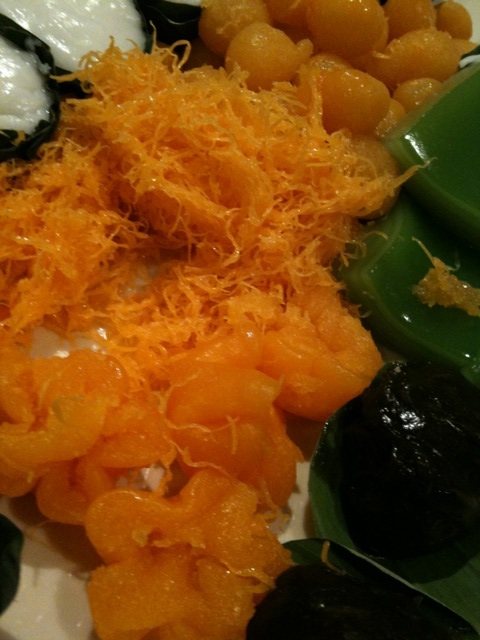
That said, Thai cuisine is also the beneficiary of a number of foreign influences that have seeped in from interaction with the rest of the world over the course of Thailand’s history. In the Sukhothai period (1238-1438), we were scarfing down fish, fruit and wild boar on rice flavored with peppercorns, cilantro roots and palm sugar. And then, in the Ayutthaya period (1351-1767) the Portuguese came along, and gave us this:


"Golden threads" and "golden drops": traditional Thai sweets that are also Portuguese


They also introduced us to eggs, tomatoes, potatoes, eggplants and sugarcane; co-introduced us to savory uses for coconut milk; and showed us a crazy new way to flavor our food with these things called “chilies”. They also found a way to form a curry custard by mixing fish and egg and steaming it; the result was called hor mok:


Steamed seafood curry at Aor Thor Kor


(Photo by @SpecialKRB)

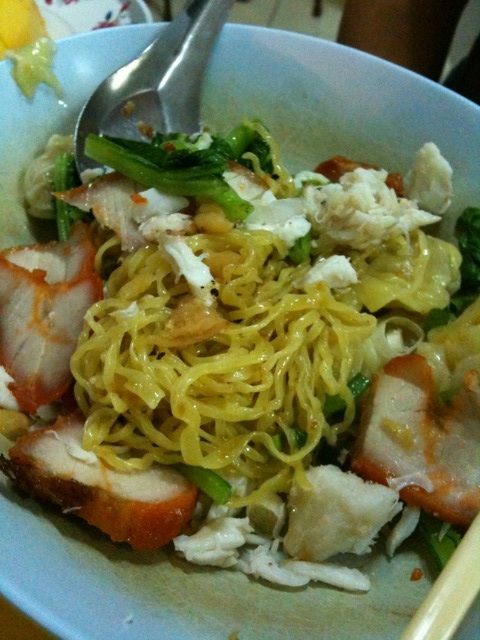
And then there were the Chinese. What to say about the Chinese? Without them, Thai food would not be “Thai food”. From them we got: shrimp paste, fish sauce, the use of duck meat in cooking, pans, stir-frying, and frying. Another innovation: an interesting alternative to rice in the form of long, thin strands of rice flour (and sometimes egg-based flour), which can be served in soup, blanched, fried, or even in desserts. They are popular in Thai street food, so keep your eyes peeled for this rare, strange delicacy:


Bamee at Sukhumvit Soi 38


So sometimes fusion isn’t so bad after…..zzzzzzzzzzzzzzzzzzzzzzzzzzOh, sorry, you’re still here?

Thailand is at a point in its history where its future — like that of the rest of the world — is uncertain. Maybe people are unsure of where they stand and so long to return to a time when things seemed more secure. Food serves as a convenient stage on which to act out this current identity crisis. But that doesn’t mean we should shut out foreign influences, or, for that matter, a foreigner who is doing the exactly same thing as us.


27 Comments

Filed under Asia, bamee, Bangkok, celebrity chefs, Chinese, curries, food, food stalls, Japanese, noodles, Portuguese, restaurant, rice, Thai-Chinese, Thailand, TV chefs

Two great food stalls

Beef noodles 'nam thok'-style at Nai Soi

There comes a time … when I actually have to talk about street food. Yes, I know. I know you actually want to hear about my day, and how my minders are making me eat cardboard for lunch, and how my life is a Jennifer Aniston movie if Jen put boot polish on her hair and gained 30 lbs. But I’m going to save all that good stuff for my widely anticipated TV movie screenplay for the Hallmark channel. All you get to read about are these two relatively undiscovered gems.

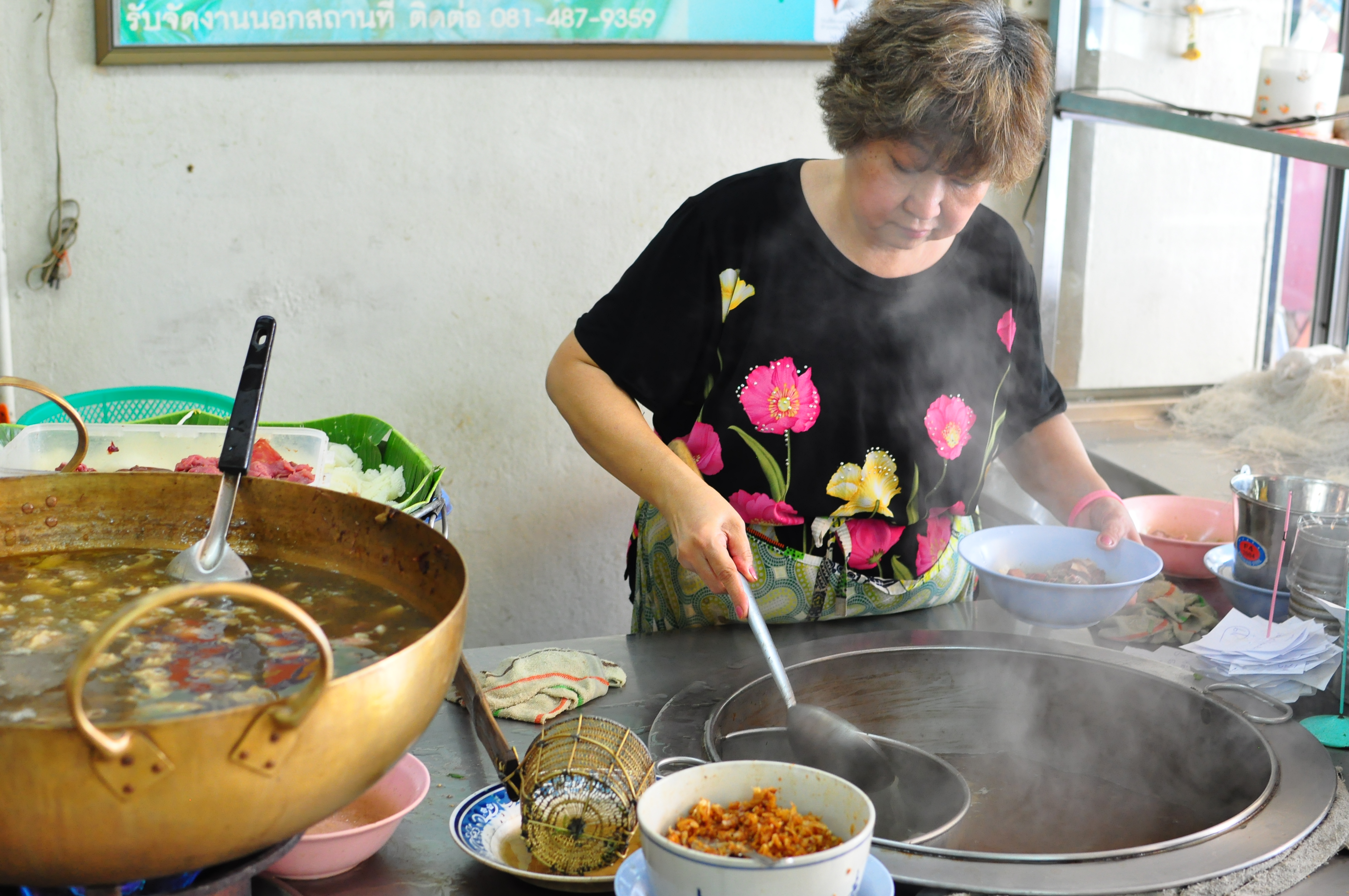
Emphasis on “relatively”. Because Nai Soi (100/2-3 T. Phra Arthit, 081-487-9359 or 086-982-9042) is well-known to any journalist who works for the Manager group or general traveler-in-the-know who makes Phra Arthit Road his or her base of operations. This Banglamphu standby is popular for its gorgeously amber-colored beef noodles — slightly chewy rice noodles bathed in a garnet-colored broth and tender, flimsy slices of freshly blanched beef. Unlike my other beef noodle favorite, Raan Anamai, the broth here is thickened with blood (known as nam thok, or “water falling”) and not crystal-clear; nonetheless, it doesn’t make it any less yummy.  OM NOM NOM NOM.

Making our beef noodles

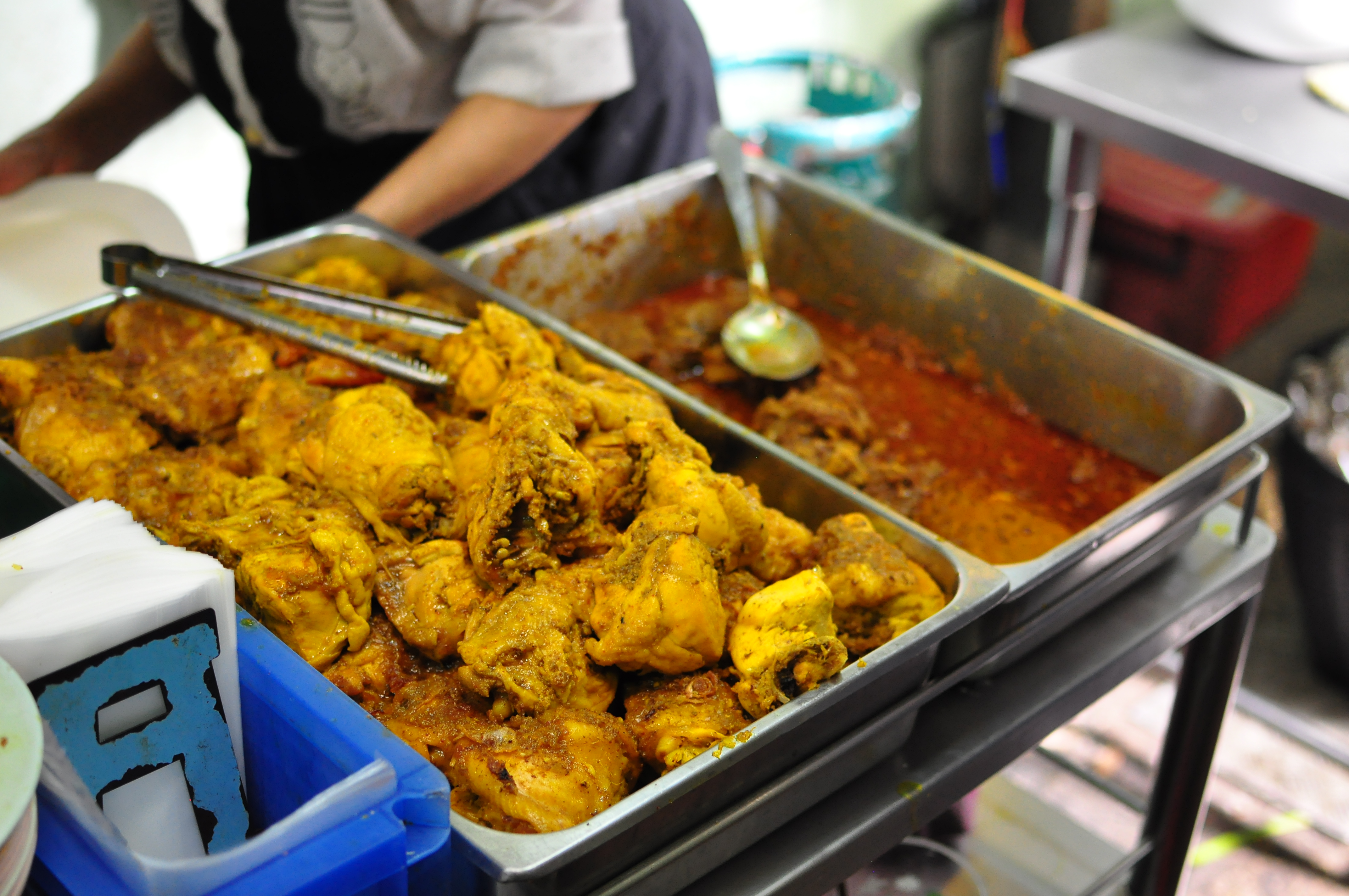
Too bad I can’t eat there right now. Another place where I can’t eat is the incomparable Aisa Rot Dee (the beginning of Thanee Rd., 02-282-6378, 081-401-1326), purveyor of most things delicious and Thai-Muslim. Mounds of soft and fragrant yellow rice, perfumed with cumin, atop hunks of slightly charred barbecued chicken; bowls of aromatic beef noodles smelling slightly of star anise; comfortingly substantial oxtail chunks in a fiery broth; sweet-salty beef satay coated in coconut milk — the offerings here turn other Thai-Muslim eateries like the nearby Roti-Mataba into mere whispers of an afterthought. There is no way you would be able to leave this hole in the wall hungry.

Thai-Muslim yellow chicken

And I mean “hole in the wall”. The only suggestion that there is a bustling “restaurant” somewhere behind all the touristy knick-knack shops hawking fishermen’s pants and flip-flops is a sign on the sidewalk — in Thai — reading “Aisa rot dee” (Aisa good taste). In the narrow alleyway behind the sign, two forbidding faces manning a beef noodle stand, and as you approach the darkness, the hint of more. After passing the khao mok gai and tripping over two or three people on the way, the darkness becomes the light, and the alleyway opens into a substantial open-air courtyard, tables, chairs — even waiters.

Aisa is a leap of faith for a hungry Indiana Jones-type searching out answers in a culinary maze. Don’t let the darkness fool you.

(Photos by @SpecialKRB)

1 Comment

Filed under Asia, Bangkok, beef, chicken, food, food stalls, noodles, restaurant, rice, Thai-Muslim, Thailand