Category Archives: seafood

What’s Cooking: Gaeng om

If there’s a good place to start for a Thai food cooking virgin, it’s with this tasty Northeastern Thai “soup”. It’s full of good-for-you greens, bright and light with fresh, herbal flavor, and crazy easy to make. Felt like I robbed a bank with this one.

Gaeng Om (for four)
-1 head white cabbage, chopped

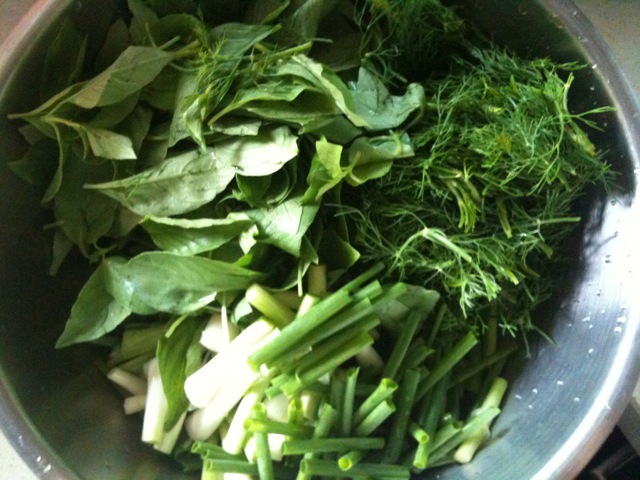
-2 g Thai lemon basil (bai maeng rak)
-2 g dill, chopped
-2 g scallions, cut into 1-in pieces

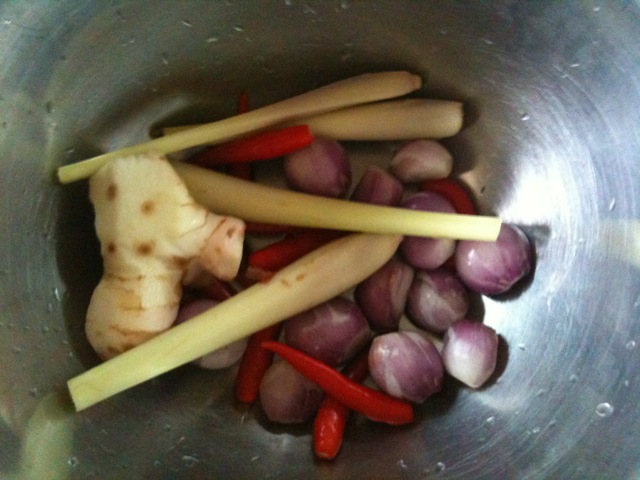
-2 stalks lemongrass, cut in half
-1 large piece galangal, sliced
-12 shallots
-12 small red chilies

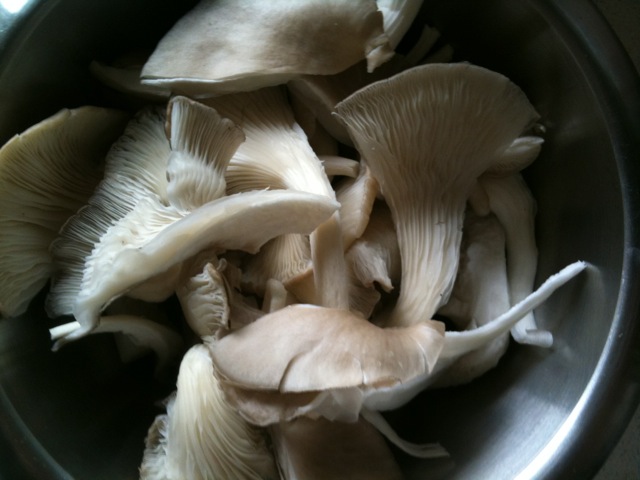
-3 g oyster mushrooms (het nang rong)

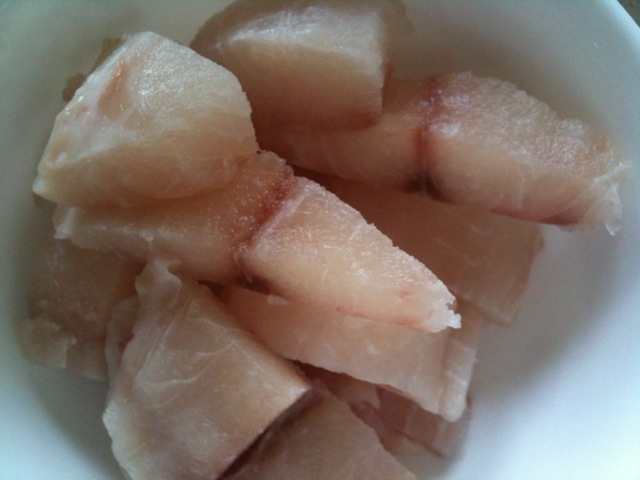
-300 g white fish filets, skin-on, cut into pieces*

-2 Tbsp fermented Thai anchovy juice (nam pla rah)**

-200 g chicken stock

-200-300 g water

-1 Tbsp fish sauce (plus more to taste)***

1. Set water and chicken stock to simmering boil in pot. Meanwhile, mix lemongrass, galangal, shallots and chilies in blender or food processor until finely diced.
2. Once simmering boil is achieved, add chili mixture to stock.
3. Add pla rah juice, 1 Tbsp fish sauce and fish pieces. Do not overstir, or fish will get mushy. Cover.
4. Increase heat to rolling boil. Add mushrooms and white part of scallions.
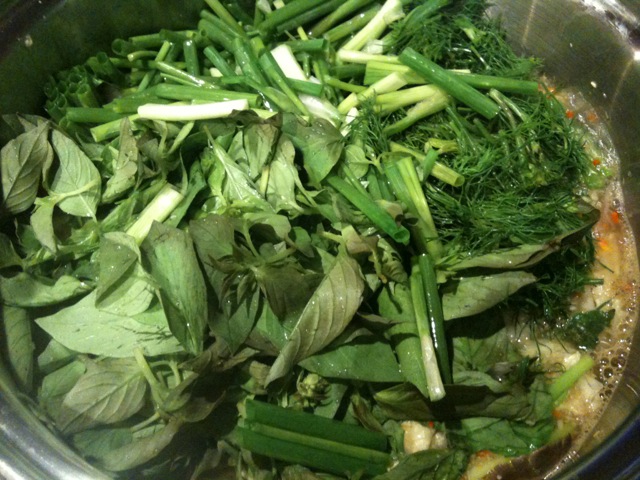
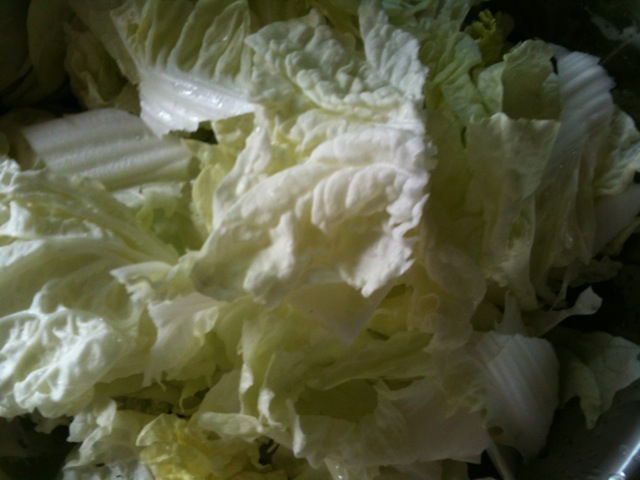
5. When water returns to the boil, add cabbage and the rest of greens. The pot should look like this:

Cover.
6. When vegetables lose some volume, carefully “fold” into broth. Taste and add more fish sauce if needed.
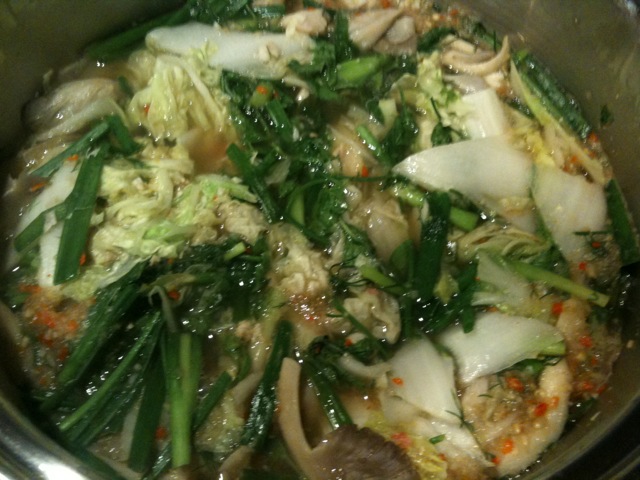
7. Shut off flame. Pot should look like this:

Cover and let “marinate” for a few hours (cool and place in fridge if leaving overnight).

*If you’re a meat person, use sauteed chicken wings or pork ribs instead.
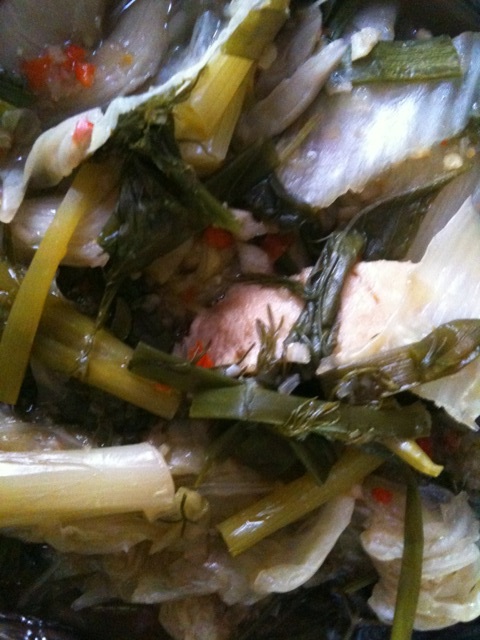
**You can buy Thai anchovies in any supermarket here in Thailand, but Khum Gon, my Thai food tutor, claims homemade is best (obviously). Fermented Thai anchovies look like this:

If this isn’t available to you, try mashing regular good-quality anchovies instead.
***Khum Gon believes that fish sauce from shellfish (such as razor clams) is best because it smells less fishy than other types. Frankly, I am not that sensitive to the smell, but if that is an issue, then take Khum Gon’s advice.

What we ended up with:

Lunch

In the end, it was … pretty good. I’d use all chicken broth next time. And more Thai anchovy juice. But it was everything I expected and wanted from my first Thai cooking experiment. Next up: a veggie-rich gaeng liang.

12 Comments

Filed under Asia, Bangkok, fish, food, Isaan, seafood, Thailand

The Far Side of Angst

Let me tell you a secret. Is it presumptuous of me to burden you with this so soon? It’s just that I feel such a bond, this far into our 30-second relationship — I feel like we’re two of a dust girdle kind, you and I.

It is a big surprise to all and sundry well-acquainted with my sunny personality, the privileged few who have been bombarded with my hemming and hawing, bitching and moaning, peanut butter and jelly-ing for the past 50-odd years, but: I am terrified of public speaking. Get me in front of a crowd of two or three and my knees start a-shakin’ and palms start a-sweatin’, the words in my mouth congealing into a mealy jumble that will make sense to no one, including myself.

Yet I continue to inflict myself upon unsuspecting bystanders because there is some sort of masochistic streak in me that says I MUST — somehow — persevere and someday — someway — emerge victorious. And I continue to fail, melting into a puddle of angst-ridden Robert Pattinson every time skeptical eyes lock onto me, daring me to say something of substance.

So it is with some trepidation that I said okay to the incredibly kind people at “Poh’s Kitchen”, a cooking show on ABC in Australia featuring Poh Ling Yeow, a chef/artist of Malaysian-Chinese heritage who got her start on “MasterChef Australia”. Aside from being beautiful and kind, Poh is a very knowledgeable cook, so it was a big surprise to get a call from her people suggesting that I might be able to show Poh around some of my favorite food spots and tell her something about Thai food.

I told myself I didn’t know anything about Thai food Poh didn’t already know herself. Envisioning a crowd of disappointed eyes compounded by the glare of the camera (and Lordy, am I familiar with that experience), I suggested a sheath of other names that they could use. I suggested I would be tied up with a possible trip abroad, a hair appointment, a heart attack. They were strangely insistent. I showed up, smudged from nausea and sleeplessness, having driven my husband crazy the night before with useless questions (“You’ll still be my friend, right?” was one of them).

For once, it wasn’t that bad. I did a lot of “uhs” and “absolutelys” (go ahead, down a shot every time I say one of those. I dare you.) I looked like Quasimodo next to Poh’s Esmerelda. But then I remembered that I would probably never, ever see this, and that realization was enormously freeing. As long as I could remain in my little bubble of denial, safe in the cocoon of the delusion that I was svelte and resembled the Asian Anouk Aimee, I would be OK.

Oh, are you still here? Did you think that I would be talking about food? Hahahahaha. Why would I do that, when I can blather endlessly about myself? But yes, it’s true: the day held yet another blessing. Hours spent roasting in a boat under the midday sun yielded — besides renewed exclamations of “Why are you so DARK?! You’re so DARK, isn’t she so DARK?!” — a sheltered Thai-Muslim community along Klong Saen Saep specializing in gorgeous fish-based nam prik, or so-called “chili paste”.

Readying ingredients for the camera

While the chili dips and nam prik gaeng that are used as the base for countless soups and curries form the bulk of what people think about when they think about nam prik, these are dried and used as a condiment, sprinkled over rice. Here, the most famous nam prik is the nam prik ruammit (mixed “nam prik”), incorporating little dried fish, dried shrimp, and grilled flaked fish with the requisite chilies (hand-roasted and pounded into a powder), palm sugar, tamarind paste, deep-fried shallots and garlic, fish sauce and lime juice.

Ingredients ready for a fresh nam prik

Not to get all earnest on you, but: it was eye-opening to see this beautiful community, self-sufficient (mosque, bank and houses are all canal-side and easily accessible via boat) and with an eye on sustainability (the waters are brimming with fish, and healthy gardens and pet cows are in abundance). Lunching on khao mok gai (Thai-Muslim chicken rice) and an especially fiery oxtail soup, I thought myself lucky, and my shriveled, withered old heart grew two sizes that day.

Glum Mae Baan Than Diew
Saen Saep, Minburi
Bangkok 10510
02-919-4777, 081-905-6974, 085-974-6791

6 Comments

Filed under Asia, Bangkok, celebrity chefs, fish, food, food stalls, rice, seafood, Thai-Muslim, Thailand, TV chefs

Brazilian Days, Vol. 2

Ever feel like you’ve been through some sort of time warp, doomed to a Bill Murray-like existence living the same day over and over again? That is what this interminable trip is starting to feel like, despite the loveliness of the setting and friendliness of the people.

There is plenty of both in Gramado, a Southern Brazilian town famous for its German and Italian communities, Swiss-style buildings and ludicrous number of fondue restaurants for a town of 30,000, a minute fraction of whom are actually Swiss. We are here for Marcelo and Renata’s wedding, joining 298 others in a heavy-duty bash (in case this is news to you, Brazilians like to party) incorporating an all-you-can-drink caipirinha bar, 40 bottles of whisky, 40 bottles of vodka and a whopping 220 bottles of champagne. Win and I, old farts that we are, battle valiantly to stay up past midnight. We make it to 12:30am, failing to outlast Marcelo’s 10-month-old cousin and 80-year-old grandmother, who is still out on the dance floor when we skulk out of the ballroom, pretending to make a call.

When it comes to food, however, we do our part, gorging on bottle after bottle of the local Merlot and sparkling wine and a uniquely Brazilian version of fondue bourguignone that doesn’t actually involve any fondue — a hot plate is coated with salt to keep the beef from sticking, and it is accompanied by a dizzying array of dips ranging from the usual (rose and tartar sauces, garlic-parsley butter and curry mayonnaise) to the, uh, unusual (wasabi, caramelized onion, candied pineapple, strawberry jam). Alas, the 9:30-10:00pm dinnertimes render me a gassy menace to society, snarling my digestive system and making me a deadly weapon in enclosed spaces like cars (sorry, Marcelo’s brother).

So despite the absolute loveliness of Marcelo’s and Renata’s families and promises to visit each other’s respective cities, it is with a certain sense of relief that we are left to our own devices in Sao Paulo, where no one is stuck with me but my husband and I can eat dinner at 7pm like any other tourist. Called the “locomotive of Brazil”, Sao Paulo is nearly everything Rio is not — fast-moving and unwieldy in a way that recalls Bangkok, but way more efficient; where two kisses is a common salutation in Rio (and three in Gramado), in Sao Paulo you get away with only one (time is money, after all). Sao Paulo is also way bigger than Rio: at last count, its population totaled 40 million.

It’s not much of a surprise, then, that Sao Paulo is also home to the biggest Japanese population outside of Japan. After what feels like months of going without Asian food, I insist on trying both ends of the spectrum of Japanese food in the city: slick and high-end vs. “authentic” everyday.

Kinoshita's crispy salmon

At Kinoshita (Rua Jacques Felix, 405, (11)3849-6940) you will get plenty of slick (minimalist, expensive decor, smooth service) and a whole lotta high-end (65 reals for a glass of Hungarian Tokaji). Food — with the exception of a nifty gazpacho with shrimp roe and sea urchin, some nice seared fish eggs with a dollop of wasabi and salmon drenched in ponzu and topped with tempura dribbles and ebiko — stands at the intersection of Mundane Avenue and High-Concept Hotel Dining Street. In other words, it’s the culinary equivalent of an Aman Resort: pretty and well-designed but somehow similar to somewhere else. Of course there is a foie gras course, cubes of it pan-fried and set atop cushions of Kobe that are only seared, so that the marbled fat in the meat isn’t activated. Why bother then?

More satisfying (and easier to do) was the ramen at Lamen Kazu (Rua Thomaz Gonzaga, (11)3277-4286), in the “Japan town” known as Liberdade. The menu is simply a succession of ramen variations: miso, salt, shoyu, with the usual varieties of toppings. All the same, I enjoyed my “Hokkaido” (corn, seaweed, pork, spring onion and a pat of butter) despite getting hangry (hungry+angry) and scaring the waitress and our neighbors at the table next to us.

"Hokkaido" ramen

In the end, we find we’ve explored only the tip of the iceberg that is Brazil. There is still the gorgeous green expanse across the north, and the awe-inspiring forest known as the Amazon. And imagine the food that remains uneaten! It would take weeks and weeks to do the country justice. We’ve only just started.

All the same, I feel like I’ve been on the road for a long time. The memories seem minted long ago: dining on a tableful of oysters at Kaufhaus des Westerns (KaDeWe) and rifling through stacks of scarves and evil-eye jewelry at the Turkish market in Berlin; stumbling through icy streets in Denmark and Finland on a bellyful of schnapps; discovering delicious cream-filled semla buns in Stockholm.

Semla at Vete-Katten in Stockholm

I love exploring the world through my stomach, and I can’t believe I’ve been lucky enough to actually do it for a month. But home beckons, finally. What’s for dinner?

Peppers at the Turkish market in Berlin
Leave a comment

Filed under beef, Brazilian, fish, food, Japanese, noodles, pork, Portuguese, restaurant, seafood