Category Archives: Thai-Chinese

Little mysteries

After what seems like a lifetime, I’m back at home, ignoring the wobbling towers of correspondence that have popped up, like furtive mushrooms, all over my house. I’m not ready to deal with Real Life just yet. So let’s procrastinate with a lil’ post before the chore monster intrudes once again!

Hongreeee

(Photo by Marijke Whitcraft)

You know you’re back when you’re at Emporium, minding your own business, and a Hitler-themed music video appears on the monitors, complete with faux-Fuhrer moustaches and synchronized “Sieg Heil” choreography. It’s by a Thai music band named (I’m not making this up) Slur, the song is called “Hitler”, and there’s a disclaimer in the beginning about how they don’t want to “offend anyone” with this video, but, uh, count me (and my ears) offended anyway, which is why I’m not linking to it. What’s next, dressing up as “Pol Pot and the Khmer Rouge Trio”? A dance routine in matching Idi Amin costumes? If you’ve done something really really bad and want to punish yourself, then by all means search for it on Youtube. It’s a mystery why people thought this video might be a good idea.

I’ve been busy pondering a lot of little mysteries lately. How can my body stubbornly cling onto its blubbery layer of flesh, regardless of the number of calories ingested? How do you make a lobster bisque using a coffee machine? Why does Winona Ryder go for Ethan Hawke in Reality Bites? Life is blooming with these puzzles, maybe because I’m on a huge Agatha Christie kick and have been reading one mystery after another (yet my Jonathan Safran Foer languishes unread. I go for the real quality stuff, I do).

But today I’m not in the mood to contemplate yet again the mysterious case of Bangkok Glutton and the Disappearing Ankles. I’ve got a new mystery to uncover, literally: What is in those intriguing lotus leaf-wrapped parcels sold streetside on Rama IV?
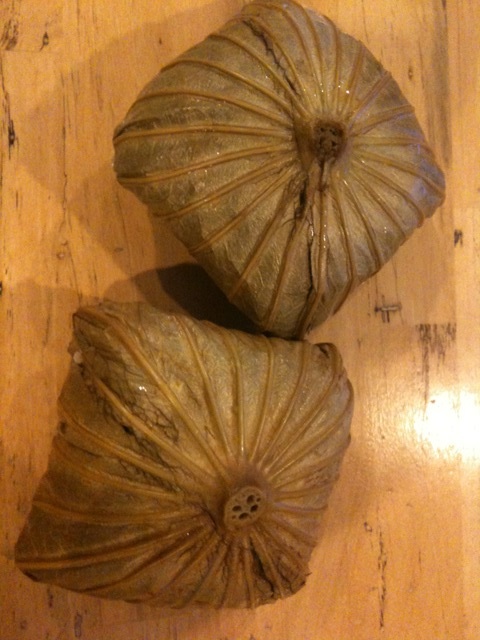
Lotus leaf-wrapped parcels, so mysterious!

Turns out it’s khao haw bai bua, or “lotus leaf rice” — wrapped in a convenient little package and steamed with gingko nuts, sliced pork, shiitake mushrooms, lotus seeds, Chinese sausage, dried shrimp and salted egg, a substantial hit of starchy flavor. There are two places along Rama IV (roughly across from the entrance to Sukhumvit Soi 22), a shophouse and a stand; the shophouse is the original and called “Khao Haw Bai Bua Lung Chu”.

The rice parcels are 35 baht each, and there are also Chinese-style steamed shrimp dumplings (kanom jeeb), 10 for 30 baht; flat stuffed rice noodles (guay thiew lod), 25 baht; and steamed white Chinese buns (salapao), 7 baht each or 3 for 20 baht. Atmosphere recalls a mix between an old-school Chinese restaurant and a nursing home, so I suggest calling in to take out.

What's inside

Khao Haw Bai Bua Lung Chu

2815 Rama IV Rd., 02-240-1812, 081-242-2533

Open: 8.00-24.00 daily

9 Comments

Filed under Asia, Bangkok, food, food stalls, pork, rice, Thai-Chinese, Thailand

Home in a Bowl

It’s been a hard transition back after three weeks of being a guest to other people’s lives. Now, it’s back to my own, and as great as it is, it also bears its own strange frustrations. For example, I’m working on a project that will never be finished. It just won’t. I have made a handful of sacrifices to edge it along to this point: throwing good money after bad, poisoning what used to be healthy relationships, transforming into a dyspeptic harpy. I have decided that these sacrifices are not worth it. I have moved beyond denial and anger to acceptance. TIT. This Is Thailand.

Is this bowl of comfortingly soggy rice, doused in pork broth and topped with a dusting of sliced scallions and indifferently poached egg, the taste of resignation? If so, resignation tastes pretty good to me. Located at the entrance to Charoen Krung Soi 16, this no-frills food cart employs a similarly Spartan approach to its rice porridges: good quality broth, stewed with pork bones for so long it has taken on an opaque, cloudy quality and a generous spoonful of bone-in pork pieces to guarantee a bowl full of piggy flavor.

Regular pork-rib porridge with egg

Regular (tamada) bowls are 35 baht, 40 baht with egg or for an extra-big serving of rice or pork (piset). And the guardian of this enterprise comes in the form of a gregarious gentleman, partial to form-fitting white tank tops, who is patient with questions and with giving directions. What more can you ask for? Thailand can confound and frustrate, yes, but it also harbors the path toward your own redemption. I am eagerly awaiting mine.

Khao Thom Gradook Moo, entrance to Charoen Krung 16. 089-682-0016.

4 Comments

Filed under Asia, Bangkok, Chinatown, Chinese, food, food stalls, pork, rice porridge, Thai-Chinese, Thailand

Accidental Fusion


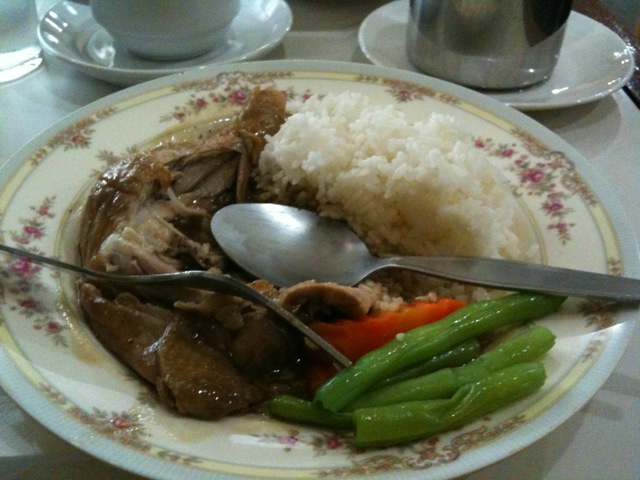
Chicken stew at Lertros


The four of you who read this blog may have noticed I’m not writing as often as I used to. The answer: I’m busy watching television. It’s called “having priorities”. Give me a break, mom, dad, @SpecialKRB and Mrs. Silverman! Haha, just kidding. My mom doesn’t read my blog.

But now that StarWorld is showing a rerun of “Britain’s Next Top Model”, I find I have the time to talk about my new favorite rediscovery. I’ve been rereading David Burton’s “The Raj at Table” and have been struck all over again about how historical events seep, unwittingly, into a country’s culture and cuisine. A silver lining from the British Raj: the ingrained sense of “superiority” that went with England’s colonization of India resulted in “English” food created from Indian ingredients that ended up an entirely new cuisine.

Not surprisingly (sorry Britons, I love Welsh rarebit as much as the next guy, but…), that culinary influence did not really go both ways. The English way of cooking had little impact on the Indians. But the ingredients they managed to transplant to their adopted country had tons: cabbage, lettuce, tomatoes (referred to as “love apples”), green beans, avocados and corn. Without the West’s potatoes, the Indians would not have come up with aloo gobi; without spinach, no saag paneer.

All the same, a lot of English food got more “Indianized”, and an entirely new Anglo-Indian fusion resulted, the most famous dishes of which are probably kedgeree (a rice porridge featuring smoked fish like Finnan haddock, which is why many mistook this dish for Scottish) and mulligatawny soup (what cynics called the “remnants of yesterday’s curry” in liquid form).

But there were other, no less noble, creations: country captain (chili- and turmeric-infused chicken); corned beef bhurta (borne out of the scarcity of beef in Hindu India); sweet potato chapatis; a”Madras Club Pudding” (using mostly dried fruit instead of the more expensive sugar for sweetness); and a “Sandhurst Curry” served in the officers’ mess alongside sliced bananas and shredded coconut. Many of these dishes, in some form or other, trickled their way through English cuisine, lending a touch of the tropical to the stoic roasts and hearty puddings of the north.

But I’m rambling. Again. I love these old-style dishes and have vowed to recreate them for my long-suffering friends and family (who have already had to put up with any number of “retro American” dinners of “perfection salad” and tuna tetrazzini) because they are perfect snapshots of an interesting point in time, irresistible to this girl who majored in Indian history (because I loved the food. Yes, really.)

Which is why I love going to Lertros Alacarte (74 74/1 Silom Soi 4, 02-234-3754). Its old-school diner ambiance — sort of like where the two old guys in “the Muppets” would hang out if they were to live in Thailand — is totally my style, and some of its food specials — a fusion of Thai-Chinese and Western — are becoming increasingly hard to find elsewhere.

Like the Indianized Anglo-cuisine of the British Raj, the story of this food (Chinese-style curries, chicken and tongue “stews”, minces and pork pate, or moo yaw) is primarily a political one. According to Chef McDang (yes, he has basically taught me all I know about non-Northern Thai food), King Rama IV sought to entertain the various Western officials at his court by  serving “Western” food. He used chefs who learned to cook in the employ of British officials; these chefs were almost always Chinese. The result: Western ingredients cooked with Chinese techniques.

So for one of the oldest forms of Thai-Western fusion out there, look no further than Lertros. And if you see Statler and Waldorf, steer clear.

6 Comments

Filed under Asia, Bangkok, chicken, Chinese, food, restaurant, rice, Thai-Chinese, Thailand