
Thai food: a focal point of the culture wars
I vowed never to talk about this again, but Sunday’s “Bangkok Post” opinion piece about the state of Thai cuisine drove me, once again, to the keyboard (I don’t have many interests, and nothing else to talk about). Like a Katherine Heigl movie, it starts out reasonably enough, and then somehow turns crazypants somewhere in the middle.
The basic premise is, modern Thai food has atrophied as a result of the culinary shortcuts commercial cooks take today, resulting in processed dreck that bears little resemblance to the dishes they are supposed to be (while this is very true, it sounds a little to me like running into a McDonald’s and complaining, “Why do they only use cheap ingredients? Why is everything so poorly made? Where is the care and thought put into my hamburger?”)
The media also deserve blame for the commodification of Thai food, concerning themselves only with “tasting this or that dish” and on “atmosphere and decor rather than offering any real knowledge concerning the food” (Because NO ONE cares about that stuff! Silly journos. Tell me once again about how the Indians and/or Portuguese inspired coconut milk-based curries).
Because of these shortcuts, Thais DESERVE to lose their mastery of their own cuisine. Because we’re so stupid! Now David Thompson has blown into town and his place is packed and that sucks, because our lives suck and so his should too! But we’ve done this to ourselves, because we bear witness to culinary crimes like this:
“…pizza with a dry version of gaeng kiew waan luk chin pla or with dry tom yum goong. These combinations are a slap in the face to both the Thai and Italian cooking traditions.”
First of all, what’s with all the slaps in the face? Is there no other way for writers here to convey getting insulted? No tug on the ear, perhaps, or maybe a kick in the pants? Get a new rhetorical device!
Secondly, well, I am no fan of crap-topped pizza either. That said, I’m sure someone probably thought tossing spaghetti with pla kem (salted fish) and dried chilies was once a daft idea, too. Now you wouldn’t bat an eye seeing this dish on a menu. And how did Thais take to the first bowl of khao soy, a “fusion” creation of egg noodles and coconut milk said to be invented by cooks in Chiang Mai from a dish originated by the Chin Haw Chinese-Muslim minority group?

Khao soy at Khao Soy Islam
(photo by @SpecialKRB)
I was lucky enough to get the chance to help work on the first English-language cookbook by Thai TV chef McDang (“The Principles of Thai Cookery”, in case you’re interested — it’s very good! Not that I’m biased or anything …) In it, Chef McDang discusses quite clearly how all the different parts of a Thai meal fit together (a minimum of five elements: a clear soup, a curry, a fried dish, a stir-fried dish, and a kreuang jim, or chili dip with vegetables), why Thais use forks and spoons (in order to kluk, or mix the different elements of the meal together to your liking), and how all the ingredients in a Thai dish are supposed to interact. That’s why traditional Thais get all crazy about substitutions like onions for shallots, or adding spring onions instead of coriander leaves.
That said, Thai cuisine is also the beneficiary of a number of foreign influences that have seeped in from interaction with the rest of the world over the course of Thailand’s history. In the Sukhothai period (1238-1438), we were scarfing down fish, fruit and wild boar on rice flavored with peppercorns, cilantro roots and palm sugar. And then, in the Ayutthaya period (1351-1767) the Portuguese came along, and gave us this:
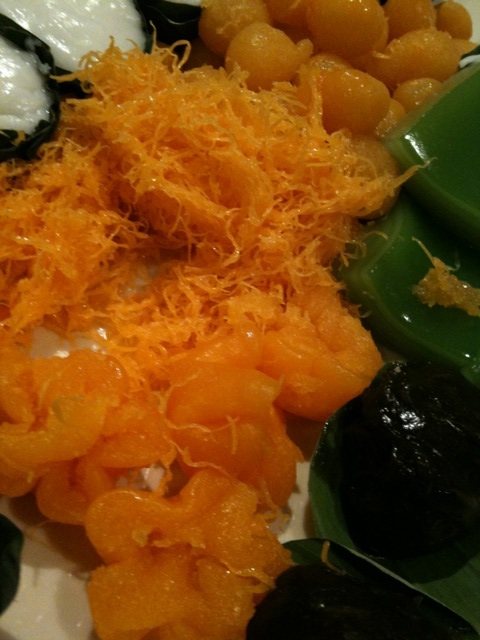
"Golden threads" and "golden drops": traditional Thai sweets that are also Portuguese
They also introduced us to eggs, tomatoes, potatoes, eggplants and sugarcane; co-introduced us to savory uses for coconut milk; and showed us a crazy new way to flavor our food with these things called “chilies”. They also found a way to form a curry custard by mixing fish and egg and steaming it; the result was called hor mok:

Steamed seafood curry at Aor Thor Kor
(Photo by @SpecialKRB)
And then there were the Chinese. What to say about the Chinese? Without them, Thai food would not be “Thai food”. From them we got: shrimp paste, fish sauce, the use of duck meat in cooking, pans, stir-frying, and frying. Another innovation: an interesting alternative to rice in the form of long, thin strands of rice flour (and sometimes egg-based flour), which can be served in soup, blanched, fried, or even in desserts. They are popular in Thai street food, so keep your eyes peeled for this rare, strange delicacy:
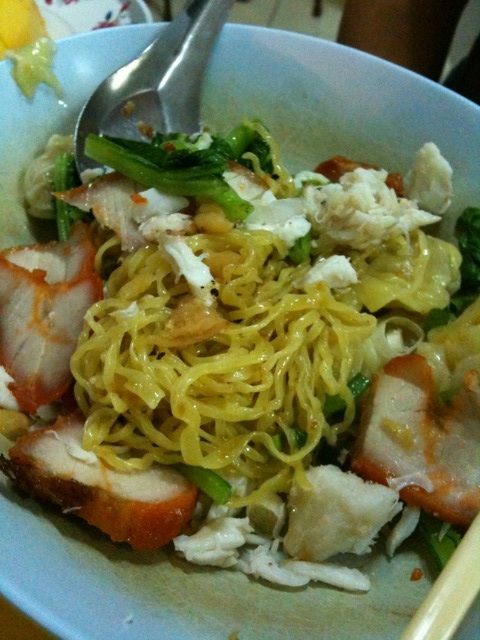
Bamee at Sukhumvit Soi 38
So sometimes fusion isn’t so bad after…..zzzzzzzzzzzzzzzzzzzzzzzzzzOh, sorry, you’re still here?
Thailand is at a point in its history where its future — like that of the rest of the world — is uncertain. Maybe people are unsure of where they stand and so long to return to a time when things seemed more secure. Food serves as a convenient stage on which to act out this current identity crisis. But that doesn’t mean we should shut out foreign influences, or, for that matter, a foreigner who is doing the exactly same thing as us.



 Bangkok Glutton