Category Archives: Thailand

Home in a Bowl

It’s been a hard transition back after three weeks of being a guest to other people’s lives. Now, it’s back to my own, and as great as it is, it also bears its own strange frustrations. For example, I’m working on a project that will never be finished. It just won’t. I have made a handful of sacrifices to edge it along to this point: throwing good money after bad, poisoning what used to be healthy relationships, transforming into a dyspeptic harpy. I have decided that these sacrifices are not worth it. I have moved beyond denial and anger to acceptance. TIT. This Is Thailand.

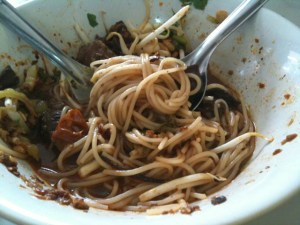
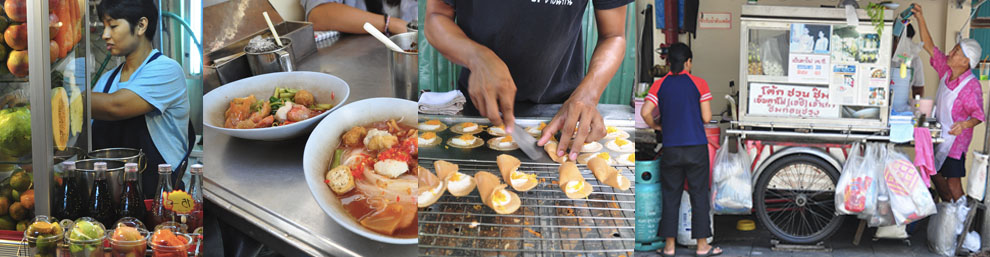
Is this bowl of comfortingly soggy rice, doused in pork broth and topped with a dusting of sliced scallions and indifferently poached egg, the taste of resignation? If so, resignation tastes pretty good to me. Located at the entrance to Charoen Krung Soi 16, this no-frills food cart employs a similarly Spartan approach to its rice porridges: good quality broth, stewed with pork bones for so long it has taken on an opaque, cloudy quality and a generous spoonful of bone-in pork pieces to guarantee a bowl full of piggy flavor.

Regular pork-rib porridge with egg

Regular (tamada) bowls are 35 baht, 40 baht with egg or for an extra-big serving of rice or pork (piset). And the guardian of this enterprise comes in the form of a gregarious gentleman, partial to form-fitting white tank tops, who is patient with questions and with giving directions. What more can you ask for? Thailand can confound and frustrate, yes, but it also harbors the path toward your own redemption. I am eagerly awaiting mine.

Khao Thom Gradook Moo, entrance to Charoen Krung 16. 089-682-0016.

4 Comments

Filed under Asia, Bangkok, Chinatown, Chinese, food, food stalls, pork, rice porridge, Thai-Chinese, Thailand

What nam ngiew means to me

Proper pork nam ngiew at Pa Suk in Chiang Rai

(Photo by @SpecialKRB)

Everyone has a dish that reminds them of their childhoods. This — and the “last meal” that a person would select were he or she able to choose — are two of the most illuminating things you can know about a person, telling you how they see themselves, and how they grew up. I’m not the only person to think this (although there is no “childhood meal” book — I mean, we have the TGI Friday’s menu for that); in 2007, photographer Melanie Dunea asked some of the most famous chefs in the world what meal would be their preferred parting shot, and the result was “My Last Supper”.

It turns out chefs are as varied as regular people when it comes to what they want, and the setting: Daniel Boulud likes Versailles, Gordon Ramsay likes home. Jacques Pepin, characteristically elegant, wants a hot dog; BLT chef Laurent Tourondel, a Krispy Kreme doughnut. Some even chose soundtracks, with U2 making an appearance (why? If it’s post-“Unforgettable Fire”, I shake my head and judge).

I really don’t know what my last meal would be. I used to say a cold lobster with mayonnaise; sometimes I think I prefer meatloaf with a side of mac and cheese. But neither of these dishes says anything about me. The dish that figures most prominently in my childhood, and the one I keep coming back to again and again in Bangkok (like a culinary Don Quixote, or an idiot) is kanom jeen nam ngiew, a Northern Thai dish of minced pork and/or beef and dried ngiew blossoms.
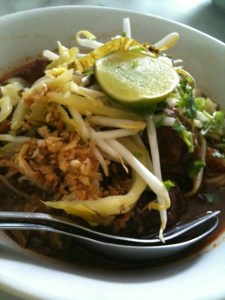
Nam ngiew at Yui Lee on Sukhumvit Soi 31

It is a widely accepted fact that good Northern Thai food is hard to find in Bangkok. This is not just a bunch of Northerners pissing and moaning about Central people mucking around with beloved old favorites (although there is some of that). For some reason, something is lost in translation that isn’t when it comes to any other region in Thailand, be it Isaan or Southern Thai. It’s not heat: actually, Northerners cannot compare to Southern Thais when it comes to spicy food. I think it’s the shortcuts that people are tempted to take with northern food, which features a lot of cut or shredded herbs and painstakingly put-together pastes (plus a lot of fatty cuts of pork to combat the “cold” weather). I cannot tell you how many nam ngiew noodles I have had missing the dried dok ngiew, or ngiew flowers, which resemble sawed-off broomsticks. The fact they still serve it without essential ingredients suggests laziness, and disrespect to the customer.

Yet I haunt every food stand serving nam ngiew, and order it at restaurants when I know I shouldn’t; against all logic, I want to find The One that will bring me back home. Home to New Castle, Pennsylvania, where I wanted to dine on cavatelli (“cavads”) like everyone else in my predominantly Italian-American town, and look forward to wedding soup or pasta fagioli (pronounced “fazool”) on holidays. Home, where I would see my dad in his pajamas stuffing his own sai oua on the floor of our kitchen and feel unaccountably embarrassed. Home, where my dad would have to refer to nam ngiew as “Thai spaghetti” to get us to eat what he cooked after a 14-hour work day. And it does resemble bolognese, after a fashion (possibly a reason why I LURVE spaghetti bolognese). But it’s much, much better — meaty and rich and a little bit macho, and, if you’re from Chiang Rai, skimpy on the girly tomatoes that effete Chiang Mai-ers use to balance out all that heft (Chiang Mai people, I jest. My mom’s family is from Chiang Mai).

So where is the best place to get this very special dish? My house, where I keep two bags of sauce at all times. Also, Chiang Rai’s Pa Suk, which probably has the best nam ngiew on earth (sorry, Chiang Mai). The sauce comes in pork or beef versions (beef is VERY beefy), with fermented rice noodles (kanom jeen) or regular guay thiew (rice noodles). Also, they offer a wide variety of pork rinds (kaab moo) because no bowl is complete without them.

Beef nam ngiew at Pa Suk

(Photo by @SpecialKRB)

But where in Bangkok? Ah, well, other people are probably better guides. (This one is good.) But I urge you to do something really crazy. You can do it yourself. Alas, the Duangnet family recipe is out of bounds. But if you don’t mind the tomatoey Chiang Mai style, here is the recipe from my great-aunt, Jiao Sri na Chiangmai.

Nam Ngiew (for 10)

Preparations:

1. Nam Prik: Grind the following together well

Dried pepper,     30 pieces

Dried Bird Chillis,   30 pieces

Shallots,    0.2 Kilo

Garlic,     0.1 Kilo

Shrimp paste (Kapi),   0.1 Kilo

Lemon Grass,    3 pieces (stems)

Salt,     1 tablespoonful

Grilled dried pickled bean paste, 0.2 Kilo

2. Next, boil until slightly soft:

Pork spare ribs, cartilage parts, 1 Kilo, cut into 1 inch pieces. Save cooking liquid.

To cook:

  1. Fry “Nam Prik” in hot vegetable oil in a big pot until it “smells good” (the inside of your nose tickles). Add 1 Kilo of ground pork and the cooked spare ribs. Stir until cooked. Add the soup from the cooked spare ribs. Then add 1 Kilo of cherry tomatoes, add cooked pork blood in pieces and 0.1 Kilo of dried “Ngiew Flowers”. Add 0.2 Kilo of Black Tao Jeao.

Boil in medium temperature until well blended. Before serving on kanom jeen, add fish sauce and lime juice to your taste.

  1. Serve with:
    1. Deep fried chopped garlic
    2. Chopped shallots
    3. Cut shallots
    4. Cut limes
    5. Cut pickled greens
    6. Ground deep-fried dried chillis

Bon appetit!
9 Comments

Filed under Asia, Bangkok, beef, Chiang Rai, food, food stalls, noodles, Northern Thailand, pork, Thailand

Accidental Fusion


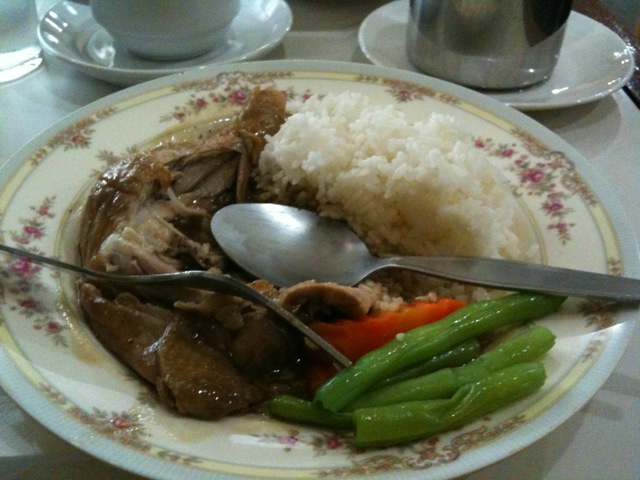
Chicken stew at Lertros


The four of you who read this blog may have noticed I’m not writing as often as I used to. The answer: I’m busy watching television. It’s called “having priorities”. Give me a break, mom, dad, @SpecialKRB and Mrs. Silverman! Haha, just kidding. My mom doesn’t read my blog.

But now that StarWorld is showing a rerun of “Britain’s Next Top Model”, I find I have the time to talk about my new favorite rediscovery. I’ve been rereading David Burton’s “The Raj at Table” and have been struck all over again about how historical events seep, unwittingly, into a country’s culture and cuisine. A silver lining from the British Raj: the ingrained sense of “superiority” that went with England’s colonization of India resulted in “English” food created from Indian ingredients that ended up an entirely new cuisine.

Not surprisingly (sorry Britons, I love Welsh rarebit as much as the next guy, but…), that culinary influence did not really go both ways. The English way of cooking had little impact on the Indians. But the ingredients they managed to transplant to their adopted country had tons: cabbage, lettuce, tomatoes (referred to as “love apples”), green beans, avocados and corn. Without the West’s potatoes, the Indians would not have come up with aloo gobi; without spinach, no saag paneer.

All the same, a lot of English food got more “Indianized”, and an entirely new Anglo-Indian fusion resulted, the most famous dishes of which are probably kedgeree (a rice porridge featuring smoked fish like Finnan haddock, which is why many mistook this dish for Scottish) and mulligatawny soup (what cynics called the “remnants of yesterday’s curry” in liquid form).

But there were other, no less noble, creations: country captain (chili- and turmeric-infused chicken); corned beef bhurta (borne out of the scarcity of beef in Hindu India); sweet potato chapatis; a”Madras Club Pudding” (using mostly dried fruit instead of the more expensive sugar for sweetness); and a “Sandhurst Curry” served in the officers’ mess alongside sliced bananas and shredded coconut. Many of these dishes, in some form or other, trickled their way through English cuisine, lending a touch of the tropical to the stoic roasts and hearty puddings of the north.

But I’m rambling. Again. I love these old-style dishes and have vowed to recreate them for my long-suffering friends and family (who have already had to put up with any number of “retro American” dinners of “perfection salad” and tuna tetrazzini) because they are perfect snapshots of an interesting point in time, irresistible to this girl who majored in Indian history (because I loved the food. Yes, really.)

Which is why I love going to Lertros Alacarte (74 74/1 Silom Soi 4, 02-234-3754). Its old-school diner ambiance — sort of like where the two old guys in “the Muppets” would hang out if they were to live in Thailand — is totally my style, and some of its food specials — a fusion of Thai-Chinese and Western — are becoming increasingly hard to find elsewhere.

Like the Indianized Anglo-cuisine of the British Raj, the story of this food (Chinese-style curries, chicken and tongue “stews”, minces and pork pate, or moo yaw) is primarily a political one. According to Chef McDang (yes, he has basically taught me all I know about non-Northern Thai food), King Rama IV sought to entertain the various Western officials at his court by  serving “Western” food. He used chefs who learned to cook in the employ of British officials; these chefs were almost always Chinese. The result: Western ingredients cooked with Chinese techniques.

So for one of the oldest forms of Thai-Western fusion out there, look no further than Lertros. And if you see Statler and Waldorf, steer clear.

6 Comments

Filed under Asia, Bangkok, chicken, Chinese, food, restaurant, rice, Thai-Chinese, Thailand