What’s Cooking: Yum

A "three-way" yum of shrimp, pork and dried fish at Polo

A “three-way” yum of shrimp, pork and dried fish at Polo

I’ve been away, so I haven’t had as much Thai food as I’d like. Although the world is full of what I’m sure are great Thai restaurants that venture beyond the sour-sweet stir-fries and chicken with cashew nuts that we all know and will perversely miss some day, I have a general rule about not eating Thai food when I’m out of the country. It is usually — not always, but a lot of the time — a pale shadow of what I’d get at home. Since I live at home, why don’t I just get it there?

But I find that the thing I miss most when I’m away is the spicy-sour-sweet melange of what-have-you called, fittingly, “yum”. It’s room temperature and chopped, perfectly made to eat in greedy mouthfuls with a spoon — the bigger, the better, hopefully alone so that you don’t have to share. It’s made up of things that might not tantalize on their own, like tiny dried fish or julienned banana blossoms or blanched Chinese kale stems or even chopped lemongrass bulbs. Its variations are infinite, but the overall effect of the dish is the same: a bit of spice, a lot of tart, some fish sauce, some sugar. Some heft in the form of a smoky grilled eggplant, or lightly cooked shrimp. Something light and refreshing, like lettuce. And always some texture, some crunch. It’s the very definition of something that is better than the sum of its parts.

The sky is the limit when it comes to thinking up yum salads of your own, so it’s probably not surprising that many families have their own favorite yum recipes. My husband’s family is no different. When they get together, you can be sure to find a big vat of beef green curry (gaeng kiew waan nuea), some fermented rice noodles (kanom keen), a bit of roti, and, in a nod to the Japanophile tendencies of modern-day Bangkok, some pickled ginger. Also on the table is a big brimming bowl of yum soon sen, a “salad” of glass vermicelli that is a far cry from the anemic glass vermicelli salads I have had anywhere else. With its mix of palm sugar and coconut milk and tamarind juice, this salad recalls more of the luxurious sweetness of a good mee Siam you’d find on the southern Thai border, and less of the cartoonish “hot ‘n spicy” of a package of Mama tom yum noodles. It’s sort of like eating garlic bread for the first time again.

Obviously, I lack the self-discipline to stop and take a photo of this dish, so you will have to be content with a photo from Karen, taken at the beginning of a family banquet when everyone was being too polite to be the first to tuck in:

_DSC8021

Yum woon sen in the earthenware bowl in the middle, surrounded by everything else anyone could think of on that day

 (Photo by Karen Blumberg)

I have to admit, I had a bit of trouble securing this recipe from my husband’s aunt. These things aren’t easy to come by. So if there’s something that might be missing, or some cooking step that someone may have forgotten to mention, well … don’t look at me. I’m just the messenger.

Yum Woon Sen

Ingredients:

–       500 g woon sen (glass vermicelli)

–       1 kg shrimp, cleaned

–       shredded kaffir lime leaves (for garnish)

–       1 L coconut milk

–       1 kg shallots

–       25 g dried chilies

–       150 g tamarind juice

–       5 Tbs fish sauce

–       150 g palm sugar

–       unscented cooking oil (for stir-frying)


To make:


  1. Soak glass vermicelli in water for half an hour.
  2. Mince and then stir-fry shrimp until pink, let rest.
  3. Slice and fry shallots until opaque.
  4. Split coconut milk into two portions, the add palm sugar, fish sauce, and tamarind juice (juice only). Mix, and heat until boiling, stirring occasionally. Set aside.
  5. With the remaining coconut milk, “stir-fry” glass vermicelli that has been drained. Add other coconut milk. Add shallots, leaving some for garnish. Add chilies, sliced roughly. Stir-fry until dry. Scatter julienned kaffir lime leaves and remaining shallots over the top as garnish.


11 Comments

Filed under Asia, Bangkok, food, noodles, Thailand

Glutton Abroad: In the Japanese hinterlands

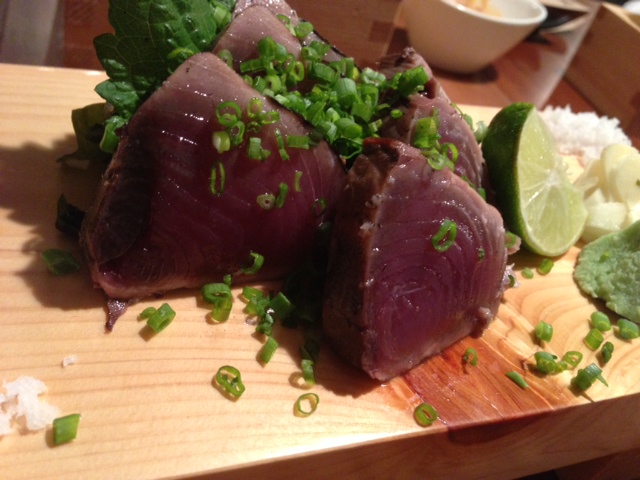
To celebrate the season: grilled matsutake and tuna sushi at Garyu in Tokyo

To celebrate the season: grilled matsutake and tuna sushi at Garyu in Tokyo

The sign said it would take 3.5 kilometers to reach the lip of the crater overlooking Tamagawa Onsen, a hot spring resort in northern Honshu that is believed to host the most acidic waters in all of Japan. This — paired with the presence of a radioactive stone thought to aid health and even combat cancer — has drawn the health-afflicted from all over the country, to lie near the fissures that hiss a thick, hot sulphuric steam.

Now, I’m not one to say what does or doesn’t work, healthwise or any-which-way-wise, really. But I am hesitant to lie on steaming hot rock smelling egg salad farts all day if there’s not a great reward guaranteed at the end of it — something like David Chang hand-feeding me Korean tacos maybe, or the Steelers winning a single game.  Neither of those things looked likely. We were going to go for a walk.

A rock-strewn path winding through the “onsen” — a collection of steaming vents around which people were lying or sitting — turned into several stories’ worth of stairs, and then a muddy incline riddled with rocks and tree roots. Treachery lurked everywhere, in every slippery stone, slick of mud, thorny branch. Whenever one stretch was finished, another would peer out from around the corner. I consoled myself with thoughts of recent meals: mashed mountain yam topped with a wasabi-flecked seaweed; peanut tofu daubed with more wasabi; a virtual downpour of awamori, an Okinawan liquor brewed from Thai rice and kept in urn-like earthenware vessels for decades. In Okinawa, despite the occasional monsoon-like shower, the sky was always blue, people were always smiling, and taco stands, inexpensive fresh fruit and ice cream cones (with seasoned salt!) were everywhere to be found.

Peanut tofu at Shine of Ryukyu in Okinawa

Peanut tofu at Shine of Ryukyu in Okinawa

But Akita was something different. Proud of its rice and udon noodles, and abundance of apples, and mountainous terrain: Akita held little to fall in love with for a Glutton like me. And now stranded on a thickly wooded hillside — did that sign say I’ve only walked 1.8 kilometers?! — I was running out of steam.

Singing along to what appeared to be a Discman, an old lady — maybe 70, although it is hard to tell here in Japan — emerged on the trail, laughing when she saw my husband and me. A quickfire barrage of questions in Japanese ensued, to which we could only smile and nod. That made her love us  more. Declaring us wonderful, she took our picture, and then when we made motions like we would, against our better judgment, continue on the path, she followed, chirping happily all the way.

Now I feel that, despite much evidence to the contrary, I am actually a pretty fit person. I work out with a trainer 2-3 days a week, do a day of TRX training a week, and run an hour on the treadmill on my off days. Just this past April, I walked 200 km on the Camino de Santiago. But this septuagenarian lady wearing what looked like orthopedic shoes smoked me on the trail. Huffing and red, with sweat stinging my eyes, I could only watch as her trim figure clambered up the rocks and jutting tree trunks ahead of me. She turned around to offer encouragement. “All this walking will make you slim!” she said, effectively sealing my humiliation.

Powered by the knowledge that turning around and walking back would be just as hard as forging ahead, the hope that our walk was nearly done, and our lady friend’s occasional interjections of “GO GO GO DE GOZAIMASU”, we finally reached a ridge where we could see the white barren crater that marked the top of our hill, and the onsen stretching below. Our friend said we had 300 meters to go, which is, in the normal world, nothing, a mere walk to the grocery store.

But this 300 meters yielded an exercise in sheer WTF-ery: a steep ascent carpeted with cut bamboo stalks that ensured a slip with nearly every step. As if to mock us, ropes hung from some sections that were particularly steep — up to 80 degrees. After a few minutes, that was it: I was okay with curling up and dying, and with the thought of my body eventually washing away on the rotting bamboo into the waiting valley below. We had been walking for more than two hours. Above us, our friend scrambled from point to point like a mountain goat, exclaiming things in Japanese to either us or to herself. “You can do it!” my husband said, trying to boost me, but since it was not in Japanese or from the mouth of a friendly old lady, I wanted to punch him in the face.

Yet it was easier to pull oneself up, each step by agonizing step, than to turn around to face Lord knows what. Better to deal with it later. Eventually, in spite of myself, we made it to the top. The Japanese lady, of course, was nowhere to be found.


7 Comments

Filed under Asia, food, Japan

Glutton Abroad: Bongiorno Lampedusa

Tuna skewers and white mullet dusted with pistachio, garnish of the gods

Tuna skewers and white mullet dusted with pistachio, garnish of the gods

I have known The Italian for 22 years. During our freshman year at Bryn Mawr, she lived at the end of my hall in Pembroke West. Even then, she was an effortlessly chic little blond tornado, a glamorous chain smoker with an Italian-accented Stevie Nicks croak, a high-heeled aficionado of Valentino and Missoni at a time when I was still wearing red plaid pinafores from Talbots picked out by my mother.

So when the time came for The Italian’s 40th birthday party, I was on board. A shame it was at a place that the Italian embassy workers in Bangkok claimed didn’t exist. “Lampedusa?” they said. “No, that is not in Italy.”

We checked our birthday invitations again. “But it is Italian,” we said. “It’s an island that belongs to Italy.” But only a phone call from an actual Italian person would persuade them. Even then, they were skeptical. No one had ever heard of this little island before, including me.

It turns out Lampedusa is the southernmost part of Italy, a pebble skipping off the toe of the boot, landing somewhere between Tunisia and Sicily. The island spans nearly 8 miles, and is home to about 4,500 people, who speak “Lampedusan” — a mish-mash of Italian, French and Arabic that is incomprehensible to the regular outsider. The dry, rocky soil means vegetables can be hard to come by, as is most meat (although a herd of goats did live nearby, roaming the hills around our rented cottage in an area charmingly known as “the Bay of Death”). The only thing this place abounded in: seafood, and plenty of it.

While Lampedusans may be considered a breed apart, their cooking is purely Italian — Sicilian, to be exact. The mussels and clams that proliferate in the azure waters around the island are melded with scampi, garlic and tomatoes in a sauce for pasta. Sometimes, bits of tuna or red snapper are mixed with spaghetti and crowned in pistachio dust in the way a Roman would scatter grated Parmesan. Mullet and tuna are simply grilled, or, if it’s a fancy place, once again dusted with pistachio (and then grilled). Bits of octopus and/or scampi are marinated and served as a ceviche; rings of calamari are lightly breaded and deep-fried.

A photo of marinara sauce on the boat, blurred by the tossing waves

A photo of seafood marinara sauce on the boat, blurred by the tossing waves

As for the sweets, fuhgeddaboudit (I’m sorry. This is the last time I do that, I promise). There is a ton of gelato, of course (I am told the best “tests” of a gelato’s quality are the pistachio and banana flavors). There is Sicilian-style granite, or finely shaved ice (coffee is, inexplicably, the most popular flavor, it would seem). There are ice cream cakes mixing coffee, pistachio and strawberry flavors. So there are all these things, but only one thing matters to me, and that is cannoli: tubes of fried dough that are filled with a ricotta-augmented cream. They are super-sweet and occasionally delectable treats while eaten at a place like Veniero’s in the East Village; in Italy, they are the greatest things to have happened to the world since Michelangelo and da Vinci.

Sicilian-style cannoli at Pizzeria Dell'Amicizia

Sicilian-style cannoli at Pizzeria Dell’Amicizia

But all this fabulousness has a price, of course. Over the week, I hit a bit of a seafood wall — there is just too damn much fish. TOO MUCH FISH! Fish, everywhere, forever and ever, purple mountains of it, and fruited plains too. You see, Lampedusans love their seafood, especially their sgombro — a bonito-like fish of which they are inordinately proud that is eaten in everything including sandwiches, paired with capers and onions. Let me tell you how much they love their seafood: there are SEVERAL types of fish-based baby food. Mull(et) over that for a while.

Fish baby food on the supermarket shelf

Fish baby food on the supermarket shelf

Meanwhile, if the water is a little rough, ships can’t cross over, and you are left with a few heads of wilting romaine lettuce, a couple of withered Sicilian cucumbers, and the disheartening sight of NOTHING at the meat counter:

Karen, in line for nothing

Karen, in line for nothing

At a low point, my husband and I stop at Gerry Fast Food, where we are told we can get a fix of some sweet, sweet, meat. What we get: boiled beef lung and tongue, spritzed with lemon juice and enclosed in a plain hamburger bun. We eat all of it. But we never want to go back to that ever again.


8 Comments

Filed under food, Italy, restaurant, seafood