What’s Cooking: Jay Fai

Image

On the menu at Jay Fai

It was an interesting proposition: turn out some recipes inspired by my favorite street food stalls. Of course, I would never get the exact recipes from these folks, however lovely they are; in the street food world, recipes are family heirlooms, to be guarded as insurance for the next generation.  Instead, the recipes we end up with would be approximations, wild guesses, stabs in the dark — love letters to the originals in the hope that imitation really is the sincerest form of flattery.

To aid my on my quest, I enlist the help of my friend Chris Schultz (http://christao408.xanga.com), one of the best home cooks I know. We would do a total of 15 dishes over the course of three months. Some would be simple, chosen for their (expected) ease. Others would take more work refining. All would, eventually, hopefully, fingers-crossedly, be delicious.

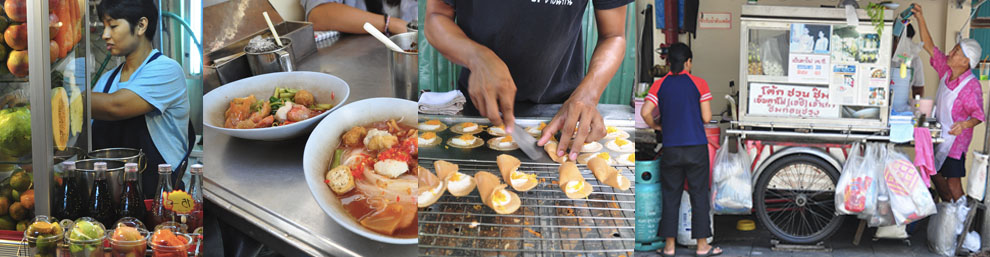
There is no question that Jay Fai (327 Mahachai Rd., 02-223-9384) is one of my favorite street food vendors. A middle-aged lady in a woven beanie and a slash of lipstick, Jay Fai plows through an extensive repertoire of made-to-order favorites, solo and with the help of two searing hot woks. Her fried noodle dishes are to die for: punters frequently argue over which is her best, wavering between her “drunken noodles” (guaythiew pad kee mow, so called because the grease and spice are good hangover remedies) and her crispy noodles in seafood gravy (guaythiew lard na talay). Her crabmeat omelet, currently holding at 900 baht/serving, is a Japanese-inspired eggy roll stuffed with mammoth chunks of white, juicy crabmeat; hers is the only kitchen in town to serve a “dry” congee (jok hang), a gelatinous splay of broken-in rice grains topped with a tumble of shredded ginger and scallion. I could go on.

But it’s possibly her spicy lemongrass soup with prawns (tom yum goong, priced at an astronomical 1,500 baht/bowl) that intrigues me most. It’s a dish that everyone knows, but I suspect few bother to tinker around with. Have you ever made a tom yum? I ask because, despite the “infusion”-style broth that simply calls for throwing a handful of bruised herbs into water at a rolling boil, this soup is hard to excel at.

Boil 6 cups water, toss in a handful of bruised galangal, 7-8 kaffir lime leaves, 4 bruised lemongrass stalks , a shallot or two, a couple of green peppercorn branches and 4 chilies; a few minutes later, throw in 3 Tablespoons fish sauce and at least 3 limes’ worth of juice, take your pan off the heat, and add your 8 cleaned and shelled jumbo shrimp; stir around in the muck until your shrimp blush a deep red, then garnish with coriander leaves — this is tom yum made the traditional way. Yet the flavor is … underwhelming, warmed-over Lean Cuisine after two days in the refrigerator. Where is the heat? Where is the tart? I was missing the fireworks, but without sticking an entire forest of dreck into the broth, what was I to do?

Image

Jay Fai’s tom yum goong

The verdict: I can’t hope to replicate even half of the flavor Jay Fai gets with her tom yum by doing a straight-up infusion. There is a chili paste in there somewhere. In the coming days, I will pound fresh chilies, garlic, shallots and herbs with my mortar and pestle and see where that gets me; I’ll also roast the chilies, garlic and shallots before pounding a second batch and compare the two. I’ll try another with roasted chili paste (nam prik pao), and in yet another, I might even add a dash of coconut milk. What do you think? There is a grocery store’s worth of places where this can go. 

Until then. The leftovers beckon.

Image

My tom yum

14 Comments

Filed under Uncategorized

Saying a little prayer

Image

Calling the universe

When did it become commonplace to request things of “the universe”? To treat the Great Beyond of one’s own body like a great big glossy catalog, peopled with goodies that can be purchased with the power of some good old-fashioned positive thinking. Ask of the universe, and you will receive. Isn’t this what “The Secret” is all about?

Well, I’m a Presbyterian, but I’m not averse to getting a little extra help when I really really need it. This is when I look to my fellow Thais for guidance. They, too, have their own way of asking something of the universe, and it doesn’t involve sitting through a two-hour sermon in a hard wooden pew. It’s called “making merit”, and it involves a trip to a shrine or temple, a few joss sticks, and a whole lot of smoke. One of the more famous of these places to merit-make is the Erawan Shrine, home of the four-faced representation of the Hindu god Brahma, god of creation. 

I’ve been twice. The first time, I purchased some incense sticks and candles, prayed a bit, copied the woman next to me, and left. When a Thai friend asked me what I asked for, I told him.

“I prayed for peace of mind,” I said.

That was met with a sigh. “That’s not how it works,” he said. 

I was going to do it right this time. This time, I want more than “peace of mind”. I mean, what is that anyway? What was wrong with me? I might as well have been asking for blond hair and a Kennedy boyfriend. No.

So after a lunch at Erawan Tea Room, which I had assiduously avoided for 100 years because I have a phobia of chichi-looking Thai restaurants, James and I amble next door to the shrine and attempt to … get some advice. The first vendor shilling marigold garlands, incense sticks, candles and miniature figurines is only too happy to show us the ropes — personally. Her neighbor, who happens to be her daughter, helps load us up with everything we need. I get the bare minimum (incense, candles, vaguely female-ish figurines) and James gets a deluxe (incense, candles, elephant figurines, and four coconuts for each of Brahma’s sides). 

Now, this could be enough, for some people. Some think that all you need to do is make these offerings, say your little prayer, and promise more (a performance by Thai dancers, an army of hard-boiled eggs) once your wish is granted. This must work sometimes. After all, those Thai dancers seem to perform fairly frequently. 

But my friend says you must make a sacrifice for it to stick. This resonates with Gluttons for punishment like James and me. So I tell myself I will give up sweets. Forever. If my wish is granted.

We approach the shrine, silently say our pieces, and go our merry ways, our guide and her daughter in tow (women go clockwise, men counter-clockwise). At every face, we light our incense and candles (this proves to be a challenge) and try to find places to stick them (an even bigger challenge). I burn myself twice, topping my avatar figurines in the process. I don’t know if this is a bad thing. 

We come out, smelling like a college dorm room. I am tempted to gorge my entire eating hole full of every sweet I can find. Melt-in-the-mouth pastel-colored cupcakes flavored with pandanus leaf; egg yolk-and-sugar tear droplets and thread bundles; palm sugar cupcakes topped with shredded coconut. I’d take them all. But I don’t. I’m waiting for the universe to answer me.

It seems a drastic move to give up sweets, but I don’t feel the pinch yet. What to eat instead? It’s hard to beat kanom jeeb, the Chinese steamed shrimp dumplings that probably number among Bangkok’s very first street foods, wrapped in tiny banana leaf bowls like little candles. My favorite right now is at a stall in Yaowaraj, in front of an outdoor plaza off of Songsawad Road next to the famous fish meatball noodlery Lim Lao Ngo, open after dusk. You know you are at the right place when you see this man:

Image

Kanom jeeb man

The size of large lychees, smelling of deep-fried garlic, kanom jeeb are not a sweets substitute, but who needs them anyway? They are enough, for now. 

And if my wish is somehow not granted? A whole universe of sweets awaits.

Image


14 Comments

Filed under Uncategorized

Mr. Right Now

Image

The khao soy vendor’s kanom jeen nam ngiew

Like a dog at a bone, I am constantly worrying at my love for the northern Thai dish kanom jeen nam ngiew, watching it fray at the edges as I sample dish after watered-down dish, chasing after the What when I don’t have the Where, Who or How. Because, you see, I live in Bangkok, where street food is wonderful, but northern Thai street food sometimes less so.

The Bangkok attitude to the north appears to be how Northeastern Americans view people living in the Southern US. They may be “charming” and “quaint” at best, or characterized as “rural” or “backward” at not-best. Both regions might house poorer residents and nurse chips on their shoulders about being looked down upon by the “educated elite”. The people of both areas might speak more slowly, in voices that might sound like sticky drawls. And both places certainly have incredible food where meat plays a major role, yet their cuisines might be looked at askance by the less adventurous as “weird” (please Google “The Ravenous Guide to Eating Like Elvis”) or just plain bad for you (ditto).

But the stomach-minded — and there are many of us out there — may see this food as achingly exotic. That is the case for me when I’ve been in Bangkok for a while. And although there is plenty of tried-and-true Isaan food to be had (the real stuff, not the sugary red candy posing as grilled chicken or pork shoulder at some Bangkok stalls) thanks to the city’s many Isaan residents, for some reason (and no, I don’t really know why this is), northern Thai food here is not as well represented.

So when a northern Thai food stall turns up just around the corner from the end of my street, in a barren expanse of concrete next to what appears to be a government compound, it’s exciting to me, the way a barbecue place in New York might be exciting to someone else. And it might not really be the same as what you’d find in its home setting (think of that NY barbecue place), but it’s good enough. Meet khao lad gang (curry rice) stall Khao Soy Chiang Mai (71 Ajnarong Rd., 02-672-7711) and its collection of northern Thai specialties like gang hang lay (Burmese-style pork stew), gang ho (northern Thai-style goulash), sai oua (northern Thai sausages), nam prik ong (pork-and-tomato chili dip), excellent larb moo kua (minced pork salad), and of course, khao soy and kanom jeen nam ngiew, without which northern Thai street food would be irreparably hobbled. Competent renditions all, with some green curry and shredded fish curry to go with your kanom jeen when you’re just not feeling the northern Thai food at the mo.

Image

The sign for Khao Soy Chiang Mai

It’s that little watering hole in the desert. The exit from a crowded dance floor. The guy who invites you out at 6:30pm on a Friday night. It’s not the end-all be-all. But it’s good enough for now.

6 Comments

by | 02/22/2013 · 10:51 am