Glutton Onboard: Yes, really, this time in Alaska

View of Seward from the ship

(Photo by Chatree Duangnet)

Ketchikan

Ketchikan was a city that couldn’t seem to get a break. First founded in 1885, Google tells us that this town burst onto the scene, fully-grown as if Athena from Zeus’ head, as a salmon cannery, but our guide Nathan — giving strong Starsky & Hutch vibes — tells us a different story. Ketchikan was born from what most towns in Alaska seemed to be born from: the centuries-old search for gold, and lots of it. Alas, Ketchikan had none.

So then the enterprising inhabitants latched onto selling a resource that was clearly in abundant supply all around them: lumber. Alas, that was also short-lived, as the surrounding temperate rainforest became Tongass National Forest, its 16.7 million acres of largely old-growth forest protected. So then, finally, Ketchikan turned to the scores of fish in its waters: of course I’m talking about salmon.

The town’s fishermen came up with a method of “fishing” that involved huge nets that caught gazillions of fish at a time. This led not only to a drastic decrease in the fish population, but also big caches of fish that were kept frozen in warehouses and parceled out for market days. Somehow, this led to fish pirates, because this is Alaska. The pirates would break into the warehouses, steal the fish, and then sell them before anyone else had had a chance to get to the market. This turned into a full-out turf war that led to people getting killed. So that method of fishing was outlawed in favor of traditional old line-catching. And this is where we find Ketchikan today, as a thriving salmon cannery that has enabled the town to call itself the “Salmon Capital of the World“.

Of course, I do not partake of the salmon. Somehow, I find my way onto a tour that promises a feast of (thankfully in-season) Dungeness crabs. It would be an all-you-can-eat affair. Naturally, I am psyched.

I have had Dungeness crab before, in Seattle, where you are armed with a nice plastic bib and a little wooden hammer and all manner of other instruments to help you pry out every last bit of meat. We have no tools of that kind here, except for our forks. Our “crab lady”, who spends her days plonking cooked Dungeness crabs onto the plates of busloads of people every two hours, shows us how to open the crab legs using the fork like a letter opener. The shells are surprisingly cooperative, revealing large, juicy and sweet sleeves of meat. The only thing missing is (alas again!) some Thai seafood dipping sauce.

We only last two rounds until we are forced to call it quits by our traitorous stomachs, but a few champs last three. No one makes it to round four.

Juneau

Reindeer sausage “mini corndogs”

Juneau is the capital of Alaska. It is also where the real Alaskan summer begins to kick in for us, meaning torrential cold rain, nonstop. This renders things like a walk around the Mendenhall Glacier park an absolute chore, and the fact that it is a food-free zone makes it even gloomier. I stupidly forego breakfast in the mistaken belief that our tour was an eating tour, and am hungry enough to consider buying the Alaskan kelp salsa in the gift shop and pouring that into my mouth straight from the jar in a secluded corner of the visitor’s center.

I’m just setting the stage for what happens next. We are at a brewery now and there is no food at our tasting. The beer is nice (although strangely no sampling of spruce tip ale) but it’s almost 2 in the afternoon and I haven’t eaten anything. There are two food trucks in the parking lot, and I think I should be able to hide my inner monster until after the tasting, when I can run away to order something while other people are getting more free beers.

There is someone already ordering at the halibut slider truck, so I go to the next-door pizza truck, which has somehow been visited by Guy Fieri. Those precious minutes are key, after all. I am about to place my order when our guide shouts out from the bus, “We are about to go to a restaurant next!”

I know this, but do not know how much food will be offered. If it’s not enough, I will kill everyone in my immediate vicinity. This is a calculation, not only for me, but for everyone: my husband, my sister and brother-in-law, their young son Remy, and I guess whoever else is on this stupid tour.

“I know, it’s just a snack!” I shout back from across the parking lot. “I haven’t eaten all day!”

Nevertheless, she persists. “It’s a lot of food at a really nice restaurant,” she says, and I wonder if I have read the tour notes correctly, because she makes it sound like we are about to have a 10-course meal. Still, in this state, I think I can swing both the pizza and the 10 courses.

She finally relents. “You can’t eat on the bus!” she says, but that is ridiculous, there will be no pizza left, SHE NO KNOW BANGKOK GLUTTON.

I choose an artichoke white pizza and go to town under a little overhang from the rain, and eat one of my brother-in-law Sergio’s halibut sliders as well. It comes with UFO-shaped fries that Sergio offers to our guide after she continues, somehow, to talk about the foolishness of getting food when an enormous repast is waiting in the wings. She agrees the fries are good. She refuses my offer of a slice.

Finally, we pile onto the bus for our last stop, Alaska Fish & Chips Company. I think, are we about to get a repeat of the Dungeness crab fest, but this time with king crab? What we end up with is a cup of salmon chowder and a halibut fish stick with house-made tartare sauce. It’s nice. But LOL FOREVER.

So we get a table outside, and eat the king crab feast I had been dreaming about in the first place. It’s pricey (around $100 for two legs), but in this case, two legs are more food than you’d expect. I’ve had king crab before, presumably from Alaska even, but nothing prepares me for the fat, juicy, not-dry-at-all meat from two gargantuan crab legs that are easily the biggest I’ve ever seen (and that includes Hokkaido snow crab). Less popular are the mini-corndogs made from reindeer sausages (not nice, sorry) and my husband also orders halibut fish and chips for some reason. I eat some chips to be nice.

Skagway

Madame Trixie Turner at the Red Onion with original “red lantern” announcing when brothel was open for business

Our tour is not food-related today. Instead, we are going on a “Good Time Girls and Ghosts” tour, because any mention of “ghost” and my sister Chissa and I will come running. Sure enough, we are outed as ghost enthusiasts within the first few minutes of the tour, because a majority of it revolves around “good time gals”, of which there were many in Skagway.

While Ketchikan had no gold, Skagway had much. Or, more accurately, was the gateway to it. So many people flocked to Skagway to find their fortunes, in fact, that a law was put in place to force fortune hunters to bring their own 1 ton of goods to town, enough to subsist on for one year. Out of the millions who came to Skagway, maybe a few hundred found gold; about 100 made their way back to Skagway with it; and a mere 20 or so were able to leave Skagway with their fortunes intact.

Where there are fortune hunters, there are good time girls. There were three classes of these girls in Skagway: the street walkers, self-explanatory, who made about $1 every 15-minute session (overly generous?); the “boudoir girls”, tucked away in rooms off of the street, who made $3; and the ones in brothels, who worked from their rooms (free with board), had madams, and bouncers for protection. These ladies made $5. In contrast, ladies working the more “traditional” jobs — teaching, factories, food service — made maybe $3 a day.

It is during a stop when we finally discuss some ghosts (one with OCD and another genuinely scary one that Chissa thinks she can hear in the wind) when a familiar, non-scary face turns up in the park behind us. It’s @karenblumberg, somehow, entertaining her 4-year-old niece during a two (!)-day stop in town. So long has she been in town, in fact, that we almost immediately start shouting Skagway trivia to each other as we make plans for lunch later (“Do you know they had to transport 1 ton of goods all the way to Carson City on their backs?” “Did you know those goods included a mandated 150 lbs of bacon?” and so on and so forth).

Later, at the Red Onion Saloon — home to a “brothel museum” where items on display range from nighties and combs to old-timey nudes of the saloon’s ladies confiscated from the home of a local judge — we discover its main business is as a pizzeria. We finally get citrusy spruce tip ale (“Do you know spruce tip has medicinal purposes?”) and a couple of pies, as well as the inescapable salmon dip, replete with Saltines (which I believe is the traditional and best way to serve this dish).

Hoonah

In-season halibut and sockeye salmon on the grill

Throughout our journey, we have touched on the indigenous community (especially in Ketchikan with its famous totem poles, which I did not visit), but Hoonah is majority Tlingit, giving it a different vibe from the rest of the cities we’ve visited. Deer carouse openly in the grass and brown bears roam the riverside, leading to a closure of the nature trail on that very day. To get to our destination, this time a cooking class, we board a gondola that takes us to a mountaintop crowned with a complex of shops, restaurants and a strangely realistic cannery museum.

We’re here to learn from Crystal, who is partly indigenous and partly from Texas. After demo-ing a salmon dip (of course) and an unexpectedly decent “salmon nori bake”, she expertly fillets a halibut and sockeye salmon and we are left to our own devices, seasoning our pieces and grilling them outdoors ourselves. A guy outside, who informs us he would otherwise be fishing, is able to tell from sight when our pieces need turning and when they are done. All the same, I see some real culinary crimes happening, right in front of my eyes. Naturally, I think my halibut and salmon are top-notch.

Crystal with a halibut

Hubbard Glacier

And here, I’ll leave you with a photo that my dad took. This is because I did not see the Hubbard Glacier. Instead, Chissa and I were getting massages, because we thought our mother wanted a massage after she told us she wanted a massage with all three of us. She cancelled, but only for herself. Pre-treatment, I manage to see numerous chunks of blue ice in the water before we get to the glacier, and feel like I can relate to it: falling apart for the entertainment of others. On the massage table, I have several epiphanies about the need to draw stronger boundaries.


4 Comments

Filed under Uncategorized

What’s Cooking: Pad cha

I am a big believer in karma. It always works, but it takes longer to set in for some. Of course, when it comes to karma visiting me, the payback is always prompt, and well-deserved. But I like to think that people who do me an ill turn eventually get their own visits from Lady Karma, too.

Now, it’s been a while since I talked about deeply personal stuff in very cryptic terms. But at the very beginnings of this blog, well nigh on 1000 years ago, it was always meant to be a sort of “dear diary” type entity, something I have tried to explain to people who contacted me about guest posts. These are my stupid dumb thoughts, I would say, so maybe you should find a better outlet. After all, it was in this blog where I wrote about friendship breakups, professional woes, and self-image problems. But I, too, eventually strayed from the personal aspect of this thing, thinking it would be far more professional and mature of me to stick to exploring Thai food.

Today, I’m like naaaaaahhhhhh. After the past few weeks I’ve had, I’m back to burn booking this shit.

And then this debate, the straw that broke the camel’s back.

Meme, created by Caroline Gallegos of Seattle

Have you seen a skankier bitch? And yet somehow also a luckier one? The skank-to-luck ratio on this guy is incredible. He gets rapped for 34 counts, rambles on incessantly about windmills and sharks, lies like a 5-year-old caught kicking the dog, and yet, because our world is a flaming capitalist hellscape in which views equal money for media outlets, we’re all focused on how old Joe Biden looks. “But his stutter,” we’ll say, as our daughters become handmaidens and longtime immigrants to the US get put into camps and deported. “How did we end up with these two choices?” we cry, as if they are somehow on the same playing field instead of one on earth and the other in the flaming abyss of hell. “Wah wah wah,” writes the New York Times, and if I could cancel my subscription, I would (I’ve never subscribed because they have never asked me to write for them and I’m super mature like that). Hmmmm, what to order, the chicken or the broken glass-encrusted turd? (Thanks David Sedaris). Well, how is the chicken cooked? I worry it might be too dry.

When I get in these moods, only something as heated as I’m feeling will do. Enter “pad cha”, a dish that I’ve always wanted to mean a “numbing stir-fry” so hot that it renders your mouth incapable of feeling, like how I feel when I watch a political debate in 2024.

Alas, “pad cha” is one of those onomatopoeic dishes — like Japanese shabu-shabu, which mimics the sound of the meat in the water, or Vietnamese banh xeo, which is the sound the batter makes in the pan. “Cha” is the sound of the sizzle in the blazingly hot wok, which is what you’ll need (a hot pan will also do) when you’re making this dish. Also, and you might catch Thai cooks saying this a lot, but it’s especially true here: you need the heat. It’s not good if it’s not spicy. You don’t have to kill yourself, but a good tingle goes a long way. Make this atop a good mound of jasmine rice, and slurp, chomp, and munch your way to onomatopoeic oblivion (as well as hopes and prayers for a visit from Lady Karma for those who deserve her).

Scallops pad cha

Serves 4-6 (as part of a Thai meal)   

Prep time: 10 minutes                          Cooking time: 10 minutes

  • 10 scallops (or jumbo shrimp, or fish, you get the picture)
  • 1 Tablespoon unscented oil
  • 3-10 chilies chopped roughly, depending on spice tolerance and type of chili used (this dish does need to be well-spiced, so we recommend 3 spur chilies at the very least)
  • 4 cloves garlic, peeled
  • 1 teaspoon peppercorns (white or black fine)
  • 3 coriander roots, chopped roughly
  • 1-2 Tablespoons fish sauce
  • 1 teaspoon sugar
  • 1 Tablespoon oyster sauce
  • ½ cup-1 cup water
  • 5-10 “fingers” of wild ginger (grachai), julienned (or ½ cup wild ginger, julienned, if jarred)
  • 1 stem green peppercorns, picked from the stem
  • 1 handful holy basil (bai gaprao) or Thai sweet basil (bai horapa), washed
  • 2-3 stems green peppercorn, on the stem (for garnish, optional)

First, make your chili paste. In a mortar and pestle (preferably stone), pound chilies until well mashed. Add garlic cloves and repeat the procedure. Add peppercorns and mash, then add coriander roots and do the same. By the end, you should have a nice, generally uniform reddish paste.

In a wok over medium heat, add oil. WIth a spoon, scrape paste out from mortar into the wok. Stir-fry paste in the oil until golden and aromatic, about 1-2 minutes. This is when you might start sneezing. This is a good thing! It means the paste has the right amount of spice in it.

Turn heat up to high and add scallops (or shrimp). Stir to encase in the nice aromatic paste. Add 1 Tablespoon fish sauce, oyster sauce, a splash of water (not all), and sugar. Taste for seasoning. Add julienned wild ginger and green peppercorns (stemmed) and stir. Because scallops (and shrimp) cook quickly, check doneness after 3 minutes, and do not cook them beyond 5 minutes. There is nothing worse than rubbery scallops (or shrimp). Remove them to a plate next to the wok, but continue cooking the sauce.

Taste the sauce again. If it’s too salty, add a bit more sugar and water. If it’s too sweet, add more water. If it’s not salty enough, add another Tablespoon of fish sauce. The point is to make this sauce intensely flavored, like it’s been dialed up to 11, as Nigel Tufnel would say. You are supposed to eat this stir-fry with rice, after all.

Once satisfied with the taste, continue with the sauce bubbling for about 5 more minutes. The sauce should get glossy, like a red wine sauce for coq au vin. You want enough sauce that it will coat the scallops (or shrimp) and form a pool around it, but not so much that it will look like a soup. The Thai term for this (halfway between “dry” and “soupy”) is “kluk klik”. 

Right before the end of the 5 minutes, add your scallops once again to the wok, turn off the heat, and add basil and green peppercorn stems (if using). Stir to incorporate, then plate and serve immediately with rice and the rest of your nice Thai meal.

4 Comments

Filed under Uncategorized

Thoughts on ketchup

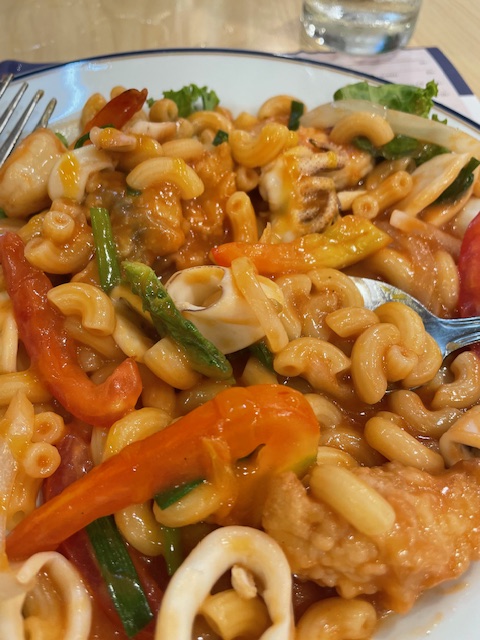
The pad macaroni seafood of Took Lae Dee

I remember my occasional visits to Thailand in the summers of my high school years. These were meant to be earnest explorations of my roots, but ultimately ended up as half-assed hijackings of my long-suffering relatives’ lives. One summer, the relatives saddled with my presence were the family of my father’s older sister, then head librarian at Chulalongkorn University. Every weekday, I would brave the traffic with my aunt, sitting down in a desk in front of her office to write abstracts on various books. This was the extent of my foray into “Thai culture”.

When I was not at the university with my aunt, I was in her home, eating dinners that were obviously made up of Thai food. Occasionally, my relatives would take pity on me and bring home pasta from a “farang” restaurant like 13 Coins or The Carlton. These pasta dishes were invariably based on the recipe for “pad macaroni”, even when they featured spaghetti.

Now, those were the days of restaurants like Paesano, with its famous salad of sliced tomatoes topped with Kraft cheese slices and a sprinkling of dried Italian seasoning, and the heyday of The Cup, home of the Caesar salad made with a clear, lime juice-based dressing. Pan Pan was but a twinkle in an Italian expat’s eye, and pasta was a no-brainer, made quite simply with “sauce makuea tet” — literally, “tomato sauce” but in real-life terms, “ketchup”. In fact, all pasta sauces at the time were based on ketchup mixed with margarine or butter, in which the protein of your choice — ham, seafood, minced meat, hot dogs — would be as generously coated as the chef’s chosen noodle. There was no carbonara, bolognese, alfredo; those things would arrive with the advent of Pan Pan. There was only “macaroni” or “spaghetti”.

Now, I have a lot of negative things to say about where I grew up, but none of them have to do with food. Specifically, Italian food. My hometown, New Castle, had long been known as the town with the most people of Italian descent per square mile outside of Italy. Restaurant and family tables were heaving with smelts, lasagne, cavatelli, braciole, pasta fagioli, and most deliciously, wedding soup, incomplete without an egg-and-cheese crust. So I thought I knew pasta. And these ketchup-coated monstrosities were not it.

I begged my aunt to take me to the grocery store, which in those days meant a trip to Villa, because most grocery stores did not have the ingredients that I deemed good enough for my spaghetti. I got imported pasta from Italy and expensive olive oil. I bought balsamic vinegar for no reason. I got Parmesan cheese — the shakey shakey kind that was the only kind available. I got basil (this was Thai). And I got tomatoes, onions, and garlic, because I was making this shit from scratch.

People, even now, like to complain about Thai tomatoes, charging Thais with not understanding them. It is true that real Thai-bred tomatoes are typically a different breed (literally, duh), tough and some would say rubbery on the outside, tart, watery and acidic within. When you make a sauce out of these tomatoes, they naturally pass those innate qualities on to the sauce. After forcing my cousins to a home-cooked spaghetti meal of “my pasta”, my cousin Boyd said, “This definitely does not taste like ketchup.” We finished the meal. I did not cook again that summer.

It took me almost 50 years to learn to appreciate Thai tomatoes. No, they are not the same kind that sprout up in the volcanic ash on Mt. Vesuvius, so sweet and juicy that no cooking is required to make a good sauce. They aren’t even the beefsteak tomatoes of an American summer, bursting when you bite into them like apples off the vine. They are plum tomatoes, a little oblong like San Marzanos, but that is where the resemblance ends. They are bred for yum salads, for som tum, as sour little punctuation marks in a fatty curry like gang phet ped yang, or as part of a flavor chorus in a soup like tom yum. As with all Thai ingredients that begin with the syllable “ma” (“manao”, or lime; “mamuang”, or mango; “magorg”, or water olive), their point is their acidity. They are not meant to coat pasta. Ketchup is.

Today, I appreciate the occasional ketchup pasta. Maybe this is because I’m sort of from Pittsburgh. Or maybe it’s because I’ve lived most of my life in Asia at this point, and I now understand (a little better) how people adapt their food to their surroundings. Ketchup is not the culinary equivalent of a gaudy golden toilet. It’s not even the Asian food equivalent of an American dousing his well-done steak in ketchup. It’s a piece of history, harkening back to the mid-1900s when post-war Asians began to learn about American food. It’s a tribute to a different time, when we were all younger and more innocent (or not even born). So when Chef McDang told us that he used to enjoy the occasional “pad macaroni” as a child at teatime in the palace, we got to thinking about pad macaroni again (as well as khao pad American, but that’s a different post).

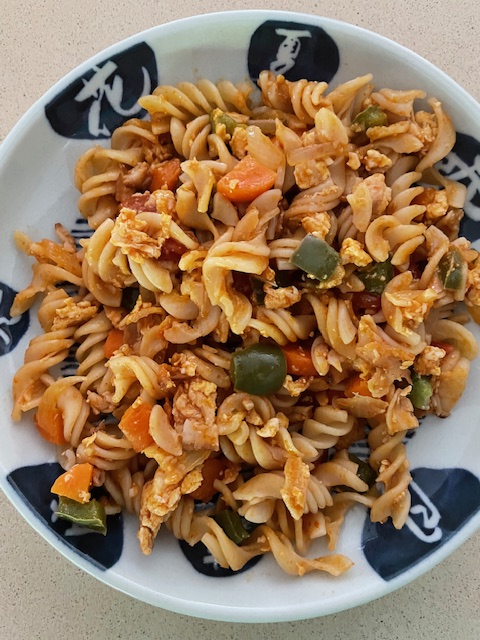
I made it at home. I used leftover pasta, because that’s the point of this dish. I used whatever luncheon meat I had in my fridge at the time. I did buy a green bell pepper from the nearby Fuji though. I just can’t imagine pad macaroni without it.

Serves 2 (if a one-dish meal) to 4

Prep time: 10-20 minutes                        Cooking time: 5 minutes

  • 4 oz (120 g) short pasta of your choice, cooked 2 minutes shy of package instructions (or leftover pasta)
  • 2 Tablespoons unscented oil
  • 1 Tablespoon butter
  • ½ green pepper, chopped
  • ½ white onion, roughly chopped
  • 1 small carrot or ½ large carrot, peeled and chopped into pieces of roughly uniform size
  • 1 tomato, cut into wedges
  • 4 slices of luncheon meat of your choice, diced
  • 1 clove garlic, minced
  • 1 egg
  • White pepper (optional)

For sauce:

  • 3 Tablespoons ketchup
  • 3 Tablespoons Sriracha (Thai, preferably. If making for children, omit this ingredient)
  • 3 Tablespoons Maggi or Golden Mountain sauce

If not using leftover pasta, set a pot of salted water to boil and cook pasta according to package instructions, but stopping shy by 2 minutes of recommended cooking time (for most pasta, package instructions say 6-8 minutes, so that would be 4-6 minutes, the extent of the math that we will do for you).

In a small mixing bowl, combine ketchup, sriracha (if using) and Maggi or Golden Mountain sauce until well mixed.

When pasta is cooked, take out of the pot and drain well. In a big frying pan or wok (this is important), heat vegetable oil or other unscented oil and add your vegetables: green pepper and carrot or whatever, onion, and, to be really true to Chow’s memories of this dish, tomato wedges. The wedges are only cooked when the skin starts peeling off.

Add butter and garlic, mix well. Add luncheon meat and repeat the mixing procedure. Push everything off to one side and crack your egg; allow the whites to set a little bit, then scramble into the mixture until well incorporated.

Add your pasta and the sauce. Make sure everything is coated with the sauce. Once you’ve achieved this coating, you are finished. Find a plate that reminds you of your grandma (even if your grandma wouldn’t come within 10 feet of this dish) and decant onto the plate. Serve immediately with a sprinkling of white pepper if you like.

Leave a comment

Filed under Uncategorized