Breakfast in Hua Hin

Congealed pig’s blood in soup — a common Thai breakfast dish

It doesn’t happen very often, maybe, but it might — somehow, for no reason at all, you wake up at 6 in the morning with an empty stomach, having picked at a watermelon salad at the neighboring hotel the night before. You are starving. You need food, pronto.

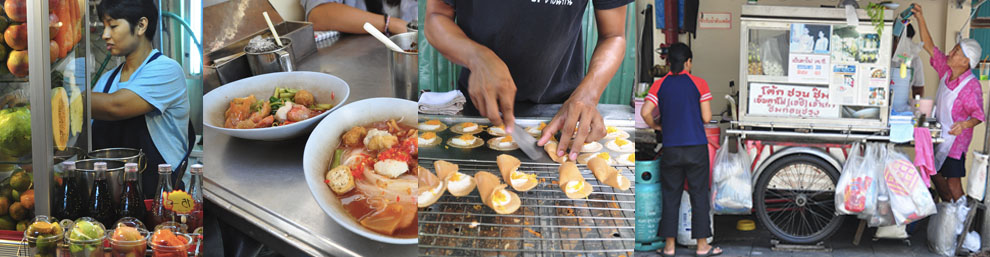
Luckily, Hua Hin has it all covered. This once-sleepy seaside town — the traditional weekend getaway of time-pressed Bangkokians everywhere — may be an amateur when it comes to approximating any sort of nightlife, but is everything a morning person with a love of food could possibly want. By 6, it’s already buzzing: steam rising from curry-filled pots; dough rolled out for the morning’s first patongko (Chinese fried bread) order; monks out strolling the market, bowls in hand.

When I get to Pa Choung (4/3 Amnuaysin Rd., 082-212-4490, open 6-noon), she is in the middle of making merit. On the hob: a fiery gaeng som full of little shrimp and dok kae (what I’ve seen referred to on some menus as cowslip blossoms), pad ped moo pa (stir-fried curried wild boar), dried and butterflied fish, sun-dried beef, deep-fried pork cutlets and a green curry full of slivered bamboo shoots.

Green curry and deep-fried pork: breakfast of champions

This isn’t all of it. She says she is finished making all of the food at 8. But it’s usually gone by 8:30. I’m happy with the smattering of curries already there.

But while Pa Choung is a one-woman curry-making machine, Raan Kafae Jek Pia (intersection of Naebkehardt and Dechanuchit Roads, open 6:30-1:30pm) is clearly Breakfast Central for the entire town. Every table is occupied, and on nearly every tabletop is a mug of sludge-like kafae boran (old-fashioned coffee), flavored with a layer of condensed milk. But this is not the main attraction. Instead, it’s the collection of stalls that service Kafae Jek Pia’s customers: jok moo (Chinese-style rice porridge with minced pork); khao thom pla (rice porridge with fish); guaythiew (noodles in soup); and, most intriguing of all, gow low lued moo (pig’s blood in soup), traditionally served for breakfast here, in a country not really known for its breakfast foods.

Cubes of pig’s blood blanched in broth

Pig’s blood cubes are taken from a chilled bowl and blanched in boiling broth for a few minutes. They are then added to slices of pork, blanched Thai watercress, some Thai celery for freshness, and a dash of deep-fried garlic for bitterness and punch. There are bits of innards too: intestine and liver and slices of heart. It’s a one-stop shop for piggy flavor. Sometimes, if you pair it with a plain bowl of rice, you can drop some of that in there too, or take a spoonful and dunk it, watching the grains soak in the broth, a bite at a time. It’s the best antidote to thinking too much that, well, I can think of. What else is breakfast for, if not that brief reprieve before the start of the day?


7 Comments

Filed under Asia, food, food stalls, Hua Hin, pork, rice, Thailand

Glutton Abroad: HK if you’re hungry

Yes, it happens. There are times when you just don’t wanna. So in an attempt to get back that elusive mojo, that ever-flickering desire to inflict myself onto the blogosphere again, to throw myself once again into that fathomless void of nothing — I went away. Specifically, to Hong Kong.

Hong Kong seems full of mojo. While Europe flounders and the U.S. seethes, Hong Kong appears to be soaring, buzzing, full of brio and activity. Sidewalks are teeming, hotels are fully booked, and, yes, restaurants are full. So, while I’ve seen my Hong Kong and my HK friends’ Hong Kong, I thought it was time to see the HK that my friends Cha and Nat (of the wildly popular website catandnat.com) like to see.

Of course, that involved a good helping of Cantonese food. Let me tell you about Cantonese food. I don’t know so much about it. All I know about it I gleaned from dozens of faceless Cantonese restaurants scattered across the American Midwest, at countless lacquered wooden tables where I cursed the gods and my fate and the people who invented this food. I know that’s a funny thing to think for a person who likes to go to Hong Kong so much. But HK is full of all types of great cuisines. Until now, it was something that was easy to avoid and dismiss as something that I just didn’t get. Just like I don’t get classical music. Or the Stone Roses. When some (inevitably British) person starts to wax nostalgic about the genius of the Stone Roses, and we actually have to listen to something by them, it’s like my brain goes “Okay, let’s find something interesting about thi-aw drat got me againzzzzzzzzzzzzzzzzzzzzzzzzzzzzzz”. You know it’s supposed to be good, you know you should appreciate it, but damned if you can get through a couple of minutes of it. It’s like the musical equivalent of reading The Economist.

A lot of Cantonese food is also like The Economist. It’s full of finesse, and subtlety. Fresh ingredients are paramount, because there is nothing to hide bad stuff behind. It’s one of those cuisines that, like French food, require great technique. Except that French cuisine has butter. Cantonese food is a rich person’s food, where only the best will do. It doesn’t have to hide its protein behind a layer of chilies or coat it in a sauce mounted with a stick of butter or stuff it into sausages to carry it long distances. Cantonese food just is.

Green beans coated in egg yolks at Xia Mian Guan

Although I had only one night in Hong Kong (devoted mainly to a wine-soaked 11-course dinner at Caprice), we managed to snatch up some time to explore some great Cantonese dishes. Such as these fresh green beans sauteed with egg yolk, giving them a rich, hefty savor perfectly complemented by a bean-y crunch. Or this:

Crab congee at Chee Kei

A smooth, unctuous rice porridge dotted with crab meat, crab claws and — best of all — globs of crab roe, punctuated with bits of ginger and green onion and just the slightest hint of saltiness. I really, really wanted to add stuff to it — chili oil and black vinegar and whatever else I could get my hands on, the way a Thai would add condiments to his jok — but it ended up changing the flavor, obscuring what had been rich and even slightly sweet. Consider that a lesson learned. Next time, Hong Kong. I’ll be back.

4 Comments

Filed under Asia, Chinese, food, Hong Kong, restaurant, rice porridge

Not just for old people

Noodles with chicken and bitter melon

Someone once asked me “Why the obsession with age?” I was surprised; I hadn’t noticed how much I was writing about my old, old oldness. But why wouldn’t I be — I am staring down the barrel of 80, people I knew five years ago no longer recognize me, and, I can’t believe I’m saying this, but I can’t eat like I used to. I cannot even be bothered to work, which is okay, since it gives me time to focus on the truly important things in life, like watching reruns of “Revenge”. Ah, youth! Its innate arrogance and unconscious cruelty and all the things we took for granted. Never to return again.

Another sign of my inexorable march to watching “Dancing With the Stars” on a religious basis: my newfound appreciation for guaythiew gai mara, or chicken-and-bitter melon noodles. Bitter melon, also known as bitter gourd or bitter squash and indigenous to the tropics, is one of those fruits that is hard to make out. Like taciturn people, they seem to offer nothing — wrinkled, waxy green flesh; a bitter, dry-mouth crunch — without a lot of work. But everyone that grows them has found some sort of use for them: sliced and scrambled with eggs in Okinawa; curried in India; souped up with shrimp in Vietnam. In Thailand, they are stuffed with minced pork and stewed for hours in a broth coaxed from pork bones to make gaeng jued mara yad sai, or stuffed bitter melon in clear soup. It’s one of those dishes that requires an introduction like “This is very good for you” (it’s supposed to be good for sore throats). Thais like to joke that you are starting to get old if you begin to appreciate it.

But rarely is there any mention of chicken-and-bitter melon noodles. That’s strange, because they are not hard to find at all. Tucked in amongst the ubiquitous papaya salad, egg noodle and rice porridge stalls are the vendors who display halved bitter melons and chickens on their carts, the ones who, inevitably, already have two or three people waiting in line. They are open for breakfast and lunch, because chicken-and-bitter melon noodles are a daytime dish. They are almost always mobile vendors, or vendors who, like the one between Emporium and Benjasiri Park, offer stools as tables with shorter stools as chairs (you are supposed to eat with your back to the traffic so road dust doesn’t fall into your bowl, but really, is this really cheaper than springing for a couple of tables?).

My favorite is the one on Sukhumvit 24 road, in front of a massage parlor and kitty-corner to another one (and a few feet down from yet another one). Noodle choices are thick (sen yai), egg (bamee), Mama (yes I know), and rice vermicelli (sen mee). The chicken, which from a distance looks like it is smoked, is actually gai jae, or boiled chicken. And the piece de resistance, the broth: sweet to offset the bitterness of the melon, aromatic with an almost cinnamon-y scent, stewed with bits of mara, old bones, and the remnants of my writing career.

Chicken-and-bitter melon broth

Before you take it home, you are invited to juice up your noodles with any combination of condiments: sugar, dried chili flakes, pickled peppers in white vinegar, crushed peanuts, roasted chili paste. The end result is what the best Thai food always is: a study in contrasts between the flavors of the melon and the broth, the texture of the crisp crunchy greens with the soft give of the noodles, the comfort implied in the chicken and the spice of the roasted chili paste. Really, can you blame me for giving this a go?

Condiment bar

4 Comments

Filed under Asia, bamee, Bangkok, chicken, food, food stalls, noodles, Thailand