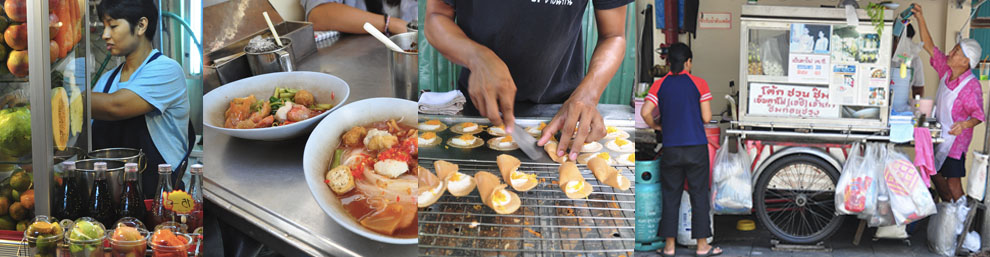
A very Phuket breakfast

Dim sum in Phuket

There are times when “research” means stuffing yourself with lots and lots and lots of food in a very short period of time. God help me, it was the kind of research I was doing today — namely, three promising stalls, all for breakfast.

Lured by the promise of “beef bamee”, I was excited by the prospect of Guaythiew Rab Arun, a small noodlery in the shadow of Bangkok Phuket Hospital. Alas, they were not as excited by our appearance, and, double-damn, a beefy variation of the popular egg noodles with barbecued pork was also not on the cards. No, this was your run-of-the-mill beef noodle shop: choice of rice vermicelli (sen mee), thin noodles (sen lek) and thick ones (sen yai), with broth that did or did not include cow blood (nam tok). The broth was as good beef broths are, cinnamon-y and sweet; the bowl an unashamed showcase for all sorts of innards — lungs, liver and tripe.

Beef noodles without broth

All very nice — except for the bizarre delay in letting us settle the bill — but nothing I wouldn’t find in Bangkok. On the other hand, I haven’t seen anything quite like the dim sum shop we visited next. When asked the name of the place, a two-room shophouse on Sam Gong Road serving kanom jeeb (Chinese-style steamed dumplings) and a wide variety of little bits, our waitress acts like I have just asked her ATM pin code. “Just ask, everyone knows the Dim Sum Place Down The Road From The Hospital,” she said (TDSPDTRFTH for short). A trayful of plates is deposited onto your table as you sit; you pick what you want, and you are charged, conveyor belt sushi-style, for whatever you choose. Small plates are 10 baht, “big” plates (which are almost the exact same size as the small plates) cost 15.

The tray of goodies at TDSPDTRFTH

Is it the best dim sum ever? Of course not. Is it crazy cheap? Well, that depends on you, but for the most part, why, yes it is. It is indeed cheap. And that is sometimes what I am looking for.

So, a question mark on the first stall, a possible “yes” on the second. The third? A resounding I WILL BE BACK. Pa Mai (at three-way intersection of Sagul and Dibuk roads near Wittaya School, 076-258-037) specializes in curry — curry, and the Mon fermented rice noodles known as kanom jeen, what some people mistakenly translate into “Chinese candy”. A plate of the stuff is handed to you at the front by this nice lady:

Dispenser of kanom jeen

Once you receive your blank canvas, an array of curries awaits your artistry: a trio of nam ya, crab, fish and “jungle” (without coconut milk); chicken green curry, made the old-fashioned way with globs of congealed pork blood; nam prik, a speckled chili-coconut milk concoction that, unlike its terrifying name, is actually quite sweet; gaeng tri pla, or the famous — and fierce — southern fish entrail curry; and because this is the south, nam prik kapi, or shrimp paste chili dip, made to go with the innumerable garnishes that greet you at every table:

A table at Pa Mai

Is there any sight more gladdening than this one? A platter bristling with greenery: tart mango leaves, chewy cashew ones, boiled jackfruit, cubed pineapple, bitter, spice-defying baby eggplants. Soft-boiled eggs for 7 baht. Dried fish. An ajad of thinly-sliced cucumber in a tart-sweet syrup. And a happy variety of pickles (I just love pickles): cabbage, bean sprouts, lotus stems, baby garlic.

My choice (at first): crab nam ya

Best of all, you are only charged 30 baht for the kanom jeen, meaning those curries can be added, mixed, or replenished as you see fit. Really. So I first took some fish nam ya, then some crab. Some green curry. Some nam prik. And then a little left for the fiery tri pla. Don’t judge me.

We have found kanom jeen nirvana, and it is open from 7 to noon.

5 Comments

Filed under Asia, beef, Chinese, curries, food, food stalls, noodles, Southern Thailand, Thailand

Glutton Abroad: No place like home

What I love most about traveling, is, of course, all the (you already know how this sentence ends). Everybody does it differently. (Insert noun here) comes in different permutations; a humdrum thing like (insert something else here) becomes something completely new when somewhere else. I love that. I love thinking “Oh, that’s how they do that” or “I’ve never seen that before” or “Hey! I’m going to try that at home!”. It’s the best part of going anywhere for me.

For example, Sweden. When confronted with the everyday 7-11 or corner souvenir shop, you are presented with this spectacle …

… which is just one corner of the store. You can then draw very generalized and probably extremely off-base conclusions like, “Oh, Swedes must harbor a devil-may-care attitude (about cavities), fast metabolisms, and act somewhat batshit crazy.” I’m right, right? I mean, we’ve all read Stieg Larsson.

As for Poland, well we all have our little stories, and this is one of them:

Polish street food in Warsaw

First of all, a surprise: Polish food is delicious. Sour cream, dumplings, freaking Polish DILL PICKLES — what’s not to like?!  Let people pooh-pooh lard on toast — um, that lard has bay-con bits on it, ok? And it’s topped by a freaking Polish DILL. Who’s laughing now?

So it may be freezing, and the only street food stand you’ve seen for miles around is manned by a dour-faced old lady who obviously has been hiding from you, afraid that you will order something. And she burns your first pierogie on the grill. Who cares? She finally cracks a smile when a band of schoolchildren pass by, making “ching chong” noises at you as you wait for her to lard up your toast. You get your food, and it’s pretty good, and lunch is just around the corner. It’s a good day. Did I mention Polish food is delicious?

Czech food is a different proposition. It’s heavier, not as prone to flights of fancy like herring, or making soup out of fermented rye. There is also street food, though, and thanks to Prague’s many hungry bar patrons, that street food is thriving. There are flat pizza-like dishes, and hot honey wine in the mornings (DO NOT inhale as you sip, or you will regret it), and this:

Czech trdelnik

Sweet and crispy and straight from the, uh, rollers. Best of all, there is Prague ham, which sounds simple, but is so so good — thick haunches of pig, skewered and rotating over an open flame, fat dripping into the fire, juicy hunks hacked off onto a paper plate and festooned with thick slices of rye bread. Eaten standing up next to the clock tower at night, really, it is the best thing in the entire city, a meal that makes you feel like the world is an essentially good place.

But, still. There is nothing like reaching home, finally, after days and days and days of airports and trains and, uh, I guess the word for some of the hotel rooms would be “surprising”? Surprising hotel rooms. There is nothing better than a bowl of snail curry (gaeng kua hoy kom), stir-fried sweet pumpkin shoots (pad pak maew), a tiny beaker of spicy nam prik prik Thai aun (black peppercorn chili dip), some just-boiled duck eggs. A handful of steamed rice. And a tart-spicy “salad” of fried eggs with chilies and coriander (yum kai dao), what food writers think of when they write of Thai food as a “jumble” or “melange” or “cacophony of tastes.” There is no place like home.

Fried egg "yum" at Ruea Thong

20 Comments

Filed under Asia, Bangkok, Czech, food, Poland, restaurant, Sweden, Thailand

Turning Japanese

Otaru street food: grilled oysters

My friend Karen, while in college, once sang this golden oldie by The Vapors while waiting in line at the college cafeteria. A person nearby (who was not Asian, btw) told her she was offended by the song. This one anecdote tells you a lot about Bryn Mawr College. But very little about Japan.

Since I too can look up things on Wikipedia, I discovered that “Turning Japanese” is actually a song about youthful alienation and becoming something you didn’t expect. Well, if that is the case, many of us are Japanese. And intrinsic to this image of being “Japanese” is the idea — not too far removed from reality in Tokyo, at least — of a life perpetually on the go, snatching sustenance, T. Rex-like, any way one can, greedily and quickly.

That’s the instinct that coaxed ramen from China into Japan. But it’s not the only Japanese “street food” out there. Unlike Thai street food, which is, quite literally, food enjoyed or at least purchased while on the street, a lot of Japanese street food hews closer to the Western idea: portable food that you can eat while walking (Thais hate to eat while moving. Don’t know why, but that’s the way it is).

A good snapshot of this type of Japanese street food can be had on the 200 meter-or-so walk up to Sensoji Temple in the Asakusa district of Tokyo. This walk melds the everything from the expected taiyaki (baked sea bream-shaped cakes stuffed with red bean paste) and senbei (freshly-made rice crackers, often wrapped in nori seaweed) to handfuls of surprising delights like lacquered, grilled chunks of sweet potato and aisumonaka, which are basically ice cream sandwiches. Yum!

Kibidango-mochi are grilled rice cakes dipped in a sweet sesame powder; as with everything that is served on the skewer, you are meant to eat it right there and return the skewer, which kind of ruins my whole point about this type of Japanese street food. Oh well! There is manju (steamed Chinese-style buns stuffed with savory fillings like minced pork) and agemanju (fried buns), in this case usually stuffed with something sweet and for that reason, infinitely more popular — the most popular stand boasts every type of filling from pumpkin to green tea to cherry.

Nothing, however, touches my favorite, the bizarrely-named wazatokowashi, deep-fried, light, fluffy dough cooked in front of your eyes and bearing an elusively salty flavor reminiscent of Cheetos. There is nothing better than Cheetos.

The best thing ever

Hokkaido has its own kind of street food. A good city to sample it is Otaru which, while seen as “too commercial” by my Japanese friends, is at least charming, tourist-friendly and has these mini-stands set up by smart seafood wholesalers catering to people who simply can’t wait until they get home for a taste of the Japanese ocean. The grills are inside, just past the doorway, fronted by tables where diners cluster like hobos over chopsticks and bottles of soy sauce.

For your street food consideration

Yes — not only is that hulking big sea snail thingie (sazae) available, but so are scallops grilled with miso, giant sea crab legs, clams and oysters, cooked in their own juices. It is good, and it is cheap. A shame that it is also freezing.

An unlikely street food that has almost completely obliterated its humble origins is a food that everyone knows and associates with fine dining: sushi. Believe it or not, it started out as a street food in Edo (basically ancient Tokyo), where fresh fish is in abundance and easy to obtain. Today, Edo-style sushi basically refers to nigiri, but not the big ol’ slabs of fish flesh that are so trendy in a lot of sushi bars abroad. What makes sushi such a great experience in Otaru is that it has taken a cue from Sapporo’s numerous ramen alleys and created its own “Sushiya Dori”, a street lined almost completely with sushi bars. Heaven on earth or what?

Otaru omakase (chef's choice) platter

One thing you might find at your sushi bar (but is definitely not a street food): shirako, which I’m told means “white children”. My friend Yukari first introduced it to me when I moved to Tokyo, but waited until I finished my bowl of creamy, cloudy glob drenched in ponzu to tell me what it was. Some other Japanese people (who work in tourism PR, go figure!) then tried to tell me it was not what it was, but guys, I know how to Google. It’s the sperm sacs of male cod. See, it’s hard to pull a fast one on me (if I have an Internet connection).

Luckily, it tastes much better than human sperm. Sorry, humans! Better luck next time.

Better than you think

6 Comments

Filed under Asia, fish, food, food stalls, Japan, Japanese, restaurant, seafood