When Gluttony becomes a chore

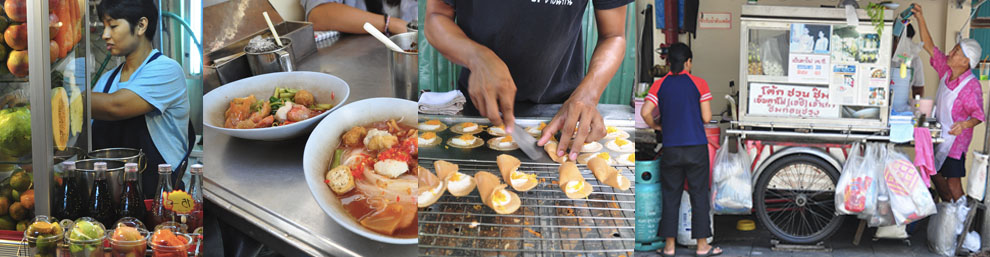
Fish rice porridge at Sieng Gi

(Photo by @SpecialKRB)

When the Popes lived in Avignon, they had a lot of visitors. That goes without saying, of course — what Pope doesn’t have a lot of visitors?  And visitors who are visiting always expect dinner.

Well, the Pope couldn’t just have any old dinner. When he entertained various and assorted important people in his cavernous grand hall-slash-dining room the size of a private airplane hangar, diners could expect to spend the next 4-5 hours with their butts firmly planted in their seats, enjoying, on average, 24 courses a night.

What did they have for dinner? Well, first and foremost, the higher the food was from the ground, the closer it was to God. So there was a lot of this kind of food — fruit, lettuces and veggies that grew up out of the ground instead of those nasty, dirt-burrowing root vegetables. There was, obviously, meat, but it had to be roasted; none of this boiling business was allowed, because boiling was for peasants. The kitchen responsible for these 24-on-average courses is surprisingly small, considering: the size of a generous living room as opposed to, say, a hotel lobby. But there are three ovens set up — obviously, roasting was a big deal.

As I listened to the tour guide as she wended her way through the upper reaches of the Pope’s Avignon palace, I couldn’t help thinking — how? How could he do it? I struggle with two big meals a day — yes, the old stomach is not what it used to be. While I am not immune to obsessing over gray hairs or wrinkles or sagging jowls or the Great Beyond that awaits us all, the thing that I miss most is my incredibly efficient, ever-elastic digestive system. Where did it go? Especially now that floodwaters are breaching the gates, and supermarket lines are as congested as the expressways where everyone has parked their cars, and spicy lemongrass shrimp Mama is worth its weight in gold … I find stuffing my face does not hold the allure it once did. Where did the beautiful past go? (I ask this as I look down at my own supermarket cart, the contents of which are: avocados, squash, and Betty Crocker French onion dip mix. Everyone else may be equipped for the floodpocalypse, but I will have a much easier time making dip, yo!)

Times like these call for drastic measures. Times like these call for khao thom (rice porridge). Boiling some rice with water sounds like a pitiful meal, but to me, right now, it sounds heavenly: the straight, almost sweet taste of watery rice, the purity of white porridge, amenable to anything you wish to pair it with — fish, omelet, stir-fried leafy vegetable, and even you, strange pickled shredded turnip, or you, weirdly pink fermented tofu glob, yes. Even you. What better to fix what (sort of) ails you, this ennui of the stomach that no grilled rib-eye something-or-other or braised pork belly this-and-that can fix?  What better to fortify you through this wait?

Good places for khao thom, if you can get to them:

1. Khao Thom Bowon — Across from the entrance to Wat Bowonniwet on Phra Sumen Road, this rice porridge shop is open from 4pm-late. They claim to be the originator of pad pak boong fai dang, or stir-fried morning glory with chilies.

2. Jay Suay — On Plang Nam Road, next to the famous shellfish omelets of Nai Mong Hoy Tod, this rice porridge shop is also open at night. It is especially known for its pork dishes; a personal favorite: pork meatballs in a clear soup flavored with pickled plums.

3. Khao Thom Polo — On the corner of Soi Polo and Wireless Road, this shop is almost perpetually packed for dinner. The dish that seems to get everyone fired up, despite the extreme spice factor, is their gaeng pa, or jungle curry.
 

2 Comments

Filed under Asia, Bangkok, food, food stalls, rice porridge, Thailand

Glutton Abroad: My kind of people

How far would I go to eat a good meal? Far. How far? Three words: River boat cruise.

No, I don’t really like cruises. People with an unlimited range of experiences and perspectives come together into a very limited space, a surefire recipe for driving themselves crazy. This one, on a river in France, for a week, was no exception. People shushed us when our wild ‘n crazy Thai-speaking got too rowdy. Boat boys imitated our “ching chong” language, leading to unwelcome memories of the 8th grade. And the food … oh, the food. It was what you would get if your elementary school lunch lady took on fine dining pretensions. In short: not my kind of people.

France, on the other hand, seems to be full of my kind of people. Marketing campaigns try to tell you that France is about romance, or culture, or blahbladiblahblah zzzzzzzzzzzzzzzzzzzzz. Seriously, whatever. Whatever forever. We all know it’s actually about food. No French person is without an opinion on food, especially French food. The land is blanketed with a gazillion vineyards. There is a cheese for every day of the year. Come on. France is a food place.

And France in the fall is an especially lovely food place. There’s little wonder why chefs here like to say autumn is their favorite time of year: game is in season, mushrooms start sprouting, fruit and veggies are still in abundance. What could be better than exploring it then, right before a week of BLT sandwiches and “medium-rare” pork slices in a floating cafeteria?

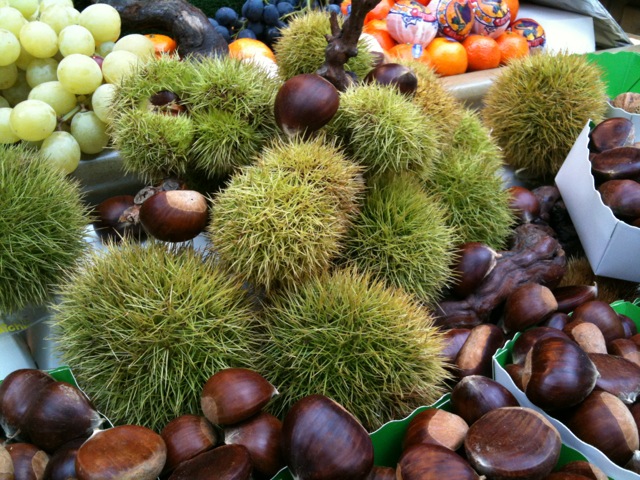
Chestnuts in season at an outdoor market in Paris

So it was a happy, upbeat Glutton buzzing into Burgundy, wedged between a stack of guidebooks and my hand luggage and an empty plastic bag in my purse JUST IN CASE. Like millions of people before us, we were to take part in the great French tradition of grand “hotel-restaurants” — fantastic chefs, many with long cooking pedigrees, in family-run restaurants who just happen to also have well-appointed rooms. These are the guys (and ladies) who, for years, have ruled the local culinary roost from places like Vienne and Saulieu, innovating French food and picking up Michelin stars in the process.

One chef well-regarded by Big Red (he does have 3 stars, after all) is Jean-Michel Lorain, whose La Cote Saint Jacques in Joigny is perched right next to the Yonne, boasting gigantic views over the water and two beautiful, if somewhat subdued, dining rooms. The cooking is equally beautiful, suggesting a sort of jeweler’s temperament (and a fondness for tapioca pearls): meticulous, artistic, a little bit fiddly. Some of the dishes on the menu were inspired by Chef Lorain’s father, Michel, like a terrine featuring oysters suspended in an “ocean” amber, tasting just like the sea. A deceptively simple-sounding “rose” of lobster and hearts of palm comes festooned in tapioca pearls like a Little Mermaid; a hefty blue-collar fish like cod gets gold star treatment when it is perfectly pan-fried and dressed up with more tapioca pearls and a sea urchin sauce.

La Cote Saint Jacques's cod

If Jean-Michel Lorain is an artist, Bernard Loiseau was more of a showman. Gregarious and charming, Chef Loiseau was also very smart; like a writer who understands he lacks the agility of an Updike, Loiseau seemed to understand he wasn’t the greatest technical cook and focused instead on purity and simplicity. It worked — Michelin awarded his “Cote d’Or” in Saulieu three stars, but the stress seemed to take its toll, and Bernard Loiseau took his own life in 2003.

I never got to eat at the Cote d’Or, but entering the rechristened “Bernard Loiseau” is a bit like entering a shrine. His face is everywhere, grinning in countless photos on various sitting room walls, a tireless reminder that, if the name didn’t tip you off first, this is BERNARD LOISEAU’s place, okay?

Not to say the place isn’t stunning. There is a beautiful garden, and THREE lovely dining rooms, and a gigantic staircase with an elevator in the middle — all renovations that Chef Loiseau oversaw. The only place Bernard Loiseau doesn’t seem to be omnipresent is on the menu; aside from three or four of his famous dishes, it’s more about the present chef Patrick Bertron (who has maintained the restaurant at a 3-star level), who is like a closed-mouth smile as opposed to Loiseau’s wide grin. There was a delicate, subtly flavored little duck, perfectly rosy and skin slightly crisped, and a perfectly poached egg (no whiff of vinegar! No chewy, thick egg white!) atop a raft of tiny baby leeks, the yolk just crying to be broken. And yes, we had a Loiseau classic too: juicy squares of skin-on sandre (pike perch) with a shallot marmalade and red wine sauce.

Poached egg on baby leeks vinaigrette

The best thing about French places, particularly the ones adored by Michelin? The great service. These “temples of gastronomy” are actually not supposed to be temples. They are, like everywhere else, meant to be places to relax and enjoy yourself. That means waitstaff are unfailingly, politely affable, like your older brother’s college roommate sophomore year. That means not batting an eye while you are pulling off your moth-eaten black turtleneck sweater while ordering, or making faces at your crusty old jeans when you come in for an unexpected lunch, or expressing dismay when you ask about rose on their wine menus (OK, maybe the last one, a little bit). These guys are my kind of people.

2 Comments

Filed under celebrity chefs, food, France, French food, restaurant

About my grandma, and sausage

For as long as I can remember, I was told to refer to my grandmother as “Jiao Yai” (Lady Grandma). As a kid in Amish country somewhere in western Pennsylvania, I thought all Thais called their mother’s mother this term. Grandpa would be content with being a “khun tha”, but grandmas required something a little better.

I found out my grandma was kind of like a princess when we were getting ready to move back to Thailand. Her grandfather Inthawarorot had been the 8th of his line to “govern” Chiangmai; her father had been slated to be his heir. Her family name was “Na Chiangmai”, which, like “Na Ayutthaya”, “Na Songkhla”, or the like, means “Of [insert town name here]”.

Because I am really shallow, I became interested in my mom’s family history because of my grandma. When there were family gatherings, like a big ol’ buzzard, I was there, devouring scraps of old family gossip, hidden (and not so hidden) resentments, embroidering a new mental narrative of myself. Family dynamics were fascinating to me — there were “greater jiao” and “lesser jiao” (guess which branch yours truly belongs in?) and celebrations featuring dancers with ribbons and peacock feathers where everyone dresses up in old Thai clothing and complains about the heat (that’s just me, actually. I sweat a lot, what can I say?)

Best of all, there is gorgeous, life-changing, extraordinary Thai food. Getting gussied up in diapers and gossiping are all well and good, but after a couple of times, that story about Uncle So-and-so in 1847 gets old. The food never got old. It became the reason I still lurk, an ever-hungry buzzard, on the edges of family conversations, inviting myself to this or that party against the wishes of everyone involved. There is gabong, battered and deep-fried pumpkin, beans and whatnot (northern Thai tempura!) with a sweet chili dipping sauce. A sort of gaeng som in crystal-clear broth with chunks of pomfret, intense and flavorful despite its prettiness. A nam prik pla rah (fermented fish chili paste), tangy and salty but strangely un-fishy. Gluay buat chee, bananas served in a hot coconut milk, soft and comforting and almost buttery in taste.

And then there is the sai oua (northern Thai sausage), which I will always associate with my grandma. Obviously, my grandma has never stuffed a sausage link in her long life, but her cook has made exemplary sausage since I was a little girl, and although lots of places make nice sai oua (Soul Food Mahanakorn, the 5th floor of Emporium), I will always associate this particular sausage — fiery, yellow, flecked with fragrant herbs — with her. Nothing compares to my Grammy’s.

Too bad it’s so hard to get the freaking recipe. When I call Porn, my grandma’s cook, it’s a list of vagaries: “Get some shallots — 10 baht worth at the market near Victory Monument … some garlic …” “How much?” “Oh, well … five?” “Five cloves?” “Well, yes.” “What else? What else?” “Kaffir lime leaf, coriander, oh, slice it really thinly.” “Are there seasonings?” “What?” “ARE THERE SEASONINGS?” “Well, salt, and fish sauce, and MSG, and [something unintelligible] and curry base … mix all of that together …” “Anything else? Is there pork?” “Oh yes, pork. Maybe 2 kilos? Soak dried chilies in hot water, and don’t forget the pak chee farang … don’t forget the turmeric! You can’t forget the turmeric.” After guesstimating a handful of shallots as “10 baht worth” and mixing central and southern Thai curry paste to get a nice orange color, I end up with a paste that I think will work. I also get a kilo of minced pork and a kilo of minced pork fat.

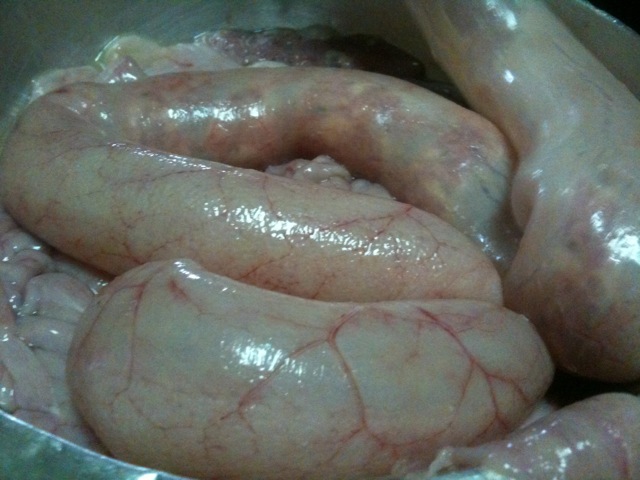
Luckily, it was way easier to stuff the sausages than to make up the stuffing. Jarrett Wrisley, the owner of Soul Food, was kind enough to let my friend Chris and me use his sausage casings (100 percent natural!) and his kitchen, as well as his sai oua expertise — we used a mixture of fish sauce, salt and soy sauce, just like Jarrett does for his own, MSG-free sai oua. Chris made a gorgeous Polish sausage, slightly tart and salty, and a nice chicken sausage studded with dried apple.

Getting stuffed

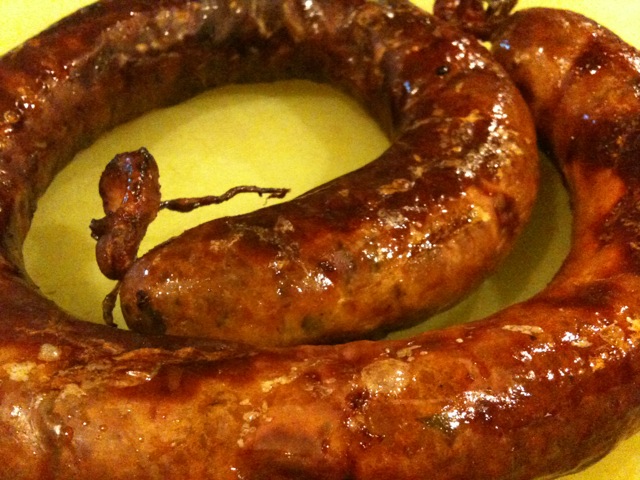
The final product? When I got home, the first thing I did was turn on the oven and cook my very first sai oua. The result: burnished mahogany, soft on the inside, juices running from the pan.

Again, there is lots of great sai oua in the world, but nothing compares to my Grammy’s.

7 Comments

Filed under Asia, Bangkok, cooking, food, Northern Thailand, recipe, Thailand